Pages

Friday, 7 October 2022

In Search of Lost Time Vol.2: Bergotte and genius

The narrator’s first meeting with his childhood hero and favourite writer Bergotte must be one of the most interesting sequences in Within a Budding Grove, perhaps in all of In Search of Lost Time. 

“… there, in front of me, like one of those conjurers whom we see standing whole and unharmed, in their frock-coats, in the smoke of a pistol shot out of which a pigeon had just fluttered, my greeting was returned by a youngish, uncouth, thickset and myopic little man, with a red nose curled like a snail-shell and a goatee beard.” (Vol.2, P.1) 

We have heard of the name Bergotte in Swann’s Way, and heard M. de Norpois’s impression of him at the beginning of Within a Budding Grove, but don’t see him till the narrator finally meets him at the Swanns’. 

“… Starting from them, I should never have arrived at that snail-shell nose; but starting from the nose, which did not appear to be in the slightest degree ashamed of itself, but stood out alone there like a grotesque ornament fastened on his face, I found myself proceeding in a totally different direction from the work of Bergotte, and must arrive, it would seem, at the mentality of a busy and preoccupied engineer, of the sort who when you accost them in the street think it correct to say: “Thanks, and you?” before you have actually inquired of them how they are…” (ibid.) 

Proust is hilarious! 

Then Proust—or the narrator—spends pages writing about the differences between Bergotte the writer and Bergotte the person in real life, and analysing the nature of literary genius. 

“… genius, and even great talent, springs less from seeds of intellect and social refinement superior to those of other people than from the faculty of transforming and transposing them.” (ibid.)

George Eliot is undeniably more intellectual, but I think Jane Austen and Emily Bronte are both better writers.

“Similarly, the men who produce works of genius are not those who live in the most delicate atmosphere, whose conversation is the most brilliant or their culture the most extensive, but those who have had the power, ceasing suddenly to live only for themselves, to transform their personality into a sort of mirror, in such a way that their life, however mediocre it may be socially and even, in a sense, intellectually, is reflected by it, genius consisting in reflecting power and not in the intrinsic quality of the scene reflected. The day on which the young Bergotte succeeded in showing to the world of his readers the tasteless household in which he had spent his childhood, and the not very amusing conversations between himself and his brothers, was the day on which he rose above the friends of his family, more intellectual and more distinguished than himself…” (ibid.) 

Part of me thinks Proust has a point, but part of me feels uneasy. 

This is how M. de Norpois describes Bergotte: 

““… Ah! there’s a man who justifies the wit who insisted that one ought never to know an author except through his books. It would be impossible to imagine an individual who corresponded less to his—more pretentious, more pompous, more ill-bred. Vulgar at times, at others talking like a book, and not even like one of his own, but like a boring book, which his, to do them justice, are not—such is your Bergotte. He has the most confused and convoluted mind…”” (ibid.) 

We later see how ill-bred he is: 

“The malice with which Bergotte spoke thus to a stranger of the friends in whose house he had for so long been received as a welcome guest was as new to me as the almost tender tone he invariably adopted towards them in their presence.” (ibid.) 

Can a pretentious, pompous, ill-bred, vulgar, and boring person be a literary genius? The great writers I love, as far as I know (I mean, hear from other people), were not vulgar or boring. I can more readily accept a great writer being cruel and selfish in real life, than them being pompous, vulgar, or boring.

It also makes me wonder: people have often said that Bergotte is based on Anatole France, or at least the meeting is based on young Proust’s disappointing meeting with Anatole France. Are these lines about him? Was Anatole France like this? I can’t say. But if they are, Anatole France’s reputation has greatly fallen—nobody talks about him now, I doubt he’s even big in his home country—so the writer Proust calls a literary genius, in spite of dullness and lack of intellect, is not really a genius after all. 

The next part is also interesting: 

“As for those other vices to which M. de Norpois had alluded, that almost incestuous love affair, which was made still worse, people said, by a want of delicacy in the matter of money, if they contradicted in a shocking manner the trend of his latest novels […] those vices did not necessarily prove, supposing that they were fairly imputed to Bergotte, that his literature was a lie and all his sensitiveness mere play-acting.” (ibid.)

Here Proust discusses the questions that have bothered people for years: why were some writers who showed such humanity, such sensitivity and compassion and understanding in their novels such assholes in real life? 

“It is the vices (or merely the weaknesses and follies) of the circle in which they live, the meaningless conversation, the frivolous or shocking lives of their daughters, the infidelity of their wives, or their own misdeeds that writers have most often castigated in their books, without, however, thinking to alter their way of life or improve the tone of their household.” (ibid.) 

He goes further: 

“Perhaps the more the great writer developed in Bergotte at the expense of the little man with the beard, the more his own personal life was drowned in the flood of all the lives that he imagined, until he no longer felt himself obliged to perform certain practical duties, for which he had substituted the duty of imagining those other lives. But at the same time, because he imagined the feelings of others as completely as if they had been his own, whenever the occasion arose for him to have to deal with an unfortunate person, at least in a transitory way, he would do so not from his own personal standpoint but from that of the sufferer himself, a standpoint from which he would have been horrified by the language of those who continue to think of their own petty concerns in the presence of another’s grief. With the result that he gave rise everywhere to justifiable rancour and to undying gratitude.” (ibid.) 

I think he’s right.

I see this post as a starting point, so tell me your thoughts! Discuss! Argue!

Saturday, 1 October 2022

In Search of Lost Time Vol.2: society and Proust’s extended metaphors

I love the metaphors in Proust.

Look at this passage in Within a Budding Grove, when the narrator writes about Professor Cottard: 

“… we must bear in mind that the character which a man exhibits in the latter half of his life is not always, though it often is, his original character developed or withered, attenuated or enlarged; it is sometimes the exact reverse, like a garment that has been turned.” (Vol.2, P.1) 

At some point I will discuss the way Proust writes characters, maybe, but I like that garment simile.

This is the narrator going to the Swanns’ to visit Gilberte: 

“Meanwhile, on those tea-party days, pulling myself up the staircase step by step, reason and memory already cast off like outer garments, and myself no more now than the sport of the basest reflexes, I would arrive in the zone in which the scent of Mme Swann greeted my nostrils.” (ibid.) 

I like that.

This is another garment simile, when he buys a photograph of the famous opera singer Berma, whom he finds neither beautiful nor a magnificent singer as he’s been told:  

“The wholesale admiration which that artist excited gave an air of slight impoverishment to this one face that she had to respond with, immutable and precarious like the garments of people who have none “spare,” this face on which she must continually expose to view only the tiny dimple upon her upper lip, the arch of her eyebrows, and a few other physical characteristics, always the same, which, after all, were at the mercy of a burn or a blow. This face, moreover, would not in itself have seemed to me beautiful, but it gave me the idea and consequently the desire to kiss it, by reason of all the kisses that it must have sustained and for which, from its page in the album, it seemed still to be appealing with that coquettishly tender gaze, that artfully ingenuous smile.” (ibid.)

Now that is a rather strange simile, no? I find it strange. 

Sometimes Proust has extended metaphors: 

“And as though she found a similarity between the somewhat summary, rapid, and violent manner in which Mme Swann conquered her new connections and a colonial expedition, Mamma went on to observe: “Now that the Tromberts have been subdued, the neighbouring tribes will soon surrender.” If she had passed Mme Swann in the street, she would tell us when she came home: “I saw Mme Swann in all her war-paint; she must have been embarking on some triumphant offensive against the Massachutoes, or the Singhalese, or the Tromberts.” And so with all the new people whom I told her that I had seen in that somewhat composite and artificial society, to which they had often been brought with some difficulty and from widely different worlds, Mamma would at once divine their origin, and, speaking of them as of trophies dearly bought, would say: “Brought back from the expedition against the so-and-so!”” (ibid.) 

“Colonial expedition”, “tribes”, “war-paint”, “offensive”, “trophies”: throughout the entire passage, Proust expands on the expedition metaphor.

The Swanns, the narrator tells us, “shared this failing of people who are not much sought after”: a visit or invitation from anyone prominent is loudly publicised. 

“The Swanns were incapable even of keeping to themselves the complimentary letters and telegrams received by Odette. […] Thus the Swanns’ drawing-room was reminiscent of a seaside hotel where telegrams are posted up on a board.” (ibid.) 

It is rather pathetic, and Proust makes it appear more ridiculous as the narrator’s mother compares the “conquests” to war and expedition. Then he switches to another extended metaphor: 

“… a great deal of the pleasure which a woman finds in entering a class of society different from that in which she has previously lived would be lacking if she had no means of keeping her old associates informed of those others, relatively more brilliant, with whom she has replaced them. For this, she requires an eye-witness who may be allowed to penetrate this new, delicious world (as a buzzing, browsing insect bores its way into a flower) and will then, so it is hoped, as the course of her visits may carry her, spread abroad the tidings, the latent germ of envy and of wonder.” (ibid.)

That is why Madame Swann invites the boring Madame Cottard. Proust expands some more on the pollination metaphor:  

“She knew what a vast number of bourgeois calyxes that busy worker, armed with her plume and card-case, could visit in a single afternoon. She knew her power of pollination…” (ibid.) 

Like Tolstoy, Proust notices everything and sees through everything. But Proust goes further than Tolstoy in dissecting and analysing the rules, the little games in high society. Perhaps French society in Proust’s time is more subtle, more snobbish and complicated? Or perhaps Proust is more interested in all the social games, the mores, the different circles, the hypocrisies and pretensions—Tolstoy after all doesn’t like high society. 

For example, the narrator writes that in his early childhood, no respectable salon would have opened its doors to a Republican. But the rules about whom to exclude change over time. 

“... like a kaleidoscope which is every now and then given a turn, society arranges successively in different orders elements which one would have supposed immutable, and composes a new pattern. […] These new arrangements of the kaleidoscope are produced by what a philosopher would call a “change of criterion.” The Dreyfus case brought about another, at a period rather later than that in which I began to go to Mme Swann’s, and the kaleidoscope once more reversed its coloured lozenges.” (ibid.)

This is another extended metaphor. Proust starts with the kaleidoscope image then talks about changes in society, the different circles, the perceptions of Odette/ Madame Swann in society, and so on for pages, then returns to the metaphor: 

“To return to the reasons which prevented Odette, at this period, from gaining admittance to the Faubourg Saint-Germain, it must be observed that the latest turn of the social kaleidoscope had been actuated by a series of scandals.” (ibid.) 

It is a rather unusual metaphor—I tend to associate kaleidoscopes with light and colours—but it works. 

My copy is the translation by C. K. Scott Moncrieff & Terence Kilmartin, revised by D. J. Enright. 

Friday, 30 September 2022

Sane vs mad

It’s reductive perhaps, but in a moment of idleness, I was thinking that all prose writers could be roughly categorised as sane or mad. 

Jane Austen and George Eliot are sane.

Emily Bronte is mad. Charlotte and Anne Bronte are sane, despite the madwoman in the attic. 

Charles Dickens is mad, or at least he has a mad imagination. 

Same with Lewis Carroll. 

Henry James and Edith Wharton are sane.

Melville is obviously mad. 

Murasaki Shikibu is sane. Soseki and Kawabata are sane. 

Akutagawa is mad. 

Kafka is mad. 

Chekhov is as sane as a physician can be, perhaps the sanest of writers. 

Turgenev is sane.

Tolstoy, despite his idiosyncratic views on art and extreme views on religion, is sane as a novelist. 

Dostoyevsky is mad.

Gogol is perhaps the maddest of them all.

Nabokov, despite often writing about madmen, is sane as he knows them to be madmen and dissects them in a calm, controlled way.

Proust, despite being a stylist, is mad. Stylistically he may be closer to Tolstoy, but like Dostoyevsky, he has strong interest in extreme and abnormal states of mind. 


It’s interesting that when we look at it this way, I clearly enjoy both but personally feel closer to sane writers. What does it mean? I have no idea. 

But what about you? 


(By the way, I’m reading Volume 2 of Proust, Within a Budding Grove, translated by C. K. Scott Moncrieff & Terence Kilmartin, revised by D. J. Enright). 

Wednesday, 14 September 2022

Richard III

 1/ Most of Shakespeare’s plays open with some supporting or background characters, Richard III begins with the main character’s soliloquy: 

“RICHARD Now is the winter of our discontent

Made glorious summer by this sun of York;

And all the clouds that loured upon our house 

In the deep bosom of the ocean buried…”

(Act 1 scene 1) 

That’s how you begin a story. 

Imagine the excitement of the first people ever to watch Richard III on the stage. Marlowe’s Barabas, also a Machiavelli character, appears so crude and primitive in comparison. 

A central theme that appears in almost all of Shakespeare’s plays is disguise/ pretence/ acting—people are not what they appear to be—the obsession has been there from the beginning, and Richard is perhaps the best actor of all. 

This for example is a very good speech: 

“RICHARD […] Because I cannot flatter and look fair, 

Smile in men’s faces, smooth, deceive, and cog, 

Duck with French nods and apish courtesy, 

I must be held a rancorous enemy. 

Cannot a plain man live and think no harm

But thus his simple truth must be amused

With silken, sly, insinuating Jacks?”

(Act 1 scene 3)  

He puts on different roles and speaks with different voices to different people. In Shakespeare, there are two other characters who are comparable in their ability to adapt, to put on different performances before different people: Hamlet and Hal. The difference is that Richard has no conscience, and does it to manipulate others for his own gains.  


2/ I love the scene where Clarence, in prison, recounts his nightmare: 

“KEEPER Had you such leisure in the time of death

To gaze upon these secrets of the deep? 

CLARENCE Methought I had; and often did I strive 

To yield the ghost, but still the envious flood 

Stopped in my soul and would not let it forth 

To find the empty, vast, and wand’ring air, 

But smothered it within my panting bulk, 

Who almost burst to belch it in the sea.”

(Act 1 scene 4) 

It’s full of striking imagery, but this is particularly interesting: 

“CLARENCE Ah, keeper, keeper, I have done these things

That now give evidence against my soul 

For Edward’s sake, and see how he requites me! 

O God! If my deep pray’rs cannot appease thee, 

But thou wilt be avenged on my misdeeds,

Yet execute thy wrath in me alone. 

O, spare my guiltless wife and my poor children!

Keeper, I prithee sit by me awhile.

My soul is heavy, and I fain would sleep.”

(ibid.) 

Himadri of Argumentative Old Git said to me: 

“Till then, dreams were depicted as messages from the gods, or as prophecies of some sort. This is the earliest instance I know of where a dream is depicted as the writhings of a guilty mind. The substance of the dream is what is already in Clarence’s mind.”

Clarence, like other victims of Richard, is not an innocent victim—he too has done evil, he too has blood on his hands. 

Tony Tanner tells me that Richard III is the longest of Shakespeare’s history plays, and the second longest of his plays after Hamlet. It’s interesting to look at the scenes or moments that are not strictly essential to the plot, such as the conversation about conscience between the two murderers hired to kill Clarence. The scene between them and Clarence is also long, and it must be long for a reason. 

This is why I find it particularly useful to read the tetralogy in succession (rather than jump straight to Richard III): we don’t hear of conscience when the powerful men at court plot against each other; we don’t hear of conscience when they plan to frame the Duchess of Gloucester and then kill the Duke; we don’t hear of conscience when Clifford kills Rutland; we don’t hear of conscience when Margaret taunts York with a paper crown and a cloth dyed with his son’s blood; we don’t hear of conscience when King Edward and others kill Margaret’s young son in front of her; we don’t hear of conscience when Richard arranges to have his own brother killed, and so on and so forth. It is only these murderers who have doubt and guilt, and one of them cannot carry on with the act. 

The word “conscience” reappears near the end of the play, when Richard says “Conscience is but a word that cowards use...” (Act 5 scene 3). 


3/ I like this bit, after Kind Edward’s death: 

“FIRST CITIZEN Come, come, we fear the worst. All will be well. 

THIRD CITIZEN When clouds are seen, wise men put on their cloaks; 

When great leaves fall, then winter is at hand; 

When the sun sets, who doth not look for night? 

Untimely storms makes men expect a dearth. 

All may be well; but if God sort it so, 

’Tis more than we deserve or I expect.” 

(Act 2 scene 3) 

Common sense and caution, which we later find lacking in Lord Hastings. 

“HASTINGS O momentary grace of mortal men, 

Which we more hunt for than the grace of God! 

Who builds his hope in air of your good looks 

Lives like a drunken sailor on a mast, 

Ready with every nod to tumble down

Into the fatal bowels of the deep.” 

(Act 3 scene 4) 

Interestingly, his metaphor echoes the image in Clarence’s dream, in which he’s struck overboard “into the tumbling billows of the main”, “the slimy bottom of the deep”. 


4/ Richard kills his way to the top: 

“RICHARD […] Uncertain way of gain! But I am in

So far in blood that sin will pluck on sin…”

(Act 4 scene 2) 

Whom does that remind me of? 

“MACBETH [...] I am in blood

Stepp’d in so far that, should I wade no more,

Returning were as tedious as go o’er…” 

(Macbeth, Act 3 scene 4) 

There’s no need to talk about the differences between them—we all can see. But this makes me want to reread Macbeth. 


5/ There are many good passages about grief, but I want to draw your attention to this one from wife of York and mother of Richard: 

“DUCHESS OF YORK Dead life, blind sight, poor mortal living ghost, 

Woe’s scene, world’s shame, grave’s due by life usurped, 

Brief abstract and record of tedious days, 

Rest thy unrest on England’s lawful earth, 

[Sits down]

Unlawfully made drunk with innocent blood!” 

(Act 4 scene 4) 

That image has appeared in the previous play:

“RICHARD Ah, Warwick, why hast thou withdrawn thyself?

Thy brother’s blood the thirsty earth hath drunk, 

[…] 

WARWICK Then let the earth be drunken with our blood!...” 

(Henry VI, Part 3, Act 2 scene 3)

In the same scene, Queen Elizabeth (wife of King Edward IV) compares her children to “gentle lambs” thrown “in the entrails of the wolf”—the metaphor of lambs and wolves has appeared multiple times in the Henry VI plays. 

Now this is a new metaphor: 

“QUEEN MARGARET […] From forth the kennel of thy womb hath crept

A hellhound that doth hunt us all to death. 

That dog that had his teeth before his eyes

To worry lambs and lap their gentle blood,

That foul defacer of God’s handiwork,

That excellent grand tyrant of the earth

That reigns in gallèd eyes of weeping souls, 

Thy womb let loose to chase us to our graves…” 

(Act 4 scene 4) 

I can’t help feeling that Shakespeare had a blast writing Margaret—he gave her many long speeches—she’s striking and almost always dominates the scene when she appears. In this play, she’s pushed to the margins because the play is dominated by Richard, but she still has a strong presence whenever she appears. 

“QUEEN MARGARET […] Richard yet lives, hell’s black intelligencer, 

Only reserved their factor to buy souls 

And send them thither. But at hand, at hand, 

Ensues his piteous and unpitied end.

Earth gapes, hell burns, fiends roar, saints pray, 

To have him suddenly conveyed from hence. 

Cancel his bond of life, dear God, I pray, 

That I may live and say “The dog is dead”.” 

(ibid.)

And we hear that at the end of the play. 

“RICHMOND […] The day is ours; the bloody dog is dead.” 

(Act 5 scene 5) 

An image that recurs more often is the boar. The first time the image appears is when Lord Hastings hears from a messenger that Lord Stanley had a nightmare in which “the boar had razed his helm” (Act 3 scene 2). Lord Hastings sees no danger, foolishly thinking “To fly the boar before the boar pursues/ Were to incense the boar to follow us/ And make pursuit where he did mean no chase” (ibid.). 

Naturally before he dies, he recalls the dream about the boar. 

Lord Stanley later on also uses the boar image: 

“STANLEY Sir Christopher, tell Richmond this from me: 

That in the sty of the most deadly boar

My son George Stanley is franked up in hold; 

If I revolt, off goes young George’s head…” 

(Act 4 scene 5) 

And Richmond (the future king), having got the image from Stanley, expands the metaphor: 

“RICHMOND […] The wretched, bloody, and usurping boar,

That spoiled your summer fields and fruitful vines, 

Swills your warm blood like wash, and makes his trough

In your emboweled bosoms, this foul swine 

Is now even in the center of this isle,

Near to the town of Leicester, as we learn…” 

(Act 5 scene 2) 


6/ Tony Tanner’s essay is very good, especially the part where he writes about the rise and fall of Richard. On the way to the throne, he’s utterly cool and in control—a chameleon, a Machiavelli—he never falters. But the moment he’s on the throne: 

“RICHARD […] But shall we wear these glories for a day?

Or shall they last, and we rejoice in them?” 

(Act 4 scene 2) 

Tony Tanner says: 

“This is something new, and potentially fatal, in Richard—anxiety, loss of nerve. He immediately, and utterly pointlessly, decides to test Buckingham, the one man above all others who helped him to the throne. […] He has gratuitously alienated his most loyal accomplice.” (Introduction) 

As Richard murders his way to the top and continues killing people around him, he becomes more and more isolated. He doubts everyone, and slowly loses confidence in himself. By the end, he’s in a state of mental disintegration:  

“RICHARD […] What do I fear? Myself? There’s none else by. 

Richard loves Richard: that is, I am I. 

Is there a murderer here? No. Yes, I am. 

Then fly. What, from myself? Great reason why! 

Lest I revenge. What, myself upon myself? 

Alack, I love myself. Wherefore? For any good 

That I myself have done unto myself? 

O no! Alas, I rather hate myself 

For hateful deeds committed by myself. 

I am a villain. Yet I lie, I am not…” 

(Act 5 scene 3) 

In terms of poetry, this is of course not on the level of Hamlet or Macbeth. But in terms of characterisation and psychology, this is excellent. 

Tony Tanner says: 

“… this is the self in complete tatters and fragments. Richard, himself alone, the supreme impresario of evil, is ending in gibberish.” (Introduction) 

Friday, 2 September 2022

Henry VI, Part 3

1/ In my previous blog post, I quoted Henry IV, Part 2: 

“KING […] Uneasy lies the head that wears a crown...”

Contrast that with Duke of York’s son Richard (later Richard III): 

“RICHARD […] How sweet a thing it is to wear a crown, 

Within whose circuit is Elysium 

And all that poets feign of bliss and joy…” 

(Act 1 scene 2)

In the same speech: 

“RICHARD […] I cannot rest 

Until the white rose that I wear be dyed 

Even in the lukewarm blood of Henry’s heart.” 

That makes me think of the garden scene in Part 1:

“SOMERSET Prick not your finger as you pluck it off; 

Lest bleeding you do paint the white rose red

And fall on my side so against your will.” 

(Act 2 scene 4) 

And: 

“SOMERSET Here in my scabbard, meditating that 

Shall dye your white rose in a bloody red.” 

(ibid.) 

The roses are again revoked when King Henry is sitting on a molehill, and sees a man who in battle has accidentally killed his own son: 

“KING HENRY […] The red rose and the white are on this face,

The fatal colors of our striving houses: 

The one his purple blood right well resembles:

The other his pale cheeks, methinks, presenteth:

Within one rose, and let the other flourish! 

If you contend, a thousand lives must wither.” 

(Act 2 scene 5) 

Interestingly, I’d note that the red rose – white rose symbolism, central to Part 1, is not at all mentioned in Part 2. Not even once. 


2/ When Queen Margaret finds out that the King has disinherited his own son on condition that York and his people stop the civil war and make no attempt to kill him, she’s full of rage. I’ve noted this metaphor: 

“QUEEN […] And yet shalt thou be safe? Such safety finds 

The trembling lamb environèd with wolves…” 

(Act 1 scene 1)

This is like the animal imagery we have seen in Part 2. And when York is chased by Margaret’s army: 

“YORK […] And all my followers to the eager foe

Turn back and fly, like ships before the wind

Or lambs pursued by hunger-starved wolves…” 

(Act 1 scene 4) 

Lambs, wolves. York echoes Margaret’s metaphor. 

This, by the way, is the scene that has the line “O tiger’s heart wrapped in a woman’s hide!”, to which Robert Greene alludes in his mockery of Shakespeare as “an upstart crow”. 


3/ York is an ambitious, scheming politician who manipulates the King, works with others to get rid of the most honourable man at court, uses people (Jack Cade) and causes turmoil in his own country for personal gains, but in the scene before his death, he’s humanised:   

“YORK […] Bid’st thou me rage? Why, now thou hast thy wish. 

Wouldst have me weep? Why, now thou hast thy will. 

For raging wind blows up incessant showers,

And when the rage allays the rain begins.

These tears are my sweet Rutland’s obsequies,

And every drop cries vengeance for his death…” 

(Act 1 scene 4) 

His pain for the death of his young son is real. He weeps.

Contrast it with Richard’s reaction: 

“RICHARD I cannot weep; for all my body’s moisture

Scarce serves to quench my furnace-burning heart; 

Nor can my tongue unload my heart’s great burden, 

For selfsame wind that I should speak withal

Is kindling coals that fires all my breast,

And burns me up with flames that tears would quench. 

To weep is to make less the depth of grief. 

Tears, then, for babes; blows and revenge for me!

Richard, I bear thy name; I’ll venge thy death,

Or die renownèd by attempting it.” 

(Act 2 scene 1) 


4/ Like Part 2, this is a bloody play. 

“CLIFFORD Platagenet! I come, Platagenet! 

And this thy son’s blood cleaving to my blade

Shall rust upon my weapon, till thy blood, 

Congealed with this, do make me wipe off both.” 

(Act 1 scene 3) 

And the other side: 

“RICHARD Ah, Warwick, why hast thou withdrawn thyself?

Thy brother’s blood the thirsty earth hath drunk, 

Broached with the steely point of Clifford’s lance; 

And in the very pangs of death he cried, 

Like to a dismal clangor heart from far, 

“Warwick, revenge! Brother, revenge my death!”

So, underneath the belly of their steeds,

That stained their fetlocks in his smoking blood, 

The noble gentleman gave up the ghost.

WARWICK Then let the earth be drunken with our blood!...” 

(Act 2 scene 3) 

I don’t think the poetry is particularly good in these lines, compared to later Shakespeare, but there are some interesting images: “the thirsty earth hath drunk”, “smoking blood”, “let the earth be drunken with our blood”. 

Everyone in this play is thirsty for blood—except King Henry. He feels alienated, out-of-place. His soliloquy on the molehill is probably the most moving speech in the play. 

“KING HENRY […] Would I were dead, if God’s good will were so! 

For what is in this world but grief and woe?

O God! methinks it were a happy life,

To be no better than a homely swain; 

To sit upon a hill, as I do now,

To carve out dials quaintly, point by point,

Thereby to see the minutes how they run—

How many makes the hour full complete,

How many hours brings about the day, 

How many days will finish up the year, 

How many years a mortal man may live; 

When this is known, then to divide the times—

So many hours must I tend my flock, 

So many hours must I take my rest, 

So many hours must I contemplate,

So many hours must I sport myself, 

So many days my ewes have been with young, 

How many weeks ere the poor fools will ean, 

So many years ere I shall shear the fleece…” 

(Act 2 scene 5) 

After lots of scheming, fighting, and head-severing, Shakespeare gives us this quiet scene, where everything seems to stand still. 

“KING HENRY […] Ah, what a life were this! how sweet! how lovely! 

Gives not the hawthorn-bush a sweeter shade

To shepherds looking on their silly sheep,

Than doth a rich embroidered canopy

To kings that fear their subjects’ treachery?

O, yes, it doth! a thousand-fold it doth!...”

(ibid.) 

We know, and we know that Shakespeare knows, that this is a dream, an idealisation of a shepherd’s life. We see right after this speech two common men who get caught up in a conflict that has nothing to do with them, and who tragically have killed their own family members. But the King’s dream about being a shepherd is still lovely and poignant. 

Before this scene, King Henry hasn’t always been present in a scene, and when he is, he’s generally quiet—or silenced. But now Shakespeare gives him a long soliloquy, and the soliloquy for a moment makes the play—a play full of fighting and chaos—stand still. 


5/ When Lady Elizabeth Grey comes to Edward, now the new king, for help: 

“KING EDWARD An easy task; ’tis but to love a king.

LADY GREY That’s soon performed, because I am a subject. 

KING EDWARD Why, then, thy husband’s lands I freely give thee. 

LADY GREY I take my leave with many thousand thanks. 

[…] KING EDWARD But stay thee, ’tis the fruits of love I mean. 

LADY GREY The fruits of love I mean, my loving liege. 

KING EDWARD Ay, but, I fear me, in another sense. 

What love, think’st thou, I sue so much to get?” 

(Act 3 scene 2) 

This makes me think of Measure for Measure.

After some more back-and-forth: 

“LADY GREY My mind will never grant what I perceive 

Your Highness aims at, if I aim aright. 

KING EDWARD To tell thee plain, I aim to lie with thee.” 

(ibid.)

It’s a funny scene, a comic scene, but at the same time, it’s sinister. The new king abuses his power. And when he is questioned by his own brothers and others in Act 4 scene 1, he says over and over again that he is King and will have his will. He is a tyrant.

There’s something else I’ve noted: if King Edward doesn’t force Lady Grey to marry him, he would be expected to marry the sister of the Queen of France—for the alliance between England and France. There are also a few political marriages, such as Warwick, when he has abandoned King Edward’s side, marrying his eldest daughter to the son of Henry and Margaret. The daughter’s feelings are irrelevant. 

I think we can guess what Shakespeare thinks about these things, based on his depictions of arranged or forced marriages in other plays, especially the comedies.

But Shakespeare doesn’t depict the women as all damsels in distress. I absolutely love Margaret’s long speech in Act 5 when she leads the army to fight King Edward after Warwick’s death: 

“QUEEN MARGARET […] Say Warwick was our anchor. What of that? 

And Montague our topmast. What of him? 

Our slaughtered friends the tackles; what of these? 

Why, is not Oxford here another anchor? 

And Somerset another goodly mast? 

The friends of France our shrouds and tacklings? 

And though unskilful, why not Ned and I

For once allowed the skilful pilot’s charge? 

We will not from the helm to sit and weep,

But keep our course (though the rough wind say no)

From shelves and rocks that threaten us with wrack.

As good to chide the waves as speak them fair. 

And what is Edward but a ruthless sea? 

What Clarence but a quicksand of deceit? 

And Richard but a ragged fatal rock?...”

(Act 5 scene 4) 

Shakespeare is master of rhetoric. This is only a part of the speech—the extended metaphor of the ship runs through the entire speech. 


6/ There are plenty of great lines in Henry VI, Part 3, but a few particularly stand out. 

“WARWICK […] Why, what is pomp, rule, reign, but earth and dust? 

And, live we how we can, yet die we must.” 

(Act 5 scene 2) 

Or this line:

“KING HENRY […] Then why should they love Edward more than me?...” 

(Act 4 scene 8) 

He’s right to ask—why should they?—when he is a better man. He’s just wrong for thinking people consequently wouldn’t choose Edward over him. 


7/ Richard’s final soliloquy is one of the greatest speeches in the play: 

“RICHARD […] Then, since the heavens have shaped my body so, 

Let hell make crook’d my mind to answer it. 

I have no brother, I am like no brother; 

And this word “love”, which graybeards call divine,

Be resident in men like one another 

And not in me: I am myself alone…” 

(Act 5 scene 6) 

Tony Tanner says: 

“I am myself alone. This is the first time but far from the last, that these words are heard in Shakespeare. A certain kind of hard, Renaissance individualism is beginning to speak out, and it can take frightening forms.” (Introduction) 

Earlier, he writes: 

“[Richard] will outplay all the famous dissemblers and shape-changers of legend and epic. Indeed, he promises a performance the like of which has never been seen before. He will treat history as his theatre, which he will dominate because he is capable of playing any and every role.” (ibid.) 

I can’t wait to read Richard III. 

Saturday, 20 August 2022

Henry VI, Part 2

1/ Compared to Part 1, Part 2 does sound a lot more like Shakespeare. For example, look at the metaphor used by the Duke of York when he bemoans the King giving away Anjou and Maine for his marriage to Margaret: 

“YORK […] Pirates may make cheap pennyworths of their pillage, 

And purchase friends, and give to courtesans, 

Still reveling like lords till all be gone; 

While as the silly owner of the goods 

Weeps over them and wrings his hapless hands, 

And shakes his head and trembling stands aloof, 

While all is shared and all is borne away, 

Ready to sterve and dare not touch his own…” 

(Act 1 scene 1) 

When Eleanor, Duchess of Gloucester, tells her husband about her dream of them being King and Queen, he chides her. She later thinks to herself: 

“DUCHESS […] While Gloucester bears this base and humble mind.

Were I a man, a duke, and next of blood, 

I would remove these tedious stumbling-blocks

And smooth my way upon their headless necks; 

And, being a woman, I will not be slack 

To play my part in Fortune’s pageant…”

(Act 1 scene 2) 

Does she not make you think of Lady Macbeth? 

The first few scenes also show that some of the themes that occupy Shakespeare’s mind throughout his career have been there from the beginning: political forces, power, ambition, truth, slander, and so on. 

Jonathan Bate writes in The Genius of Shakespeare: 

“His own political position cannot be inferred from the drama; what can, however, be inferred is that he was a great deal more interested in political forces than Marlowe was.” (Ch.4) 


2/ There are two main debates among scholars about Part 1. 

The first is about authorship: the consensus is that it’s a collaboration, I have no doubt. It is imbalanced, there are clearly different hands involved, and Part 2 is significantly better. The questions are how much was Shakespeare’s; who the other playwrights were; whether they wrote different scenes in isolation or, like modern TV writers, sat in the same room and bounced ideas off each other until nobody knew who came up with what…

I personally think Shakespeare wrote parts of Act 2 and Act 4. Edward Burns, the editor of the third series Arden King Henry VI, Part 1, also thinks so.

The second debate is about whether Part 1 was the first play in a 4-part cycle, or a prequel quickly produced after the success of the other plays. Edward Burns thinks it’s the latter, but I have to read arguments from different sides before I can come back to this point.  


3/ In the blog post about Part 1, I complained about Joan la Pucelle as a character, and I also thought Margaret wasn’t interesting. It’s not the case with the female characters in Part 2: they’re full of life. 

The scene of the Duke of Gloucester with his wife Eleanor, now being punished, is very good. 

“DUCHESS […] Ah, Humphrey, can I bear this shameful yoke? 

Trowest thou that e’er I’ll look upon the world

To count them happy that enjoys the sun? 

No, dark shall be my light and night my day; 

To think upon my pomp shall be my hell…” 

(Act 2 scene 4) 

I like the bird metaphors: 

“DUCHESS […] And York, that impious Beaufort, that false priest,

Have all limbed bushes to betray thy wings; 

And fly thou how thou canst, they’ll tangle thee. 

But fear not thou, until thy foot be snared,

Nor never seek prevention of thy foes.” 

(ibid.) 

Gloucester’s response is naïve. 

Margaret is also full of life:

“QUEEN Not all these lords do vex me half so much

As that proud dame, the Lord Protector’s wife:

She sweeps it through the court with troops of ladies, 

More like an empress than Duke Humphrey’s wife.

Strangers in court do take her for the Queen: 

She bears a duke’s revenues on her back, 

And in her heart she scorns our poverty.

Shall I not live to be avenged on her?...” 

(Act 1 scene 3) 

Much more interesting than Margaret in Part 1. But perhaps I’m being unfair: after all, Margaret here is a queen, whereas in Part 1, she was a poor king’s daughter, taken prisoner by Suffolk.


4/ I like the metaphors. Part 2, as I said, sounds a lot more like Shakespeare. 

For example, when Margaret tries to poison the King’s mind about Gloucester, she says: 

“QUEEN […] Now ’tis the spring, and weeds are shallow-rooted;

Suffer them now, and they’ll o’ergrow the garden, 

And choke the herbs for want of husbandry…” 

(Act 3 scene 1) 

Her slander is followed and echoed by Suffolk’s. Note the metaphor: 

“SUFFOLK […] The fox barks not when he would steal the lamb…” 

(ibid.) 

In his response, the King combines both the garden metaphor and the animal metaphor: 

“KING My lords, at once: the care you have of us, 

To mow down thorns that would annoy our foot, 

Is worthy praise: but, shall I speak my conscience, 

Our kinsman Gloucester is as innocent

From meaning treason to our royal person 

As is the sucking lamb or harmless dove…” 

(ibid.) 

Margaret follows up with the same imagery: 

“QUEEN Ah, that’s more dangerous than this fond alliance! 

Seems he a dove? His feathers are but borrowed,

For he’s disposèd as the hateful raven.

Is he a lamb? His skin is surely lent him,

For he’s inclined as is the ravenous wolves.

Who cannot steal a shape, that means deceit?

Take heed, my lord: the welfare of us all

Hangs on the cutting short that fraudful man.” 

(ibid.) 

Clever, scheming woman. I like the way Shakespeare depicts the various factions setting aside their conflicts for the moment and joining forces to get rid of a common enemy—the most honourable man at court—throwing out all sorts of allegations about him that they themselves know to be untrue. It is fascinating. 

When Margaret and the others plan Gloucester’s death, the conversation is full of animal imagery: crocodile, snake, eagle, chicken, kite, fox. And when the news comes that Gloucester is dead, the King also evokes animals in his speech: raven, wren, serpent, basilisk. The animal metaphors recur throughout the entire play. 

Margaret’s long speech in response to the King is fantastic. Queen Margaret is perhaps Shakespeare’s first great female character. She is scheming, ruthless, manipulative—more like Iago or Edmund than Lady Macbeth, Goneril, or Regan.

I especially like this bit: 

“QUEEN […] What did I then, but cursed the gentle gusts

And he that loosed them forth their brazen caves, 

And bid them blow towards England’s blessèd shore, 

Or turn our stern upon a dreadful rock?

Yet Aeolus would not be a murderer, 

But left that hateful office unto thee. 

The pretty vaulting sea refused to drown me, 

Knowing that thou wouldst have me drowned on shore

With tears as salt as sea, through thy unkindness; 

The splitting rocks cow’red in the sinking sands,

And would not dash me with their ragged sides, 

Because thy flinty heart, more hard than they, 

Might in thy palace perish Margaret…” 

(Act 3 scene 2) 

Shakespeare is a master of rhetoric. 

I also like that Shakespeare gives Margaret and Suffolk a tender parting scene. From the earlier plays, he depicts a wide range of voices and perspectives, and portrays all the characters with depth and complexity. Even a ruthless villain like Margaret has a tender side. 


5/ The language in this play cannot compare to the language in Richard II or the 2 parts of Henry IV, of course, but the imagery is so much better than in Part 1. 

“LIEUTENANT The gaudy, blabbing and remorseful day 

Is crept into bosom of the sea, 

And now loud-howling wolves arouse the jades 

That drag the tragic melancholy night; 

Who, with their drowsy, slow, and flagging wings 

Clip dead men’s graves, and from their misty jaws 

Breathe foul contagious darkness in the air…” 

(Act 4 scene 1)

That is when the ship carrying Suffolk is attacked. 


6/ Besides Margaret, Jack Cade is another great creation. In The Genius of Shakespeare, Jonathan Bate discusses Jack Cade as something new, original—especially compared to Marlowe. 

It’s true that it’s something new Shakespeare did that Marlowe didn’t do; I haven’t read enough contemporary plays to know if it’s something original to Shakespeare at the time. But I’ve always loved that Shakespeare contains everything, high and low: not just all classes and all kinds of people, but both high, sophisticated language and common language, puns, and smutty jokes. His mind encompasses everything. 

(Tolstoy hates this, calling it vulgarity). 

Jack Cade doesn’t appear in many scenes, but he’s a compelling and memorable character. 

“CADE […] Dost thou use it to write thy name? Or hast thou a mark to thyself, like an honest plain-dealing man?” 

(Act 4 scene 2) 

Would anyone in the audience at the time have identified with Cade? 

The clerk can write. 

“CADE Away with him, I say! Hang him with his pen and ink-horn about his neck.” 

(ibid.) 

For those of you who haven’t read the play, or have read it but don’t remember, this scene contains the famous line “The first thing we do, let’s kill all the lawyers.” 

Later, the scene of Jack Cade and his gang throwing false accusations at Lord Say is a nice echo of the people at court making false allegations about Gloucester. 

Jonathan Bate draws my attention to something interesting in Cade’s speech to Lord Say: 

“CADE […] Thou hast most traitorously corrupted the youth of the realm in erecting a grammar school: and whereas before, our forefathers had no other books but the score and the tally, thou hast caused printing to be used, and contrary to the King, his crown and dignity, thou hast built a paper-mill…” 

(Act 4 scene 7) 

Bate writes in The Genius of Shakespeare: 

“There is some purposeful anachronism at work here: the first printing-press in England was established by William Caxton in 1477, twenty-seven years after Cade’s rebellion, and the first paper-mill was new at the time of the play (it was built in 1588). The Lord Say may have established a grammar school (that at Sevenoaks in Cade’s native Kent), but the great expansion of grammar schools belongs to the mid-sixteenth century. The corruption which Cade alludes to is really the enfranchisement from which Shakespeare benefited in his own youth. His father signed his name with a mark and almost certainly did not go to school. Shakespeare owed his reading, his writing, his ticket out of Stratford, and his new profession as a dramatist to exactly those innovations which Cade condemns: education and print.” (Ch.4) 

Is that not fascinating? 

Tony Tanner also points out that Shakespeare’s Jack Cade is different from Jack Cade in the sources. He explains the differences, and says: 

“At this point in his pattern, having shown all English law and order gone to the grave with Humphrey, Shakespeare hardly wants the sudden appearance of a reasonable, civilized, and literate mob-leader, with a manifest respect for law and letters. […] So Shakespeare turned back to the Wat Tyler rebellion of 1381, and took just what he needed for his plan—the killing of the lawyers, the destruction of the Savoy and the Inns of Court, and the burning of the records of the realm.” (Introduction) 

My only complaint about the Cade plot is that the resolution isn’t very satisfying. 


7/ The entire tragedy of the King is summed up in these lines:

“KING Was ever king that joyed an earthly throne, 

And could command no more content than I? 

No sooner was I crept out of my cradle

But I was made a king, at nine months old. 

Was never subject longed to be a king

As I do long and wish to be a subject.” 

(Act 4 scene 9)

He’s a good man, a moral man, but being king isn’t his thing. 

I like the way Shakespeare explores politics and examines different kinds of kings in his history plays. 

“Uneasy lies the head that wears a crown.” 

(Henry IV, Part 2)

This is an excellent play. 

Monday, 8 August 2022

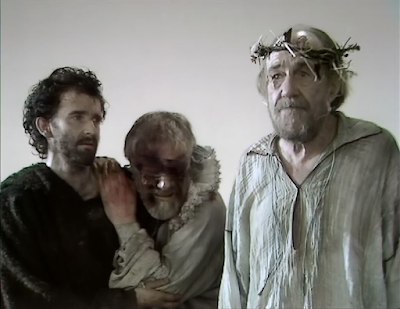
On the 1982 BBC King Lear

After the 2016 version starring Don Warrington, this is the second King Lear I’ve seen. Or third, if you count the Russian film directed by Grigori Kozintsev. Or even fourth, if you count Kurosawa’s Ran. 

A central difference between Michael Hordern in the BBC production and Don Warrington—and I suppose most other Lears—is that Michael Hordern’s Lear is not monumental, not larger-than-life, not striving against cosmic forces. He plays Lear as old, frail, and feeble-minded, and this version seems to be a King Lear on a small scale.   


Some people may find it a disappointment, but I do like this different approach. It works. His entire performance is great, but there are three scenes I find particularly magnificent: the scene in the storm, the meeting between Lear and blind Gloucester, and the final scene with Cordelia. There is no need to talk about the final scene—the line “Why should a dog, a horse, a rat have life,/ And thou no breath at all?” always brings tears to my eyes. But the scene of mad Lear meeting blind Gloucester is particularly good: it is a tragic scene, a cruel scene, but at the same time there’s a kind of terrible comedy in it. 

“LEAR I remember thine eyes well enough. Dost thou squiny at me? No, do thy worst, blind Cupid! I'll not love. Read thou this challenge; mark but the penning of it.” 

(Act 4 scene 6) 

Michael Hordern and Norman Rodway (Gloucester) play the scene just right: it’s terrible and at the same time funny—a dark, terrible kind of funny. 

I also love the way he says the line “Let me wipe it first; it smells of mortality.”

Another performance worthy of praise is Anton Lesser playing Edgar. When reading the text, I think there isn’t much to the role of Edgar, and yet in the hands of a fantastic actor such as Anton Lesser, he’s transformed into something more tragic, more haunting. He’s even more interesting than Edmund, portrayed by Michael Kitchen.

In the 2016 version (directed by Michael Buffong and featuring Don Warrington in the titular role), my main complaint is about Fraser Ayres as Edmund—partly because he overacts, partly because he lacks the attractiveness of Edmund. In the 1982 version, Michael Kitchen is attractive—one can understand why Goneril and Regan both fall in love with him and plot against each other—but it’s a bland, unmemorable performance.

However, that’s not my main complaint about the 1982 version—it’s the lack of comedy. King Lear is a tragedy, a bleak, devastating play, but there’s comedy in it, and I think the main problem is Frank Middlemass’s performance as the Fool. Jonathan Miller’s decision to have an old Fool, someone who has probably grown up with Lear, is an interesting one and it could work. The scene on the heath feels very different when the Fool is as old and frail as Lear. But to me, Frank Middlemass isn’t funny, so in many scenes, the Fool comes across as angry, bitter, and moralising. I much prefer Miltos Yerolemou in the 2016 version. 

The unfunny Fool almost ruins the first half of the play for me, and yet the second half is overwhelming. If you really think about it, King Lear is in some ways not very logical and realistic—some of Tolstoy’s complaints are perfectly valid—but it has a strange, overwhelming power I can’t quite explain. By the end, I’m devastated. And the 1982 version gets that right.

It is largely thanks to Michael Hordern and Anton Lesser. I also like Penelope Wilton—her girlish smile as she watches her husband gouge out Gloucester’s eyes and urges him “One side will mock another; the other too” is unnerving. And Brenda Blethyn is closer to my idea of Cordelia than Pepter Lunkuse in the 2016 version.

Despite some imperfections, the 1982 King Lear is excellent. 

Sunday, 7 August 2022

Henry VI, Part 1

This is one of the candidates for the title of Shakespeare’s Worst Play. What do I think? Let’s see. I don’t have a lot to say, but I’m going to poke at it from different directions. 


1/ Generally speaking, when you’re spoilt by Shakespeare, the language here is not very good. But once in a while, I come across something interesting. 

“BEDFORD […] Our isle be made a nourish of salt tears, 

And none but women left to wail the dead…” 

(Act 1 scene 1) 

The king, my lord, is dead. 

“PUCELLE […] Glory is like a circle in the water, 

Which never ceaseth to enlarge itself 

Till by broad spreading it disperse to nought…” 

(Act 1 scene 2) 

The Christopher Marlowe chapter in Jonathan Bate’s The Genius of Shakespeare is good to (re)read whilst reading this play: we know Marlowe tends to write 2 kinds of characters—the overreacher and the Machiavellian schemer—and Bate says Shakespeare created “a figure who was both Faustus-like conjuror and cunning schemer: Joan la Pucelle”.

Bate then says, by dramatising the war between Talbot and Joan, Shakespeare doesn’t let a single character dominate the play, as Marlowe generally does. 

“TALBOT My thoughts are whirlèd like a porter’s wheel; 

I know not where I am, nor what I do. 

A witch, by fear, not force, like Hannibal, 

Drives back our troops and conquers as she lists; 

So bees with smoke and doves with noisome stench 

Are from their hives and houses driven away. 

They called us for our fierceness English dogs; 

Now, like to whelps, we crying run away…” 

(Act 1 scene 5) 

On a side note, this is silly:  

“TALBOT […] Pucelle or pussel, Dolphin or dogfish, 

Yours hearts I’ll stamp out with my horse’s heels, 

And make a quagmire of your mingled brains…” 

(ibid.) 


2/ Look at this passage: 

“TALBOT I laugh to see your ladyship so fond

To think that you have aught but Talbot’s shadow 

Wherein to practice your severity.

COUNTESS Why, art not thou the man?

TALBOT I am indeed.

COUNTESS Then have I substance too.

TALBOT No, no, I am but shadow of myself: 

You are deceived, my substance is not here, 

For what you see is but the smallest part

And least proportion of humanity […] 

COUNTESS This is a riddling merchant for the nonce; 

He will be here; and yet he is not here. 

How can these contrarieties agree?” 

(Act 2 scene 3) 

Perhaps I’m talking rubbish, but I can’t help thinking that even though this exchange is not very well phrased, this kind of doublespeak is very Shakespearean: like “so foul and fair a day I have not seen” in Macbeth, or “brown and not brown”, “true and not true” in Troilus and Cressida. 


3/ Almost all of a sudden, I came across something that sounded more like Shakespeare: 

“MORTIMER Kind keepers of my weak decaying age, 

Let dying Mortimer here rest himself. 

Even like a man new halèd from the rack, 

So fare my limbs with long imprisonment, 

And these gray locks, the pursuivants of death, 

Nestor-like agèd in an age of care, 

Argue the end of Edmund Mortimer.

These eyes, like lamps, whose wasting oil is spent, 

Wax dim, as drawing to their exigent; 

Weak shoulders, overborne with burthening grief,

And pithless arms, like to a withered vine

That droops his sapless branches to the ground. 

Yet are these feet, whose strengthless stay is numb,

Unable to support this lump of clay, 

Swift-wingèd with desire to get a grave, 

As witting I no other comfort have…” 

(Act 2 scene 5) 

The whole scene between Mortimer and his nephew Richard Plantagenet (later Duke of York) is very good, but I’m pasting here this passage because, even though it’s not on the level of, say, Richard II or Henry IV, it sounds more like Shakespeare than many other passages, especially in the early part of the play: “wasting oil”, “wax dim”, “burthening grief”, “pithless arms”, “withered vine”, “sapless branches”, etc.

In Act 4, the language becomes more interesting and the play is full of energy, as there are two things going on: the English court is deeply divided into two factions (York vs Somerset), and the Duke of Burgundy has joined France. The scenes between Talbot and his son John especially are good. 


4/ The Earl of Suffolk meets Margaret and wants her, even though he is married. He later makes the match for her and King Henry VI, with the intention of keeping her near him and controlling both her and the King. In the scene of their first meeting, one thing caught my attention: 

“SUFFOLK [Aside] She’s beautiful and therefore to be wooed; 

She is a woman, therefore to be won.” 

(Act 5 scene 3) 

This is similar to a few lines in Titus Andronicus, another of Shakespeare’s weakest plays:  

“DEMETRIUS Why makes thou it so strange? 

She is a woman, therefore may be wooed; 

She is a woman, therefore may be won; 

She is Lavinia, therefore must be loved…” 

(Act 2 scene 1) 


5/ It is helpful to read Tony Tanner’s essay, as he explains both the historical context and the context of theatre development (with the influence of morality plays). He also, as usual, tells us what Shakespeare does with his sources. 

“In no other history play does Shakespeare so freely disrupt and alter the time sequence of his Chronicle material. He brings events together that were years apart, he inverts the order of their happening; he makes sudden what was slow; he makes simultaneous what was separate. He expands and contracts; he omits—and invents. […] Shakespeare is tightening his pattern—pointing up the conflict between the once heroic English and the devious, effeminate French; the undermining of chivalric ideals, the decay of feudal loyalties, and loss of old values; the fading of the old, noble heroic ethos, and the rise of a generation driven by ruthlessness, expediency, and cunning; and (this is not so commonly noted) the capitulation—on certain fronts—of the masculine to the feminine.” (Introduction)  

Tony Tanner also mentions the pattern of 3 throughout the play, which I didn’t notice. You have to read the essay for yourself. Even for a weak, imbalanced play such as Henry VI, Part 1, Tanner has a lot of interesting things to say. 


6/ One final comment: Tony Tanner mentions the 3 French women in the play—Joan la Pucelle, the Countess of Auvergne, and Margaret of Naples.

The Countess only appears in one scene and I shouldn’t comment on Margaret, whom I expect to become more interesting in the rest of the tetralogy, but I don’t think Joan is good. I’m not comparing her to Lady Macbeth or Cleopatra or Rosalind; in an early play such as The Comedy of Errors, Adriana and Luciana are rather complex and full of life; even in Titus Andronicus, the villainess Tamora is humanised by her love, pain, and anger for her son at the beginning of the play, and she seems to love Aaron. Joan la Pucelle lacks something in comparison. 

I suppose Shakespeare does add something interesting, when Joan sees her father before her execution and denies knowing him—we can see her shame and, in a way, her vulnerability. But I still don’t think Joan is particularly good as a character.