 If you’re familiar with Kieslowski’s career, you know there are 2 Kieslowskis: the Polish Kieslowski—realistic, social/political, grey, unglamorous (Blind Chance, Dekalog…), and the international Kieslowski—metaphysical, poetic, visually dazzling… (The Double Life of Veronique, the Three Colours trilogy).
Marek Haltof talks about the turning point:
If you’re familiar with Kieslowski’s career, you know there are 2 Kieslowskis: the Polish Kieslowski—realistic, social/political, grey, unglamorous (Blind Chance, Dekalog…), and the international Kieslowski—metaphysical, poetic, visually dazzling… (The Double Life of Veronique, the Three Colours trilogy).
Marek Haltof talks about the turning point:
“In his Polish- French co-productions […] the realistic, often uncomplimentary vision of Poland—a realm of drab landscapes populated by grey characters that are dwarfed by the political system—gives way to dazzling photography, as if taken from glossy illustrated journals. Individuals struggling with themselves replace earlier recognisable characters struggling with communist reality. The unglamorous female characters from Kieslowski’s previous films, often portrayed as narrow-minded and not understanding the aspirations of the male protagonists, are replaced by glamorous foreign characters. From being almost always on the margin of Kieslowski’s stories, and often not deserving of the viewer’s sympathy, they move to the centre of his films. They are young, beautiful and tirelessly dynamic.”
I don’t agree with every single point. It’s true that women are on the margin of the story in Blind Chance and I don’t know about Kieslowski’s earlier films, but the 10 episodes of Dekalog are about stories of both men and women, and Kieslowski depicts both sexes with humanity and without judgment. The female characters in Dekalog exist as individuals, with their strengths and shortcomings, like the male ones.
However, the passage does explain well the differences between the 2 periods in Kieslowski’s career. He moves inward. The Double Life of Veronique is a film about feelings, and Three Colours: Blue is an internal film.
 Haltof also talks about the stylistic changes:
“Unlike Kieslowski’s earlier works, his films made in the 1990s become visually refined to the point of being ornate. The camera does not reveal as in his early films, but intrudes, and calls attention to itself through symbolic, ‘unnatural’ use of colours, camera angles and lighting. The same can be said about Zbigniew Preisner’s music which sometimes takes over the films. Kieslowski’s change of direction can be described as follows: from functional to ‘expressionistic’ photography, from unobtrusive soundtrack to overwhelming musical score, from ordinary characters in everyday situations to literary characters set in a designer’s world, from the particular to the general, from outer to inner reality and from realism to ‘artiness’. A director of detailed realistic observations becomes a director of metaphysical experiences.”
Is it just me, or does Haltof reveal himself to prefer the Polish period to the international period?
First of all, Kieslowski’s Polish-French films are undeniably beautiful, especially The Double Life of Veronique and Three Colours: Blue are among the most beautiful films I have ever seen. But they are not beautiful in a superficial, empty, style-over-substance way—the cinematography is visually dazzling but it’s Kieslowski’s skills for visual storytelling, attention to details, and poetic sensibilities that I admire. The best example is the opening of Blue, in which he does not use words or anything lengthy but hints and suggests in close-ups and lets the audience piece together what’s going on.
Secondly, if we exclude Three Colours: White (which is mostly set in Poland and different from the other international productions anyway), Kieslowski moves inward, exploring feelings such as loneliness, grief... so his style naturally has to change to fit it. People who prefer the realism of the Polish films may call it artiness, but he utilises lots of POV shots (which I would say do not call attention to themselves) and lots of music, because these films are internal and abstract, showing the main character’s inner world. In addition, The Double Life of Veronique and Blue are both about music.
Thirdly, the “core” remains the same.
Grazyna Stachowna, as quoted by Haltof, lists the motifs in the trilogy that are also in Kieslowski’s earlier films:
“… blind chance, Van den Budenmayer, voyeurism and eavesdropping, an old woman with a bottle, the final cry of the protagonists, windows, beads made of glass, the 2-franc coin, loneliness, jealousy, humiliation, contempt, sex and suicide.”
More importantly, Kieslowski, whether he’s dealing with social/political issues or private struggles, is still most of all interested in the individual. He’s interested in emotions, relationships, moral dilemmas, choices, and the different paths we may take. He’s interested in depicting and exploring people, as individuals, without judgment—he seeks to understand.
________________________________________
It is strange the way some directors have a clear turning point in their career. Fellini can be divided into early Fellini (neorealism) and late Fellini (Felliniesque—grotesque, dreamlike, cartoonish, heavily influence by Carl Jung). 8 ½ is the peak of his career, which stands apart and can’t be categorised this way, and the same might be said of La Dolce Vita, but before La Dolce Vita is early Fellini (The White Sheik, I vitelloni, La Strada, Il bidone, Nights of Cabiria…) and after 8 ½ is late Fellini (Juliet of the Spirits, Fellini Satyricon, Roma, Fellini’s Casanova, Amarcord, City of Women…). My favourite Fellini film is 8 ½, and generally I prefer early Fellini, apart from Amarcord.
(Perhaps that means I’m not truly a Fellini fan).
Another example is Zhang Yimou. Early Zhang Yimou (before Hero) is serious drama films, about socio-political issues in Chinese society. Some of his early films are masterpieces, such as Raise the Red Lantern and To Live, and I like or once liked very much some others such as Red Sorghum and Ju Dou. That Zhang Yimou is the great director in Chinese cinema. Since Hero, his career has taken a new turn—he not only turned to commercial cinema but also betrayed himself and sold his soul to the devil (by which I mean the Chinese communist party), attempting to rewrite history and making propaganda movies for the Chinese government. Since Hero, House of Flying Daggers, and Curse of the Golden Flower, I have not seen anything else by Zhang Yimou. I despise him only less than Jackie Chan. However, because of his great talent, I might watch Shadow for curiosity, if I can find it.
To go back to Kieslowski, he didn’t betray himself. I like both periods, for different reasons. And he’s great.
I’m reading Sidney Lumet’s Making Movies, which I think is a very good and enjoyable book, especially for aspiring film directors.
Look at this:
 Isn’t that such a good “defence” of dialogue? The writer-director who has created the most memorable lines is Billy Wilder, who has 3 contenders for the best closing lines of all time—The Apartment (“Shut up and deal”), Some Like It Hot (“Nobody’s perfect”), and Sunset Boulevard (“All right, Mr. DeMille, I'm ready for my close-up”). Dialogue is not uncinematic. It is only uncinematic when it is superfluous exposition, and worst if it’s the director’s way of explaining the film to the audience (which is common in Christopher Nolan’s films).
Now look at this passage:
Isn’t that such a good “defence” of dialogue? The writer-director who has created the most memorable lines is Billy Wilder, who has 3 contenders for the best closing lines of all time—The Apartment (“Shut up and deal”), Some Like It Hot (“Nobody’s perfect”), and Sunset Boulevard (“All right, Mr. DeMille, I'm ready for my close-up”). Dialogue is not uncinematic. It is only uncinematic when it is superfluous exposition, and worst if it’s the director’s way of explaining the film to the audience (which is common in Christopher Nolan’s films).
Now look at this passage:
 That is fascinating and scary at the same time—would I be able to tell?
The book offers some invaluable insight and advice about directing. I admire Sidney Lumet immensely, and now love him even more as I read the book. He is not an auteur, he might not even be seen as a stylist, but does it matter? I would say that 12 Angry Men and Dog Day Afternoon are masterpieces, and Before the Devil Knows You’re Dead is a great, heartbreaking film that should be better known. Many of his other films are also highly acclaimed, such as Serpico, The Verdict, Network, Murder on the Orient Express, Long Day’s Journey into Night... Why are some other directors ranked higher just because their films are more stylistic or technically more impressive?
That leads me to another point: is the ability to work with actors not important? The directors who I think are masters at getting the best performances out of actors are Ingmar Bergman, Elia Kazan, Sidney Lumet, and Francis Ford Coppola. And perhaps Roman Polanski (Adrien Brody never had anything remotely as good as his performance in The Pianist).
Some other directors who are also good at working with actors are Billy Wilder, Clint Eastwood, Martin Scorsese, Zhang Yimou, Krzysztof Kieslowski… (I don’t include Kurosawa and Mizoguchi because Japanese acting is a different style).
As you follow a director’s work, you realise what their main strengths are—they are better at some aspects of filmmaking than others. Fellini’s main strengths, for example, are in blocking/staging, cinematography, and visual storytelling. Billy Wilder’s are in story, structure/ pacing, dialogue, and working with actors. Orson Welles’s are in cinematography (especially lighting), structure, editing, and sound. Luis Bunuel’s are in story/ plot, ideas, and pacing. Andrei Tarkovsky’s are in ideas, cinematography, sound, and atmosphere.
You also notice, not weaknesses, but that some aspects don’t interest a director as much as others. There isn’t much to say about cinematography and lighting in Luis Bunuel’s films, for example; or editing in Tarkovsky’s; or story in Wong Kar-wai’s.
It is not without reason that I think Ingmar Bergman’s the best director of all time, because his films do have everything—good story, interesting idea, depth, pacing, great cinematography (especially lighting), great sound, great editing (most notably in Persona), good production design (at least in Cries and Whispers and Fanny and Alexander), wonderful performances, good visual storytelling, experiments… But usually, directors have their strengths, and they may be weaker, or at least not as spectacular, in some other aspects of filmmaking, so why is it that directors who are good at techniques valued much more highly than directors who are good at drama (emotional complexity in a scene, and pacing for the film as a whole) and working with actors?
When a film looks good, it is visually pleasing, but at the end of the day, so what? I like good acting. I like touching stories. I like films that make me see life differently and learn something about myself. I never use the word “great” for directors like Quentin Tarantino or Wes Anderson—they’re good at what they do, and their films are entertaining, but have no depth and offer no more than that. But even if we talk about Stanley Kubrick, a director I admire very much when it comes to techniques (especially the production design, cinematography, and use of music), none of his films has ever touched me on an emotional, personal level like 12 Angry Men or Dog Day Afternoon has. In Dog Day Afternoon, people talk a lot about Al Pacino, who indeed delivers a fine performance, one of the best in his career, but we should also talk about John Cazale—for some reason, I can never forget the incredibly sad look on his face when Al Pacino asks where he wants to go if he could go anywhere, and he says “Wyoming”. 12 Angry Men shows Sidney Lumet’s talent at working with actors, and also his ability to make an engrossing film in an enclosed space. I’d choose Sidney Lumet over Kubrick anytime.
But that’s enough. Get Making Movies. It’s a good book. Even Roger Ebert said:
That is fascinating and scary at the same time—would I be able to tell?
The book offers some invaluable insight and advice about directing. I admire Sidney Lumet immensely, and now love him even more as I read the book. He is not an auteur, he might not even be seen as a stylist, but does it matter? I would say that 12 Angry Men and Dog Day Afternoon are masterpieces, and Before the Devil Knows You’re Dead is a great, heartbreaking film that should be better known. Many of his other films are also highly acclaimed, such as Serpico, The Verdict, Network, Murder on the Orient Express, Long Day’s Journey into Night... Why are some other directors ranked higher just because their films are more stylistic or technically more impressive?
That leads me to another point: is the ability to work with actors not important? The directors who I think are masters at getting the best performances out of actors are Ingmar Bergman, Elia Kazan, Sidney Lumet, and Francis Ford Coppola. And perhaps Roman Polanski (Adrien Brody never had anything remotely as good as his performance in The Pianist).
Some other directors who are also good at working with actors are Billy Wilder, Clint Eastwood, Martin Scorsese, Zhang Yimou, Krzysztof Kieslowski… (I don’t include Kurosawa and Mizoguchi because Japanese acting is a different style).
As you follow a director’s work, you realise what their main strengths are—they are better at some aspects of filmmaking than others. Fellini’s main strengths, for example, are in blocking/staging, cinematography, and visual storytelling. Billy Wilder’s are in story, structure/ pacing, dialogue, and working with actors. Orson Welles’s are in cinematography (especially lighting), structure, editing, and sound. Luis Bunuel’s are in story/ plot, ideas, and pacing. Andrei Tarkovsky’s are in ideas, cinematography, sound, and atmosphere.
You also notice, not weaknesses, but that some aspects don’t interest a director as much as others. There isn’t much to say about cinematography and lighting in Luis Bunuel’s films, for example; or editing in Tarkovsky’s; or story in Wong Kar-wai’s.
It is not without reason that I think Ingmar Bergman’s the best director of all time, because his films do have everything—good story, interesting idea, depth, pacing, great cinematography (especially lighting), great sound, great editing (most notably in Persona), good production design (at least in Cries and Whispers and Fanny and Alexander), wonderful performances, good visual storytelling, experiments… But usually, directors have their strengths, and they may be weaker, or at least not as spectacular, in some other aspects of filmmaking, so why is it that directors who are good at techniques valued much more highly than directors who are good at drama (emotional complexity in a scene, and pacing for the film as a whole) and working with actors?
When a film looks good, it is visually pleasing, but at the end of the day, so what? I like good acting. I like touching stories. I like films that make me see life differently and learn something about myself. I never use the word “great” for directors like Quentin Tarantino or Wes Anderson—they’re good at what they do, and their films are entertaining, but have no depth and offer no more than that. But even if we talk about Stanley Kubrick, a director I admire very much when it comes to techniques (especially the production design, cinematography, and use of music), none of his films has ever touched me on an emotional, personal level like 12 Angry Men or Dog Day Afternoon has. In Dog Day Afternoon, people talk a lot about Al Pacino, who indeed delivers a fine performance, one of the best in his career, but we should also talk about John Cazale—for some reason, I can never forget the incredibly sad look on his face when Al Pacino asks where he wants to go if he could go anywhere, and he says “Wyoming”. 12 Angry Men shows Sidney Lumet’s talent at working with actors, and also his ability to make an engrossing film in an enclosed space. I’d choose Sidney Lumet over Kubrick anytime.
But that’s enough. Get Making Movies. It’s a good book. Even Roger Ebert said:
“Invaluable… I am sometimes asked if there is 1 book a filmgoer could read to learn more about how movies are made and what to look for while watching them. This is the book.”
This is my list of favourite underrated films.
To explain, I don’t mention films such as Cries and Whispers—generally speaking, most people haven’t watched it, but it’s regarded as one of the peaks of Ingmar Bergman’s oeuvre and recognised as among the greatest films ever made.
By underrated films, I’m thinking of the films that are overlooked—the films that people don’t often include in the list of best films or films you should watch, and the films that people forget when talking about an important director.
The list (strong favourites in bold):
Letter from an Unknown Woman (1948), dir. Max Ophuls
In a Lonely Place (1950), dir. Nicholas Ray
Gion Bayashi/ A Geisha (1953), dir. Kenji Mizoguchi
Street of Shame (1956), dir. Kenji Mizoguchi
The Killing (1956), dir. Stanley Kubrick
Nights of Cabiria (1957), dir. Federico Fellini
The Bad Sleep Well (1960), dir. Akira Kurosawa
The Innocents (1961), dir. Jack Clayton
My Fair Lady (1964), dir. George Cukor
The Private Life of Sherlock Holmes (1970), dir. Billy Wilder
The Last Detail (1973), dir. Hal Ashby
The Phantom of Liberty (1974), dir. Luis Bunuel
Alice Doesn't Live Here Anymore (1974), dir. Martin Scorsese
3 Women (1977), dir. Robert Altman
On Golden Pond (1981), dir. Mark Rydell
My Left Foot (1989), dir. Jim Sheridan
Bound (1996), dir. The Wachowskis
Happy Together (1997), dir. Wong Kar-wai
Happiness (1998), dir. Todd Solondz
Memento (2000), dir. Christopher Nolan
Sideways (2004), dir. Alexander Payne
Fracture (2007), dir. Gregory Hoblit
This list would expand.
In Masters of Cinema: Federico Fellini, Angel Quintana writes about I vitelloni:
“… A voice-over strengthens the film’s links with autobiography: an unidentified vitellone, haunted by his own ghosts, guides us through these images from a world with limited horizons.
[…] The neologism vitelloni conveys the idea of a bunch of insipid characters, forever trapped in the planning phase without really knowing what to do with their lives. As prisoners of their own little world, incapable of moving beyond it, they are travellers going nowhere. The 5 main characters represent different aspects of provincial mediocrity. […]
All these characters wear masks, to deceive the world around them and to try to control it. […] These 3 events allow Fellini to pinpoint the sadness of the vitelloni, trapped behind the walls of their own indolence. It is not just they lie; what is worse is that they lie to themselves.”
That’s a good analysis. All the chapters about the films up to 8 ½, plus Amarcord, remind me of how much I love Fellini.
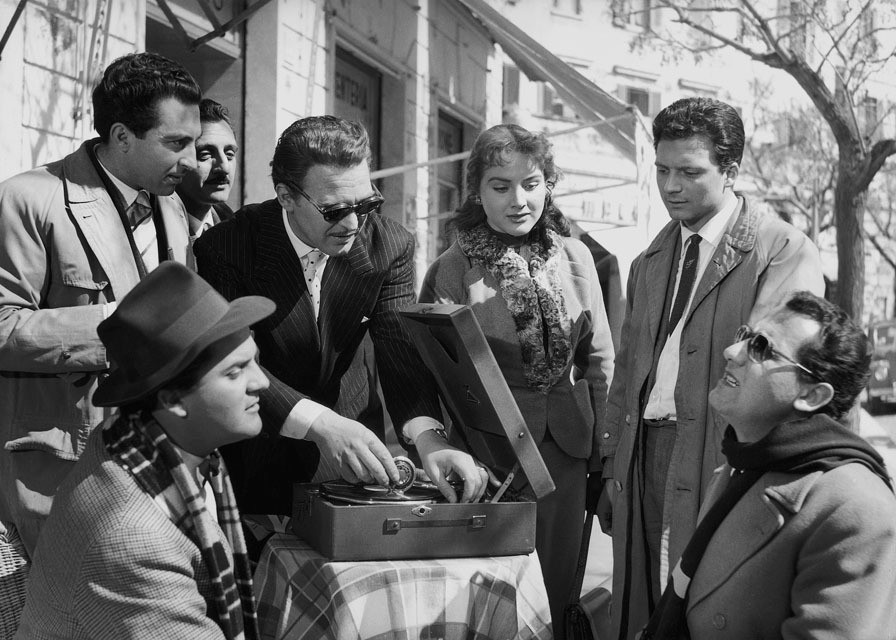 Out of interest, I looked at Wikipedia to search for some other definitions of vitelloni.
Fellini himself said, they were “the unemployed of the middle class, mother’s pets. They shine during the holiday season, and waiting for it takes up the rest of the year”.
Ennio Flaiano, co-writer of I vitelloni, explained further:
Out of interest, I looked at Wikipedia to search for some other definitions of vitelloni.
Fellini himself said, they were “the unemployed of the middle class, mother’s pets. They shine during the holiday season, and waiting for it takes up the rest of the year”.
Ennio Flaiano, co-writer of I vitelloni, explained further:
“The term vitellone was used in my day to define a young man from a modest family, perhaps a student – but one who had either already gone beyond the programmed schedule for his coursework, or one who did nothing all the time... I believe the term is a corruption of the word vudellone, the large intestine, or a person who eats a lot. It was a way of describing the family son who only ate but never 'produced' – like an intestine, waiting to be filled.”
Angel Quintana writes about Il bidone, aka The Swindle:
“Its characters are continuations of the layabouts of I vitelloni. As the economic miracle had introduced a Protestant work ethic into Mediterranean culture, these good-for-nothings find themselves obliged to do something with their lives. So, they become conmen.”
Years later, the vitellone reappear in Amarcord:
“Titta and his friends form a group of nascent vitelloni who hang around on the streets, participate in the town’s festive events, bask in the lights and shadows of the Fulgor cinema and dream of make-believe paradise by spying on the people in the Grand Hotel. Women occupy a special place in this world…”
Fellini made films out of his own dreams, desires, frustrations, and obsessions. He himself was a vitellone, so we keep seeing the image of vitelloni in his films.
Somehow, I’m also thinking of the main character in La Dolce Vita and 8 ½, both played by Marcello Mastroianni. They are not very different; in a sense, they’re like the grown-up version of the vitellone, travellers going nowhere, prisoners of their own world (of la dolce vita—the sweet life), wracked with guilt but unable to escape from themselves.
 At least Guido in 8 ½ is able to come to terms with himself, to some extent, and make a film in the end. Marcello in La Dolce Vita gets sucked into the life of pointless debauchery and hedonism—in the end, he’s pushed even further into that life, after the shocking murder and suicide of the man that he has always believed to have a perfect, ideal life. In the end, Marcello doesn’t understand the girl—he has forgotten his own aspirations. He’s trapped.
About La Dolce Vita, Quintana puts it nicely:
“A dream-like heaviness hangs over every scene, which invariably ends with a painful return to reality, as if every pleasurable situation inevitably has to end in post-coital sadness.”
After Ingmar Bergman and Orson Welles, I’m now reading about Federico Fellini by Angel Quintana, in the Masters of Cinema series of Cahiers du Cinema.
“Caricature makes it possible to convey psychological traits with just a few broad strokes. Fellini, the inventor of highly arresting worlds, saw images not in purely pictorial terms but as expressions of cartoonish aggression. This approach would eventually come to fruition by unleashing a visual dream-world.”
Angel Quintana writes about the early influences on Fellini, from his childhood love of cartoons, comic strips, caricatures, carnivals, and the circus (the elements that make up his style) to neorealism and the collaborations with Rosselini.
“Fellini learned then from Rossellini, as Gianni Rondolino has observed, that looking at the world means going beyond appearances, ‘introducing a new and original dramatic dimension and discovering the motivations hidden behind the facts’. […] A human being is not merely a social creature, as he or she is also subject to existential problems. Fellini came to realize that our understanding of reality is devoid of any sense if we ignore the constitutive elements of culture, and more especially the elements involved in the construction of the personality.”
Quintana later writes about the influence of Carl Jung:
“Unsettled by the success of La Dolce Vita and the scandal it provoked in some conservative quarters, Fellini went into psychoanalysis. Dr Ernst Bernhard introduced him to the theories of Carl Gustav Jung and made him understand that, contrary to the Freudian notion that symbols in dreams are merely a translation of repression, the unconscious can also be a repository for a richly poetic imaginary world. Reading Jung enabled Fellini to explore the symbolism of the collective unconscious and convinced that irrational images can be emotionally captivating. Fellini himself acknowledged that it was Jung who allowed him to make his cinema ‘a meeting point between science and magic, between rationality and imagination.’ He started to envisage a cinema with no borders between the real and the imaginary, a cinema immersed in the psyche. The influence of Jungian psychiatry led Fellini to analyse his own male ego in 8 ½ (1963) and reflect on femininity as a complex otherness in Juliet of the Spirits (1965).”
I believe that Ingmar Bergman was also influenced by Jung—look at Persona*.
I should read Jung.
*: Here is a Jungian interpretation of Persona: http://www.iveybarr.com/persona-shadow-jungian-archetype-as-character/
Which is different from my list of favourite films.
Persona (1966), Wild Strawberries (1957), Hour of the Wolf (1968), and Cries and Whispers (1972) by Ingmar Bergman
Citizen Kane (1941) and F for Fake (1973) by Orson Welles
The Exterminating Angel (1962), The Phantom of Liberty (1974), and That Obscure Object of Desire (1977) by Luis Bunuel
La Jetée (1962) by Chris Marker
8 ½ (1963) by Federico Fellini
The Godfather (1972) by Francis Ford Coppola
Bicycle Thieves (1948) by Vittorio De Sica
Three Colours: Blue (1993) by Krzysztof Kieslowski
Ivan's Childhood (1962) by Andrei Tarkovsky
Taxi Driver (1976) by Martin Scorsese
Dogville (2003) by Lars von Trier
3 Women (1977) by Robert Altman
_____________________________
Every filmmaker is influenced by other filmmakers. Sometimes we may even be inspired by some aspect of a film we don’t like, like how I feel about Dogville.
As a filmmaking student, I’m still learning the skills and techniques, and exploring the form, I have yet to find my style, but it’s still nice to make a list to acknowledge the influences and have something to compare to in the future.
Or maybe I just really like lists.
The 50s: http://thelittlewhiteattic.blogspot.com/2017/08/my-favourite-films-from-1950s.html
The 60s: http://thelittlewhiteattic.blogspot.com/2018/03/my-favourite-films-from-1960s.html
The Private Life of Sherlock Holmes (1970) by Billy Wilder
Harold and Maude (1971) by Hal Ashby
The French Connection (1971) by William Friedkin
The Godfather (1972) by Francis Ford Coppola
Cries and Whispers (1972) by Ingmar Bergman
The Discreet Charm of the Bourgeoisie (1972) by Luis Bunuel
Last Tango in Paris (1972) by Bernardo Bertolucci
Cabaret (1972) by Bob Fosse
Solaris (1972) by Andrei Tarkovsky
Play It Again, Sam (1972) by Herbert Ross
Amarcord (1973) by Federico Fellini
The Last Detail (1973) by Hal Ashby
Mean Streets (1973) by Martin Scorsese
The Sting (1973) by George Roy Hill
Sleep (1973) by Woody Allen
F for Fake (1973) by Orson Welles
The Godfather Part II (1974) by Francis Ford Coppola
The Conversation (1974) by Francis Ford Coppola
Chinatown (1974) by Roman Polanski
The Phantom of Liberty (1974) by Luis Bunuel
Alice Doesn't Live Here Anymore (1974) by Martin Scorsese
Dog Day Afternoon (1975) by Sidney Lumet
Scent of a Woman (1975) by Martin Brest
Love and Death (1975) by Woody Allen
Taxi Driver (1976) by Martin Scorsese
Network (1976) by Sidney Lumet
3 Women (1977) by Robert Altman
That Obscure Object of Desire (1977) by Luis Bunuel
Annie Hall (1977) by Woody Allen
Autumn Sonata (1978) by Ingmar Bergman
The Tin Drum (1979) by Volker Schlöndorff
Manhatttan (1979) by Woody Allen
All That Jazz (1979) by Bob Fosse
Persona by Ingmar Bergman
Citizen Kane by Orson Welles
Nights of Cabiria by Federico Fellini
Yojimbo & Sanjuro by Akira Kurosawa
Sunset Boulevard by Billy Wilder
The Discreet Charm of the Bourgeoisie by Luis Buñuel
Spring, Summer, Fall, Winter... and Spring by Kim Ki-duk
Taxi Driver by Martin Scorsese
The Godfather by Francis Ford Coppola
Casablanca by Michael Curtis
------------------------------------------------------------
Once in a while I make a new list of favourites to see what has changed and to keep notes over time.
Now there have been only a few changes since last year: http://thelittlewhiteattic.blogspot.com/2017/06/my-new-10-favourite-films.html
Ran is replaced with Yojimbo and Sanjuro. Choosing a favourite Kurosawa is difficult. I love Ran. I love The Bad Sleep Well. I love High and Low. The Bad Sleep Well is a perfect film, and a great example to learn from about the geometry of the scene—about staging and creating a shape in the frame. But finally I chose Yojimbo and Sanjuro (for how do you separate them?) for their dynamic quality and humour, and Toshiro Mifune’s charismatic hero, over the tragic The Bad Sleep Well.
Persona and Citizen Kane, I love to the point of obsession. They are masterpieces, and I keep coming back to them for inspiration. Citizen Kane has everything you need to learn about cinema, especially in terms of blocking, cinematography, and editing; whilst Persona in particular and European art films in the 1950s-60s in general have changed my view of the possibilities of cinema and had a huge influence on me, especially with the idea of film as dream.
------------------------------------------------------------
On this date in 2007, Ingmar Bergman passed away.
Today is also Emily Bronte's 200th birthday.
For the 1950s: http://thelittlewhiteattic.blogspot.com/2017/08/my-favourite-films-from-1950s.html
The Bad Sleep Well (1960) by Akira Kurosawa
The Apartment (1960) by Billy Wilder
Psycho (1960) by Alfred Hitchcock
La Dolce Vita (1960) by Federico Fellini
Le Trou (1960) by Jacques Becker
Viridiana (1961) by Luis Buñuel
One, Two, Three (1961) by Billy Wilder
Breakfast at Tiffany’s (1961) by Blake Edwards
Yojimbo (1961) by Akira Kurosawa
Sanjuro (1962) by Akira Kurosawa
Ivan’s Childhood (1962) by Andrei Tarkovsky
The Exterminating Angel (1962) by Luis Buñuel
The Trial (1962) by Orson Welles
Winter Light (1963) by Ingmar Bergman
High and Low (1963) by Akira Kurosawa
8 1/2 (1963) by Federico Fellini
Knife in the Water (1963) by Roman Polanski
Charade (1963) by Stanley Donen
Woman in the Dunes (1964) by Hiroshi Teshigahara
Dr Strangelove (1964) by Stanley Kubrick
My Fair Lady (1964) by George Cukor
Persona (1966) by Ingmar Bergman
Blow-Up (1966) by Michelangelo Antonioni
2001: A Space Odyssey (1968) by Stanley Kubrick
The Graduate (1968) by Mike Nichols
Hour of the Wolf (1968) by Ingmar Bergman
Romeo and Juliet (1968) by Franco Zeffirelli
Following the previous post, here’s a list of my 3 favourite films of some directors. I also note how many of the directors’ films I’ve watched.
(I don’t include a director if I’ve only seen 5 films or less. You probably notice that I broke my own rule a few times).
Woody Allen:
Annie Hall
Crimes and Misdemeanors
Love and Death
(out of 18)
Martin Scorsese:
Taxi Driver
Mean Streets
The Aviator
(out of 17)
Ingmar Bergman:
Persona
Cries and Whispers
Wild Strawberries or The Seventh Seal
(out of 15)
Alfred Hitchcock:
Psycho
Dial M for Murder
Vertigo
(out of 15)
Billy Wilder:
Sunset Boulevard
The Apartment
Witness for the Prosecution
(out of 14)
Federico Fellini:
Nights of Cabiria
8 ½
Amarcord
(out of 10)
Clint Eastwood:
Million Dollar Baby
Changeling
True Crime
(out of 10)
Zhang Yimou:
Raise the Red Lantern
To Live
Red Sorghum or Ju Dou
(out of 10)
Stanley Kubrick:
Dr Strangelove
The Killing
2001: A Space Odyssey
(out of 9)
Joel& Ethan Coen:
No Country for Old Men
The Big Lebowski
Fargo
(out of 9)
Kenji Mizoguchi:
Gion bayashi, aka A Geisha
Ugetsu monogatari
Akasen chitai, aka Street of Shame
(out of 8)
Luis Bunuel:
The Exterminating Angel
The Discreet Charm of the Bourgeoisie
The Phantom of Liberty or Viridiana
(out of 8)
Wong Kar-wai:
Chungking Express
Happy Together
2046
(out of 8)
Tim Burton:
Edward Scissorhands
Corpse Bride
Sweeney Todd
(out of 8)
Akira Kurosawa:
Ran
The Bad Sleep Well
High and Low
(out of 7)
Francis Ford Coppola:
The Godfather
The Conversation
The Godfather Part II
(out of 7)
Steven Spielberg:
Catch Me If You Can
A.I. Artificial Intelligence
The Terminal
(out of 7)
Park Chan-wook:
The Handmaiden
Thirst
(out of 6)
Roman Polanski:
Chinatown
The Pianist
Knife in the Water
(out of 6)
Quentin Tarantino:
Pulp Fiction
Inglourious Basterds
Jackie Brown
(out of 6)
Ang Lee:
Sense and Sensibility
Brokeback Mountain
Crouching Tiger, Hidden Dragon
(out of 6)
Some of these are not great, some of these I can’t stand, but these are the most inventive/ unusual/ unconventional films I’ve ever seen—films that break rules (especially in narrative), films that tell stories in an unusual way, films that are experimental and audacious, films where the directors take the most advantages of film as opposed to other art forms and strive to expand the possibilities of cinema.
Wild Strawberries (1957) by Ingmar Bergman
La Dolce Vita (1960) by Federico Fellini
Breathless (1960) by Jean-Luc Godard
The Exterminating Angel (1962) by Luis Buñuel
8 1/2 (1963) by Federico Fellini
Persona (1966) by Ingmar Bergman
Blow-Up (1966) by Michelangelo Antonioni
2001: A Space Odyssey (1968) by Stanley Kubrick
Hour of the Wolf (1968) by Ingmar Bergman
The Milky Way (1969) by Luis Buñuel
Cries and Whispers (1972) by Ingmar Bergman
The Discreet Charm of the Bourgeoisie (1972) by Luis Buñuel
The Phantom of Liberty (1974) by Luis Buñuel
The Obscure Object of Desire (1977) by Luis Buñuel
3 Women (1977) by Robert Altman
Pulp Fiction (1994) by Quentin Tarantino
Festen (1998) by Thomas Vinterberg
Memento (2000) by Christopher Nolan
Songs from the Second Floor (2000) by Roy Andersson
Mulholland Drive (2001) by David Lynch
Irréversible (2002) by Gaspar Noé
À la folie... pas du tout (2002) by Laetitia Colombani
The Dance of Reality (2013) by Alejandro Jodorowsky
Birdman (2014) by Alejandro González Iñárritu
(Note that this is a list of favourites, so some great films may be absent, such as Rashomon or Tokyo Story).
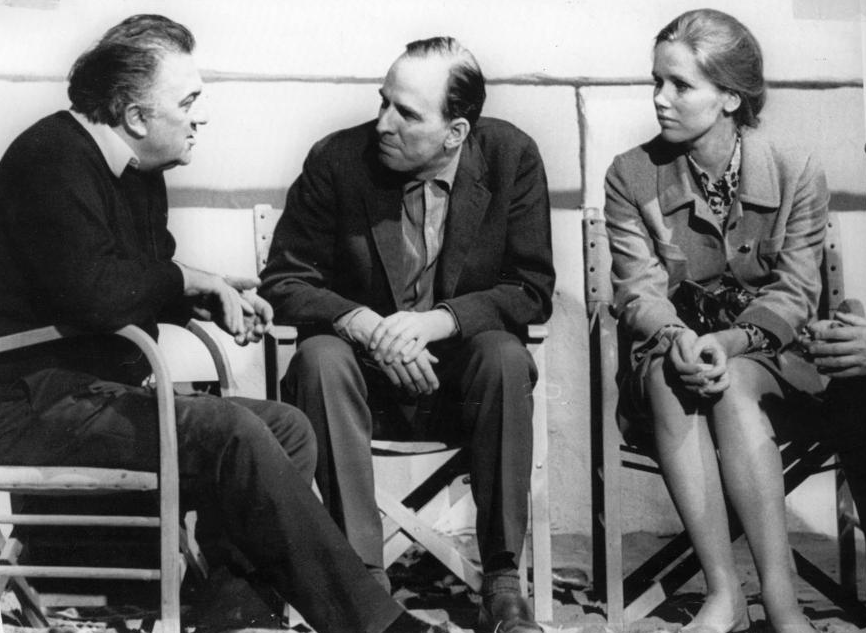 (A photo of Fellini and Bergman, with Liv Ullmann- source)
All about Eve (1950) by Joseph L. Mankiewicz
Sunset Boulevard (1950) by Billy Wilder
In a Lonely Place (1950) by Nicholas Ray
A Streetcar Named Desire (1951) by Elia Kazan
The Big Carnival aka Ace in the Hole (1951) by Billy Wilder
The Life of Oharu (1952) by Kenji Mizoguchi
Ugetsu Monogatari (1953) by Kenji Mizoguchi
A Geisha aka Gion bayashi (1953) by Kenji Mizoguchi
Summer with Monika (1953) by Ingmar Bergman
Roman Holiday (1953) by William Wyler
La Strada (1954) by Federico Fellini
On the Waterfront (1954) by Elia Kazan
Rear Window (1954) by Alfred Hitchcock
Dial M for Murder (1954) by Alfred Hitchcock
Smiles of a Summer Night (1955) by Ingmar Bergman
The Killing (1956) by Stanley Kubrick
The Trouble with Harry (1956) by Alfred Hitchcock
Street of Shame (1956) by Kenji Mizoguchi
Nights of Cabiria (1957) by Federico Fellini
Witness for the Prosecution (1957) by Billy Wilder
12 Angry Men (1957) by Sidney Lumet
Wild Strawberries (1957) by Ingmar Bergman
The Seventh Seal (1957) by Ingmar Bergman
An Affair to Remember (1957) by Leo McCarey
Vertigo (1958) by Alfred Hitchcock
Some Like It Hot (1959) by Billy Wilder
Anatomy of a Murder (1959) by Otto Preminger
So many great films in the 50s. Wonderful period.
My favourite film critic, whom I always turn to after watching a film, is Roger Ebert. Even though I don’t always agree with him, I share with him an enthusiasm, a passion for cinema, and admire his sensitivity and openness and his elegant prose. Among his best writings are the brilliant reviews of Fellini, which greatly help me appreciate the Italian maestro.
Here are some of my favourite excerpts:
Review of La Strada:
“In almost all of Fellini's films, you will find the figure of a man caught between earth and sky. ("La Dolce Vita" opens with a statue of Jesus suspended from a helicopter; Marcello Mastroianni opens "8 1/2" floating in the sky, tethered to earth.) They are torn between the carnal and the spiritual. You will also find the waifs and virgins and good wives, contrasted with prostitutes and temptresses (Fellini in his childhood encountered a vast, buxom woman who lived in a shack at the beach, and made her a character again and again). You will find journeys, processions, parades, clowns, freaks, and the shabby melancholy of an empty field at dawn, after the circus has left...”
Review of Nights of Cabiria:
“By the nature of their work prostitutes can find themselves almost anywhere in a city, in almost any circle, on a given night. She's admitted to the nightclub, for example, under the sponsorship of the movie star (Alberto Lazzari). He picks her up after a fight with his fiancee, takes her to his palatial villa, and then hides her in the bathroom when the fiancee turns up unexpectedly (Cabiria spends the night with his dog). Later, seeking some kind of redemption, she joins another girl and a pimp on a visit to a reputed appearance by the Virgin Mary. And in the scene cut from the movie, she accompanies a good samaritan as he visits the homeless with food and gifts (she is shocked to see a once-beautiful hooker crawl from a hole in the ground).
All of these scenes are echoed in one way or another in “La Dolce Vita,” which sees some of the same terrain through the eyes of a gossip columnist (Marcello Mastroianni) instead of a prostitute. In both films, a hooker peeps through a door as a would-be client makes love with his mistress. Both have nightclub scenes opening with exotic ethnic dancers. Both have a bogus appearance by the Virgin. Both have a musical sequence set in an outdoor nightclub. And both have, as almost all Fellini movies have, a buxom slattern, a stone house by the sea, a procession and a scaffold seen outlined against the dawn. These must be personal touchstones of his imagination.”
Review of La Dolce Vita:
“The famous opening scene, as a statue of Christ is carried above Rome by a helicopter, is matched with the close, in which fisherman on the beach find a sea monster in their nets. Two Christ symbols: the statue "beautiful" but false, the fish "ugly" but real. During both scenes there are failures of communication. The helicopter circles as Marcello tries to get the phone numbers of three sunbathing beauties. At the end, across a beach, he sees the shy girl he met one day when he went to the country in search of peace to write his novel. She makes typing motions to remind him, but he does not remember, shrugs, and turns away.”
Ibid:
“Movies do not change, but their viewers do. When I saw "La Dolce Vita" in 1960, I was an adolescent for whom "the sweet life" represented everything I dreamed of: sin, exotic European glamour, the weary romance of the cynical newspaperman. When I saw it again, around 1970, I was living in a version of Marcello's world; Chicago's North Avenue was not the Via Veneto, but at 3 a.m. the denizens were just as colorful, and I was about Marcello's age.
When I saw the movie around 1980, Marcello was the same age, but I was 10 years older, had stopped drinking, and saw him not as a role model but as a victim, condemned to an endless search for happiness that could never be found, not that way. By 1991, when I analyzed the film a frame at a time at the University of Colorado, Marcello seemed younger still, and while I had once admired and then criticized him, now I pitied and loved him. And when I saw the movie right after Mastroianni died, I thought that Fellini and Marcello had taken a moment of discovery and made it immortal. There may be no such thing as the sweet life. But it is necessary to find that out for yourself.”
Review of 8 ½:
“The critic Alan Stone, writing in the Boston Review, deplores Fellini's "stylistic tendency to emphasize images over ideas." I celebrate it. A filmmaker who prefers ideas to images will never advance above the second rank because he is fighting the nature of his art. The printed word is ideal for ideas; film is made for images, and images are best when they are free to evoke many associations and are not linked to narrowly defined purposes.”
Ibid:
“Fellini's camera is endlessly delighting. His actors often seem to be dancing rather than simply walking. I visited the set of his "Fellini Satyricon," and was interested to see that he played music during every scene (like most Italian directors of his generation, he didn't record sound on the set but post-synched the dialogue). The music brought a lift and subtle rhythm to their movements. Of course many scenes have music built into them: In "8 1/2," orchestras, dance bands and strolling musicians are seen, and the actors move in a subtly choreographed way, as if they're synchronized. Fellini's scores, by Nino Rota, combine snatches of pop tunes with dance music, propelling the action.
Few directors make better use of space. One of his favorite techniques is to focus on a moving group in the background and track with them past foreground faces that slide in and out of frame. He also likes to establish a scene with a master shot, which then becomes a closeup when a character stands up into frame to greet us. Another technique is to follow his characters as they walk, photographing them in three-quarter profile, as they turn back toward the camera. And he likes to begin dance sequences with one partner smiling invitingly toward the camera before the other partner joins in the dance.”
Review of Amarcord:
“Sometimes from this tumult an image of perfect beauty will emerge, as when in the midst of a rare snowfall, the count’s peacock escapes and spreads its dazzling tail feathers in the blizzard. Such an image is so inexplicable and irreproducible that all the heart can do is ache with gratitude, and all the young man can know is that he will live forever, love all the women, drink all the wine, make all the movies and become Fellini.”
Ibid:
“Fellini was more in love with breasts than Russ Meyer, more wracked with guilt than Ingmar Bergman, more of a flamboyant showman than Busby Berkeley. He danced so instinctively to his inner rhythms that he didn’t even realize he was a stylistic original; did he ever devote a moment’s organized thought to the style that became known as “Felliniesque,” or was he simply following the melody that always played when he was working?”
Ibid:
“It’s also absolutely breathtaking filmmaking. Fellini has ranked for a long time among the five or six greatest directors in the world, and of them all, he’s the natural. Ingmar Bergman achieves his greatness through thought and soul-searching, Alfred Hitchcock built his films with meticulous craftsmanship, and Luis Buñuel used his fetishes and fantasies to construct barbed jokes about humanity. But Fellini .. well, moviemaking for him seems almost effortless, like breathing, and he can orchestrate the most complicated scenes with purity and ease. He’s the Willie Mays of movies.”
This is just wonderful.
Having just watched again La Dolce Vita and Amarcord, I’m thinking about Fellini’s detractors. He’s overrated, they say, as though it meant anything and could negate his tremendous influence on cinema and other filmmakers. He’s self-indulgent, they say, and we who love his films are seen as pretentious, the 2 words so commonly (mis)used in criticisms, in literature as well as cinema, that I’m not even sure what they mean now. Fellini’s an enormous force, and like Ingmar Bergman, one of the few true auteurs with a specific vision and worldview that is expressed over and over again in their films—his is a world of weak, philandering men and buxom women; of dreams and fantasies and people seeking miracles; of dwarves, clowns and grotesque characters; of magic, circus, hypnosis and carnivals; of parties, affairs and decadence; of drifting people wracked with guilt but unable to escape from themselves. He’s seen as narcissistic because he makes films about himself, creates art out of his own fears, dreams and longings. His films are personal, like Bergman’s, they’re his means of self-expression. That to me is not a drawback—Fellini and Bergman are both so large, so original and visionary; and, genius aside, they don’t have the self-pity that makes someone like Woody Allen so limited in comparison.
Another argument against Fellini is that his films don’t have a narrative. What they mean is a conventional plot. His earlier films like La Strada and Nights of Cabiria, and perhaps I Vitelloni (which I don’t remember very well), have a 3-act structure; his later masterpieces such as La Dolce Vita, 8 ½ and Amarcord don’t. They don’t even have what is known as the inciting incident. But why must a film have a conventional structure to work?

The structure of La Dolce Vita is 7 days and 7 nights, with the same formula—night of pleasure, and morning of disillusion and guilt. That is the point of the film, that his life is forever the same and Marcello is stuck in a cycle that he can’t get out, that he both despises his job as a gossip reporter and the life of hedonism but at the same time loves “the sweet life” (la dolce vita) and can’t leave it, that he keeps searching for love and meaning, in the wrong places, and never finds it. The only kind of break from the structure of 7 nights 7 days is his visits to Steiner, the model, the embodiment of success and happiness that Marcello admires and aims towards, until an event shatters all the illusion, breaks him, and makes him sink deeper in his life of hedonism.
Similarly, 8 ½ doesn’t have an inciting incident, and doesn’t really have a journey. Guido is stuck. 8 ½ is a film about being unable to make a film, about the equivalent of writer’s block in cinema. Mixing reality with fantasy and dream, it is not a director’s search for ideas for a film, but an examination of his creative problems and personal troubles, his childhood, his relations with women, and his own selfishness and inability to love. Guido has to accept and reconcile with them all, to get out of creative block, but he is the same person in the end.

Different from La Dolce Vita and 8 ½, Amarcord is a series of vignettes and not about a character being stuck. A film made out of nostalgia and pure joy, it’s a film that encapsulates Fellini’s memories of a village and its people, and the experience of growing up. It’s watched not for a story, but for the place, for the characters and Fellini’s warmth and love for people, for Nino Rota’s music, for many memorable moments and the sense of the wonder. As Roger Ebert put it, Amarcord is “like a long dance number, interrupted by dialogue, public events and meals”. It’s a beautiful film about adolescence.
Why do some people think a film must have a conventional narrative to work?
Love and Death? Watch Bergman’s The Seventh Seal instead.
Stardust Memories? Watch Fellini’s 8 ½ instead.
A Midsummer’s Night Sex Comedy? Watch Bergman’s Smiles of a Summer Night instead.
The Purple Rose of Cairo? Watch Fellini’s Nights of Cabiria instead.
Radio Days? Watch Fellini’s Amarcord instead.
Alice? Watch Fellini’s Juliet of the Spirits instead.
Husbands and Wives? Or Scenes from a Mall? Watch Bergman’s Scenes from a Marriage instead.
Shadows and Fog? Watch Bergman’s The Seventh Seal, The Magician and Sawdust and Tinsel instead.
Deconstructing Harry? Watch Bergman’s Wild Strawberries instead.
Crimes and Misdemeanors? And Match Point? Read Dostoyevsky’s Crime and Punishment instead.
To Rome with Love? Watch Fellini’s The White Sheik instead.
Blue Jasmine? Watch Elia Kazan’s A Streetcar Named Desire instead.
Interiors? Just watch any Ingmar Bergman chamber drama instead.
Disclaimer: I do like Woody Allen, especially Annie Hall, Love and Death, Manhattan and Crimes and Misdemeanors.

1/ After the 2nd viewing of Persona, I’m more inclined to go with the literal interpretation—a story between 2 women, as what we see on the screen, instead of the interpretation that they’re 2 sides of the same woman.
2/ Of course, not everything that appears on the screen does happen. Persona is a blend of reality and fantasy. This time, it becomes clearer which sequences are real and which not.
3/ The women are alike. The repetition of the exact same scene, from another angle, creates an effect, makes us feel something different—the 1st time, Alma is trying to speak for Elisabet, analysing her; the 2nd time, she seems to be speaking about herself.
4/ The women are alike; both have been hiding behind a mask (persona) and now cast it away—Elisabet as a loving wife and mother, Alma as a good nurse and happy engaged woman.
5/ A good nurse she is not. Alma lacks the necessary detachment, she lacks the stability and mental strength for the job. She lets bitterness and resentment get the better of her, and betrays the principle of her profession.
6/ Between the 2, Alma is weak, Elisabet is stronger. The nurse herself knows it requires some mental strength to remain silent, refuse to speak.
7/ Ingmar Bergman says, in an interview by Charles Thomas Samuels, “The monk scares her because his conviction is so enormous he is willing to die for it”. That is a much greater mental strength.
6/ Perhaps she realises that that is real suffering, as is the tragedy of the Holocaust. What does she think of? The smallness and insignificance of her own suffering? The catastrophes and injustices of the world? The unfairness of life in general? The falsehoods of all things, which make her fall silent so as not to say a lie?
7/ Of course, the words of the doctor should not be seen as the key to understanding the film.
8/ I shall not attempt to decode the opening sequence of Persona and reduce them to a series of symbols: sexual desire, horror, sacrifice, etc. Film is a visual medium—it’s about image, and how we intuitively respond to it, how we feel about it.
Ingmar Bergman remarks in his essay “Each Film Is My Last”:
“Film is not the same thing as literature. As often as not the character and substance of the 2 art forms are in conflict. What it really depends on is hard to define, but it probably has to do with the self-responsive process. The written word is read and assimilated by a conscious act and in connection with the intellect, and little by little it plays on the imagination or feelings. It is completely different with the motion picture. When we see a film in a cinema we are conscious that an illusion has been prepared for us and we relax and accept it with our will and intellect. We prepare the way into our imagination. The sequence of pictures plays directly on our feelings without touching the mind.”
He says again in the introduction to Four Screenplays:
“When we experience a film, we consciously prime ourselves for illusion. Putting aside will and intellect, we make way for it in our imagination. The sequence of pictures plays directly on our feelings. Music works in the same fashion; I would say that there is no art form that has so much in common with film as music. Both affect our emotions directly, not via the intellect. And film is mainly rhythm; it is inhalation and exhalation in continuous sequence. Ever since childhood, music has been my great source of recreation and stimulation, and I often experience a film or play musically.”
Andrei Tarkovsky expresses the same idea in Sculpting in Time:
“A literary work can only be received through symbols, through concepts — for that is what words are; but cinema, like music, allows for utterly direct, emotional, sensuous perception of the work.”
Many literature lovers speak of films with disdain because, they argue, reading requires you to use your own imagination whereas a film already gives you images which you take passively. That is the mistaken view of people who neither know truly great films nor understand the nature of cinema and what it’s capable of. The 2 media have different strengths and powers (and different limitations). The 1st films I think of as a response to people who think film is an inferior art, or not a serious art form, would be: 8 ½, Persona, Three Colours: Blue and 2001: A Space Odyssey.
9/ I also found, on the internet, this quote by Ingmar Bergman:
“When film is not a document, it is dream. That is why Tarkovsky is the greatest of them all. He moves with such naturalness in the room of dreams. He doesn't explain. What should he explain anyhow? He is a spectator, capable of staging his visions in the most unwieldy but, in a way, the most willing of media. All my life I have hammered on the doors of the rooms in which he moves so naturally. Only a few times have I managed to creep inside. Most of my conscious efforts have ended in embarrassing failure – The Serpent’s Egg, The Touch, Face to Face and so on.
Fellini, Kurosawa and Bunuel move in the same fields as Tarkovsky. Antonioni was on his way, but expired, suffocated by his own tediousness. Melies was always there without having to think about it. He was a magician by profession.
Film as dream, film as music.”
Not commenting on Antonioni (who, when I watched a few years ago, didn’t quite get), I agree about Fellini, and a bit more tentatively (because I haven’t seen much) about Tarkovsky and Bunuel. It also applies for Ingmar Bergman. But I’m not quite sure about Kurosawa—that doesn’t sound right to me.
10/ After Ingmar Bergman, I intend to check out Tarkovsky. I’ve seen Solaris.

