Pages

Showing posts with label Sei Shonagon. Show all posts

Friday, 15 January 2021

East Asian literature 2020

2020 somehow became my year of East Asian literature and I’ve just realised that I forgot to put up a list of the works I read. Here it is: 

Vietnamese (included because Vietnam is culturally East Asian even though it is geographically Southeast Asian): 

- Nguyễn Du: Văn tế thập loại chúng sinh (Văn chiêu hồn), Truyện Kiều

- Đoàn Thị Điểm/ Phan Huy Ích: Chinh phụ ngâm (translated into verse in chữ Nôm from the original in chữ Hán by Đặng Trần Côn). 

- Nguyễn Gia Thiều: Cung oán ngâm khúc


Japanese: 

- Murasaki Shikibu: The Tale of Genji (trans. Royall Tyler), The Diary of Lady Murasaki (trans. Richard Bowring).

- Sei Shonagon: The Pillow Book (trans. Meredith McKinney). 

- The daughter of Sugawara Takasue, also known as Lady Sarashina: Sarashina Nikki (retitled As I Crossed a Bridge of Dreams, trans. Ivan Morris).

- Natsume Soseki: Kokoro (trans. Meredith McKinney), Kusamakura (retitled The Three-Cornered World, trans. Alan Turney).

- Kawabata Yasunari: The Sound of the Mountain (trans. Edward. G. Seidensticker), Snow Country (trans. Edward. G. Seidensticker).

- Tanizaki Junichiro: Some Prefer Nettles (trans. Edward. G. Seidensticker), Naomi (trans. Anthony H. Chambers). 

- Akutagawa Ryunosuke : Rashomon and Seventeen Other Stories (trans. Jay Rubin).

- Abe Kobo: The Woman in the Dunes (trans. E. L. Saunders). 


Chinese: 

- Cao Xueqin: Hong lou meng, also known as Dream of the Red Chamber, A Dream of Red Mansions, or The Story of the Stone, and Hồng lâu mộng in Vietnamese (trans. Vũ Bội Hoàng group). 


In total: 4 long poems, a collection of short stories, 10 thin or average-sized books (not including the collection and Truyện Kiều), and 2 doorstoppers. 

All were newly discovered authors except for Nguyễn Du (because what Vietnamese person doesn’t grow up with Nguyễn Du?). 


Favourites: 

Hong lou meng

The Tale of Genji

Truyện Kiều 

Kokoro 

Rashomon and Seventeen Other Stories

The Pillow Book 

Monday, 3 August 2020

The Diary of Lady Murasaki

Readers may find it tempting to compare The Diary of Lady Murasaki and The Pillow Book—after all, the authors are the 2 most celebrated female prose writers in the Heian period. In a sense, The Pillow Book stands alone better as literature, as The Diary of Lady Murasaki is much thinner and more private, more personal in nature—mostly interesting to her fans, perhaps. But the diary is invaluable as the only personal account of the author of The Tale of Genji
Murasaki Shikibu’s genius cannot be exaggerated. When I compare her and Tolstoy in terms of scope, characterisation, and depiction of human consciousness, I’m also aware that before Tolstoy, there were Walter Scott, George Eliot, Charles Dickens, Gustave Flaubert, Mikhail Lermontov, Ivan Turgenev, and so on and so forth. Before Murasaki Shikibu started writing The Tale of Genji in the early 11th century, there was barely anything in Japan—all the writings I have read state the same fact that previously there had been personal diaries and tales, mostly romantic tales; no fiction with a similar realism or depiction of characters’ inner lives, let alone something of such breadth and depth. The Tale of Genji was built upon such a slight foundation that it almost seems to have come out of nowhere. 
It is no wonder that her diary is a treasure. Murasaki Shikibu is elusive on the pages of The Tale of Genji, but in her diary, I can get to know her better. In it, I recognise the beautiful writing and melancholic tone, the love of nature (especially the moon) and vivid descriptions of events, the sensitivity, sharp observations, and self-analysis that one would expect from the author. She isn’t overwhelmed by the rank and splendour of court life like Sei Shonagon, but instead, feels out of place—she writes about the pettiness of court life, its constant rivalry, noblemen’s drunkenness, and her own loneliness and sense of alienation. 

Murasaki Shikibu herself was part of a minor branch of the powerful Fujiwara clan, and at court she was serving Empress Shoshi, daughter of Fujiwara no Michinaga. As written in my blog post about The Pillow Book, Sei Shonagon was serving Empress Teishi, daughter of Fujiwara no Michitaka, but soon after Michitaka’s death, Michinaga gained power, then banished Teishi’s brother, and installed Shoshi as a concurrent Empress to Emperor Ichijo. In Japan around this time, the Emperor had little power—the actual power belonged to the Fujiwara clan. 
It is interesting that Murasaki Shikibu was part of the Fujiwara clan, but in The Tale of Genji, the central character is Genji, a commoner, and the Fujiwara clan is his enemy, especially the Kokiden Consort. 
My copy was a Penguin Classics edition, translated and introduced by Richard Bowring. The book is (disappointingly) thin, and about half of it is introduction and appendices. I’m glad that the introduction is long and detailed, explaining the cultural and religious background, language, style, architecture, dress, women’s titles, Murasaki Shikibu’s biography, and the structure of the diary, but I wish the diary were longer, much longer. I’d be interested to read 400, even 500, pages. 

I perhaps shouldn’t be comparing, but comparison is hard to resist. Fans of The Pillow Book who come to The Diary of Lady Murasaki, expecting a similar book, may be disappointed, because there are no amusing anecdotes and lively characters. Apart from the prince’s birth (Shoshi’s son) and various rituals, the focus of the diary is on the author herself, her feelings and self-reflection, not really other people. 
Between the two, Sei Shonagon is livelier and more fun, but Murasaki Shikibu is much deeper and more sensitive, and much greater as an artist. 
She does praise Empress Shoshi, but without the same kind of excessive adoration and worship as when Sei Shonagon writes about Empress Teishi. There’s nothing clear so I’m not sure about her views on people of lower classes, and I don’t expect her to think that everyone is equal regardless of class, but still think that, to some extent, she seems critical of the ranking system, and in the diary, writes about being bound by rank. 
She doesn’t write anything overly belittling or insulting about people of lower classes, which Sei Shonagon does constantly throughout The Pillow Book—we of course shouldn’t try to impose modern standards on people from centuries ago, but at the same time I don’t really think everything should be uncritically taken for granted as part of its time either. It is definitely a world of strict hierarchy, and Japan at its roots is a Confucian society, where everyone has their own place, but I also think that Sei Shonagon is particularly snobbish and contemptuous, even callous, which I don’t see in Murasaki Shikibu. Murasaki’s scathing remarks about some other court ladies are about knowledge, skills, attitude, and behaviour (particularly arrogance and smugness), not rank, class, or poverty. There is no malicious mockery. 
A reader of The Pillow Book who expects snobbery, bordering on meanness and contempt, to be a matter of course in the Heian period would be surprised to realise that Murasaki is not the same. 
(There’s a part in me that very much likes Sei Shonagon’s wit, humour, and strong personality, but the other part dislikes her superficiality, meanness, and obsession with rank). 

This is a lovely book for fans of Murasaki Shikibu. If only it were a few hundred pages longer.

Wednesday, 29 July 2020

A more sober view on The Pillow Book

In the introduction of The Pillow Book, Meredith McKinney quotes Murasaki Shikibu’s lines about her in her diary: 
“Sei Shonagon… was dreadfully conceited. She thought herself so clever and littered her writings with Chinese characters; but if you examined them closely, they left a great deal to be desired. Those who think of themselves of being superior to everyone else in this way will inevitably suffer and come to a bad end, and people who have become so precious that they go out of their way to try and be sensitive in the most unpromising situations, trying to capture every moment of interest, however slight, are bound to look ridiculous and superficial. How can the future turn out well for them?” 
I’m going to dismiss the possibility of jealousy, which people often bring up when an artist speaks scathingly of another, as I don’t think it’s always, or even often, the case—I think a writer would be bound to clash with another who has different aesthetics and different approaches to writing. The questions that interest me are: why do they think so? does it make sense that they think that way? 
In this case, there are 3 things to unpack. Sei Shonagon is witty and fascinating, but she’s certainly vain and arrogant—The Pillow Book is full of accounts of men being unable to respond to her poems, the Empress and others admiring her witty poetic exchanges, and her looking down on others. I know nothing about her Chinese writing so cannot comment, but one can easily tell that Sei Shonagon has such a strong personality and a tendency to be confrontational that people would either adore her or loathe her. 
What about the final point—that she tries to capture every moment of interest and ends up sounding superficial?
As I wrote in the earlier blog post, Sei Shonagon sometimes does appear superficial because of her interest in things and scenes. The brilliance of the book is that life at court appears so vivid and we get to learn about not only the festivals and rituals but also the day-to-day life of people at court, as seen through the eyes of a gentlewoman serving the Empress. The best thing, I would say, is that from afar we may think of people in the Heian period as solemn, austere, bound by all kinds of rules and rituals, but Sei Shonagon and the people in her book are full of life, with the same weaknesses, irritations, and absurdities that we can all recognise in ourselves and people around us. 
Sei Shonagon’s observations are always sharp, if not always profound. 
But after a while I cannot help thinking, would I be interested in The Pillow Book if it depicted life today, written the same way? Or is the main attraction the unfamiliar world it depicts, and the amazement that it resonates across 1000 years? Of course, the fact that it resonates today proves its universality and timelessness, and I don’t deny that The Pillow Book is both enjoyable and brilliant, but after a while does it not sound a bit, I don’t know, trivial? 
I don’t mean that writing about human behaviour is trivial, the question is whether there is anything beyond it. Sometimes there are some great insights (entry 273 in the Meredith McKinney translation), but overall there is no moral vision as far as I can see, and Sei Shonagon depicts and comments on behaviour but doesn’t examine it and doesn’t go further. It’s not without reason that most readers use the word “gossip” when talking about the content of The Pillow Book
More importantly, about halfway through the book, I started realising something else: readers (almost) always comment on Sei Shonagon’s snobbery and contempt for the lower classes (especially when she makes fun of, and laughs at, a man whose house burns down—entry 293), but not only so, she is fascinated by high rank and splendour and royal activities, adores the Emperor and Empress, and judges people based on class, rank, clothes, and manners. For example, entry 178 is called “Nothing is more splendid than rank” (referring to high rank, not the institution of ranking itself). 
I would have to read the diary to get a glimpse of Murasaki Shikibu as a person, but the implied author of The Tale of Genji has a Buddhist worldview, recognises the vanity of all things, and makes a point about education and promotions—Genji refuses to promote Yugiri easily, and forces him to focus on studies and prove himself. On the page Murasaki Shikibu is elusive and we may not know her views for certain, but I think she is critical of the ranking system, to some extent, or at least she is critical of gender inequality and double standards in Japanese society—the fact that a woman’s rank is dependent on her father’s and her position at court is precarious without strong backing (i.e. powerful male relatives). 
This is what Meredith McKinney writes in the introduction:  
“She has been dismissed by some as a mere chatterbox of a woman, and The Pillow Book considered to be nothing more than a silly gentlewoman’s idle thoughts spilling themselves haphazardly on to the page. It is common in Japan to contrast her with Murasaki Shikibu, and those who side with Sei Shonagon in this perceived rivalry are often characterized as vacuous and frivolous. 


Given this criticism, it is all the more impressive that The Pillow Book has always been accorded important status as a classic. Its fascination and odd genius are undeniable, and there have been and are many scholars happy to give it the attention it richly deserves, just as there will surely always be new readers who rediscover its delights.” 
That’s quite a weak defence, no? (That’s the ending of the introduction). 
Sei Shonagon’s definitely not “a mere chatterbox of a woman”, and she doesn’t just spill her thoughts haphazardly onto the page. She writes well, has good observations, and lots of sensitivity to beauty in nature and in things. Over time she has become a historian, capturing the aesthetic sensibility of Teishi’s court and depicting life at court from the point of view of a gentlewoman. In that sense, The Pillow Book is invaluable, and even more so as her view of life contrasts with Murasaki Shikibu’s. 
Personally I do think that, brilliant and witty as she is, she does appear superficial and trivial, especially next to Murasaki Shikibu. 
But how much does it matter? Sei Shonagon speaks directly to us from a millennium ago.

Thursday, 23 July 2020

The Pillow Book, Heian literature, and The Tale of Genji

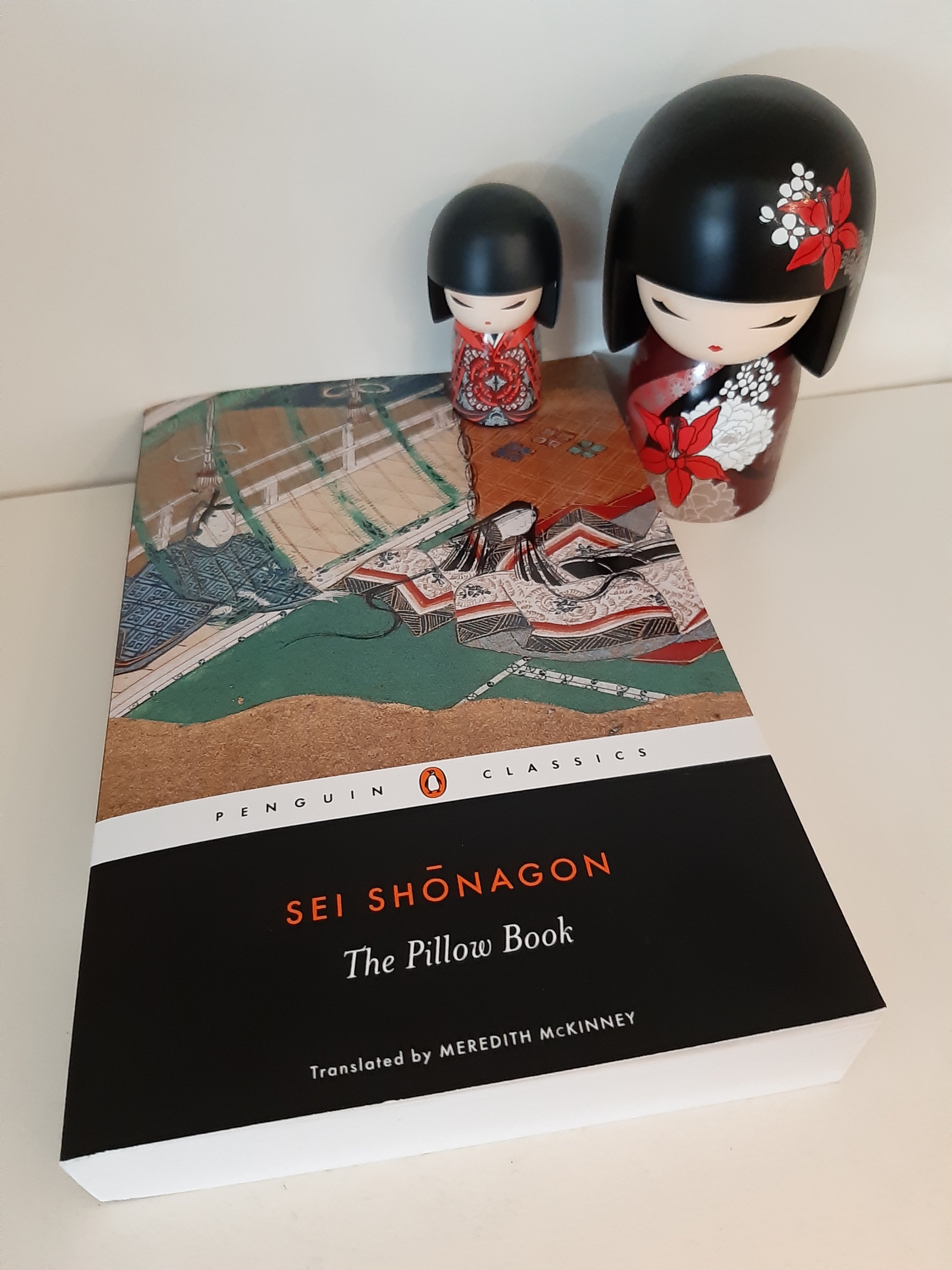
1/ I’ve been reading The Pillow Book by Sei Shonagon (translated by Meredith McKinney), which I think would be a great companion piece to The Tale of Genji
Image
I should briefly write about the cultural context: this is the Heian period (794-1185), one of the richest periods of Japanese culture. Japan was heavily influenced by Chinese culture, but it was during the Heian period that the Japanese were starting to shake off the influence and create their own styles and aesthetics. 
At this time, men were writing in kanji (Chinese characters) whereas women were not allowed to learn it and Chinese classics, and instead, were writing in Japanese script kana (though it should be noted that both Murasaki Shikibu and Sei Shonagon knew Chinese, but had to conceal it). In addition, men wrote poetry and some forms of prose (such as history, diary...) but not fiction, as fiction (tales) was looked down on and became a female form. 
Ironically over time, it was largely women who developed a uniquely Japanese writing method and had a central role in the emergence of Japanese vernacular literature. Many of the greatest and most important works from this era were written by women, most notably The Tale of Genji and The Pillow Book. Both of them also became historical documents, depicting life at Heian court—customs, habits, festivals, values, and so on.
Sei Shonagon and Murasaki Shikibu were not only contemporary but also knew about each other—the former was serving Empress Teishi (who gradually lost backing as her father died and her brothers got disgraced and exiled), and the latter entered court to serve Empress Shoshi (who was gaining standing as she got the unprecedented appointment as a concurrent Empress to the same Emperor). It’s possible that Murasaki Shikibu was sent to court to be rival to Sei Shonagon. 

2/ I don’t think it’s possible to compare The Tale of Genji and The Pillow Book, as they’re different forms—the former is a psychological novel or a long tale, and the latter is a literary genre called zuihitsu, a form consisting of loosely connected personal essays and fragmented ideas. The writings in The Pillow Book can be divided into 3 types: narratives (events and incidents she experienced at court, or fictional scenes like part of a romantic tale), thoughts on various subjects, and lists (such as “dispiriting things”, “infuriating things”, “things that make your heart beat fast”, etc).
But we can compare the authors. 
The Tale of Genji, as I have written before, captures the intellectual and moral climate of the Japanese court in the Heian period, but if you read The Pillow Book right afterwards, you realise that it’s not any more Japan than War and Peace is Russia (by which I mean, War and Peace is not Russia but Tolstoy’s Russia). 
In some ways, the 2 authors are similar—both are ladies-in-waiting, or gentlewomen; both are highly intelligent, observant, and knowledgeable; both know Chinese but have to conceal it; both love nature and culture; both are part of a culture of refinement and elegance. But they are very different, with different temperaments. It’s a different perspective—The Pillow Book shows the court through the eyes of a gentlewoman (The Tale of Genji has an omniscient narrator and some interesting gentlewomen but largely focuses on the nobility), and Sei Shonagon’s view of the world is different.
“Japanese critics have often distinguished the aware of Genji monogatari and the okashi of Makura no sōshi. Aware means sensitivity to the tragic implications of a moment or gesture, okashi the comic overtones of perhaps the same moment or gesture. The lover’s departure at dawn evoked many wistful passages in Genji monogatari, but in Makura no sōshi Sei Shōnagon noted with unsparing exactness the lover’s fumbling, ineffectual leave-taking and his lady’s irritation. Murasaki Shikibu’s aware can be traced through later literature—sensitivity always marked the writings of any author in the aristocratic tradition—but Sei Shōnagon’s wit belonged to the Heian court alone.” (source
Murasaki Shikibu is introspective, sensitive, and deeply aware of the fragility and uncertainty of everything, and even though she’s also funny and there are some comic scenes in The Tale of Genji, the overall tone is melancholic and darker towards the end. Sei Shonagon, in contrast, is witty, hilarious, possibly extroverted, sometimes arrogant, snobbish, even mean, and she often sees the amusing or absurd side of things. My impression from The Pillow Book is that she has a strong personality, laughs a lot, and can be confrontational and intimidating. 
I’ve just read about the solemn exorcist monks, or the wistful partings in The Tale of Genji, then I’ve got to The Pillow Book—everything appears absurd. 

3/ Sei Shonagon isn’t interested in soul-searching. The Pillow Book is basically about her personal likes and dislikes, her opinions on things, and the things she finds delightful about the world in which she lives. It’s not only a valuable historical document but also interesting for itself—the reason The Pillow Book is still read and still enjoyable is that the author has a strong personality and appears very vivid, very real on the page. She is fascinating. 
In the introduction, Meredith McKinney discusses different speculations about Sei Shonagon’s intentions for writing The Pillow Book. It may be personal, but there’s an awareness and acknowledgement of an audience, and the book seems like an equivalent of the modern day’s blog. The lists may be her personal views, but they may also be a catalogue of shared tastes and opinions. But whatever the intentions are, Sei Shonagon comes to epitomise the sensibility of Teishi’s court.   
Like The Tale of Genji, part of the charm of The Pillow Book is the alien, sometimes strange environment and culture depicted, and part of it is that you recognise the things she’s talking about, and go “yes! I can relate”. She speaks directly to me from 1000 years ago. The culture, customs, and social norms may be different, but human beings haven’t changed at all. 

4/ I once saw someone complain about the lack of political intrigue in The Pillow Book. Indeed, the translator Meredith McKinney provides the background, and lots of things were happening when Sei Shonagon was at court—Empress Teishi’s position became insecure as her father died, power went to his brother/rival, then her brothers became exiled, and the rival established his daughter Shoshi as an Empress. These things only get a brief mention, if at all, in The Pillow Book, and don’t get discussed in detail. 
I too would be curious about her thoughts, but this condescending complaint seems to me quite ignorant. One must remember that Sei Shonagon’s writing non-fiction, about real people and real events, so she cannot go far as far as Murasaki Shikibu can in The Tale of Genji—Murasaki also moves the settings of her novel to the 10th century, probably so that others don’t think she’s writing about current conflicts at court. Sei Shonagon’s also not part of the nobility—she’s at court to serve an Empress and can be kicked out or punished any moment if she offends someone of high rank. Even though she means to write for herself, other people are aware of her writings.

5/ Compared to Murasaki Shikibu (and some other writers I love), Sei Shonagon is very worldly, entertainingly so. She’s interested in things, scenes, and people. She writes anecdotes and character sketches, and describes events at court. That’s part of the appeal. 
She’s also not very religious, compared to Murasaki Shikibu. As written above, exorcist monks, so solemn and holy in The Tale of Genji, are portrayed in The Pillow Book as amusingly ineffectual, exhausted, drowsy, and desperate not to become laughingstocks. Or, she may describe her pilgrimage to the temple at Kiyomizu and start off writing about the reverence, but she soon gets distracted. 
“If it’s at New Year, though, the place is simply an uproar of noisy activity. You have no hope of pursuing your own practice, you’re too busy watching the endless melee of people to the temple to offer up prayers for this and that.” (entry 115) 
And then: 
“You always wonder who it is if you don’t recognize them, and it’s fun to try to identify the ones you think you do recognize.” (ibid.)  
She’s too interested in people. 
But then, why should I be surprised? After all, early on in the book, she says that preachers should be good-looking because, if we are to absorb what he’s saying, we must keep our eyes on him as he speaks. 
Personally I’m not religious, and I may dislike certain things about organised religion. But I do love the supernatural elements in The Tale of Genji, especially the spirit of the Rokujo Haven, which is strange and one of the finest creations I’ve encountered in literature. As Royall Tyler has noted in his book of essays about the novel, the way the Rokujo Haven isn’t aware of any hostility towards Aoi but her jealousy and bitterness takes the form of a spirit to attack Aoi savagely shows Murasaki Shikibu’s awareness of a gap between conscious and unconscious feelings. That is brilliant. 

6/ The greatness of The Tale of Genji is more obvious to see, and easier to talk about—we can talk about the great scope, characterisation and psychological insights, techniques, style, beauty, descriptions, structure, themes, ideas, moral vision, and so on. 
It is harder to talk about the brilliance of The Pillow Book. In a way, Sei Shonagon does appear superficial because of her interest in things and scenes (and some of her narratives may count as gossip about people at court), and sometimes she does sound conceited, as Murasaki Shikibu remarks in her diary. But she’s very clever, quick-witted, and extremely funny, and she can convey well the various scenes and life in general at court—the Heian court appears vivid, intimate, and full of life under her pen. She’s also sensitive to beauty. 
Mostly the charm of the book is the author herself, and I can’t help feeling drawn to her. Sure, she often sounds mean and definitely snobbish, but I relate to her because she apparently has a short temper and tends to be confrontational. As she describes in the book, a few times a close male friend and she may have some argument over something minor and she gets a bit confrontational, but she doesn’t really bother and the friendship ends. She is flamboyantly alive on the pages, we see her flaws, but she still appears charming but I can’t help feeling drawn to her. 
A simplistic way of explaining the different ways I feel about the authors is that Murasaki Shikibu is a genius I put on a pedestal, and I see Sei Shonagon as a friend. 
This shouldn’t be taken lightly—is it not remarkable that I feel a connection with a woman living in Japan over a millennium ago?

Here is a thread of things I find fascinating in The Pillow Book (still to be updated). 

Update on 29/7: see my follow-up blog post about The Pillow Booka more sober view.