After writing about fishes and their social relationships, Jonathan Balcombe devotes Part VI to fishes’ sexual behaviours and parenting styles.
The chapter about fishes’ sex lives is, again, full of fascinating facts: promiscuous fishes (Balcombe’s word), polygamous fishes, monogamous fishes, fish harems, fishes that produce eggs and sperm at the same time (simultaneous hermaphrodites), fishes that change sex (sequential hermaphrodites, such as the clownfish of Finding Nemo), courtship, mating, oral sex and sperm drinking (yeah, you read that right), faking orgasms (you didn’t read that wrong either), external fertilisation, and so on.
The chapter about parenting is also interesting, talking about protecting eggs and taking care of the young, helpers, and freeloaders (brood parasitism—a fish leaving its eggs with other fishes’ eggs to be protected and raised, like some birds do).
Then we get to Part VII: “Fish out of Water”. That’s when I felt the book was starting to have a different tone. Or did I imagine it? Balcombe discusses fishing, bycatch (the fishes caught that are not wanted and thrown back into the sea), fish-farming, problems of hatchery-reared fishes that are released into the wild, different killing methods, different ways a fish may die when caught, shark finning, recreational fishing, and the practice of eating fish.
As he talked about cruelty, fishes’ suffering, and moral concerns (the word “moral” gets repeated a lot in this section of the book), I started to realise that the whole point of the book was not only to tell people more about fishes and make them realise that fishes are smart and have individuality, but to get people to stop eating fish.
Do I feel bad? In a way, yes. But would I stop eating fish? No. I eat meat and fish (and dairy and vegetables and so on).
I’m not going to debate the subject of meat eating vs vegetarianism/ veganism—it’s not the point of this blog post. Vegetarianism/ veganism is a legitimate cause, if you do it for animal rights and the environment, and if you can commit to it, that’s good for you. It’s the preaching that is annoying. Perhaps my perception of the final part of the book and its epilogue is coloured by my experience with many vegetarians and vegans in real life and on social media, though I think that the book borders on preaching and trying to make you feel bad for eating meat and taking part in the cruel and inhumane treatment of fishes. People have different causes, just as they have different interests. With interests, we also have priorities and can’t get to know everything in depth, even things we do enjoy, because life is short—a friend of mine, for example, enjoys jazz but has to “neglect” it because he spends time on classical music and opera, whereas my decision to listen to John Coltrane properly at the moment means that I don’t have time for other kinds of music.
It’s similar with causes. Some people do everything they can to limit their negative impact on the environment, that’s good. Some people fight for animal rights, that’s good. I come from a single-party state which doesn’t respect freedom or human rights, where people don’t have the most basic rights that Westerners take for granted, such as the right to vote for leaders or the right to remain silent. Dissidents get years in prison, people get killed whilst in custody… It’s hard to really care about animal rights. My main focus is on free speech, freedom, equality, and human rights. I care enough about animal rights to be against trophy hunting, hunting and killing endangered species, cruel treatment of animals in tourism, and that sort of thing, but not enough to be ready for the difficult commitment to a vegetarian or vegan diet.
I can’t imagine a Vietnamese vegan either. A vegetarian, yes, but not a vegan. Compared to Westerners, we eat more kinds of animals, and also eat more of an animal—for example, with chicken, Westerners only eat the meat, we also eat the skin and feet, and make bone broth. Everything we eat has animal products—we have fish sauce, shrimp paste, and lots of other sauces and other kinds of food. Replace all ingredients with plant-based products, you don’t really have a Vietnamese dish. A vegan fresh spring roll isn’t a fresh spring roll.
Having left my country, I only have the language, and the food. To become a vegetarian, or further (because, as vegans say, “it’s not enough to be a vegetarian, veganism is the way”) requires sacrifice, commitment, and a strong belief in the cause, all of which I lack.
Anyway, this is getting more personal, so let’s go back What a Fish Knows. It is a very interesting book, but it’s tiresome in the final part. I suppose that says more about me than about the book itself.
Showing posts with label nghien cuu. Show all posts
Showing posts with label nghien cuu. Show all posts
Thursday, 22 August 2019


Friday, 16 August 2019
Fishes and social contracts
In Part V of What a Fish Knows, Jonathan Balcombe writes about fishes in a community—with company/tank mates or in a shoal or school of fishes. You now may ask, do fishes recognise each other? They do. Fishes may have patterns that are only visible in UV light. Balcombe says, fishes have individual recognition, memory, and preference about whom they choose to swim with; they also have personalities. Do they recognise human faces? People who have pet fishes say yes.
Yesterday I made a video about fish watching, using my footage of The Deep (aquarium in Hull). Watch who swims with whom.
Now, to get back to the book, the most fascinating section of Part V is when Balcombe writes about social contracts among fishes—consider the cleaner-client symbiosis of fishes.
The relationship between a cleanerfish and their client is also not random.
Now, just as in the business world of human beings, there can be conflicts, cheats, and frauds, there are equivalents in the fish world.
The conflict between cleaners and clients is because cleaners most like to glean from the mucus, which has more nutritional value and might taste better than algae and parasites, and clients wouldn’t like this.
The cleaner-client symbiosis, in many ways, mirror business relationships in the human world. For example, if we read reviews before watching a film or ordering a product online, prospective client fishes “watch the performances of cleaners before deciding whether to let a particular cleaner inspect them”, mucus-nipping cleaners are shunned, and cleaners do a better job when they are being watched.
This social system is highly complex and “encompasses long-term relationships built on trust, crime and punishment, choosiness, audience awareness, reputation, and brownnosing.”
Guess what, there are also con artists in the fish world—fishes that pretend to be cleanerfishes, and when the client least expects it, the impostor takes a bite of fin and dashes for cover.
I can no longer look at fishes the same way again.
Yesterday I made a video about fish watching, using my footage of The Deep (aquarium in Hull). Watch who swims with whom.
Now, to get back to the book, the most fascinating section of Part V is when Balcombe writes about social contracts among fishes—consider the cleaner-client symbiosis of fishes.
“The system works as follows. 1 or 2 cleanerfishes signal that they are open for business. They work at specific locations, and may use swimming postures and bright colours to enhance the signal’s visibility (a fish’s version of the rotating red-white-blue cylinder outside a barbershop). Other fishes of various types congregate at the cleaning station, where they wait their turn to be serviced by the cleaners. […] [Cleaners] pick over the clients’ bodies, removing parasites, dead skin, algae, and other undesirable blemishes. Clients benefit by receiving a spa treatment, including parasite removal. Cleaners get fed.”So which species are they?
“Marine cleanerfishes include many wrasses, some triggerfishes, butterflyfishes, discus fishes, damselfishes, angelfishes, gobies, leatherjackets, pipefishes, sea chubs, surfperches, suckerfishes, jacks, and topsmelts. Freshwater cleanerfishes include cichlids, guppies, carps, sunfishes, killifishes, and sticklebacks. Some invertebrates, including several shrimps, also provide cleaning services. Client lists number well over 100 known fish species, including sharks and rays. Other clients include lobsters, sea turtles, sea snakes, octopuses, marine iguanas, whales, hippopotamuses, and humans.”Regarding humans, in Asian (I think Chinese) spas, people can dangle their feet in pool for cleanerfishes to pluck over.
“This is a dramatic scene if the client is a large predator. Although a shark or a moral eel could easily snap up the cleaner for a quick snack; it just isn’t savvy to eat your service provider.Isn’t that so interesting?
But it is kosher to show consideration toward them. […]
Grey reef sharks invite cleaners to service them by angling their bodies upward and opening their mouths wide. The cleaners show no fear as they enter the shark’s deadly cavern. They seem to know that this massive predator, hundreds of times their size, means them no harm.”
The relationship between a cleanerfish and their client is also not random.
“It is built on trust, and cultivated over weeks or months. A social contract such as this requires that individual cleaners recognise their clients. With dozens of clients per cleaner, cleanerfishes maintain an impressive mental database of clientele. In choice experiments where a cleaner could choose to swim near 1 of 2 clients, the cleaner spent more time near a familiar one. […]These fishes can use memory along 3 dimensions—who, when, and what. They demonstrate episodic memory.
In addition to remembering whom they cleaned, cleaner wrasses can also remember when they cleaned them. They are more likely to give precedence, say, to a particular triggerfish client who missed their last appointment, because that client will probably have greater parasite buildup.”
“If a fish can track past events, might she also be able to predict future ones? […] Roving cleaners are more cooperative with their clients near the centre of their home ranges, where they are more likely to reencounter client fishes. They do less mucus nipping and cause fewer ‘jolts’ in their clients during cleaning interactions.”This is like our behaviour—human beings are more cooperative with a partner when we’re likely to interact with them again. Doesn’t this make you look at fishes in a different way?
Now, just as in the business world of human beings, there can be conflicts, cheats, and frauds, there are equivalents in the fish world.
The conflict between cleaners and clients is because cleaners most like to glean from the mucus, which has more nutritional value and might taste better than algae and parasites, and clients wouldn’t like this.
“A jolt happens when a client flinches as a cleaner nips at the protective mucus layer that surrounds a fish’s body.”Consequently, cleaners give clients some tactile stimulation.
“They do this by facing away from the client and stroking them with rapid movements of their pelvic and pectoral fins. This caressing behaviour seems to be done for 2 reasons: (1) to encourage a client to stay longer at the cleaning station, and (2) to mollify a client following a jolt. Cleaners are more likely to caress a predaceous client, probably because it lowers the risk of an aggressive chase from a potentially dangerous customer.”I don’t know, that sounds like a massage to me.
The cleaner-client symbiosis, in many ways, mirror business relationships in the human world. For example, if we read reviews before watching a film or ordering a product online, prospective client fishes “watch the performances of cleaners before deciding whether to let a particular cleaner inspect them”, mucus-nipping cleaners are shunned, and cleaners do a better job when they are being watched.
“If a new client, who has no history with the cleaner, is cheated, he or she simply swims away. But a resident client who has built up a relationship of trust with the cleaner behaves as if having been insulted: he chases the cleaner around.”Cheats get punished.
This social system is highly complex and “encompasses long-term relationships built on trust, crime and punishment, choosiness, audience awareness, reputation, and brownnosing.”
Guess what, there are also con artists in the fish world—fishes that pretend to be cleanerfishes, and when the client least expects it, the impostor takes a bite of fin and dashes for cover.
I can no longer look at fishes the same way again.
Thursday, 15 August 2019
What does a fish know?
After discussing fish feelings, Jonathan Balcombe moves onto fish cognition: What are fishes’ mental abilities?

Or:
They’re smarter than we think.
He also talks about tigerfishes catching and eating birds, which means that they must know about the distortion of image over water surface and how to calculate to make a leap from the right angle and with the right speed so they can ambush the bird—planning instead of making random leaps and snaps at the air.
I’m disappointed he doesn’t mention the bird-eating fishes in David Attenborough’s documentary.
At the end of Part IV in What a Fish Knows, Balcombe talks about the plurality and contextuality of intelligence, and our “wobbly criteria for gauging intelligence”. There are, instead, “multiple intelligences”, manifesting in different sets of skills and abilities. If something is critical for a species’ survival, it would be good at it.
“Here’s an example of fish intelligence, courtesy of the frillfin goby, a small fish of intertidal zones of both eastern and western Atlantic shores. When the tide goes out, frillfins like to stay near shores, nestled in warm, isolated tide pools where they may find lots of tasty tidbits. But tide pools are not always safe havens from danger. Predators such as octopuses or herons may come foraging, and it pays to make a hasty exit. But where is a little fish to go? Frillfin gobies deploy an improbable manoeuver: they leap to a neighbouring pond.This, Balcombe says, is an example of cognitive mapping.
How do they do it without ending up on the rocks, doomed to die in the sun?
With prominent eyes, slightly puffy cheeks looking down on a pouting mouth, a rounded tail, and tan-grey-brown blotchy markings along a 3-inch, torpedo-shaped body: the frillfin goby hardly looks like a candidate for the Animal Einstein Olympics. But its brain is an overachiever by any standard. For the little frillfin memorises the topography of the intertidal zone—fixing in its mind the layout of depressions that will form future pools in the rocks at low tide—while swimming over them at high tide!” (Part IV)
Or:
“… But can fishes spontaneously invent tool use, as we can when unexpected conditions require us to improvise? In May 2014, a study highlighted an example of innovative tool use by Atlantic cods being held in captivity for aquaculture research. Each fish wore a coloured plastic tag affixed to the back near the dorsal fin, which allowed the researchers to identify them individually. The holding tank had a self-feeder activated by a string with a loop at the end, and the fishes soon learned that they could release a morsel of food by swimming up to the loop, grabbing it in their mouth, and pulling on it.In these chapters, Balcombe talks about lots of studies regarding fishes’ cognition skills. These studies demonstrate that fishes, or at least the fishes used in the experiments, can create mental maps, remember escape routes, have good memory, be trained to perform tricks, learn from experience, innovate to solve a problem, use tools (for example, smash open a clam against a rock), learn from observing other fishes (observational learning skills), and so on.
Apparently by accident, some of the cods discovered that they could activate the feeder by hooking the loop onto their tag and then swimming a short distance away. These clever cods honed their technique through hundreds of ‘tests’—and it became a finely tuned series of goal-directed, coordinated movements. It also demonstrated true refinement, because the innovators were able to grab the pellet a fraction of a second faster than by using their mouth to get the food. That fishes are routinely expected to interact with a foreign device to feed themselves is impressive enough, but that some devised a new way of using their tags shows a fish’s capacity for flexibility and originality.”
They’re smarter than we think.
He also talks about tigerfishes catching and eating birds, which means that they must know about the distortion of image over water surface and how to calculate to make a leap from the right angle and with the right speed so they can ambush the bird—planning instead of making random leaps and snaps at the air.
I’m disappointed he doesn’t mention the bird-eating fishes in David Attenborough’s documentary.
At the end of Part IV in What a Fish Knows, Balcombe talks about the plurality and contextuality of intelligence, and our “wobbly criteria for gauging intelligence”. There are, instead, “multiple intelligences”, manifesting in different sets of skills and abilities. If something is critical for a species’ survival, it would be good at it.
Wednesday, 14 August 2019
Fish videos: hunting, being hunted
As I read Jonathan Balcombe’s What a Fish Knows, I find it useful to have my phone next to me, to google images of the fish species he’s talking about. Sometimes I search for videos.
Watch this video I found:
This is one of the best nature sequences I’ve ever seen. The thrill! For some seconds at the beginning, I thought that flying fishes were magical, and then…
Man, if you think your life is tough, think about flying fishes.
Now let’s watch another video.
You know birds eat fishes, but did you know some fishes eat birds?
Here’s the story of the filming if anyone’s interested: https://www.gq-magazine.co.uk/article/blue-planet-2-fish-eating-birds
This is crazy.
_____________________________________________
The other day I saw a David Attenborough documentary called Creatures of the Deep. Fantastic stuff. There’s footage of a Humboldt squid hunting, which is awesome because of its massive size and its speed, but I can’t find the sequence on youtube.
However, the footage of jellyfishes and a fried egg jellyfish is here:
(I know jellyfishes are not fishes. But the video is cool, no?).
The fried egg jellyfish is massive. And it looks just like a fried egg.
Tuesday, 13 August 2019
What can a fish feel?
Jonathan Balcombe writes about the debate over whether fishes can feel pain. One of the main points of What a Fish Knows is that, yes, fishes can feel pain and can suffer—as a vegetarian, he notes that human beings don’t treat fishes very nicely, and he doesn’t understand why some people don’t eat meat but eat fish. He aims to write a book on behalf of fishes.
However, Balcombe doesn’t write in an emotional, sentimental kind of way, but bases the book on scientific facts, research, and studies, and now and then sprinkles the narrative with some anecdotes.
The fact that a fish doesn’t have a neocortex doesn’t mean that it doesn’t have consciousness and therefore doesn’t feel pain. Look at birds, the bird-brain myth has long been debunked—they can use tools, remember for months locations of thousands of buried objects, recognise a neighbour’s voice, categorise objects, and so on.
Balcombe says:
Whether fishes feel pain is a question of cardinal importance, because it forces us to question the practice of catching and eating fishes, even if it doesn’t change our eating habits.
Reading Jonathan Balcombe’s book, I myself am more interested in whether fishes can experience other kinds of feelings. He argues that they can, and do.
For example, they can feel pleasure—the pleasure of touch.
He goes on:
I will not write more details, because I think you should read Jonathan Balcombe’s book. It is a good book, an enjoyable read full of fascinating facts.
But it’s interesting to talk about fishes being playful and feeling joy. Fishes don’t get much sympathy probably because they don’t have facial expressions and make sounds in the way that mammals do, and they seem boring—as a pet, there isn’t much you can do with a fish, like with a dog or a cat. But they can enjoy play.
Gordon M. Burghardt, an ethologist at the University of Tennessee, studies fish play, and defines play as follows:
That is play.
Fishes can have object play, social play (even interspecies social play), and solitary play.
Another example could be fishes jumping and leaping. Why do they jump? We don’t know.
Balcombe says:
Doesn’t that look fun?
Fishes are awesome.
However, Balcombe doesn’t write in an emotional, sentimental kind of way, but bases the book on scientific facts, research, and studies, and now and then sprinkles the narrative with some anecdotes.
The fact that a fish doesn’t have a neocortex doesn’t mean that it doesn’t have consciousness and therefore doesn’t feel pain. Look at birds, the bird-brain myth has long been debunked—they can use tools, remember for months locations of thousands of buried objects, recognise a neighbour’s voice, categorise objects, and so on.
Balcombe says:
“If any animal without a neocortex is nevertheless conscious, it disproves the notion that a neocortex is required for consciousness. As such, it is no basis for a claim that fishes are unconscious. ‘There are many ways to get to a complex awareness’, says the neuroscientist Lori Marino of Emory University. ‘To suggest that fishes cannot feel pain because they don’t have sufficient neuroanatomy is like arguing that balloons cannot fly because they don’t have wings.’He then spends the next few pages writing about the scientific experiments on trouts and zebrafishes. Fishes’ responses to pain are not mere reflexes. The experiments provide evidence that a fish can “feel both initial, sharp pain and the lasting pain that follows”, responds to different kinds and levels of pain in different ways, in pain may be “distracted” and unable to perform normal survival behaviours, can improve with painkillers (“Morphine belongs to a family of drugs called opioids, and fishes are known to have an opioid-responsive system”), can withstand higher temperature with morphine before reacting to it, and is willing to pay a cost for pain relief.
Or that humans cannot swim because they don’t have fins.” (Part III)
Whether fishes feel pain is a question of cardinal importance, because it forces us to question the practice of catching and eating fishes, even if it doesn’t change our eating habits.
Reading Jonathan Balcombe’s book, I myself am more interested in whether fishes can experience other kinds of feelings. He argues that they can, and do.
For example, they can feel pleasure—the pleasure of touch.
“Fishes often touch one another in pleasurable contexts. Many court with rubbing or gentle nips. Cleanerfishes curry favour with their valued clients by caressing them with their fins as a means to strengthen the cleaner-client relationship. Moral eels and groupers approach familiar divers and receive strokes and chin rubs.” (Part II)Sharks, rays, and skates also “show pleasurable responses to touch”. Balcombe mentions the story of manta rays that enjoy bubble massages (the diver “swims beneath them and bellows bubbles from her SCUBA regulator”). There’s also a similar story with zebra sharks.
He goes on:
“Besides touch, there are many other ways that fishes may derive pleasure. Food, play, and sex spring to mind. And then there’s comfort for its own sake. Southern bluefin tunas in the waters of Australia spend hours rolling on their sides, catching the sun’s rays. It’s not known for sure why they do this. 1 possibility is that they are sunbathing to raise their body temperature, which in turn helps them swim and react faster, making them more efficient hunters. I expect the warmth of the sun also feels good to a tuna, for pleasure evolved to reward useful behaviours.” (ibid.)According to What a Fish Knows, fishes can feel pain, fear, and stress, and they may seek relief. They have social lives and can feel compassion. They can have curiosity. They can also feel joy, and enjoy play.
I will not write more details, because I think you should read Jonathan Balcombe’s book. It is a good book, an enjoyable read full of fascinating facts.
But it’s interesting to talk about fishes being playful and feeling joy. Fishes don’t get much sympathy probably because they don’t have facial expressions and make sounds in the way that mammals do, and they seem boring—as a pet, there isn’t much you can do with a fish, like with a dog or a cat. But they can enjoy play.
Gordon M. Burghardt, an ethologist at the University of Tennessee, studies fish play, and defines play as follows:
“1. It does not achieve any clear survival purpose, such as mating, feeding, or fighting;An example is fishes riding air bubbles. I’ve found this video:
2. it is voluntary, spontaneous, or rewarding;
3. it differs from typical functional behaviours (sexual, territorial, predatory, defensive, foraging) in form, target, or timing;
4. it is repeated but not neurotic; and
5. it takes place only in the absence of stressors, such as hunger, disease, crowding, or predation.” (Part III)
That is play.
Fishes can have object play, social play (even interspecies social play), and solitary play.
Another example could be fishes jumping and leaping. Why do they jump? We don’t know.
Balcombe says:
“Mobula rays aren’t motivated by fear when they hurl their large bodies (up to a 17-foot wingspan and a ton in weight) skyward in leaps of up to 10 feet before splashing down with a loud slap. […] They do it in schools of hundreds. Most of their leaps are calculated to land them on their bellies, but sometimes they do a forward somersault, landing on their backs. Males seem to be the initiators, so some speculate that there might be a courtship role. Other scientists think it might be a parasite removal strategy. Whatever its function, I posit that the rays are enjoying themselves.”Here’s a video of mobula rays leaping:
Doesn’t that look fun?
Fishes are awesome.
Sunday, 11 August 2019
How does a fish perceive the world?
I’m reading What a Fish Knows: The Inner Lives of Our Underwater Cousins by Jonathan Balcombe. Why? Since you ask, I want to learn about fishes.
This is a fascinating book.
The book is also full of weird facts, such as this:
Here’s a photo:

I hope Balcombe writes about rays, which have eyes on the upper side of their bodies and mouths on the other side.
Now check this out:


Such fascinating facts.
I’ve been enjoying this book also because I’m interested in how fishes perceive the world. Balcombe’s intention in writing the book, it seems, is to debunk myths, and to help people realise that fishes (he prefers this to “fish”) are a lot more complex, knowing, and interesting than we realise—they are sentient beings, with personalities and feelings.
He writes about their sense and perceptions. Most fishes can see more colours than we do—they can see light in the near UV spectrum. Fishes can hear, some can hear ultrasounds, much above human limit, whilst some others are responsive to infrasounds as low as 1 Hz.
Fishes can also create sounds:
Not only so, fishes fall for optical illusions like humans, which means that they perceive things and form mental concepts instead of perceiving visual fields in a mindless, mechanical way, like robots.
They also know more than we think they do—they can be trained, and as shown in a study, can distinguish between different music genres.
I’m afraid that after reading this book, I can’t eat fish again. I love salmon.
This is a fascinating book.
“What we casually refer to as ‘fish’ is in fact a collection of animals of fabulous diversity. According to FishBase—the largest and most often consulted online database on fishes—33249 species, in 564 families and 64 orders, had been described as of January 2016. That’s more than the combined total of all mammals, birds, reptiles, and amphibians. When we refer to ‘fish’ we are referring to 60% of all the known species on Earth with backbones.” (Part I)You can read this book to learn some basic facts about fishes. For example, almost all modern fishes are members of 1 of 2 major groups: bony fishes (salmons, herrings, basses, tunas, eels, flounders, goldfishes, carps, pikes, minnows...) and cartilaginous fishes (sharks, rays, skates, chimaeras…).
The book is also full of weird facts, such as this:
“On finding a female, males of some deep-sea anglerfish species latch their mouths onto her body and stay there for the remainder of their lives. It doesn’t matter much where they fix their bite on the female—it could be on her abdomen or her head—they eventually become fused to her. Many times smaller, the male resembles little more than a modified fin, living off her blood supply and fertilizing her intravenously. 1 female may end up with 3 or more males sprouting from her body like vestigial limbs.Or:
[…] It is estimated that female deep-sea anglerfishes occur at a density of about 1 per 800000 cubic meters (28 million cubic feet) of water, which means a male is searching for a football-size object in a darkened space about the volume of a football stadium. Thus, it is desperately hard for anglerfishes to find each other in the vast darkness of the abyss, making it wise to hang on to your partner if you find one.
[…] In exchange for the male being the ultimate couch potato, the female never has to wonder where her mate is on a Saturday evening. It turns out that some males do indeed amount to little more than an appendage.” (ibid.)
“Baby flounders look like any other normal fish, swimming upright with 1 eye on each side. Then, in preparation for adult life, they undergo a bizarre transformation: 1 eye migrates to the other side of the face. It’s like facial reconstructive surgery, only in slow motion, and without scalpels and sutures. It isn’t even always slow. The entire migration takes just 5 days if you’re a starry flounder, and less than 1 day in some species. If a fish can have an awkward adolescence, this one qualifies.” (Part II)What?
Here’s a photo:
I hope Balcombe writes about rays, which have eyes on the upper side of their bodies and mouths on the other side.
Now check this out:
“Flashlight fishes—one of the few bioluminescent fishes generally not found in deep waters—take a more direct approach to illumination, using a multifunctional light consisting of a semi-circular organ just below each eye. This pair of organs contains luminescent bacteria whose continuously emitted light can be turned on and off by the fish using a muscular lid. […] Mated pairs of flashlight fishes maintain territories over a reef, and if an intruding flashlight fish approaches, the female of the pair will swim up and flash her light literally in the interloper’s face, as if to say ‘Get lost!’.” (ibid.)That’s cool. Here are some photos:
Such fascinating facts.
I’ve been enjoying this book also because I’m interested in how fishes perceive the world. Balcombe’s intention in writing the book, it seems, is to debunk myths, and to help people realise that fishes (he prefers this to “fish”) are a lot more complex, knowing, and interesting than we realise—they are sentient beings, with personalities and feelings.
He writes about their sense and perceptions. Most fishes can see more colours than we do—they can see light in the near UV spectrum. Fishes can hear, some can hear ultrasounds, much above human limit, whilst some others are responsive to infrasounds as low as 1 Hz.
Fishes can also create sounds:
“Despite the common assumption that fishes are silent, they actually have more ways of producing sounds than any other group of vertebrate animals. None of these methods involve the main method of all the other vertebrates: the vibration of air against membranes. Fishes can rapidly contract a pair of vocal muscles to vibrate their swim bladder, which also serves as a sound amplifier. They have the options of grating their teeth in their jaws, grinding additional sets of teeth lining their throat, rubbing bones together, stridulating their gill covers, and even—as we’ll see—expelling bubbles from their anuses.” (ibid.)The descriptors human beings have assigned to fishes’ symphony of sounds are: “hums, whistles, thumps, stridulations, creaks, grunts, pops, croaks, pulses, drums, knocks, purrs, brrrs, clicks, moans, chirps, buzzes, growls, and snaps.” (ibid.)
Not only so, fishes fall for optical illusions like humans, which means that they perceive things and form mental concepts instead of perceiving visual fields in a mindless, mechanical way, like robots.
They also know more than we think they do—they can be trained, and as shown in a study, can distinguish between different music genres.
I’m afraid that after reading this book, I can’t eat fish again. I love salmon.
Saturday, 9 March 2019
On finishing The Soul of an Octopus
Bill, 1 of the people working at the aquarium, makes the decision of switching tanks for Octavia and Karma.
(Source)
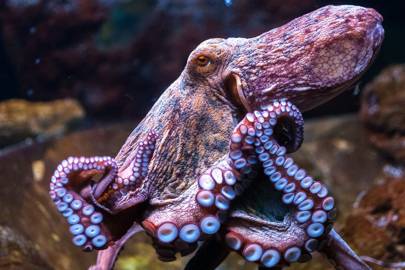
I have now finished reading The Soul of an Octopus. It’s such a wonderful book. I’ve just read about an encounter with a stump-armed female octopus in the ocean, followed by a visit with Octavia the octopus in the aquarium in her old age, in chapter 8 “Consciousness”.
The Soul of an Octopus is full of interesting facts and descriptions, but it is so captivating and affecting because everything is observed and described with such awe and wonder, such joy and gratitude, and such compassion, that I too am full of curiosity about octopuses and the ocean, and can no longer look at them the same way. In a sense, I feel changed as a person. Once in a while, you pick up a book, expecting nothing, then you’re surprised to find yourself changed because of it. Your perspective’s expanded, your thinking’s shifted.
Sy Montgomery learns, and wishes us to learn, about octopuses—creatures that are so alien and so different from us in everything. We don’t just read about what octopuses are like, she also makes us wonder what it’s like to be an octopus. Their experience of the world is completely different. At the same time, she doesn’t treat them like subjects of study, but like beings, with feelings—she treats them with respect, sensitivity, and tenderness, and seeks to understand them and have a connection with them.
With octopuses, Montgomery could do something Melville/Ishmael couldn’t do with whales—develop a connection, or even friendship, with them.
It’s interesting that I’m writing my dissertation about love and human contact (and motif of touch) in 3 Ingmar Bergman films, and now, The Soul of an Octopus has this passage:
Everyone should read this book.
“Bill had made the right choice. Though for many months, Octavia’s constant attentions to her eggs were rituals rich and full of meaning, at some point, her tending may have ceased to feel fulfilling. A wild octopus tending fertile eggs is surely rewarded, as are birds on the nest, by the signals that her eggs are alive, her embryos growing. Mother birds and their babies chirp and cheep to one another when the young are still in the egg; the mother octopus can see her babies developing inside the egg, starting with the dark eyes, and feel them moving. But Octavia had no such feedback. Perhaps the very sight of the eggs inspired her to try to protect them, the way a mother orangutan will continue to carry and even groom a dead infant, often for many days, and some dogs will refuse to leave the body of someone they love who has died. Perhaps, now that her eggs are no longer in view, Octavia at last was freed of duties she might have suspected were pointless but had felt compelled to perform. Perhaps now, at last, she could rest.”
(Source)
I have now finished reading The Soul of an Octopus. It’s such a wonderful book. I’ve just read about an encounter with a stump-armed female octopus in the ocean, followed by a visit with Octavia the octopus in the aquarium in her old age, in chapter 8 “Consciousness”.
The Soul of an Octopus is full of interesting facts and descriptions, but it is so captivating and affecting because everything is observed and described with such awe and wonder, such joy and gratitude, and such compassion, that I too am full of curiosity about octopuses and the ocean, and can no longer look at them the same way. In a sense, I feel changed as a person. Once in a while, you pick up a book, expecting nothing, then you’re surprised to find yourself changed because of it. Your perspective’s expanded, your thinking’s shifted.
Sy Montgomery learns, and wishes us to learn, about octopuses—creatures that are so alien and so different from us in everything. We don’t just read about what octopuses are like, she also makes us wonder what it’s like to be an octopus. Their experience of the world is completely different. At the same time, she doesn’t treat them like subjects of study, but like beings, with feelings—she treats them with respect, sensitivity, and tenderness, and seeks to understand them and have a connection with them.
With octopuses, Montgomery could do something Melville/Ishmael couldn’t do with whales—develop a connection, or even friendship, with them.
It’s interesting that I’m writing my dissertation about love and human contact (and motif of touch) in 3 Ingmar Bergman films, and now, The Soul of an Octopus has this passage:
“…We wished she had eaten, but we learned something new: Hunger was not the reason she had surfaced earlier, and it wasn’t what brought her now.That is so moving.
The reason she surfaced was abundantly clear. She had not interacted with us, or tasted our skin, or seen us above her tank for 10 full months. In less than 4 weeks, on a Saturday morning in May, Bill would find her, pale, thin, and still, dead at the bottom of her barrel. Yet, despite everything, we knew in that moment that Octavia had not only remembered us and recognized us; she had wanted to touch us again.”
Everyone should read this book.
Wednesday, 27 February 2019
Mother octopus
I’ve just read a very sad chapter in The Soul of an Octopus.
Female octopuses die a few months after laying their eggs—they spend all energy caring for and cleaning the eggs, and at some point, stop feeding, and slowly die.
At the aquarium that Sy Montgomery visits for The Soul of an Octopus, the octopus Octavia lays eggs, and starts dying.
The sad part is that her eggs are not fertile.
Female octopuses die a few months after laying their eggs—they spend all energy caring for and cleaning the eggs, and at some point, stop feeding, and slowly die.
At the aquarium that Sy Montgomery visits for The Soul of an Octopus, the octopus Octavia lays eggs, and starts dying.
“Octavia is puffed up, her skin not, as usual, creased or crinkled, thorny or warty, but smooth as a blown-up balloon.Octavia changes colour, and devotes all the time and energy to caring for the eggs. She loses interest in interaction with people at the aquarium. Nothing else matters but the eggs.
This looks decidedly wrong to me, like a giant tumor or an internal organ bloated with disease. My distress increases when I can’t see her gills, her funnel, or her eyes. She has turned her face to the wall, as a dog or cat often does when suffering.” (p.111, ch.4)
The sad part is that her eggs are not fertile.
“… we watch Octavia, our alien, invertebrate friend, caring for her infertile eggs at the end of her life with a tenacity and tenderness at once heartbreaking and glorious.” (p.118, ch.4)
“Though Octavia’s eggs will never hatch, it fills us with gratitude that Octavia tends them with diligence and grace. For when she dies, Octavia will do so in the act of loving as only a mature female octopus, at the end of her short, strange life, can love.” (p.119, ch.4)This is heartbreaking.
Monday, 25 February 2019
A difference between me and Sy Montgomery
Before going to the main point, I’d like to say that The Soul of an Octopus is a very good book. It is less about octopus facts than about the author’s personal accounts of her encounters with octopuses at New England Aquarium, written in lucid prose, full of feeling and tenderness. Now and then there’s a sense that there’s some exaggeration—like the over-enthusiasm of an octopus lover who glorifies everything about the creature, but the author has such an infectious curiosity and sense of wonder that you share the enthusiasm and want to know everything possible about octopuses and start seeing them in a different way.
Now, on chapter 4, I’ve started to see a significant difference between me and Sy Montgomery—it is the fact that I’m not an animal lover. By this, I don’t mean that I dislike animals; I love dogs and cats, and like other “safe” animals like hamsters or rabbits, and so on, and even with dogs, prefer puppies and small dogs; I’m not a fan of insects nor arthropods, and don’t come near wild, untamed animals, especially those with venom or massive strength.
Part of it is ignorance, indifference, and fear. I have always been a city person, who can’t tell the difference between crocodiles and alligators, between leopards and jaguars, between rabbits and bunnies and hares, between frogs and toads, you get the idea. I can’t tell which kinds of snakes are venomous either. To me it’s simple—stay away from snakes. My interests have always been in other things.
Part of it is that I think wild animals are wild animals. No matter how much you love them and care for them and understand them, they are still wild animals, driven by instinct, undomesticated, untamed, and unpredictable. Animal lovers usually say people are not much better, they may also kill you or ruin you in other ways, but at least people can communicate in language, and people know such things as law and concept of ethics. Animals follow instinct, they function and operate in their own ways, and don’t know anything about law or consequences. Wild animals are very different from us humans.
On page 70-71, chapter 3, Sy Montgomery writes about Marion Fish, who “demonstrated the positive power of interesting, gentle, loving interaction between keepers and the animals in their care” by directly handing anacondas, without head restraint. “[T]he snakes are healthier and happier for it”, she says.
That seems to work, I guess, but they are anacondas. What if 1 day they go crazy? What if they get irritated by something and take it out on a keeper? What would you do?
Now, in chapter 4, Montgomery describes an episode where several people are having an interaction with a young octopus named Kali, suddenly she (Kali) hoses and then, for no obvious reason, bites Anna, a volunteer.
It is an act of aggression. The bite isn’t serious, there is no venom, Anna feels fine afterwards. Montgomery says “Being bitten is an intimate interaction” and “a bite is proof of a kind of contact that—even when it goes wrong—at a time when most people are increasingly isolated from the natural world, we are privileged to experience.”
Nobody understands why the octopus bit Anna. Montgomery’s theory is that Anna is on medication and the doctor has just changed prescription, so Kali could taste the difference and got confused.
Even then that doesn’t change the fact that the octopus, unprovoked, bites someone it knows. If an octopus attacks again, you can never know, as you don’t know what they think. Montgomery may try to understand, and explain the behaviour, but it doesn’t change anything.
Wild animals are still wild animals. At the beginning of the book, when an aquarist introduces Montgomery to an octopus, he also tells her never to let an octopus near her face. He has worked there for years, and knows enough not to let an octopus near the face. It could pull out your eye.
Saturday, 23 February 2019
Octopuses and colour
I’m on a break, after finishing filming on Monday night 18/2.
Currently reading The Soul of an Octopus by Sy Montgomery.
There are lots of interesting facts and observations about octopuses in the book.
Take this passage from chapter 2:
Like Ishmael in Moby Dick, Sy Montgomery has such an immense curiosity and sense of wonder that you feel captivated and feel changed as a person as you read the book—you start to wonder, what is it like to be an octopus? do they have consciousness? do they think? how do they feel about us? how do they see the world? do they dream? why are they so smart?
Love this book.
Currently reading The Soul of an Octopus by Sy Montgomery.
There are lots of interesting facts and observations about octopuses in the book.
Take this passage from chapter 2:
“The ability of the octopuses and their kin to camouflage themselves is unmatched in both speed and diversity. Octopuses and their relatives put chameleons to shame. Most animals gifted with the ability to camouflage can assume only a tiny handful of fixed patterns. The cephalopods have a command of 30 to 50 different patterns per individual animal. They can change color, pattern, and texture in 7/10 of a second. On a Pacific coral reef, a research once counted an octopus changing 177 times in a single hour.Later in the same chapter:
[...] For its color palette, the octopus uses 3 layers of 3 different types of cells near the skin’s surface—all controlled in different ways. The deepest layer, containing the white leucophores, passively reflects background light. This process appears to involve no muscles or nerves. The middle layer contains the tiny iridophores, each 100 microns across. These also reflect light, including polarized right (which humans can’t see, but a number of octopuses’ predators, including birds, do). The iridophores create an array of glittering greens, blues, golds, and pinks. Some of these little organs seem to be passive, but other iridophores appear to be controlled by the nervous system. They are associated with the neurotransmitter acetylcholine, the 1st neurotransmitter to be identified in any animal. Acetylcholine helps with contraction of muscles; in humans, it is also important in memory, learning, and REM sleep. In octopuses, more of it “turns on” the greens and blues; less creates pinks and golds. The topmost layer of the octopus’s skin contains chromatophores, tiny sacks of yellow, red, brown, and black pigment, each in an elastic container that can be opened or closed to reveal more or less color. Camouflaging the eye alone—with a variety of patterns including a bar, a bandit’s mask, and a starburst pattern—can involve as many as 5 million chromatophores. Each chromatophore is regulated via an array of nerves and muscles, all under the octopus’s voluntary control.
To blend with its surroundings, or to confuse predators or prey, an octopus can produce spots, stripes, and blotches of color anywhere on its body except its suckers and the lining of its funnel and mantle openings. […] And of course the octopus can also voluntarily control its skin texture—raising and lowering fleshy projections called papillae—as well as change its overall shape and posture.”
“… the octopus eye and our own are strikingly similar. Both have lens-based focusing, with transparent corneas, irises that regulate light, and retinas in the back of the eye to convert light to neural signals that can be processed in the brain. Yet there are also differences. The octopus eye, unlike our own, can detect polarized light. It has no blind spot. (Our optic nerve attaches to the back of the eye at the retina, creating the blind spot. The octopus’s optic nerve circles around the outside of the retina). Our eyes are binocular, directed forward for seeing what’s ahead of us, our usual direction of travel. The octopus’s wide-angle eyes are adapted to panoramic vision. And each eye can swivel independently, like a chameleon’s. Our visual acuity can extend beyond the horizon; an octopus can see only about 8 feet away.Isn’t that fascinating? It’s like reading about whales in Moby Dick.
There is another important difference as well. Human eyes have 3 visual pigments, allowing us to see color. Octopuses have only one—which would make these masters of camouflage, commanding a glittering rainbow of colors, technically color-blind.”
Like Ishmael in Moby Dick, Sy Montgomery has such an immense curiosity and sense of wonder that you feel captivated and feel changed as a person as you read the book—you start to wonder, what is it like to be an octopus? do they have consciousness? do they think? how do they feel about us? how do they see the world? do they dream? why are they so smart?
Love this book.
Wednesday, 24 October 2018
Nabokov as a Darwin doubter
My interest in butterflies extends no more than a casual acknowledgement of their beauty when I see one, so I usually don’t feel much when reading Nabokov’s writings about butterflies, but this passage from Speak, Memory is interesting:
http://www.hcs.harvard.edu/tract/nabokov.html
There are some valid points, though the author of the essay also writes:
To be honest, I’m not even sure that Nabokov’s really anti-Darwinian, or believed in intelligent design rather than natural selection as someone else seems to suggest. Does anyone know his views? The way it appears to me is that, perhaps he was against natural selection and the theory of evolution altogether, but it’s also possible that he saw some validity in Darwin’s idea of natural selection but it couldn’t explain everything, such as the subtle mimicry in butterflies.
Here is the final paragraph of the essay:
“The mysteries of mimicry had a special attraction for me. Its phenomena showed an artistic perfection usually associated with man-wrought things. Consider the imitation of oozing poison by bubblelike macules on a wing (complete with pseudo-refraction) or by glossy yellow knobs on a chrysalis (“Don’t eat me–I have already been squashed, sampled and rejected”). Consider the tricks of an acrobatic caterpillar (of the Lobster Moth) which in infancy looks like bird’s dung, but after molting develops scrabbly hymenopteroid appendages and baroque characteristics, allowing the extraordinary fellow to play two parts at once (like the actor in Oriental shows who becomes a pair of intertwisted wrestlers): that of a writhing larva and that of a big ant seemingly harrowing it. When a certain moth resembles a certain wasp in shape and color, it also walks and moves its antennae in a waspish, unmothlike manner. When a butterfly has to look like a leaf, not only are all the details of a leaf beautifully rendered but markings mimicking grub-bored holes are generously thrown in. “Natural Selection,” in the Darwinian sense, could not explain the miraculous coincidence of imitative aspect and imitative behavior, nor could one appeal to the theory of “the struggle for life” when a protective device was carried to a point of mimetic subtlety, exuberance, and luxury far in excess of a predator’s power of appreciation. I discovered in nature the nonutilitarian delights that I sought in art. Both were a form of magic, both were a game of intricate enchantment and deception.”I came across this essay, which elaborates on and contextualises Nabokov’s “anti-Darwinian stance”:
http://www.hcs.harvard.edu/tract/nabokov.html
There are some valid points, though the author of the essay also writes:
“Notably, Nabokov was consistently opposed to organized religion; he was also, however, undeniably concerned with the problem of death. One might therefore contend that his skepticism of Darwinism was fostered, on some level, as a knee-jerk defense of the prospect of immortality.”That to me doesn’t make much sense. All (major) artists are concerned with death and the question of what happens after death, if anything. Nabokov has never struck me as being anywhere near religious (not just opposed to organised religion), nor have I ever got the impression that he believes in immortality, even if he sometimes mentions ghosts in his works.
To be honest, I’m not even sure that Nabokov’s really anti-Darwinian, or believed in intelligent design rather than natural selection as someone else seems to suggest. Does anyone know his views? The way it appears to me is that, perhaps he was against natural selection and the theory of evolution altogether, but it’s also possible that he saw some validity in Darwin’s idea of natural selection but it couldn’t explain everything, such as the subtle mimicry in butterflies.
Here is the final paragraph of the essay:
“Boyd, Pyle and Zimmer all address the question of whether Nabokov, if privy to the full burden of proof now available in support of natural selection, would accept the Darwinian model as true. The general consensus is affirmative. Perhaps the next question to ask is how this conversion, by forcing a complete overhaul of Nabokov’s natural views, could have shaped his later fiction. Nabokov’s artistic precepts and staple themes are of course compelling enough to stand on their own, but one wonders to what extent a gloss of Darwinian utilitarianism might have altered the author’s basic literary sensibilities.”Note: “the author’s basic literary sensibilities”. I don’t even know what that means.
Monday, 16 May 2016
Interesting whale facts
From Leviathan or, The Whale by Philip Hoare:
1/ “The beluga is the most vocal of all whales, known by sailors as the canary of the sea...”
2/ “No one really knows why whales leap. Almost every species does it—from the smallest dolphin to the greatest blue whale—in their own style: backward breaches, belly-flops, half-hearted lunges or full-blown somersaults.”
“It seems likely that their aerobatics are an energetic means of communication—advertisements of physical power and presence, telling other whales ‘Here I am’ and ‘Aren’t I splendid?’. But when you see a whale leap out of the water like a giant penguin, your 1st thought is that it looks fun. The fact that calves and young whales are more prone to breach reinforces this idea.”
Reminds of this line from Moby Dick about the whale:
4/ “Although mysticetes foetuses have teeth buds, these are resorbed into their jaws before being born, to be replaced by sprouts of fibrous protein called keratin, the same material that furnishes humans with their fingernails.”
5/ Whales “have bad breath, and shit reddish water.”
6/ Humpbacks eat a ton of fish a day, “mostly sand eels which, with their salt-excreting glands, are full of fresh water and therefore sate the animals’ thirst. Whales might live in the world’s greatest bodies of water, but they can never drink.”
Later in the book, Hoare says Malcom Clarke tells him about “how the contents of sperm whales’ stomachs would yield dozens of unidentified species: in one he found no fewer than 18000 beaks”.
7/ “Their nearest relation on land is the hippopotamus…”
8/ Food found in sperm whales’ bellies seldom shows tooth marks; juveniles eat squid and fish long before developing teeth and females don’t develop teeth till late in maturity, if at all; their teeth aren’t necessary for sustenance. Their function is obscure.
“This great predator does not chew its prey; rather, it sucks it in like a giant vacuum cleaner, as the presence of ventral pleats on its throat indicates.”
Reminds of Captain Boomer in Moby Dick:
10/ Female sperm whales produce single calves only once every 4-6 years.
11/ Their heart beats 10 times/ minute.
1/ “The beluga is the most vocal of all whales, known by sailors as the canary of the sea...”
2/ “No one really knows why whales leap. Almost every species does it—from the smallest dolphin to the greatest blue whale—in their own style: backward breaches, belly-flops, half-hearted lunges or full-blown somersaults.”
“It seems likely that their aerobatics are an energetic means of communication—advertisements of physical power and presence, telling other whales ‘Here I am’ and ‘Aren’t I splendid?’. But when you see a whale leap out of the water like a giant penguin, your 1st thought is that it looks fun. The fact that calves and young whales are more prone to breach reinforces this idea.”
Reminds of this line from Moby Dick about the whale:
“…as a general thing, he enjoys such high health; taking abundance of exercise; always out of doors; though, it is true, seldom in the open air…”3/ Cetaceans—from the Greek ketos for sea monster—fall neatly into 2 suborders. The toothed odontocetes—71 species of porpoises, river and ocean dolphins, beaked whales, orcas and sperm whales—feed on fish and squid. The mysticetes or moustached whales—of which there are at least 14 species—filter their diet of plankton and smaller fish through their baleen.”
4/ “Although mysticetes foetuses have teeth buds, these are resorbed into their jaws before being born, to be replaced by sprouts of fibrous protein called keratin, the same material that furnishes humans with their fingernails.”
5/ Whales “have bad breath, and shit reddish water.”
6/ Humpbacks eat a ton of fish a day, “mostly sand eels which, with their salt-excreting glands, are full of fresh water and therefore sate the animals’ thirst. Whales might live in the world’s greatest bodies of water, but they can never drink.”
Later in the book, Hoare says Malcom Clarke tells him about “how the contents of sperm whales’ stomachs would yield dozens of unidentified species: in one he found no fewer than 18000 beaks”.
7/ “Their nearest relation on land is the hippopotamus…”
8/ Food found in sperm whales’ bellies seldom shows tooth marks; juveniles eat squid and fish long before developing teeth and females don’t develop teeth till late in maturity, if at all; their teeth aren’t necessary for sustenance. Their function is obscure.
“This great predator does not chew its prey; rather, it sucks it in like a giant vacuum cleaner, as the presence of ventral pleats on its throat indicates.”
Reminds of Captain Boomer in Moby Dick:
“…I'm thinking Moby Dick doesn't bite so much as he swallows.”9/ Male sperm whales may be twice the size of females.
10/ Female sperm whales produce single calves only once every 4-6 years.
11/ Their heart beats 10 times/ minute.
12/ “At the surface, the sperm whale is slower, less agile and has less time and energy than other whales—and is therefore less able to flee such an unnatural predator as man.” Philip Hoare calls it “an inexplicable and potentially fatal evolutionary flaw” and mentions that John Fowles wonders why the sperm whale “has never acquired—as it easily could in physical terms—an efficient flight behavior when faced with man. At times, it will almost queue up to be gunned… The poor brutes just never learnt.”
13/ “Not only did [the right whale] boast plentiful blubber, but its particularly long baleen, when heated, could be moulded into shape for umbrellas, corset stays and venetian blinds, or used as bristles for brushes.”
14/ Male right whales “assert their supremacy by multiple matings rather than fighting for favours” and females “will even permit more than 1 partner to enter them at the same time, after sessions of delicate foreplay in which the courting animals use their flippers to stroke each other with inordinate gentleness; like all whales, their skin is incredibly sensitive, and the pressure of a human finger can send their entire body quivering”.
15/ Hoare describes the right whale’s smell as “a deep insupportable smell, somewhere between a cow’s fart and a fishy wharf, a pungent reminder of its function as a processing plant for plankton”.
16/ Belugas “are born grey, and only achieve pure white in late adulthood, becoming sinless with old age”. Narwhals also change colour over time.
17/ The name of narwhals comes from Old Norse “nar” and “hvalr”, meaning “corpse whale”, “because its smudges resemble the livid blemishes on a dead body”.
18/ The Latin name for the killer whale, or more correctly, whale-killer, Ornicus orca, has its root in orcus, which means “belonging to the kingdom of the dead”. Hoare adds, “a reflection of its reputation as the only non-human enemy of the great whales”.
19/ “The narwhal’s tusk is actually an overgrown, living tooth which erupts to pierce its owner’s lip on the left-hand side and spirals up to 9 feet long, sometimes even longer”. “Unlike other teeth, its surface has open tubules connected to inner nerves; it is, in effect, a giant sense organ, lined with 10 million nerve endings to enable the animal to detect subtle changes in temperature and pressure. […] Other research indicates that the tusk is not only a sensory probe, but may also be a transmitter or receiver of sound, and even of electricity.”
20/ Discovery of stone or ivory harpoons in whales suggests that they can live longer than we think they can. Dr. Jeffrey L. Bada of the Scripps Institution of Oceanography in California, using “a technique for dating animals from changes in the aspartic acid levels in their eyes”, “examined tissue from whales caught by the Inupiat hunters” and found that most were 20-60 years old when they died, but of 5 large male bowheads, 1 was 90 years old, 4 were between 135 and 180 years old, and 1 was 211 years old.
21/ “While I read illicit American comics under my bedclothes, fantasizing about a world of sleek-suited superheroes, new processes—sulphurization, saponification, distillation—extended and rationalized the use of whales in lubricants, paint, varnish, ink, detergent, leather and food: hydrogenation made whale oil palatable, sanitizing its taste. Efficiency ruled, in place of the early whalers’ waste. Whale liver yielded vitamin A, and whale glands were used to make insulin for diabetics and corticotrophin to treat arthritis. 19th century trains had run on whale oil; now streamlined cars with sleek chrome fins used brake fluids made from the same stuff. Victorian New Englanders had relished doughnuts fried in whale oil; now children with crew-cuts and stripy T-shirts licked ice cream made from it. Their bright shiny faces were washed with whale soap, and having tied their shoelaces of whale skin, they marched off to school, past gardens nurtured on whale fertilizer, to draw with whale crayons while Mum sewed their clothes on a machine lubricated with whale oil, and fed the family cat on whale meat. In her office, big sister transcribed memos on typewriter ribbon charged with whale ink, pausing to apply her whale lipstick. Later that afternoon, she would play a game of tennis with a whale-strung racquet. Back home, Daddy lined up the family to take their photograph on film glazed with whale gelatine.”
Later in the book: “… whale meat was ground into flour for use as animal food. European cattle fed on whales. Nothing was wasted. […] The whale’s liver produced vitamin extracts. The teeth were used to create scrimshaw, destined to gather dust on tourist’ shelves at home.”
22/ “Research on humpback brains has also discovered the presence of spindle neurons, otherwise confined only to primates and dolphins. These cells—important in learning, memory and recognizing the world around and, perhaps, one’s self—first appeared in man’s ancestors 15 million years ago. In cetaceans, they may have evolved 30 million years ago.”
23/ Whales may have culture. Research “suggests entire communities of whales, ocean-wide clans moving in distinctive patterns and ‘speaking’ in distinctive repertoire of clicks, like humans sharing the same language. Separate groups of the same species will act in different ways, foraging for food in different manners—methods learned maternally, passed on from generation to generation.”
Dr Hal Whitehead organises the sperm whale’s clicks into: “usual clicks, about 2 a second, made by foraging whales; creaks, a regular, more rapid succession of clicks which he describes as sounding like the rusty hinge on an opening door, and which indicate a whale homing in on its prey, or scanning other whales at the surface; the communicative sequence of codas—such as click-click-click-pause-click—a kind of cetacean Morse code which suggests ‘conversations’, although ‘we do not know what information is being transmitted’. Most mysterious of all are the slow clicks or clangs made by mature males and which Whitehead compares to ‘a jailhouse door being slammed every 7 seconds’.”
24/ “Although Ishmael declares that it was whale oil that was rubbed on the British sovereign’s head in the coronation service, this was in fact an ambergris-infused concoction…” The new monarch “is marked on the head, heart, shoulders, hands and elbows with this oil”.
25/ Hoare says that ambergris is actually whale shit.
“Light-giving wax, lubricating oil, scented faeces: sometimes it seems as though the whales are cetacean Magi, bringing offerings that presage their own sacrifice.”
Monday, 4 April 2016
The sperm whale's deadly call
Reading Moby Dick isn't enough. I have to know more about whales, especially sperm whales.
How do they function, having such small eyes and ears?
Here is a useful article:
How do they function, having such small eyes and ears?
Here is a useful article:
"... In 1839, in the first scientific treatise on the sperm whale, Thomas Beale, a surgeon aboard a whaler, wrote that it was “one of the most noiseless of marine animals.” While they do not sing elaborate songs, like humpbacks or belugas, in fact they are not silent. Whalers in the 1800s spoke of hearing loud knocking, almost like hammering on a ship’s hull, whenever sperm whales were present. They called the animals “the carpenter fish.” Only in 1957 did two scientists from the Woods Hole Oceanographic Institution confirm the sailors’ observations. Aboard a research vessel, the Atlantis, they approached five sperm whales, shut off the ship’s motors and listened with an underwater receiver. At first, they assumed the “muffled, smashing noise” they heard came from somewhere on the ship. Then they determined the sounds were coming from the whales.
Biologists now believe that the sperm whale’s massive head functions like a powerful telegraph machine, emitting pulses of sound in distinct patterns. At the front of the head are the spermaceti organ, a cavity that contains the bulk of the whale’s spermaceti, and a mass of oil-saturated fatty tissue called the junk. Two long nasal passages branch away from the bony nares of the skull, twining around the spermaceti organ and the junk. The left nasal passage runs directly to the blowhole at the top of the whale’s head. But the other twists and turns, flattens and broadens, forming a number of air-filled sacs capable of reflecting sound. Near the front of the head sit a pair of clappers called “monkey lips.”
Sound generation is a complex process. To make its clicking sounds, a whale forces air through the right nasal passage to the monkey lips, which clap shut. The resulting click! bounces off one air-filled sac and travels back through the spermaceti organ to another sac nestled against the skull. From there, the click is sent forward, through the junk, and amplified out into the watery world. Sperm whales may be able to manipulate the shape of both the spermaceti organ and the junk, possibly allowing them to aim their clicks. The substance that made them so valuable to whalers is now understood to play an important role in communication..."
"... “Acoustics is a great way to see what’s going on where you can’t see,” Benoit-Bird says. To understand sperm whale sound, she had to first establish how the whales use their clicks to find squid. Unlike fish, squid don’t have swim bladders, those hard, air-filled structures that echolocating hunters such as spinner dolphins and harbor porpoises typically key in on. “Everyone thought squid were lousy sonar targets,” she says. But she thought it unlikely that the whales would spend so much time and energy—diving hundreds or thousands of feet, clicking all the way down—only to grope blindly in the dark.
In a test, Benoit-Bird, Gilly and colleagues tethered a live jumbo squid a few feet under their boat to see if the echo sounders could detect it. They found that squid make fabulous acoustic targets. “They have plenty of hard structures for sonar to pick up,” she says. Toothy suckers cover their arms; the beak is hard and sharp; and the pen, a feather-shaped structure, supports the head. Benoit-Bird was thrilled. “You could say,” she says, “that I’m learning to see like a sperm whale.”..."
Sunday, 2 November 2014
Notes from "Consequences of Democratic Institutions"
Chapter 16 of Principles of Comparative Politics (William Roberts Clark, Matt Golder and Sona Nadenichek Golder)
- 2 visions of democracy:
+ Majoritarian vision: elections are events in which citizens get to choose between 2 alternative teams of politicians that are competing for government=> citizens know that whichever team forms the government is responsible for the policies that do or do not get implemented during its tenure=> can reward or punish the incumbents in the following election=> exert influence over policy decisions only at election time.
=> all policymaking power is concentrated in the hands of a majority government.
+ Consensus vision: elections are events in which citizens chose representative agents from as wide a range of social groups as possible and these agents then go on to bargain over policy in the legislature=> legislature: a miniature reflection of society as a whole=> elections provide citizens with the opportunity to choose representatives that they believe will advocate their interests=> citizens can influence the policymaking process between elections.
=> no precise set of policies, all groups of citizens should have the power to influence.
=> power should be dispersed among as many political actors as possible.
- Institutions:

(Presidential systems fall at the consensus end of the spectrum because power is dispersed between the executive and legislature. In parliamentary systems, the executive is supported by a legislative majority. For semi-presidential regimes, the premier-presidential democracies are close to parliamentary democracies, whereas the position of the president-parliamentary democracies on the spectrum depends on whether there's cohabitation or not, i.e. whether the president's from 1 political bloc and the PM's from another, or from the same one).
Prototype for consensus democracies: Belgium
+ federal
+ bicameral
+ constitutional review
+ proportional representation=> large party system, broad coalition governments
+ cabinets: equal number of French- and Flemish- speaking ministers (not including the PM)
=> Evaluating majoritarian and consensus visions of democracy:
- Accountability and mandates:
+ Accountability: the extent to which voters are able to reward or punish parties for their behaviour in office.
Retrospective voting: voters look at the past performance of incumbent parties to decide how to vote in the current election.
+ Clarity of responsibility: ability of citizens to identify who's responsible for the policies that are (or are not) implemented.
=> majoritarian> consensus (blame shifting, credit claiming, etc.)
also: governments in non-presidential democracies can fall in the middle of an interelection period=> voters may have to pass judgment on a government that hasn't been in power for a long time=> who's responsible for the policies in place and the outcomes being experienced?

+ Mandate: a policy that the government's both authorised and obligated to carry out once in office.
Prospective voting: voters base how they will vote in the current election on the expected performance of incumbents and challengers.
=> majoritarian: elections are not just about throwing the rascals out but also about giving the next government a mandate to implement the policies that it ran on during the electoral campaign.
consensus: views mandates as being bad because they mean ignoring the preferences of the minority not in power.
+ Government identifiability: the extent to which voters can identify what government alternatives they are voting for at election time.
=> majoritarian> consensus.
- Representation: responsiveness+ congruence.
+ Responsiveness/ dynamic representation: how well elected representatives respond to changes in the preferences of the electorate.
=> majoritarian: fully responsive when the party with a majority of the votes controls the government, partially responsive when the party with a mere plurality of the votes controls the government.
consensus: government formation process is complicated=> weak connection between percentage of seats and share of power.
=> both majoritarian and consensus democracies come close to but fall short of realising their ideals of democratic responsiveness.
+ Congruence/ static representation: how well elected representatives match the preferences of the electorate.
=> can be achieved in both, but empirically: majoritarian< consensus.
=> Conclusion:
Majoritarian: better at promoting mandates, accountability, government identifiability, clarity of responsibility and the like.
Consensus: better at dispersing power, providing choice, generating ideological congruence between citizens and representatives.
=> the US: best example of a hybrid.
_________________________________________________________
The effect of political institutions on fiscal policy
- Fiscal policy: manipulation of tax and spending decisions to accomplish government goals.
- Economic and cultural determinants of fiscal policy:
+ Net contributors and net recipients.

+ The partisan model of macroeconomic policy: left-wing parties represent the interests of low-income voters and right-wing parties, high-income voters.
+ Americans and Europeans have different attitudes towards the poor=> different policies.
- Electoral laws and fiscal policy:
Higher fiscal policy activity in countries with proportional representation electoral systems=> why?
+ PR leads to more redistribution by facilitating the election of left-wing governments.
+ PR leads to more redistribution through its effect on the size of electoral districts.
+ PR affects government spending and debt through its effect on the composition of governments.
_________________________________________________________
Electoral laws, federalism and ethnic conflict
- Ethnic diversity and conflict:
+ We should recognise that such conflict is the exception and that interethnic peace is the rule.
+ Ethnic violence, irredentism, rebellion, civil war.
+ It's ethnic polarisation, not ethnic heterogeneity that increases the likelihood of things like civil war.
The risk is higher when there are a few large ethnic groups with opposing interests than when there are many small ethnic groups.
+ Ethnic outbidding: a process in which ethnic divisions are politicised and the result is the formation of increasingly polarised ethnic parties.
- Electoral laws and ethnic conflict:
+ Debate: whether democratic stability is best ensured by taking ethnic groups as given and ensuring that minorities are guaranteed adequate representation, or by assuming that group identities are malleable and can be successfully channelled into regime-supporting, rather than regime-challenging, behaviours.
+ Arend Lijphart: 1st view=> consensus.
=> Consociationalism: form of government that emphasises power sharing through guaranteed group representation.
Confessionalism: form of government that emphasises power sharing by different religious communities through guaranteed group representation.
=> Criticisms: PR systems can replicate societal division in the legislature, sometimes facilitate the election of small anti-system parties that become locked in cycles of legislative conflict, which can then spill over into violent social conflict; or give a disproportionate influence to small parties that can be very radical, etc.
=> Donald Horowitz=> alternative vote=> voters motivated by ethnic identity are likely to indicate a co-ethnic as their 1st preference and the least unsavoury candidate from an alternative ethnic group as their 2nd choice=> successful candidates would be those successful at making board-based centrist appeals that cross ethnic lines=> encourages moderation and compromise.
(little evidence, however).
+ Selway and Templeman: PR appears to exacerbate political violence when ethnic fractionalisation is high; similar results for the effect of parliamentary, as opposed to presidential, rule.
- Federalism and ethnic conflict:
+ Incongruent and asymmetric federalism has been seen as particularly appealing for those countries in which policy preferences differ in significant ways across geographically concentrated ethnic groups.
+ Several studies challenge this view, some even go as far as to suggest that federalism may actually intensify, rather than reduce, ethnic conflict:
=> reality: success in some countries, failure in some others=> why?
=> Brancati: political decentralisation reduces ethnic conflict when regional parties are weak, but can increase it when regional parties are strong.
=> should combine incongruent and asymmetric federalism with other institutional features that lower the likelihood that regional parties will form and do well.
+ Electoral laws=> preferential voting systems attempt to weaken or even transcend the political salience of regional as well as ethnic identities=> likely to discourage the emergence and success of parties that focus their campaigning on a particular identity (regional or ethnic) group.
+ Can impose cross-regional vote requirements.
_________________________________________________________
- 2 visions of democracy:
+ Majoritarian vision: elections are events in which citizens get to choose between 2 alternative teams of politicians that are competing for government=> citizens know that whichever team forms the government is responsible for the policies that do or do not get implemented during its tenure=> can reward or punish the incumbents in the following election=> exert influence over policy decisions only at election time.
=> all policymaking power is concentrated in the hands of a majority government.
+ Consensus vision: elections are events in which citizens chose representative agents from as wide a range of social groups as possible and these agents then go on to bargain over policy in the legislature=> legislature: a miniature reflection of society as a whole=> elections provide citizens with the opportunity to choose representatives that they believe will advocate their interests=> citizens can influence the policymaking process between elections.
=> no precise set of policies, all groups of citizens should have the power to influence.
=> power should be dispersed among as many political actors as possible.
- Institutions:
(Presidential systems fall at the consensus end of the spectrum because power is dispersed between the executive and legislature. In parliamentary systems, the executive is supported by a legislative majority. For semi-presidential regimes, the premier-presidential democracies are close to parliamentary democracies, whereas the position of the president-parliamentary democracies on the spectrum depends on whether there's cohabitation or not, i.e. whether the president's from 1 political bloc and the PM's from another, or from the same one).
Prototype for consensus democracies: Belgium
+ federal
+ bicameral
+ constitutional review
+ proportional representation=> large party system, broad coalition governments
+ cabinets: equal number of French- and Flemish- speaking ministers (not including the PM)
=> Evaluating majoritarian and consensus visions of democracy:
- Accountability and mandates:
+ Accountability: the extent to which voters are able to reward or punish parties for their behaviour in office.
Retrospective voting: voters look at the past performance of incumbent parties to decide how to vote in the current election.
+ Clarity of responsibility: ability of citizens to identify who's responsible for the policies that are (or are not) implemented.
=> majoritarian> consensus (blame shifting, credit claiming, etc.)
also: governments in non-presidential democracies can fall in the middle of an interelection period=> voters may have to pass judgment on a government that hasn't been in power for a long time=> who's responsible for the policies in place and the outcomes being experienced?
+ Mandate: a policy that the government's both authorised and obligated to carry out once in office.
Prospective voting: voters base how they will vote in the current election on the expected performance of incumbents and challengers.
=> majoritarian: elections are not just about throwing the rascals out but also about giving the next government a mandate to implement the policies that it ran on during the electoral campaign.
consensus: views mandates as being bad because they mean ignoring the preferences of the minority not in power.
+ Government identifiability: the extent to which voters can identify what government alternatives they are voting for at election time.
=> majoritarian> consensus.
- Representation: responsiveness+ congruence.
+ Responsiveness/ dynamic representation: how well elected representatives respond to changes in the preferences of the electorate.
=> majoritarian: fully responsive when the party with a majority of the votes controls the government, partially responsive when the party with a mere plurality of the votes controls the government.
consensus: government formation process is complicated=> weak connection between percentage of seats and share of power.
=> both majoritarian and consensus democracies come close to but fall short of realising their ideals of democratic responsiveness.
+ Congruence/ static representation: how well elected representatives match the preferences of the electorate.
=> can be achieved in both, but empirically: majoritarian< consensus.
=> Conclusion:
Majoritarian: better at promoting mandates, accountability, government identifiability, clarity of responsibility and the like.
Consensus: better at dispersing power, providing choice, generating ideological congruence between citizens and representatives.
=> the US: best example of a hybrid.
- extremely majoritarian in electoral system, party system, government type and interest group relations
- extremely consensus-oriented in that it has constitutional review and it is presidential, federal and bicameral
_________________________________________________________
The effect of political institutions on fiscal policy
- Fiscal policy: manipulation of tax and spending decisions to accomplish government goals.
- Economic and cultural determinants of fiscal policy:
+ Net contributors and net recipients.
+ The partisan model of macroeconomic policy: left-wing parties represent the interests of low-income voters and right-wing parties, high-income voters.
+ Americans and Europeans have different attitudes towards the poor=> different policies.
- Electoral laws and fiscal policy:
Higher fiscal policy activity in countries with proportional representation electoral systems=> why?
+ PR leads to more redistribution by facilitating the election of left-wing governments.
+ PR leads to more redistribution through its effect on the size of electoral districts.
+ PR affects government spending and debt through its effect on the composition of governments.
_________________________________________________________
Electoral laws, federalism and ethnic conflict
- Ethnic diversity and conflict:
+ We should recognise that such conflict is the exception and that interethnic peace is the rule.
+ Ethnic violence, irredentism, rebellion, civil war.
+ It's ethnic polarisation, not ethnic heterogeneity that increases the likelihood of things like civil war.
The risk is higher when there are a few large ethnic groups with opposing interests than when there are many small ethnic groups.
+ Ethnic outbidding: a process in which ethnic divisions are politicised and the result is the formation of increasingly polarised ethnic parties.
- Electoral laws and ethnic conflict:
+ Debate: whether democratic stability is best ensured by taking ethnic groups as given and ensuring that minorities are guaranteed adequate representation, or by assuming that group identities are malleable and can be successfully channelled into regime-supporting, rather than regime-challenging, behaviours.
+ Arend Lijphart: 1st view=> consensus.
=> Consociationalism: form of government that emphasises power sharing through guaranteed group representation.
Confessionalism: form of government that emphasises power sharing by different religious communities through guaranteed group representation.
=> Criticisms: PR systems can replicate societal division in the legislature, sometimes facilitate the election of small anti-system parties that become locked in cycles of legislative conflict, which can then spill over into violent social conflict; or give a disproportionate influence to small parties that can be very radical, etc.
=> Donald Horowitz=> alternative vote=> voters motivated by ethnic identity are likely to indicate a co-ethnic as their 1st preference and the least unsavoury candidate from an alternative ethnic group as their 2nd choice=> successful candidates would be those successful at making board-based centrist appeals that cross ethnic lines=> encourages moderation and compromise.
(little evidence, however).
+ Selway and Templeman: PR appears to exacerbate political violence when ethnic fractionalisation is high; similar results for the effect of parliamentary, as opposed to presidential, rule.
- Federalism and ethnic conflict:
+ Incongruent and asymmetric federalism has been seen as particularly appealing for those countries in which policy preferences differ in significant ways across geographically concentrated ethnic groups.
+ Several studies challenge this view, some even go as far as to suggest that federalism may actually intensify, rather than reduce, ethnic conflict:
- reinforces regionally based ethnic identities
- provides access to political and economic resources that ethnic leaders can then use to bring pressure against the state
- makes it easier for ethnic groups at the subnational level to produce legislation that discriminates against regional minorities
- decreases outright rebellion but increase protest activity among minority groups
- no effect on the level of attachment that minority (or majority) groups feel towards the state
=> reality: success in some countries, failure in some others=> why?
=> Brancati: political decentralisation reduces ethnic conflict when regional parties are weak, but can increase it when regional parties are strong.
=> should combine incongruent and asymmetric federalism with other institutional features that lower the likelihood that regional parties will form and do well.
+ Electoral laws=> preferential voting systems attempt to weaken or even transcend the political salience of regional as well as ethnic identities=> likely to discourage the emergence and success of parties that focus their campaigning on a particular identity (regional or ethnic) group.
+ Can impose cross-regional vote requirements.
_________________________________________________________
Presidentialism and democratic survival
- Evidence suggests that democracy's less stable in presidential regimes than in parliamentary ones, and that parliamentary democracies last much longer.
=> due to something inherent in the structures of presidentialism?
- Shively: consequences of presidentialism:
+ Presidents can appeal directly to voters and fuse the powers associated with the head of the state and the head of government, so they can wield a degree of power unavailable to most PMs, who, by comparison, are "1st among equals" in the legislature.
+ Low clarity of responsibility.
+ Makes it difficult for policy to be made quickly: new legislation must work its way through the legislature and be accepted by the president before it can be enacted.
+ Different recruitment: PMs tend to be selected from the leadership of a party's legislative delegation=> have worked their way up (debating skills, policy expertise, loyalty). President candidates may not have experience and expertise.
=> However, parliamentary democracies that have coalition governments are also likely to have difficulty in making policy quickly, locating responsibility for policy and making comprehensive policy.
Immobilism: a situation in parliamentary democracies in which government coalitions are so weak and unstable that they are incapable of reaching an agreement on new policy.
=> French 4th republic (1946- 1958)=> Charles de Gaulle's new constitution=> a stronger president's the solution to the problems of parliamentarism as exhibited in the 4th republic (instability, immobilism, stalemate).
=> Are the dangers of parliamentarism greater than the dangers of presidentialism or vice versa?
- Stepan and Skach: the prospects for the survival of democracy are worse under presidentialism.
+ Presidentialism: mutual independence (legislative and executive branches).
Parliamentarism: mutual dependence.
+ Presidentialism: antagonism.
Parliamentarism: reconciliation.
+ Parliamentarism: constitutional means for resolving deadlock=> the legislature can pass a vote of no confidence and remove the government, or the PM can dissolve the parliament and call for new elections=> greater stability.
+ Data: parliamentary democracies have higher survival rate.
=> What if the factors that cause democracies to fail are also associated with the choice to adopt parliamentarism or presidentialism in the 1st place? Because then it may be these factors, not presidentialism per se, that cause the collapse of democracy.
- Vanhanen=> democratisation index.
=> association between it and power resource index.
=> overachievers (score surprisingly high on democratisation index)- 37 parliamentary, 10 presidential
vs underachievers- 6 parliamentary, 12 presidential
(=> affect survival).
=> However, if presidentialism is adopted in moments of crisis, then the regime collapses not because there's something problematic about presidentialism, but because it tends to be adopted in difficult circumstances.
- Mainwaring:
+ Legislative fragmentation=> cabinet instability in parliamentary systems, democratic instability in presidential (=> deadlock).
+ Presidents lack experience to deal with the legislature or to solve deadlock situations.
+ But, low legislative fragmentation=> low likelihood of deadlock=> low democratic instability.
=> not presidentialism per se that imperils democracy, but rather presidentialism combined with a highly fragmented legislature.
Subscribe to:
Posts (Atom)