Pages

Showing posts with label Natsume Sōseki. Show all posts

Sunday, 14 September 2025

The Odyssey and The Tale of Genji: on human nature, customs, and literary tradition

In an earlier blog post, I wrote “I actually had more trouble trying to understand the characters in The Tale of Genji (about 1,000 years old) than the ones in the Odyssey (about 2,700 years old).” My friend Susan asked why that was, so perhaps I’ll write a bit about the subject.

The Odyssey is—if we have to boil it down to one word—about homecoming. The only thing strange about is the concept of xenia—hospitality and guest-friendship—because why does Odysseus’s household have to keep feeding the suitors and allowing them to eat up the estate in his absence? Athena’s involvement is perhaps also a bit strange, but not that strange if you think of her as a character—the gods are like human beings, just with power—and if you’re used to the depiction of the gods’ interferences in Greek tragedy. Everything else is familiar: Odysseus’s urge to go home and his companions’ unthinking recklessness and Poseidon’s anger and Telemakhos’s hatred of the suitors and Odysseus’s caution upon his return and Penelope’s suffering and so on are all familiar.

The Tale of Genji is closer to us in time, but more alien. It requires us to adjust to that world, but many things remain baffling and incomprehensible, if not downright reprehensible: on the one hand, men and women at the Heian court who aren’t married to each other can’t even have a conversation except through servants, and upon further acquaintance, behind screens; but on the other hand, someone like Genji has sex with everyone and nothing seems out of bounds, as he has sex with (or even forces himself on) his first cousin and his best friend’s lover and his own stepmother and other relatives, and he even abducts an eight-year-old and raises her to be his perfect wife.  

Not only so, the characters don’t have names! As the narrator is a lady-in-waiting, like Murasaki Shikibu, she has to refer to them by titles or nicknames or some other ways—we have to keep track of hundreds of characters without names (unless you take the easy way and read another translation instead of Royall Tyler’s). 

That doesn’t mean that The Tale of Genji can’t be appreciated, or even loved, by readers used to Western culture and tradition. It is among my Top 10 novels (or at least was, when I last made the list over a year ago). Once you (manage to) get past the weird stuff in The Tale of Genji, many experiences and feelings are—to use a word lots of readers seem to like—relatable: love and jealousy and heartbreak and suffocation and disappointment and envy and loneliness and fear and grief, etc. Murasaki is especially good at writing about death, grief, women’s suffering, and the impermanence of everything. Her novel simply requires more efforts from the reader. 

But it’s not just that 11th century novel, I also had a hard time when I was exploring 20th century Japanese novels. It’s a different tradition, with different styles and expectations. The only Japanese writer I wholeheartedly embrace is Akutagawa (at least the 18 short stories I’ve read). With all others, there are barriers and the novels often seem blurry to me, as someone interested in characters, details, and metaphors: the characters often seem blurry, without the vividness and complexity of characters in Western novels (except for the main characters in Kokoro and Botchan); descriptions tend to be impressionistic; metaphors are generally rare (Mishima and Abe Kobo excepted); but above all, I’m baffled by the (lack of) sense of pacing and tension, either because it has an odd structure and ends so abruptly (such as Kokoro), or because of its evenness of tone and lack of emphasis (like some novels of Kawabata and Tanizaki). I love Japanese cinema, which I know the best after American and British cinema, but Japanese literature remains for me a challenge. 

I wouldn’t be surprised if it turns out I have more difficulty with Japanese plays than with the ancient Greek plays.

It is perhaps for the same reasons—different tradition, different styles and expectations—that I took quite a while to get into Hong lou meng (Dream of the Red Chamber) from 18th century China, even though I’m familiar with Chinese culture, whereas I took to the 17th century Don Quixote immediately. Descriptions in Don Quixote may be crude—to use Nabokov’s word—but descriptions in Hong lou meng are all catalogues, awkwardly listing qualities or different aspects of someone or something like items. More importantly, Cao Xueqin often doesn’t go very far in depicting characters’ thoughts: sometimes he writes down some thoughts and one expects him to go further, but he doesn’t. Reading Hong lou meng, I had to make an effort and readjust my expectations. 

Where am I going with all this? My point is that it’s important to think of works of literature as part of a tradition. This is why I didn’t randomly pick up a single play from ancient Greece and stop, I read Aeschylus and Sophocles and Euripides and Aristophanes. This is why, with my interest in Western literature, I’m now going back to its foundation. This is why I advocate for teaching Shakespeare and the Western canon in school. This is why, when I explore literature outside the West (especially before the 20th century), I keep in mind that it’s a different tradition and try to explore multiple works and multiple writers. 

All that said, isn’t it amazing that the Odyssey is so relatable—to use again a word I don’t particularly like—after something like 2,700 years? 


PS: I recently read Cyclops by Euripides but didn’t blog about it, as I had nothing to say. 

Wednesday, 23 February 2022

Sanshiro and some curious references

I finished Sanshiro last night. I don’t have a lot to say—in the end, the characters are still opaque, unlike those in Soseki’s Kokoro and Botchan, and the only exception is Sanshiro’s friend Yojiro, but even he is not a character who would stay with you over time. The usual themes of change, modernisation, and Westernisation of Japan are there, and the novel has a lingering sadness and uncertainty. 

Perhaps my tastes are too Western. 

There are two things that caught my attention, however. First of all, there are many Ibsen references throughout the novel, from different characters.

Here is a conversation Sanshiro overhears, between Yojiro and Professor Hirota, about Mineko. 

““She’s so calm and patient, she would just go on chewing until the flavor came out.”

“She’s calm, all right,” said the Professor, “but wild, too.”

“It’s true she is wild. There’s something of the Ibsen woman about her.”

“With Ibsen women, it’s all out in the open. Mineko is wild deep inside. Of course, I don’t mean wild in the ordinary sense. Take Nonomiya’s sister: she has this kind of wild look at first glance, but in the end she’s very feminine. It’s an odd business.”” (Ch.6) 

(translated by Jay Rubin) 

Sanshiro has a crush on Mineko, so he later asks Yojiro. 

““What’s wild about her?”

“It’s not any one thing. All modern women are wild, not just Mineko.”

“You said she’s like an Ibsen character, didn’t you?”

“I did.”

“Which character did you have in mind?”

“Well… she’s just like an Ibsen character, that’s all.”

Sanshirō was not convinced, but he decided not to pursue the matter. They had walked a short way in silence when Yojirō said, “Mineko is not the only one like an Ibsen character. All women are like that nowadays. And not just women. Any man who’s had a whiff of the new atmosphere has something of Ibsen about him. People just don’t act freely the way Ibsen’s characters do. Inside, though, something is usually bothering them.”” (ibid.) 

I wonder if I look at it from the modern perspective, because I can’t see anything wild about Mineko and in the end, she does not defy conventions. But Sanshiro doesn’t think so either and the novel mostly focuses on his perspective, so perhaps Yojiro and the Professor know something that the main character doesn’t know. 

Yojiro mentions Ibsen again, and also mentions Shakespeare, when he’s making a speech campaigning to replace the Western professor with someone Japanese at the university: 

““De te fabula! Who gives a damn how many words Shakespeare used or how many white hairs Ibsen had? We don’t have to worry about ‘surrendering ourselves’ to stupid lectures like that. But it’s the University that suffers. We’ve got to bring in a man who can satisfy the youth of the new age. Foreigners can’t do it. First of all, they have no authority in the University.”” (ibid.) 

Why does he say that? I have no idea.  

The name of Ibsen pops up again when Professor Hirota has a rant with Sanshiro about change in Japan and hypervillains: 

““… Of course, when there’s too much glory, the hypervillains get a little annoyed with each other. When their discomfort reaches a peak, altruism is resurrected. And when that becomes a mere formality and turns sour, egoism comes back. And so on, ad infinitum. That’s how we go on living, you might say. That’s how we progress. Look at England. Egoism and altruism have been in perfect balance there for centuries. That’s why she doesn’t move. That’s why she doesn’t progress. The English are a pitiful lot—they have no Ibsen, no Nietzsche. They’re all puffed up like that, but look at them from the outside and you can see them hardening, turning into fossils.”” (Ch.7) 

Soseki was clearly obsessed with Ibsen when he was writing Sanshiro. That made me laugh though, “The English are a pitiful lot” hahaha. 

Later, when Sanshiro and Mineko are walking together, at her suggestion, he thinks to himself: 

“How would Mineko react if someone told her to live like Miwata Omitsu? Tokyo was different from the country, it was wide open, so perhaps most of the women here were like Mineko. He could only imagine what the others were like, but at a distance they did seem to be a little more old-fashioned than Mineko. It occurred to him how right Yojirō had been: she was an Ibsen woman. But was it only her disregard for convention that made her an Ibsen woman, or did it involve her deepest thoughts and feelings? He did not know.” (Ch.8) 

The disregard for convention is her walking with him without asking anyone’s permission. What about it is like an Ibsen woman? Perhaps I’m too modern to understand. 

Later, at a party, different characters debate whether physicists are naturalists—Nonomiya thinks so, because he himself is doing experiments on the pressure of light, whereas Professor Hirota doesn’t, because “You have to go about it artificially, with quartz threads and vacuums and mica, all these devices so that the pressure becomes visible to the eye of the physicist” (Ch.9). 

One more time, Ibsen is (randomly?) mentioned by entirely different characters. 

““Then physicists are romantic naturalists,” said Dr. Shōji, sitting diagonally opposite Nonomiya, and he offered a comparison: “In literature, that would be someone like Ibsen, I suppose.”

“True,” said the critic in the striped coat. “Ibsen has as many devices as Nonomiya, but I doubt if his characters follow natural laws the way light does.”” (ibid.) 

Isn’t it curious how often the name of Ibsen pops up in this novel? 

The second thing that caught my attention was about Shakespeare. Since I caught the Shakespeare bug, I’ve been noticing him everywhere. It is to be expected—Shakespeare is the greatest and most influential writer of all time—but it’s also a bit weird to actually notice it? Dickens, Tolstoy, Turgenev, Chekhov, Balzac, Proust… all reference him at some point, then I read Soseki’s Sanshiro and the main characters went to watch a performance of Hamlet, near the end of the book. 

“The movements of this Hamlet were wonderfully nimble. He moved grandly across the stage and imparted grand movement to the others. This was vastly different from Iruka’s restrained Noh style. Especially when he stood in the middle of the stage, stretching his arms out wide or glaring at the sky, he aroused such excitement that the spectators were conscious of nothing but him.

The dialogue, however, was in Japanese, translated Japanese, Japanese spoken with exaggerated intonations, unusual rhythms. It poured forth so fluently at times it seemed almost too eloquent. It was in a fine literary style, but it was not moving. Sanshirō wished that Hamlet would say something a little more characteristically Japanese. Where he expected him to say, “Mother, you must not do that. It is an affront to Father’s memory,” Hamlet would suddenly bring in Apollo or someone and smooth things over. Meanwhile, both mother and son looked ready to burst into tears. Sanshirō was only dimly aware of the inconsistency, however. The courage to pronounce the thing absurd was not forthcoming.” (Ch.12) 

I know that Soseki loves Shakespeare, so either that is a complaint about the Japanese translation, or it’s only Sanshiro’s thoughts and not shared by Soseki. 

More curious is an earlier conversation between Sanshiro and Professor Hirota about marriage. 

““Are there so many things that prevent people from marrying?”

The Professor looked at Sanshirō steadily through the smoke.

“You know that Hamlet didn’t want to marry. Maybe there was only one Hamlet, but there are lots of people like him.”” (Ch.11) 

Would you expect some characters in a novel to bring up Hamlet to discuss “matrimonial cripples”, i.e. people incapable of marrying? I didn’t. 

As he watches the performance, Sanshiro thinks about the conversation. 

“When Hamlet told Ophelia, “Get thee to a nunnery,” Sanshirō thought of Professor Hirota. No one like Hamlet could possibly marry, the Professor had said, which seemed true enough when you lingered over the poetry in the book, but on stage it seemed that Hamlet might just as well marry. After careful consideration, Sanshirō concluded that this was because the line “Get thee to a nunnery” was no good. The proof of this was that even after Hamlet had said it to Ophelia, you didn’t feel sorry for her.” (Ch.12) 

That sounds more like a comment on the performance than on the play itself. 

All these Ibsen and Shakespeare references in Sanshiro are a bit odd though. What do you think? 


Side note: If you’re subscribing to my blog by emails, the updates are currently not being sent because I’m out of credit on Mailchimp (until next month, I guess). Sorry about the inconvenience.  

Sunday, 13 February 2022

Botchan and Sanshiro

Botchan is about a 22-year-old guy from Tokyo coming to a small town to become a teacher. Sanshiro is about a 23-year-old guy from a small town coming to Tokyo to study. I therefore thought it would probably be a good idea to read Sanshiro after Botchan, but now I’m considering quitting it.  

The writing in Sanshiro is arguably more mature than in Botchan.  

“He stood in the center of activity now, but his life as a student was the same as before. He had merely been set down in a new position from which to observe the activity all around him. The world was in an uproar; he watched it, but he could not join it. His own world and the real world were aligned on a single plane, but nowhere did they touch. The real world would move on in its uproar and leave him behind. The thought filled him with a great unease.” (Ch.2) 

(translated by Jay Rubin) 

Some descriptions: 

“Pale red flames of burning sun swept back from the horizon into the sky’s deep clarity, and their fever seemed to rush down upon him.” (ibid.) 

“Nonomiya looked up at the broad sky. A meager gleam was all that remained of the sun’s light. A long wisp of cloud hung across the sky at an angle, like the mark of a stiff brush on the tranquil layer of blue.” (ibid.) 

Look at this: 

“He stared at the surface of the pond. The reflection of many trees seemed to reach to the bottom, and down deeper than the trees, the blue sky. No longer was he thinking of streetcars, or Tokyo, or Japan. A sense of something far-off and remote had come to take their place. The feeling lasted but a moment, when loneliness began to spread across its surface like a veil of clouds.” (ibid.) 

Soseki’s writing is good, but I can’t help thinking that Sanshiro has neither the psychology and intensity of Kokoro, nor the humour and vitality of Botchan. Botchan I do like a lot.

Botchan has a reckless streak in him, he narrates his own story and Soseki gives him a strong voice. 

“I had been taken for plenty of other things as well over the years, but nobody had ever accused me of being a gentleman of quite sophisticated tastes before!” (Ch.3) 

(translated by J.Cohn) 

“I couldn’t stand the Hanger-on. If somebody tied him to a nice big rock and dumped him in the ocean, they’d be doing Japan a favor.” (Ch.6) 

He makes up nicknames for other teachers. Whilst school novels are generally about students, Botchan is about teachers, and the main character—a teacher—often gets into trouble. 

“Still, the world is a strange place when you think about it: a guy who rubs you the wrong way treats you kindly while a friend, somebody you get along with fine, turns out to be a scoundrel; it all seems like some kind of farce. This being the country, I figured, everything must be the opposite of what it was in Tokyo. You’ve got to watch out in a place like this – for all I knew fire might suddenly turn to ice out here, or the rocks might turn into lumps of tofu.” (ibid.)  

He is hilarious. 

“If the Principal was really assuming responsibility for the entire incident, and going so far as to speak of it as his own fault, a manifestation of his own lack of virtue, you would think that it would be better for him to forget about punishing the students and simply turn in his own resignation. In that case, there wouldn’t have been any need to go to the bother of calling a staff meeting. All you needed was to use a little common sense.” (ibid.) 

If you haven’t read Botchan, you should.

“It sounds like a town where the inhabitants must be divided about evenly between monkeys and humans. What kind of whim would make anybody, even somebody as unworldly as the Squash, want to go out there and associate with a bunch of monkeys?” (Ch.8) 

Some readers have compared Botchan to The Catcher in the Rye and I can see why. He is sarcastic, reckless, and impulsive but still lovable because he is good-natured and has a strong sense of principles. Like Holden Caulfield, he feels out of place because he’s straight as a bamboo, unable to flatter and unwilling to put on an act, and he can see hypocrisy and insensitivity in others. But if some readers see Holden as whiny (forgetting that he is grieving), Botchan is not. He is very funny. 

We don’t have such a voice in Sanshiro because it’s written from the third person’s point of view, but I don’t think that’s the only reason Sanshiro seems to lack vitality. The characters are more opaque, like those in the novels of Tanizaki or Kawabata. All the characters in Botchan are distinct and vivid—some of them verge on appearing two-dimensional, but they are vivid and that is how they’re seen by the narrator/ main character. 

Perhaps I’ll finish reading Sanshiro just to see what it’s like. It’s interesting that I’ve read Kokoro, Kusamakura, Botchan, and now part of Sanshiro, and they are all different. I like Soseki. 

Friday, 15 January 2021

East Asian literature 2020

2020 somehow became my year of East Asian literature and I’ve just realised that I forgot to put up a list of the works I read. Here it is: 

Vietnamese (included because Vietnam is culturally East Asian even though it is geographically Southeast Asian): 

- Nguyễn Du: Văn tế thập loại chúng sinh (Văn chiêu hồn), Truyện Kiều

- Đoàn Thị Điểm/ Phan Huy Ích: Chinh phụ ngâm (translated into verse in chữ Nôm from the original in chữ Hán by Đặng Trần Côn). 

- Nguyễn Gia Thiều: Cung oán ngâm khúc


Japanese: 

- Murasaki Shikibu: The Tale of Genji (trans. Royall Tyler), The Diary of Lady Murasaki (trans. Richard Bowring).

- Sei Shonagon: The Pillow Book (trans. Meredith McKinney). 

- The daughter of Sugawara Takasue, also known as Lady Sarashina: Sarashina Nikki (retitled As I Crossed a Bridge of Dreams, trans. Ivan Morris).

- Natsume Soseki: Kokoro (trans. Meredith McKinney), Kusamakura (retitled The Three-Cornered World, trans. Alan Turney).

- Kawabata Yasunari: The Sound of the Mountain (trans. Edward. G. Seidensticker), Snow Country (trans. Edward. G. Seidensticker).

- Tanizaki Junichiro: Some Prefer Nettles (trans. Edward. G. Seidensticker), Naomi (trans. Anthony H. Chambers). 

- Akutagawa Ryunosuke : Rashomon and Seventeen Other Stories (trans. Jay Rubin).

- Abe Kobo: The Woman in the Dunes (trans. E. L. Saunders). 


Chinese: 

- Cao Xueqin: Hong lou meng, also known as Dream of the Red Chamber, A Dream of Red Mansions, or The Story of the Stone, and Hồng lâu mộng in Vietnamese (trans. Vũ Bội Hoàng group). 


In total: 4 long poems, a collection of short stories, 10 thin or average-sized books (not including the collection and Truyện Kiều), and 2 doorstoppers. 

All were newly discovered authors except for Nguyễn Du (because what Vietnamese person doesn’t grow up with Nguyễn Du?). 


Favourites: 

Hong lou meng

The Tale of Genji

Truyện Kiều 

Kokoro 

Rashomon and Seventeen Other Stories

The Pillow Book 

Wednesday, 9 September 2020

Some Prefer Nettles: first impressions, East vs West, 2 types of women

1/ Here is the blurb of Some Prefer Nettles by Junichiro Tanizaki: 
“Kaname, a young man from Tokyo, escapes from a loveless marriage into the arms of Louisa, a Eurasian prostitute, tactfully permitting his wife to take a lover. His father-in-law, sensing that the marriage is failing, tries to revitalize it by drawing the couple into an appreciation of classical Japanese arts, especially the puppet theater, which Tanizaki describes magnificently. Kaname’s conflict—whether to embrace the traditional aesthetic and emotional satisfactions that are the mainstay of Japanese culture or to accept the more superficial westernized ways represented by Louisa—is symbolized by the parallels between the puppets of the traditional Japanese theater and the human puppets of the domestic conflict…” 
That looks like a good thing to read after The Sound of the Mountain. Even though they’re a few decades apart—the Kawabata novel was serialised between 1949 and 1954 and Some Prefer Nettles was published in 1929, they share several themes in common: a failing marriage, relationship between two generations, and the clash between East and West, old and new.  
The subject of East vs West has never bothered me much personally, as I embrace both in me, but it is interesting in the context of Japan. Compared to Vietnam, their contact with the West was very different—Japan wasn’t colonised, but was deliberately learning from the West. Several years ago I even read Yukichi Fukuzawa’s autobiography—as Vietnam is still an authoritarian regime and in many ways still under Chinese influence, I’m fascinated by Japan deciding to break out of Chinese influence, learn from the West, adopt modern technology and certain values from the West. Today Japan is one of the most modern countries in the world in terms of technology, but still has a strong, rich culture and tradition—in certain aspects, I think Japan is even more traditional and oppressive than Vietnam (such as gender relations). 
I suppose it’s the high contrast between modernity and tradition in Japan that many foreigners find fascinating. 
It’s therefore interesting to read Japanese writers writing about the East vs West conflict in the early 20th century.  

2/ The blurb is probably unclear—what does an appreciation of classical Japanese arts have to do with saving a marriage? The idea is that Misako’s father (Kaname’s father-in-law) seems to think that the marriage is falling apart because of Western influences—Kaname thinks he is a modern man, they are having a modern marriage, and now they’re contemplating a divorce. 

3/ Chapter 2 has a passage comparing the Japanese bunraku puppets and the Western string puppets. 
In chapter 3, through Kaname, Tanizaki talks about the differences between Tokyo people and Osaka people (to the reserved Tokyo natives, Osaka is associated with the merchant class—loud, coarse, forward, and impudent). There’s an interesting passage about the Japanese tastes. 
“… pure Japanese tastes, such as the old man’s, were dominated by the standards of the Edo period, the period of the two and a half centuries before the Restoration of 1868, and Kaname simply did not like the Edo period. […] Edo culture was colored through and through with the crassness of the merchant class, and no matter where one turned, one could not escape the scent of the market place. […] the very fact that he was a child of the merchants’ quarter made him especially sensitive to its inadequacies, to its vulgarity and its preoccupation with the material. He reacted from it toward the sublime and the ideal.” 
Later: 
“Kaname had an intense feeling of loneliness and deprivation when he thought of the emotional life of the Japanese, so lacking in this particular feeling of worshipfulness. Ancient Japanese court literature and the drama of the feudal ages, with Buddhism a strong and living force behind it, had in its classical dignity something of what he sought, but with the Edo shogunate and the decline of Buddhism even that disappeared.” (ibid.) 
The translation is by Edward G. Seidensticker. 
This is very interesting. Is it true? I have no idea, knowing nothing about Edo culture. But there might be something there. 
Tanizaki wrote Some Prefer Nettles before translating The Tale of Genji into modern Japanese. Having read nothing else by him, I wonder if his writing changes after Genji.  

4/ For whatever reasons, I have always grouped Kawabata and Tanizaki together in my mind, separate from Soseki. That hasn’t changed. 
While Soseki begins Kokoro by introducing the main focus (Sensei) and where the narrator first meets him (Kamakura), Kawabata in The Sound of the Mountain and Tanizaki in Some Prefer Nettles both throw the reader into the middle of a scene, the middle of a conversation. Then the story slowly unfolds, and they start introducing the characters and their relationship with each other. 
Both the Kawabata and the Tanizaki have lots of dialogue, but Kawabata pays more attention to nature, and The Sound of the Mountain is more meditative. Some Prefer Nettles especially has more dialogue after a cousin named Takanatsu Hideo (Japanese order) enters the scene to help Kaname and Misako come to a decision regarding the divorce—for instance, in chapter 6, there are more than 2 pages of dialogue about a dog’s throat. 

5/ As Kaname says to Takanatsu, he divides women in 2 types: the courtesan type and the mother type. 
Later: 
“For Kaname a woman had to be either a goddess or a plaything. Possibly the real reason for his failure with Misako was that she could be neither.” (Ch.8)
That’s not a very healthy way to look at women, is it? 
Tanizaki uses dialogue to contrast between Misako in Kaname’s presence and Misako when she talks to Takanatsu alone. When her husband’s not there, she seems livelier, more animated, more comfortable with herself. 
To my surprise, Kaname doesn’t look at women the way Shingo in Kawabata’s novel does—he doesn’t seem obsessed with breasts, at least so far. 

6/ For Tanizaki’s reputation, the writing in the novel so far is rather tame. But perhaps the subject matter was shocking at the time—Kaname withdraws from his wife sexually and after a while accepts her getting a lover (making the marriage open), even though they have a small son called Hiroshi. 
A large part of the novel seems to be about them hesitating about getting a divorce. 

Monday, 7 September 2020

The Sound of the Mountain: characters, style, tone

1/ Shingo, the main character of the novel, is generally portrayed sympathetically but he’s not always likable. He’s not very tactful. 
For example, while talking to his wife Yasuko about an old couple in the news who go off to die, he notes that the husband leaves a note but the wife doesn’t, and then turns to his daughter-in-law Kikuko to ask that if she and Shuichi committed suicide together, whether she would leave a note. That’s not very nice to ask, is it? Especially when Kikuko and Shuichi don’t have a good marriage. 
In the previous blog post, I wrote about a scene in which his daughter Fusako had an outburst of feeling, but he said nothing to console her or clear the misunderstanding. 
In another scene, Shingo talks to Fusako of his past love, Yasuko’s dead sister, and remarks that she was very beautiful, one wouldn’t know that she and Yasuko were sisters. That’s not the right thing to say to your daughter about her mother, or am I sensitive? 
Kawabata writes well the feelings of an aged man who doesn’t feel much for his wife and children—the love of his life is long dead, and now he’s yearning for his daughter-in-law, whom he cannot have. 

2/ Freudians would probably have lots of fun with The Sound of the Mountain—the dreams and Shingo’s obsession with breasts all show his repression, frustration, and loneliness. 
There’s even a scene where Shingo almost kisses a Noh mask. 

3/ Is Kikuko too perfect, or does she appear perfect because she’s seen by Shingo? 

4/ Shingo is the main character and the novel focuses on his perspective, but he is passive. Perhaps he has the reticence and reservation of an old Japanese man, but he is passive, compared to other characters, especially the women. He doesn’t do anything about Fusako’s failed marriage. He doesn’t do much about Shuichi cheating on Kikuko either—when he speaks to Shuichi, his is a mild objection; when he addresses it with Kikuko, he doesn’t name the action but only says Shuichi is the way he is. 
His wife Yasuko is more forthright than him, and several times tells him to ask Fusako, Shuichi, or Kikuko questions. Fusako once or twice speaks her feelings, which doesn’t get a response from him—he holds things back, and generally keeps his feelings to himself. 
Eiko, his secretary, whom he reduces in his mind to a girl with small breasts, is in some sense perhaps the most active character in the novel, as she’s the one who talks to Shingo about Shuichi’s mistress Kinu, she’s the one who brings Kinu’s friend Mrs Ikeda and then quits the office, she’s the one who tries to get Kinu to end it with Shuichi, then she’s also the one who comes to Shingo to tell him that Shuichi takes money from Kinu to give Kikuko for the abortion. 
Even Kikuko, who shares the same kind of reservation and quietness, is more active than Shingo, as she chooses to have an abortion, which is a big decision and a shocking act.  
The passivity (or just lack of involvement?) does explain why the daughter and the son turn out the way they are, however. 

5/ Shingo’s interaction with Shuichi’s mistress Kinu is interesting. Her name is actually Kinuko, but Seidensticker shortens it to avoid confusion, with Kawabata’s permission. Next to her, Shingo is so weak, so inept, perhaps even pathetic. 
It is a bit hard to see why someone like her, who appears to be independent and strong-willed, has an affair with Shuichi—what does she see in him? And what does Kikuko see in him? 
Shuichi is a rather pale, colourless character. He’s meant to be a selfish, philandering man, who is callous to his wife and can be violent to his mistress, and Shingo starts to recognise the moral decay and lack of discipline in him, but the character himself doesn’t appear very clear and vivid. Shuichi isn’t quite alive.  

6/ Shingo’s main interest is in nature—trees, plants, flowers, the mountain, the wind, birds, insects… This is something he shares with Kikuko. Because he is interested in nature, the character becomes more interesting, as he seems passive and languid in his relationships. 

7/ Soseki’s Kokoro was published in 1914 (Meiji era) whereas The Sound of the Mountain was serialised between 1949 and 1954 (post-war), and the 2 novels are very different in style, but both of them deal with differences between generations, the Westernisation of Japan, and an old man’s response to a rapidly changing society, among other themes. Perhaps it’s a common theme for the Japanese novel in the 20th century? I have no idea. 
Kawabata’s novel is not only about an old man meditating on aging and death, and observing his family members, but it’s also about him observing the changes in society around him. Kikuko gets Shingo an electric razor, for instance, and he and Yasuko talk about getting a fridge, a vacuum cleaner, or a washing machine—they don’t have anything modern in the house. Yasuko remarks that Kikuko doesn’t know that giving someone a comb as a present means cutting off relations.  
Shingo also observes other changes like the new kind of prostitutes, or the differences between him and later generations. 
However, it doesn’t seem to be a great, serious conflict as in Kokoro. Kokoro shows some devastating things when a character is torn between tradition/ aspirations and individualism/ pursuit of personal happiness. It is intense. The Sound of the Mountain is a quiet novel. 

8/ Tom at Wuthering Expectations wrote this about The Makioka Sisters by Tanizaki: 
“What struck me the most was the evenness of the tone.  Every event is told with the same emphasis.  The flood, a natural disaster that killed hundreds, receives more pages but the same rhetorical weight as a meal at a favorite sushi restaurant.” (full post
I think the same can be said about The Sound of the Mountain though it’s not the same author (for context, The Makioka Sisters was serialised between 1943 and 1948). The abortion has an emotional impact on everyone in the family but receives the same rhetorical weight as Shingo’s various dreams, his encounters with childhood friends, or his observations of the plants and birds around the house. The dramatic impact of the event is much reduced because Kawabata drops earlier on in the story the news about Eugenics law in Japan and teenage girls getting an abortion, then Shingo has a related dream, then some time afterwards he has suspicions about the abortion, so by the time the news comes out, it barely has much impact. 
Normally the news of the teenage girls and the dream should be foreshadowing, but because of the evenness in tone, the events all seem to be “equal”. 
It’s the same thing with the suicide and the news of the other pregnancy. They might be a bit sudden, but don’t appear shocking or impactful—Kawabata doesn’t give them more emphasis than he does other things that happen in the story. It’s all told in a quiet way, and I don’t think there’s anything like a high point in the narrative. 
You cannot say the same about Kokoro. The first part of the novel is driven by a mystery—by the young student’s curiosity about Sensei, inability to understand him, and a strong desire to penetrate the barriers to his heart. The arrival of Sensei’s letter at the end of the first part is a strong dramatic moment, especially when the student sees the final lines. The second part of Kokoro, narrated by Sensei, has a different tone and different voice, and different events get different levels of emphasis—K’s appearance gets more emphasis than Sensei taking lodgings at the house, for instance, the tension and intensity also increase as Sensei becomes more tortured with jealousy and suspicions, and there is of course a strong dramatic event in Sensei’s testament.  

9/ Then the novel ends, without any kind of ending or resolution. Is it a Japanese thing, to have an inconclusive ending? 
In a way, it almost seems to suggest a new beginning, a new book even—as the book ends, Fusako asks her father to open a shop but he says he’ll think about it; there’s uncertainty about her and the children as Shingo and his wife discuss their future; Shuichi’s affair ends but there’s also uncertainty about his marriage with Kikuko, in the way both of them talk about it; there’s ardour in the way Kikuko talks about taking care of Shingo, in which he senses some danger; Fusako still seems jealous of Kikuko; and we don’t know what would happen with the unborn baby.  
The Tale of Genji has an open ending but at least I can get an idea of what would happen (Kaoru wouldn’t give up, and either way it would be bad for Ukifune), but here, there’s no way to tell what would happen. The novel just ends. 

Friday, 4 September 2020

The Sound of the Mountain: first impressions of Kawabata

1/ After Kokoro, I read 3 other books, without blogging about them: Sarashina Nikki or As I Crossed a Bridge of Dreams by a lady known as Takasue’s daughter (translated by Ivan Morris), Stiff Upper Lip, Jeeves by P. G. Wodehouse, and The Adventures of Sherlock Holmes by Arthur Conan Doyle (a reread, but this time in English). 
I’m now returning to Japanese literature with The Sound of the Mountain by Yasunari Kawabata, translated by Edward G. Seidensticker. Kawabata writes in short, sparse sentences. The prose is not as bare as Soseki’s in Kokoro in terms of descriptions but there is an intensity to Soseki’s writing that isn’t here—Kawabata’s style is more quiet and restrained. 
The novel is about an old man named Ogata Shingo (name in Japanese order), as he looks back on his life and examines his relationships with his family members. Shingo has lived for a long time with his wife Yasuko but never truly loves her, and only married her because of the death of his love, who was her more beautiful sister that he cannot forget. Shingo cannot communicate with either of his children, and both of them fail in their marriages—the daughter Fusako leaves her husband and returns home with 2 children, and the son Shuichi has an affair, leaving his wife Kikuko at home. 
As Shingo experiences lapses of memory, has disturbing dreams about dead people while feeling distant from his living family members, and keeps hearing the sound of the mountain, which he takes to be an omen of his impending death, the only person who can bring some joy to his life is his daughter-in-law Kikuko. However, Shingo doesn’t talk to her about Shuichi’s affairs. 

2/ Look at the section named “The Cherry in the Winter”: 
“On New Year’s Day the occidental way of reckoning ages became official. Shingo was therefore sixty-one. Yasuko sixty-two.” 
This is expanded on later, as the old people watch Satoko, Fusako’s daughter. 
“Yasuko listened. ‘It gives you a strange feeling, doesn’t it? She should be five this year, and all of a sudden she’s three. It doesn’t make all that much difference for me, shifting from sixty-four to sixty-two.’ 
‘But there’s something you haven’t thought of. My birthday comes before yours, and for a while then we’ll be the same age. From my birthday to yours.’ 
Yasuko seemed aware of the fact for the first time. 
‘Quite a discovery. Once in a lifetime.’ 
‘Maybe so’, muttered Yasuko. ‘But it doesn’t do much good to start being the same age this late in life.’” 
Is that not an interesting passage? When my grandma passed away, she was 81 in the Western way of reckoning ages, and 83 in the Eastern way. 
A sudden shift from one system to another is quite something else. 

3/ It is tempting to compare The Sound of the Mountain and Wild Strawberries, because of the similar themes of old age, life and death, family relationships, and failures. However, Shingo is portrayed more sympathetically—he is a good man, ineffectual and distant perhaps, but not as cold and egoistic as Isak Borg. Kawabata’s novel is also understated, and gentler. 
For example, in this passage in “Water in the Morning”, Shingo starts suggesting to his wife that Shuichi and Kikuko live away from them, because he thinks that perhaps Shuichi would be less likely to leave Kikuko at home alone to go to his mistress. 
“‘I’m thinking of having them live away from us,’ he said in a low voice. 
‘Away from us?’ 
‘Don’t you think that would be better?’ 
‘Maybe. If Fusako is going to stay on.’ 
‘I’ll leave, Mother, if it’s a question of living away from you.’ Fusako got out of bed. ‘I’ll move out. Isn’t that the thing to do?’ 
‘It has nothing to do with you,’ Shingo half snarled at her. 
‘It does have something to do with me. A great deal, in fact. When Aihara said that you made me what I am by not liking me, I almost choked. I’ve never been so hurt in my life.’ 
‘Control yourself, control yourself. Here you are in your thirties.’ 
‘I can’t control myself because I have no place to control myself in.’ 
Fusako brought together her night kimono over her rich breasts. 
Shingo got up wearily. ‘Let’s go to bed, Granny.’” 
(Aihara is Fusako’s husband). 
The conversation ends. In Wild Strawberries, there are several conversations, between Isak Borg and his daughter-in-law, or between her and her husband, in which they are brutally honest to each other and the speaker just coldly dissects the listener’s weaknesses and cruelties—Bergman doesn’t hold back in his examination of people’s egotism and hypocrisy, and their troubled relationships. In The Sound of the Mountain, Kawabata takes a different approach—for once, Fusako speaks of her hurt feelings but the conversation doesn’t go any further, she doesn’t speak more, and Shingo neither clears the misunderstanding nor reassures her of his fatherly love. 
In a quiet way, Kawabata gives us a glimpse of the father-daughter relationship from Fusako’s point of view. Earlier, we have seen that she leaves her husband for some relatives’ house, instead of going home to her parents. Now we can see it more clearly. 
As Shingo and his daughter cannot communicate, the problem is never resolved. 

4/ Did you notice the phrase “her rich breasts”, which looked rather out of place in the passage above? I can’t help noticing that breasts are mentioned lots of times throughout the book—there’s a fixation on breasts, mostly Fusako’s and Eiko’s. I can barely visualise Eiko, who is Shingo’s secretary and Shuichi’s friend, and knows the mistress. In Shingo’s mind, she’s mostly associated with small breasts. 

5/ In the section “The Voice in the Night”, Shingo is waken up by Shuichi’s voice calling “Kikuko-o-oh” in the night. 
“Shuichi seemed to be calling out in heart-broken love and in sorrow. It was the voice of one for whom there is nothing else. The groaning was like a child calling out for its mother in a moment of pain and sorrow, or of mortal fear. And it seemed to come from depths of guilt. Shuichi was calling out to Kikuko, seeking to endear himself to her, with a heart that lay cruelly naked. Perhaps, his drunkenness his excuse, he called out in a voice that begged for affection, thinking he could not be heard. And it was as if he were doing reverence to her.” 
Does it not sound like Marlon Brando as Stanley Kowalski, crying “Stellaaa!” in A Streetcar Named Desire

Tuesday, 18 August 2020

Kokoro: Sensei’s testament and the ending

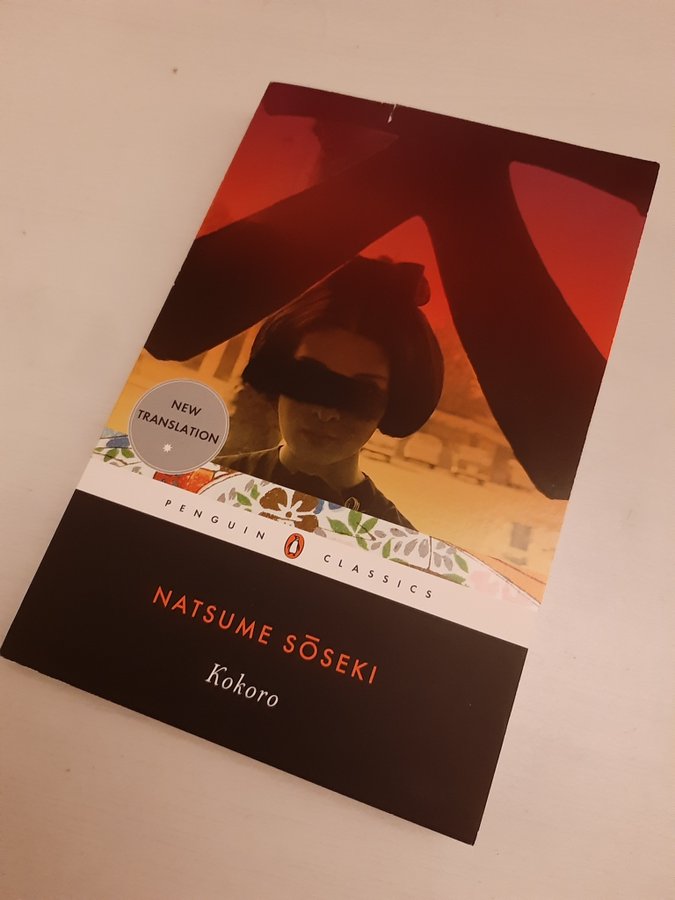
Image

1/ A brief summary: on the plot level, Kokoro by Natsume Soseki is about a young unnamed student and his friendship with an older man that he calls Sensei; on a deeper level, the novel, published in 1914, deals with the cultural shift from one generation to the next and the transition from the Meiji era to the modern era in Japan, with its various conflicts. The novel also has other themes such as isolation, egotism, and guilt. 
In terms of structure, Kokoro has 3 parts, but the first 2 parts, “Sensei and I” and “My Parents and I”, form the first half of the book—a sort of memoir narrated by the student. The final part and second half of the book is called “Sensei’s Testament”—a long letter from Sensei to the student. 
The central character therefore is Sensei—in the first half, we see Sensei through the eyes of the student, and later, he speaks for himself and recounts the story of his past. 

2/ In the previous blog post, I wrote that I didn’t know what Sensei and the student generally talked about, how he viewed things, why the student seemed to admire, even worship him almost. This is a man who hasn’t been doing anything since graduating from university. 
It is perhaps deliberate that we don’t see the student’s Sensei clearly—his perception of the man is perhaps obscured by adoration. 
Near the end of the student’s narration, Sensei starts to appear to be an egotist. The young man sends him letters, he never replies. The young man asks him for some job or position to reassure his sick father, he never says a word. All of a sudden, he sends a telegram asking the young man to come and see him in Tokyo, even though the man is at home taking care of his seriously ill father. 
Under such circumstances, knowing that the young man has enough anxiety to deal with, Sensei sends him a long letter, in which the recipient catches a glimpse of this line: 
“When this letter reaches your hands, I will no longer be in this world. I will be long dead.” (Ch.54)   
That’s not exactly considerate, is it? 
And how does Sensei justify his silence?
“Truth to tell, I was just then struggling with the question of what to do about myself. […] I was like a man who rushes to the edge of a cliff and suddenly finds himself gazing down into a bottomless chasm. I was a coward, suffering precisely the agony that all cowards suffer. Sorry as I am to admit it, the simple truth is that your existence was the last thing on my mind. Indeed, to put it bluntly, the question of your work, of how you should earn your living, was utterly meaningless to me, I didn’t care. It was the least of my problems…” (Ch.55) 
What a self-absorbed arsehole. 

3/ The style in the second half is different. 
“You revealed a shameless determination to seize something really alive from within my very being. You were prepared to rip open my heart and drink at its warm fountain of blood. I was still alive then. I did not want to die. And so I evaded your urgings and promised to do as you asked another day. Now I will wrench open my heart and pour its blood over you. I will be satisfied if, when my own heart has ceased to beat, your breast houses new life.” (Ch.56) 
Intense. 
These lines somehow make me think of Ingmar Bergman. 

4/ The second half of Kokoro is a character study of an egotist—Sensei speaks of his past and the events that have shaped him into a bitter, vindictive man who distrusts the world, tortures himself with guilt, and has an obsession with death. 
It is captivating, and even though I read it in translation (by Meredith McKinney), it works because Soseki creates a different voice for Sensei. The student seems more curious, open, and calm—he’s unable to grasp Sensei’s moral anguish and sometimes appears innocent and naïve, but sometimes also shows great perceptiveness. Sensei, even as a young man, sounds suspicious, angry, even highly strung sometimes. 
The novel becomes more engrossing when we’re introduced to Sensei’s close friend at university, who is known as K. Both of them are colourful characters and therefore more fascinating than the first narrator of the novel. In some ways, the friends seem to be opposites—Sensei doesn’t have any clear direction in life whereas K decides to become a Buddhist monk and focuses all his energy on that one thing; K has a strong will and dominates Sensei; K has great self-assurance and seems indifferent to everything unconnected to his aspirations, whereas Sensei is jealous, anxious, and tortured by doubt. 
It is fascinating how at the beginning, K appears to lack some kind of humanity, in his high ideals, strong will, and single-mindedness, so Sensei tries to humanise him, to “infuse in him [his] own living heat” (ch.77).  
“It seemed clear to me that his heart had rusted like iron from disuse.” (Ch.79) 
Sensei tries to soften him by introducing him to the opposite sex. 
“His sights were fixed on far higher things than mine, I’ll not deny it. But it is surely crippling to limp along, so out of step with the loft gaze you insist on maintaining. […] As a first step in the task of humanizing him, I would introduce him to the company of the opposite sex. Letting the fair winds of that gentle realm blow upon him would cleanse his blood of the rust that clogged it, I hope.” (ibid.) 
But once it happens, there comes out the dark side in Sensei—his vindictive nature, his suspicion and jealousy, and his pettiness.  
If in the first half of Kokoro, the student is relatively soft and doesn’t have much of a presence, in the second half, we have 2 formidable, impressive characters, balancing off each other. 
As K softens and becomes more human, Sensei becomes consumed with jealousy, and turns to cunning. 

5/ The characters in Kokoro, especially Sensei and K, are vividly drawn, and Natsume Soseki displays keen psychological insight.  

Spoiler alert: those of you who haven’t read Kokoro are warned that from this point on, I will discuss some significant plot points in the novel. 


6/ One of the ideas in Kokoro is the idea of weakness—as Sensei says over and over again throughout his testament, he is weak and K is strong. 
I don’t really think that’s the case. K isn’t strong as much as he is stiff, hard, inflexible—he can’t bend, that’s why he breaks.

7/ I suppose that any foreign reader of Japanese literature at some point must ask: what’s up with the Japanese and suicide?
So why does K kill himself? 
Here is what Sensei says: 
“At the time it happened, the single thought of love had engrossed me […] I had immediately concluded that K killed himself because of a broken heart. But once I could look back on it in a calmer frame of mind, it struck me that his motive was surely not so simple and straightforward. Had it resulted from a fatal collision between reality and ideals? Perhaps—but this was still not quite it. Eventually, I began to wonder whether it was not the same unbearable loneliness that I now felt that had brought K to his decision.” (Ch.107) 
I think “a fatal collision between reality and ideals” must be a factor—K has alienated both his biological family and adoptive family in his pursuit of spiritual ideals and focuses all his energy on his aspirations, seeing everything else as meaningless and frivolous, only to find himself now wavering and lost because of love. But I think the more important reason is his unbearable loneliness. K has been renounced by both families and has no other friends, and his only friend, who should be helping him face his crisis, gets engaged behind his back to the first woman K ever loves. It is a betrayal and an abandonment at the same time. 
Sensei’s unbearable loneliness over the years, however, is a different kind. It is the isolation and suffering caused by guilt and self-disgust, by the thought that he doesn’t deserve life and happiness, by the thought that he is getting punished.  

8/ Sensei writes to the student so the young man can learn from his past (and not make the same mistakes). But at the same time, Sensei can finally write it all down and face the truth, and he may die thinking that at least there’s one human being he could have trusted, to whom he can confess all his guilt. 

9/ As the structure of the book has the first half narrated by the young man and the second half being Sensei’s testament, we don’t know what the young man does after reading the letter. All we know is that after getting a glimpse of some significant words in the letter, he jumps on a train, abandoning his dying father for the already dead father figure. I imagine that a Western writer would probably return to the young man after Sensei’s testament, and bring about, or at least suggest, a resolution of some kind. Soseki doesn’t. Kokoro has an inconclusive ending. 
However, the novel doesn’t feel unfinished, or lacking something. Somehow it feels right that it ends with Sensei’s death (or rather, his last words). To Sensei himself, his death is associated with the end of the Meiji era—he goes with the spirit of the Meiji era. After him, the student would have a new beginning. 

Friday, 14 August 2020

Kokoro: metaphors, similes, and impressionistic style

1/ Let’s talk about metaphors and similes in Kokoro
“Instinctively I dreamed about women as objects of desire, but these were merely vague fantasies with all the substance of a yearning for the fleeting clouds of spring.” (Ch.18) 
Is that not an interesting image? 
Now look at this moment—the narrator stays at Sensei’s house with the wife because Sensei has to go away and around this time, there are burglars in the neighbourhood; they talk about Sensei and his anguish, he tries to cheer her up but neither of them know the root of the problem: 
“Thus were the comforter and comforted equally at sea, adrift on shifting waves.” (Ch.20) 
There are not a lot of metaphors and similes in Kokoro—Soseki is not Flaubert—but when there’s one, it’s interesting. 

2/ Look at these lines: 
“Soft sunlight, of a kind rarely seen in winter, was shining through the study’s glass door onto the cloth draped over his desk. In this sunny room Sensei had set a metal basin containing water over the coals of a brazier, so that by inhaling the steam, he could soothe his lungs.” (Ch.21) 
In the previous blog post, I wrote that there wasn’t much description in Kokoro
But then something unusual happens (after the narrator finishes his thesis): 
“In the first days of summer, when the boughs of the late-flowering double cherries were misted with the first unfurling of green leaf, I finally achieved my freedom. Like a bird released from its cage, I spread my wings wide in delight and let my gaze roam over the world before me. I immediately went to visit Sensei. Along the way my eyes drank in the vivid sight of a citrus hedge, its white buds bursting forth from the blackened branches, and a pomegranate tree, the glistening yellowish leaves sprouting from its withered trunk and glowing softly in the sunlight. It was as if I were seeing such things for the first time.” (Ch.26) 
Because there has been so little description before, this becomes very effective, and I (almost) forgive Soseki for the bird-released-from-cage cliché. 
Chapter 26, in fact, is full of descriptions. Like this one of an empty house they wander into: 
“The sliding doors were all wide open, and there was no sign of life in the empty interior. The only movement was that of the goldfish that swam about in a large tub that stood by the eave.” (ibid.) 
It is done in a bare, impressionistic style—another writer might have taken several paragraphs to describe the place while Soseki only uses 2 sentences and the image of a goldfish to evoke its quietness. 
When I say chapter 26 is full of descriptions, I mean compared to before—the narrator never describes his own accommodation, his parents’ house, nor Sensei’s house (apart from a single sentence sketching the study). But the writing in Kokoro is not about describing as much as about evoking. Like this: 
“Azaleas bloomed all around us like flames.” (ibid.) 
This must be what critics mean when they compare Soseki’s style to haiku—he doesn’t describe everything, he evokes an image, a mood, a feeling. 

3/ The writing in Kokoro is bare, some may say economical. 
We don’t hear of the narrator’s parents, for example, until chapter 21, and it’s not until the following chapter do we know that he has an elder brother and a sister. They’re not mentioned until it’s necessary, but it feels natural—Kokoro is a sort of memoir, as the narrator looks back and writes about his friendship with Sensei. Everything else is secondary, even unimportant. 
Soseki strips it all down to its bare essentials. But sometimes I cannot help thinking, do we even have all the essentials? 
I don’t know what Sensei and his disciple generally talk about, nor what they do together. The narrator calls Sensei a philosopher, and now and then I get a glimpse of his thoughts, such as “love is a sin” (ch.13) or “the memory of having sat at someone’s feet will later make you want to trample him underfoot” (ch.14), but I don’t know what he thinks and how he views things, apart from a general distrust of the world and disgust with himself. I know that the narrator is drawn to Sensei, and prefers spending time with him than playing game with his own father, and I expect to get to know Sensei through his letter to the narrator later on in the novel, but at the moment, I’m not quite sure about how Sensei appears to the narrator and how he influences him. 
Put it this way, the character of Sensei is veiled by several layers of mist and the narrator once in a while gets a glimpse of something dark, hidden by the mist, but he doesn’t know what it is—the book is about his failure, at the time, to understand the older man’s moral anguish, and perhaps about his difficulty, at the present, in understanding him and his death. The novel focuses on those glimpses, so to speak, and captivates the reader’s attention with the mystery of Sensei’s dark past. 
However, the different conversations throughout the novel all seem to head towards that one thing (essentially serving the plot), and what gets lost is that I don’t know what the 2 characters generally talk about, why the narrator sees Sensei as a philosopher and an admirable man, and how he gets influenced by him. 
Now you may ask, what does it matter what they talk about? Am I missing the point? But here we have a young male student who doesn’t seem to have many friends and who feels attached to an older man, perhaps his father’s age, whom he regularly visits, so it’s natural to ask what they talk about and how they become close. He also tells us that Sensei influences him, so again I think it’s natural to ask influence in what way, and what Sensei is like as a thinker—how he views life and sees things, beyond that distrust, pessimism, and obsession with death. 
Perhaps the portrayal is meant to be impressionistic. Perhaps Sensei is meant to be opaque, because he is opaque to the narrator himself. 

4/ There is an obsession with death throughout Kokoro, but not in the sense of mono no aware as in The Tale of Genji. It is partly an awareness of human fragility (as in the case of the narrator’s father, who has a kidney disease), and partly an abnormal obsession with death and suicide (as in Sensei’s case). 

5/ I picked up Kokoro, thinking that it’s only about the generation gap between the narrator and Sensei, but there’s another: between him and his father, who lives in the country. This aspect, at the moment, seems more interesting, because the parents are conveyed more vividly. The narrator leaves home to study in Tokyo, only to come home and find his parents simple, boorish, and uncultured (unlike Sensei), without realising that he may have a degree but has no job, no direction in life, and is in some way a superfluous man (as in Russian novels). 
These chapters are exquisite, especially in the way Soseki handles the father’s reaction to his own illness—his fear, his personal association with the Emperor for also being ill (and dying from his health problems), his stubborn refusal to acknowledge the seriousness and fatality of his disease, followed by his attempts to accept it and come to terms with it. 
Amidst all this, the narrator sometimes seems conscious of what’s going on, and sometimes naïve and clueless. 

Wednesday, 12 August 2020

Kokoro: first impressions

1/ After a short break (Jane Austen’s letters, edited by Deirdre Le Faye), I’m now reading another Japanese novel: Kokoro, the most acclaimed novel by Natsume Soseki, generally recognised as Japan’s greatest novelist of the 20th century. The translator is Meredith McKinney (also translator of my copy of The Pillow Book). 
The first impression is that Kokoro is not particularly visual. We’re introduced to a few characters, and let’s say we don’t get to know the narrator’s physical appearance (which is common), but what does Sensei look like? What about the Westerner who is with Sensei the first time the narrator sees him, apart from the “marvellously white skin”? 
There are barely any descriptions of the sea resort in the first chapters, except a brief account of what people do in the background, until this passage: 
“We two were the only beings afloat on that blue expanse of water for a considerable distance. As far as the eye could see, strong sunlight blazed down upon sea and mountains. 
As I danced wildly in place there in the water, I felt my muscles flood with a sensation of freedom and delight. Sensei, meanwhile, ceased to move and lay floating tranquilly on his back. I followed his example and felt the sky’s azure strike me full in the face, as if plunging its glittering shafts of color deep behind my eyes”. (Ch.3) 
That caught my attention because descriptions were very rare. Later, the narrator neither describes Sensei’s villa at Kamakura, nor Sensei’s house in Tokyo. He doesn’t describe the maid, and doesn’t describe the woman that he takes to be Sensei’s wife beyond “I was struck by her beauty”. 
The writing mostly focuses on who does what (to whom) and what follows.

2/ My instinct is to resist it, as it’s very different from the kind of writing I usually like, which is visual, sensuous (Tolstoy, Flaubert, Edith Wharton, Nabokov, Murasaki Shikibu, etc.). But I resist my own instinct to resist the book. A different style demands a different approach. 
To introduce the plot, Kokoro is written from the first person’s point of view, and the narrator, a young student, reminisces about his obsessive friendship with an older man that he calls Sensei, and about his struggle to understand Sensei’s guilt and moral anguish. According to the blurb (and various reviews I’ve seen), the book is about “the profound cultural shift from one generation to the next that characterised Japan in the early 20th century”. 
Kokoro therefore focuses on Sensei, or rather, the narrator’s friendship with Sensei. So I’m going to focus on that. 
This is when the book started to become compelling—the scene at the cemetery: 
“I found humor and irony in this great variety of humanity displayed in the names on the tombstones, but I gathered that he did not. As I chattered on about the graves, pointing out this round tombstone or that tall thin marble pillar, he listened in silence. Finally he said, “You haven’t seriously thought about the reality of death yet, have you?” 
I fell silent. Sensei did not speak again.” (Ch.5) 
Now I’m interested. 

3/ Later on: 
“He was, as I have said, always quiet and composed, even serene. Yet from time to time an odd shadow would cross his face, like the sudden dark passage of a bird across a window, although it was no sooner there than gone again. The first time I noticed it was when I called out to him in the graveyard at Zoshigaya. For a strange instant the warm pulse of my blood faltered a little. It was only a momentary miss of a beat, however, and in no time my heart recovered its usual resilient pulse, and I proceeded to forget what I had seen.” (Ch.6) 
That’s an interesting image. 
Now look at this moment, when they are having a few drinks together and Sensei brings up the sudden quarrel with his wife (which the narrator previously overheard): 
“It produced a sharp pain in me, like a fishbone stuck in my throat.” (Ch.9) 
Another interesting image.  
Let’s see what I’m going to think later on.