Pages

Showing posts with label adaptations of novels. Show all posts

Thursday, 9 April 2026

What makes a good screen adaptation?

I have seen 7 screen adaptations of Anna Karenina. That probably tells you I’m a bit mad. But as a lover of literature and cinema, I’m also fascinated by adaptations—what makes a good one? 

Let’s start with Anna Karenina. Among the 7 versions I have seen, the best is without doubt the 1977 series by the BBC, with Nicola Pagett. We all know filmmakers have to make cuts, we all know filmmakers have to simplify the story, but the problem with most adaptations of Anna Karenina is that they don’t convey the complexity of the characters—Karenin in early adaptations tends to be portrayed as a monster whereas Karenin in some later adaptations is portrayed more sympathetically, with Anna and Vronsky presented as shallow and selfish—the 1977 series is the only one which depicts the complexity and self-contradictions and multiple facets of Anna, Karenin, and Vronsky; the only one which reminds me of the qualities for which I love Tolstoy’s novel. 

If we talk about War and Peace, Bondarchuk’s film series from 1966-1967 is popular, but I would argue that it only focuses on the epic-ness of the book. It is technically spectacular but shallow and hollow, stripping the story of depth and complexity, removing Tolstoy’s philosophical and religious ideas, reducing Pierre’s search for meaning, simplifying the “thinking characters” (Pierre and Andrei), paying little attention to emotional conflicts between characters, etc. The 1972 series by the BBC, though imperfect, shows a much better understanding of Tolstoy’s characters and ideas, and respect for the text. 

This doesn’t mean I think only faithful adaptations are worthwhile, doesn’t mean I think filmmakers have to be slaves to the sources. When I complain about film adaptations, people sometimes accuse me of being a purist, but I’m not. I find it fascinating when a classic story is moved to a different setting, a different culture: the story of Dangerous Liaisons for instance is moved from 18th century France to feudal Korea in Untold Scandal, and modern-day America in Cruel Intentions; Fingersmith, set in the Victorian era, is adapted into South Korean film The Handmaiden

Sometimes it doesn’t work quite well: Bride and Prejudice does a few clever things, moving the story of Pride and Prejudice to modern-day India and making Mr Darcy American, and it’s fun enough, but it doesn’t have the sense of urgency of Jane Austen’s novel, either in the sisters getting married or in the Wickham sub-plot; the Mrs Bennet character is therefore just vulgar and annoying; and Lalita (the equivalent of Elizabeth Bennet) comes across as nationalistic and more confrontational than witty, which gets tiresome after a while. But sometimes it works wonders: in Ran and Arashi ga oka, Kurosawa and Yoshida take King Lear and Wuthering Heights respectively as a starting point, and create something different, something very Japanese, something that stands on their own. As I wrote in a recent blog post about Wuthering Heights, Arashi ga oka is its own thing—Onimaru is not Heathcliff; Kinu is not Catherine; Hidemaru is not Hindley; Mitsuhiko is not Edgar Linton; Tae is not Isabella; Yoshimaru is not Hareton; young Kinu is not Cathy—the characters can be mapped onto Emily Bronte’s characters but they are different and their relationships are different. And yet it captures the violence, savagery, eroticism, and strangeness of Emily Bronte’s novel, which the supposedly faithful adaptations of Wuthering Heights don’t do, as most adaptations only focus on the love story, reduce the malice and brutality, and often cut the second generation.

A similar example is Clueless: loosely based on Emma and set in an American high school, it is its own thing, loved by both Jane Austen’s fans and people who have no idea it’s inspired by a 19th century novel; yet at the same time, Amy Heckerling captures the essence of Austen’s novel much better than some supposedly faithful adaptations do. What I mean is that Emma might be snobbish, she might misperceive everything, she might make a mess of people’s lives, but she means well and wants to do good and has self-reflection—we also see this in Cher in Clueless, whereas Anya Taylor-Joy and especially Gwyneth Paltrow portray Emma as bitchy, catty, even two-faced, nothing like Austen’s character. 

The trouble is that most screen adaptations are not faithful adaptations which take the text seriously and show great understanding of the source story (such as the 1995 Pride and Prejudice); but they are also not interesting adaptations which take the novel as a starting point and become their own work of art (such as Jan Švankmajer’s Alice). Most adaptations are usually somewhere in the middle. 

Take for example the 2005 Pride and Prejudice: it doesn’t transcend its source material and become its own thing; what we have instead is a film which focuses on the attraction and romance but neglects the theme of pride and prejudice, and the development of Elizabeth and Mr Darcy; Matthew Macfadyen’s Darcy doesn’t show much change throughout the story; and Keira Knightley’s Elizabeth often behaves out of character (can you imagine Jane Austen’s Elizabeth eavesdropping on her family members then bursting in on them? Or watching Georgina behind a door then running away like an intruder, with no manners? Or snatching a letter from her father’s hand?).

Or, take the 1999 Mansfield Park: it takes liberties but doesn’t become an original work of art; it’s just an awkward adaptation by someone who doesn’t accept Fanny Price as written by Jane Austen and turns her into something else, and has her accepting Henry Crawford at first, going against the text.

The 2022 Persuasion also seems to be an odd thing that is neither approach: perhaps I shouldn’t comment as I haven’t seen the whole film, but from what I have seen, it is neither a faithful adaptation, depicting the Regency era, nor an independent film with the story moved to the modern era; instead, Carrie Cracknell has characters of different skin colours wearing Regency costumes but speaking modern slang, and changes the character of Anne Elliot beyond recognition (it is perhaps aimed at the audience of Bridgerton).

And this is something lots of people don’t seem to understand: whenever someone criticises a film adaptation for misrepresenting or betraying the text, some people just say fidelity is unimportant and the film is its own work of art, but most of the time it isn’t—most of the time it doesn’t have enough strengths and originality, most of the time it doesn’t transcend its source material—all we’ve got is just a poor film that doesn’t quite transfer a great work of art onto the screen. 


10 favourite adaptations of literary works (in chronological order): 

  • Rebecca (1940) 
  • The Innocents (1961), from The Turn of the Screw 
  • Tom Jones (1963) 
  • Woman in the Dunes (1964) 
  • Anna Karenina (1977) 
  • Ran (1985), from King Lear 
  • Arashi ga oka (1988), from Wuthering Heights 
  • Alice (1988), from Alice’s Adventures in Wonderland 
  • The Age of Innocence (1993)
  • Pride and Prejudice (1995) 

Monday, 6 April 2026

2009 series and 1988 film—the most interesting Wuthering Heights adaptation is Japanese

I don’t know what possessed me, but yesterday I saw two different adaptations of Wuthering Heights: Arashi ga oka (1988) from Japan, and the 2009 TV series featuring Tom Hardy. 

There isn’t much to say about the 2009 series. There are changes. One of the main changes is that they remove the character of Lockwood and change the structure, starting with the removal of Linton Heathcliff to Wuthering Heights, and young Cathy’s first meeting with Heathcliff, which means that we see the revenge on the second generation before knowing who they are and how they relate to each other. Could that be an interesting choice? Perhaps, but I don’t think it works very well. 

Another fault is what I see as a carelessness about the ages of the characters: the introduction of Catherine to the Lintons and the incident of the bulldog should take place in their early teens, we see them differently when they are adults; we need to see time pass between Catherine’s introduction to the Lintons and the marriage proposal, to see Heathcliff find Catherine slowly drifting apart from him; the series also doesn’t mark very well the 17-year gap, as the characters barely look any older.

The worst change is the ending with Heathcliff—I shall be a good girl and not spoil it for those who want to see the series, but I’m sure you would agree. But overall, it’s quite a forgettable adaptation: the series makes more explicit the incest idea but does nothing with it; Tom Hardy and Charlotte Riley have more chemistry than Kay Adshead and Ken Hutchison (in the otherwise commendable 1978 series), but as we see in most adaptations, much brutality is removed, Catherine is defanged, and it doesn’t have the strangeness and savagery of the novel.

Arashi ga oka has a much more interesting approach. As Kurosawa creates Throne of Blood out of Macbeth and Ran out of King Lear, Yoshishige Yoshida takes Emily Bronte’s novel as a starting point and creates something different, something very Japanese. In Wuthering Heights, Heathcliff’s method of revenge hinges on 18th century English property, inheritance, and marriage laws; all this has to change when Yoshida adapts the story for feudal Japan. The characters are different—Onimaru is not Heathcliff; Kinu is not Catherine; Hidemaru is not Hindley; Mitsuhiko is not Edgar Linton; Tae is not Isabella; Yoshimaru is not Hareton; young Kinu is not Cathy—the characters can be mapped onto Emily Bronte’s characters but they are different and their relationships are different. For instance, Kinu marries Mitsuhiko not because marrying Onimaru would bring her disgrace and she wants to be rich, but because, according to custom, she would have to become a priestess and leave the mountain, and marrying him is her only way to escape that fate. The relationship between Kinu and Mitsuhiko is therefore changed, and Onimaru’s method of revenge is not the same. 

One may complain that Kinu (the equivalent of Catherine) is defanged and she doesn’t quite match the wildness and savagery of Onimaru, but as I said, Yoshida only uses Wuthering Heights as a starting point and creates a work of art of his own. Arashi ga oka is very Japanese—even the acting seems to bear the influence of Noh theatre. And yet, when I think about it, Arashi ga oka has the violence, savagery, eroticism, and strangeness of the novel; and Onimaru has the brutishness, ferocity, and viciousness of Heathcliff; he even seems demonic. 

I can see why many people think Arashi ga oka is the best adaptation of Wuthering Heights. If you want a faithful adaptation, this won’t be for you. But if you want a film that stands on its own and at the same time does capture the strangeness, brutality, and eroticism of Emily Bronte’s novel, this is the film to watch. There is something elemental about it. 

I will also add that Arashi ga oka is very visually striking and well-framed. Even if you don’t like the film as a whole, you would love the cinematography. 

Strongly recommend.

Sunday, 29 March 2026

Wuthering Heights (1978) and the difficulty of adapting Emily Bronte’s novel

Anyone who loves Wuthering Heights has long recognised the difficulty, if not the impossibility, of adapting it (properly) for the screen. There is something about it that resists adaptation. My friend Himadri says “There seems something so wild & elemental in the novel. And as soon as you flesh it out with actors and with real locations, it all comes down to earth with a bump. There’s a sense of terror running through the novel that no adaptation seems able to capture.” 

Since the Laurence Olivier – Merle Oberon film in 1939, filmmakers have had a long tradition of reducing the savagery and brutality, cutting away the second half, and turning Wuthering Heights into a romance. Over and over again, I have come across people who come to Wuthering Heights expecting a passionate love story, clearly because of pop culture and all these film adaptations, and getting shocked by the emotional violence and the detestable characters in the book. So I came to the 1978 TV series with great expectations, having read that it’s the most faithful to the novel, and noticed that it’s made by the BBC one year after they gave us the best adaptation of Anna Karenina (Caroline Langrishe, who plays Kitty in Anna Karenina, here plays Isabella).

As it turns out, the 1978 has the opposite problem: the cruelty is there, the violence is there, the hate is there—but where is the love, the passion? I don’t see the chemistry, the passion between Catherine and Heathcliff. The problem is not Kay Adshead, who I think is the best Catherine I’ve seen—she depicts the selfishness, the wayward personality and fiery temper of Catherine, but she also has charm—you can see why Heathcliff is obsessed with her and you can see why Edgar Linton is drawn to her wild, intense personality. But Ken Hutchison is not quite Heathcliff. He rants, he screams, but I don’t quite see the passion from inside. I don’t see any chemistry between him and Catherine. I don’t see what Catherine and Isabella see in him. Wuthering Heights may be a story of abuse and hate, but the love story between Heathcliff and Catherine is important—even if it’s a tortured, obsessive, and destructive kind of love that destroys everything in its path, there is love—we need to see that love, that passion between Heathcliff and Catherine, and I think the series doesn’t show that. And it’s not just Catherine. To put it perhaps a bit crudely, Heathcliff should be hot—he is savage, vengeful, a monster even, but he should be hot—Catherine may think “Whatever our souls are made of, his and mine are the same”, but Isabella doesn’t have that and we must understand why she is attracted to him, against reason, against Catherine’s warning, against Edgar’s protest. 

But this is why it’s so hard, if not impossible, to adapt Wuthering Heights: filmmakers usually reduce the ruthlessness and viciousness so that Heathcliff can be a romantic figure; the 1978 series swings too far the other way.

As for the rest of the cast, I like Maria Swailes as the young Catherine Earnshaw, David Robb as Edgar, and Caroline Langrishe as Isabella; Pat Heywood is a different interpretation of Nelly Dean, playing her as a good, reliable housekeeper (not quite my interpretation), but she is very good; the only one I really don’t like, apart from Ken Hutchison as Heathcliff, is Richard Kay as Mr Lockwood, who has a melodramatic way of acting that takes me out of the story. 

Is this worth watching? I think it is. You might disagree with my views on Ken Hutchison’s performance, and this is an adaptation that takes seriously the dark and brutal side of the characters. 

Tuesday, 24 March 2026

Wuthering Heights: what race is Heathcliff?

As my previous blog post was about race and “diverse casting” in period dramas, let’s talk about Heathcliff: what is his race/ ethnicity?

This is how Heathcliff is described by Mr Lockwood, a stranger and the first narrator of Wuthering Heights

“He is a dark-skinned gipsy in aspect, in dress and manners a gentleman: that is, as much a gentleman as many a country squire: rather slovenly, perhaps, yet not looking amiss with his negligence, because he has an erect and handsome figure; and rather morose.” (ch.1)

When Heathcliff returns after a three years’ absence, Nelly Dean also describes him as having “dark face and hair” (ch.10). The word “gipsy” appears 6 times throughout the novel—said by Mr Lockwood, Mrs Earnshaw, Hindley, Mrs Linton, Joseph, and Edgar Linton—6 different characters. Some of these characters however also use different terms throughout the story. 

In one scene, to cheer up little Heathcliff, Nelly Dean says: 

““A good heart will help you to a bonny face, my lad,” I continued, “if you were a regular black; and a bad one will turn the bonniest into something worse than ugly. And now that we’ve done washing, and combing, and sulking—tell me whether you don’t think yourself rather handsome? I’ll tell you, I do. You’re fit for a prince in disguise. Who knows but your father was Emperor of China, and your mother an Indian queen, each of them able to buy up, with one week’s income, Wuthering Heights and Thrushcross Grange together? And you were kidnapped by wicked sailors and brought to England. Were I in your place, I would frame high notions of my birth; and the thoughts of what I was should give me courage and dignity to support the oppressions of a little farmer!”” (ch.7) 

I have come across some readers who naively think this means Heathcliff is half Indian half Chinese, but all this means is that Nelly Dean—and therefore we—cannot tell Heathcliff’s parentage and origin. It might mean that she doesn’t know what Indian and Chinese people look like (who look too different to be mixed up); or we can read that speech as Nelly Dean babbling some nonsense to cheer up an upset child. 

Emily Bronte complicates matters. Mrs Linton for example says: 

“I declare he is that strange acquisition my late neighbour made, in his journey to Liverpool—a little Lascar, or an American or Spanish castaway.” (ch.6) 

The term “Lascar” is used for sailors from India or South Asia. 

All these different terms mean that Heathcliff is racially ambiguous, and that it’s Emily Bronte’s intention that his ethnicity is uncertain—the main point is that he is clearly an outsider—he is an outside force that brings destruction upon the Earnshaw family (and the Linton family) and harmony is restored only when he’s gone. I don’t think Heathcliff is simply a white guy with darker skin and dark hair, like Italian or Spanish; but I also don’t think he’s black, as depicted in the 2011 film, because he would be called a “mulatto” and there would be no ambiguity. My guess is that Heathcliff is mixed race—his father is Mr Earnshaw and his mother is either “Gypsy” or Indian. If we look at the cast of the 2026 film, Heathcliff in my head would not look like Jacob Elordi but perhaps more like Shazad Latif, an actor of mixed English, Scottish, and Pakistani descent, who for some odd reason is cast as the pale and blond Edgar Linton. 

I would say though that Heathcliff’s racial ambiguity is important and Emily Bronte can maintain and emphasise the uncertainty because this is a novel—a screen adaptation has to commit to one interpretation or another—I personally think Heathcliff is mixed race. 

What do you think? 

Monday, 23 March 2026

The Other Bennet Sister and “diverse casting”

In my previous blog post about the TV series The Other Bennet Sister, I wrote about all the changes made to the characters of Pride and Prejudice, and the resulting loss of subtlety and complexity. Now I’d like to address the racial aspect of the series. 

In The Other Bennet Sister, Mary is the black sheep, the one bullied or at least neglected by everyone else in the family, the one assumed to have no prospects. The optician’s son however takes an interest in her, and asks her to dance with him at the ball, so she does, and she dances with him twice. Charlotte Lucas then tells Mary to be careful: two dances imply liking; the third time is going to be remarked upon. Then Mrs Bennet appears and, displaying a cruelty and harshness not seen in Jane Austen’s character, tells Mary not to dance with or speak to him any longer, as he’s an optician’s son, and an association with someone in trade would ruin the prospects of her sisters. 

The remarkable part here is that we can all see that he’s Indian, but nobody mentions his race, as though class is the only barrier. 

From what I can see, there are other non-white characters in the rest of the series, and this is something we see again and again: Netflix and the BBC and Channel 4 and ITV and other companies randomly cast black and brown people in adaptations of 19th century novels and other period dramas. This has gone on for years and seems to have become standard practice. And I have always disliked it. Why do you assume that I need to see someone “looking like me” represented on the screen? Why do you assume that I need to share the same race or ethnicity as a fictional character in order to find them relatable? Why do you assume that I would relate to a character just because we have the same race? What do I have in common with, for example, the characters in Crazy Rich Asians? Why would I want to see actors of the same ethnicity as me randomly cast in adaptations of classic European novels, like Hong Chau playing Nelly Dean in Wuthering Heights? Do we not have our own stories? Do we not have our own classics? Do production companies not understand how insulting this is? 

More importantly, “diverse casting” in period dramas is a whitewashing of history, as though 19th century Britain had been a colourblind society, as though people of all races back then had been equal, as though racism had never existed. If someone grows up watching these films and TV series—every single one has black and brown people as middle-class and upper-class characters, on equal footing with white characters—that person is going to have a very distorted understanding of the past. Bridgerton may have the excuse that it’s a fantasy world, but what excuses does The Other Bennet Sister have? 

I’m going to note too that this is very different from casting in Shakespeare. My favourite King Lear production has a black Lear (Don Warrington). My favourite version of Coriolanus has a black Coriolanus (David Oyelowo). Shakespeare’s plays are full of artifice—race-bending is no big deal as long as it doesn’t draw attention to itself and the play is taken seriously. But film and TV are supposedly more naturalistic; if it doesn’t present itself as a fantasy world as Bridgerton does (which I have never watched), it would be taken to be meant to be realistic; and the depiction of Britain in the late 18th, early 19th century as a colourblind society is unrealistic. I would even say that the erasure of the racial prejudice of the past—erasure of the experiences of victims of racism—is a racist lie. 

Unfortunately I seem to be the only one having these opinions. 

Tuesday, 13 January 2026

On Emma (2009), starring Romola Garai [updated]


Why do we—I mean I—keep watching different adaptations of the same novel? 

Yesterday I saw the 2009 Emma, which is the 4th version I’ve now seen of Jane Austen’s novel, after Gwyneth Paltrow (1996), Kate Beckinsale (1996), and Anya Taylor-Joy (2020). Or the 5th, if you count Clueless (1995). 

(I mention the years so you can see the Emma craze from 1995-1996—I don’t know why though). 

At the moment, I’m not quite sure if my favourite is the Kate Beckinsale version, or the 2009 one with Romola Garai, by which I mean that both are very good, but neither have the perfection, the this-is-obviously-the-best-ness of the 1995 Pride and Prejudice

Let’s start with what I like about the 2009 series. Consisting of 4 episodes, it’s the longest of the versions I’ve seen: it has time to develop the story, to show the glances and half-smiles and secret looks, to let us see Emma change over time. It looks good: well-framed, well-lit, showing the beautiful English countryside. Some of the supporting performances are excellent, especially Blake Ritson as the good-looking but oily, mercenary, small-minded Mr Elton, and Rupert Evans as the self-centred, thoughtless, but charming Frank Churchill. I also like that Harriet Smith is not turned into a goofy and ridiculous character, as done in some other adaptations: portrayed by Louise Dylan, she is simple, impressionable, not very bright; but there’s a gentleness and timidity about her that makes Emma, Robert Martin, and others love her. Most importantly, Jonny Lee Miller is a very good Mr Knightley, and there’s great chemistry between him and Romola Garai. The 1996 TV movie depicts accurately the age gap from the novel, but Kate Beckinsale and Mark Strong have less chemistry, and I think it’s better when Mr Knightley can be seen as a romantic interest— he may be 16 years older, he may scold her and lecture her, they may be old friends, but there must be something that convinces us about the transformation of their life-long friendship into romantic love, something that makes us rejoice in their realisation and their happy ending—Romola Garai and Jonny Lee Miller have it, and make me realise that it’s not quite there between Mark Strong and Kate Beckinsale.

In many ways, it is a good adaptation, and I do like the way the series emphasises Emma’s loneliness and listlessness after her sister and then her governess gets married, leaving her alone with her father, without a female companion, without guidance, without something to do. 

But there are certain things that don’t work quite so well. For some reasons, Sandy Welch (the screenwriter) and Jim O’Hanlon (the director) tone down some of the characters: Mr Woodhouse is less tiresome and ridiculous; Miss Bates is less garrulous and exasperating; Mrs Elton is still self-centred and annoying but less vulgar, less crass, and actually quite physically attractive. These changes—when I think about them—affect how we see Emma. And that leads to the most important question: how is Romola Garai’s performance as Emma? In some ways, she’s a very good Emma: Emma meddles with people’s lives and messes many things up, but Romola Garai has that charm, that innocence and pure-heartedness of Jane Austen’s character, whereas Gwyneth Paltrow or Anya Taylor-Joy can come across as catty, disdainful, even fake, and extremely unlikeable. But Romola Garai plays Emma as animated, high-spirited, almost like a teen girl—perhaps almost like a modern teen girl—I prefer the elegance of Kate Beckinsale, and her approach to the character. 

What do you think?  


Addendum: I forgot to mention that during holiday, I watched When Harry Met Sally for the first time. What a wonderful, delightful film! The characters are all different, but I thought about When Harry Met Sally as I watched the close friendship between Emma and Mr Knightley turn into romantic love. 

Monday, 22 December 2025

Reading and viewing plans for 2026


Two Pride and Prejudice series are coming up: a Netflix straight adaptation (top) and The Other Bennet Sister by the BBC (bottom). 


1/ I wrote in December 2024

“Even if there is little impact, I can’t help feeling an urge to fight against anti-intellectualism and inverted snobbery, against identity politics and Critical Race Theory, against philistinism and the School of Resentment. 

One of the ways to fight is reading and analysing and promoting classic books.

[…] Even if the philistines and authoritarians win, even if the public becomes increasingly ignorant of classic works because of tiktoks and a million other distractions, I will not lose—because these books I read are mine.” 

That still stands. 

Compare the reading ideas in that blog post and the recent post about my reading in 2025, I’ve done quite well, haven’t I? So for next year, I intend to: 

  • Continue getting to know ancient Greek literature and culture. 
  • Explore the ancient Rome. 
  • Start on the King James Bible. 

These are the main reading projects. Why the Bible? some of you might ask. It’s one of the most important texts in the world, and one of the texts that shaped Western civilisation. I read Western literature not knowing any of the Biblical stories; I wander through the National Gallery not catching any of the religious references; that has to change. Shakespeare is going to look very different once I have read Ovid and the Bible.

As my interest in the Bible is literary rather than religious, I guess I don’t need to explain why I’m going for the King James version rather than something more modern.

Some other reading ideas scattering around: 

  • Read more Dickens, possibly Our Mutual Friend
  • Explore more of the 18th century. 
  • Read some non-Western books (such as the Akutagawa book I recently bought on impulse in Jakarta). 
  • Possibly reread Wuthering Heights.


2/ There are quite a few adaptations of classics that are currently out or soon appearing: 

  • Guillermo del Toro’s Frankenstein: you don’t expect me to watch this one, do you? This is by one of the worst directors working today. 
  • Emerald Fennell’s Wuthering Heights: all the promos I have seen—the trailer especially—tell me that the writer-director has not read the novel. I might however watch it for a laugh. 
  • Chloe Zhao’s Hamnet: no, I don’t intend to watch a film about Shakespeare when the director says she understands about a third of Shakespeare’s language and has to rely on the actor—not a Shakespearean actor and not an expert—for interpretation. 
  • Christopher Nolan’s The Odyssey: everything tells me I’m going to hate this film—why is Hollywood scared of colours?—but bring it on, I’m ready to yell at Nolan. 
  • Euros Lyn’s Pride and Prejudice (Netflix): do we really need another version of Pride and Prejudice? The perfect version exists (1995). I don’t really like Jack Lowden and Emma Corrin as Mr Darcy and Elizabeth Bennet, and don’t have any positive feelings towards Netflix—the only appeal is Olivia Colman as Mrs Bennet. I might still see it though, unless it turns out to be like Netflix’s Persuasion
  • Jennifer Sheridan’s The Other Bennet Sister (BBC): we have another Pride and Prejudice series coming up, but this one looks more interesting as it does something different—focuses on Mary Bennet—and seems to have more colours. 
  • Georgia Oakley’s Sense and Sensibility: there isn’t much to say as I haven’t seen anything about this upcoming film except the cast. Would it be as good as the Ang Lee film? Most likely not. But I don’t think anyone’s going to disagree that, much as we love Emma Thompson, she’s a bit too old for Elinor. 
  • Emma Frost’s The Age of Innocence (Netflix): look, can this possibly match the perfection that is the Martin Scorsese film? Daniel Day-Lewis? Michelle Pfeiffer? Winona Ryder? We don’t need another adaptation.   

What did I miss? 


3/ I don’t really have any plans for film watching, other than that I’d like to watch more films from the 1930s. 

Thursday, 25 September 2025

Frankenstein, Dracula, and some monster films I recently saw [updated]

As it turns out, this year I’ve seen quite a few monster films, mostly based on or inspired by the myths of Frankenstein or Dracula—let’s not get into a debate on whether vampires count as monsters—so I’d better jot down some brief thoughts. 


Nosferatu: A Symphony of Horror (1922): Pure monster, no eroticism, no romance. The best Nosferatu film, perhaps the best Dracula film. Orlok’s appearance at the door, Orlok on the ship, Orlok’s shadow on the wall, etc.—the film is full of striking, unforgettable images and Max Schreck remains bone-chilling and sinister after over 100 years. More sinister than Klaus Kinski and Bill Skarsgård.  

Nosferatu (2024): The film focuses on sex and shame, or rather, presents the vampire as an embodiment of sexual desire/ shame/ disgust, which perhaps appeals to fans of monster smut. I don’t like the look of Orlok. I don’t think it’s a good film either. Lily-Rose Depp is impressive but the characters are under-developed, there’s little change in tempo and no sense of pacing, the film feels drawn out.

Dracula (1931): This is another classic, but I don’t like it. Lots of overacting, especially Dwight Frye as Renfield; I don’t even like Bela Lugosi as Dracula (unpopular opinion, I guess?). There are some interesting shots, especially at the castle and the abbey. Can see some influence from Nosferatu

Daughters of Darkness (1971): Vampire film, no Dracula connection. Silly film, but Delphine Seyrig is so beautiful and elegant. 

Now that I’ve thought about it, I wonder why I have seen so many Dracula films over the years when I don’t care for horror and didn’t like Bram Stoker’s novel all that much. Off the top of my head: part of Hammer’s Dracula (1958); Brides of Dracula (1960); Count Dracula (1977); Coppola’s Dracula (1992); Nosferatu the Vampyre (1979). 


Frankenstein (1931): Quite different from Mary Shelley’s novel, but it’s an excellent film in its own right. Great cinematography, great production design, great makeup, great performance from Boris Karloff. One of the most visually arresting films in black and white. In a way, the film simplified the story, removing some of the complex ideas about upbringing, education, development, civilisation, etc. but then it gave us the most iconic image of Frankenstein’s monster and solidified the myth—my friend Himadri thinks the film has had more impact on public consciousness than the novel has, and he’s probably right.  

Bride of Frankenstein (1935): Another excellent film by James Whale. I must praise Jack Pierce for not only doing the fantastic makeup for Frankenstein’s monster (Boris Karloff), but also creating the iconic hairstyle for the bride (Elsa Lanchester). 

Young Frankenstein (1974): Not much to do with Mary Shelley’s novel, this is an affectionate pastiche of the Frankenstein films starring Boris Karloff. Gene Wilder and Marty Feldman are wonderful together. A perfect film, very funny, extremely quotable: “It’s Fronkensteen!”, “It’s pronounced Eye-gore”, “What hump?”, “Walk this way”, etc. Did you know Gene Hackman could be so funny? I didn’t. I laughed like a hyena.  

Son of Frankenstein (1939): This film is a sequel to the films by James Whale, but I watched it after Young Frankenstein. It’s quite all right as a film, featuring Boris Karloff and Bela Lugosi and Basil Rathbone. However, it suffers in comparison: next to James Whale’s films, Rowland V. Lee’s Son of Frankenstein doesn’t have such striking and iconic images; and I couldn’t watch it without thinking about the jokes and the parody in Young Frankenstein; the inspector in particular is so well-parodied that he seems rather ridiculous in the original. 

Poor Things (2023): Based on a novel by Alasdair Gray, inspired by the Frankenstein myth. As one would expect from Yorgos Lanthimos, it is weird and stylistically interesting, but it’s more disturbing than Frankenstein and the more I’ve thought about it, the more I dislike all the ideas about “feminism” and “female empowerment” in the film. Repugnant, even. 


Dr Jekyll and Mr Hyde (1931): What was in the air that in 1931, Hollywood produced Frankenstein and Dracula and Dr Jekyll and Mr Hyde? Stevenson’s novella is my favourite of the three books, but again the film is its own work of art—one of the major changes is the creation of two female characters—and it is a very fine film. Fredric March is very good as Jekyll and Hyde, and I especially like that the film gets right Stevenson’s idea that Jekyll and Hyde are not two sides of the same person—Hyde is the concentration of all the evil and dark impulses in Jekyll. 


Addendum: Adding some more stills so you can see how beautiful the B&W is. 

Frankenstein


Bride of Frankenstein


Son of Frankenstein

Friday, 20 June 2025

Brief comments on the 2005 Pride and Prejudice


As fans were celebrating the 20th anniversary of the film, I thought why not revisit it? So I did. And I didn’t like it, though visually it is beautiful. 

Let me explain why. 

First of all, at two hours, the film feels a bit rushed. This is a common complaint, I know—certain things get cut, certain characters are underdeveloped, the film cannot have the complexity of the novel—but I can’t help noticing that the 2005 Pride and Prejudice emphasises the attraction and romance and neglects the prejudice, and the development of the relationship between Elizabeth Bennet and Mr Darcy. Some of it is because the Mr Wickham plot is barely there—there is not much space between the introduction of Mr Wickham and the reveal of his character (Elizabeth doesn’t have much time to like Mr Wickham for the revelation to be a blow either). The film also reduces the ridiculousness of Mrs Bennet, and the wit and irresponsibility of Mr Bennet.

Another problem is that Matthew Macfadyen is not very good as Mr Darcy. Keira Knightley is good as Elizabeth Bennet (much better than her own performance as Anna Karenina) and I can see why her Lizzie is so beloved, but Matthew Macfadyen is more or less inexpressive for the entire film. Colin Firth is so popular as Mr Darcy not because he’s hot (though that helps), but because he conveys so well the pride, the awkwardness, the struggle between his own passion and his distaste for Elizabeth’s embarrassing family, and above all, because he depicts the change, the development of Mr Darcy. As a character, Mr Darcy unfolds rather than changes, but he does adjust his manners—because of Elizabeth’s “lectures”, he learns to open up, and learns to speak to strangers with more warmth and friendliness. I saw that in Colin Firth’s performance; I didn’t really see it in Matthew Macfadyen’s. 

There are other irritations. Certain lines seem wrong (Mr Darcy says “You have bewitched me, body and soul, and I love… I love… I love you”—really?). Certain actions seem out of character. Would Elizabeth join with others in eavesdropping on her parents, or on her sister? And then burst in on them? Would she remain in Pemberley, knowing that Georgina is there, then watch her behind the door only to suddenly find Mr Darcy and run away like a rude intruder? Would Elizabeth snatch a letter from her father’s hand? 

I would also add, though some of you may find it petty, that after the clearly-spoken BBC adaptations I recently saw, I couldn’t help noticing that a few times in the 2005 Pride and Prejudice, the dialogue was almost drowned out by music, or other noises (such as the sound of rain). 

The main strengths of the film are the cinematography, Keira Knightley’s performance (I did like her witty, amused look), and the bond of the sisters, especially between Elizabeth and Jane. 

But as a whole, the 1995 series handles much better the characters and their relationships.

Now did you know that there’re currently two Pride and Prejudice series in the works? One is a six-part series, made by Netflix, with Emma Corrin and Jack Lowden in the main roles. The other is a ten-part adaptation of The Other Bennet Sister, a spin-off focusing on Mary Bennet (the Bennet sister nobody likes). Not hard to tell that both would be travesties.


Note: This blog post was originally published on 16/6 but emails were not delivered. I'm republishing it on 20/6 (with content unchanged) to test the new mailing system.

Sunday, 15 June 2025

Brief thoughts on the 1983 Mansfield Park


The chief strength of this series is the script—this is an adaptation made by people who understand the novel and take it seriously and get the tone right—I think anyone who, like me, loves Mansfield Park would think that it’s in many ways a better effort than some recent adaptations. I have often complained that Mansfield Park fares less well on the screen than other Jane Austen novels because people often want Fanny Price to be something other than she is, and modern filmmakers, clearly thinking they’re “improving” on the book, change her, modernise her, make her more “fun”. I have never understood it. Do we not have enough girlbosses? The 1999 film is a travesty and the 2007 film I don’t even bother to watch—just look at the casting of Billie Piper in the role. Here in the 1983 series, there’s no modernisation, no condescension. Fanny Price is quiet, unimposing, unassertive, but perceptive, self-reliant, firm, and she has a different kind of strength. 

There is also a strong cast, especially Bernard Hepton as Sir Thomas, Anna Massey as Mrs Norris, and Jonathan Stephens as Mr Rushworth. 

Unfortunately, I cannot praise it the way I have praised the 1972 War and Peace or the 1977 Anna Karenina, also done by the BBC. The production values are lower, some of the blocking and staging feel a bit awkward. I’m not sure how I feel about Sylvestra Le Touzel as Fanny—for the large part, she’s all right, but I don’t particularly like the way she sometimes moves her hands. I don’t really like Nicholas Farrell as Edmund either, who I think looks rather too old for the role, and the switch from Mary to Fanny at the end feels rather sudden. 

But the most unconvincing are Robert Burbage and Jackie Smith-Wood as the Crawfords—I don’t think there’s anything wrong with their acting as such, but the Crawfords are the most attractive and charming of Jane Austen’s villains—so charming that some readers even fall for them, prefer Mary Crawford to Fanny Price, and think that Fanny should have accepted Henry—the actors aren’t quite right for the roles.  

I also think that, spanning 6 episodes, the series has time to develop the characters and their relationships but handles the first half much better than the second half. The first half is very good, from the depiction of Fanny’s place at Mansfield Park, to the ha-ha sequence, to the play-acting sequence. I especially like the way the series depicts Henry Crawford flirting simultaneously with Maria Bertram (Samantha Bond) and Julia Bertram (Liz Crowther), sporting with their feelings—what a rake—which doesn’t escape Fanny’s eyes. The acting is good. Like the novel, the series makes me feel sorry for the vain Julia and the ridiculous Mr Rushworth. 

It is in the second half that the series does less well—I mean the way Henry starts with wanting to break Fanny’s heart but falls in love with her, and the way he, despite his feelings for Fanny, can’t resist the fun and flirtatious Maria. Perhaps part of it is because the actor isn’t convincing in the role, I don’t know.

In short, this is a more faithful, more serious adaptation of Mansfield Park than later versions, which I appreciate. But there are flaws. 


Thanks to Brian Green for telling me about this adaptation. 

Tuesday, 10 June 2025

On Anna Karenina (1977), the 7th and best adaptation I’ve seen of Tolstoy’s novel

My collage of all the 7 Annas I have seen (in chronological order). 


One common problem with adaptations of Anna Karenina is that, because of length, they have to cut many things and thus cannot convey the complexity of the characters and their relationships. The Greta Garbo film (1935) is 1 hour 35 minutes, the Vivien Leigh film (1948) is 2 hours 19 minutes, the Tatiana Samoilova film (1967) is 2 hours 25 minutes, the Sophie Marceau film (1997) is 1 hour 48 minutes, the Keira Knightley film (2012) is 2 hours 9 minutes, the Vittoria Puccini film (2013) is 3 hours 15 minutes—the novel is over 900 pages!—the 1977 series is 10 episodes, totalling 8 hours 20 minutes. 
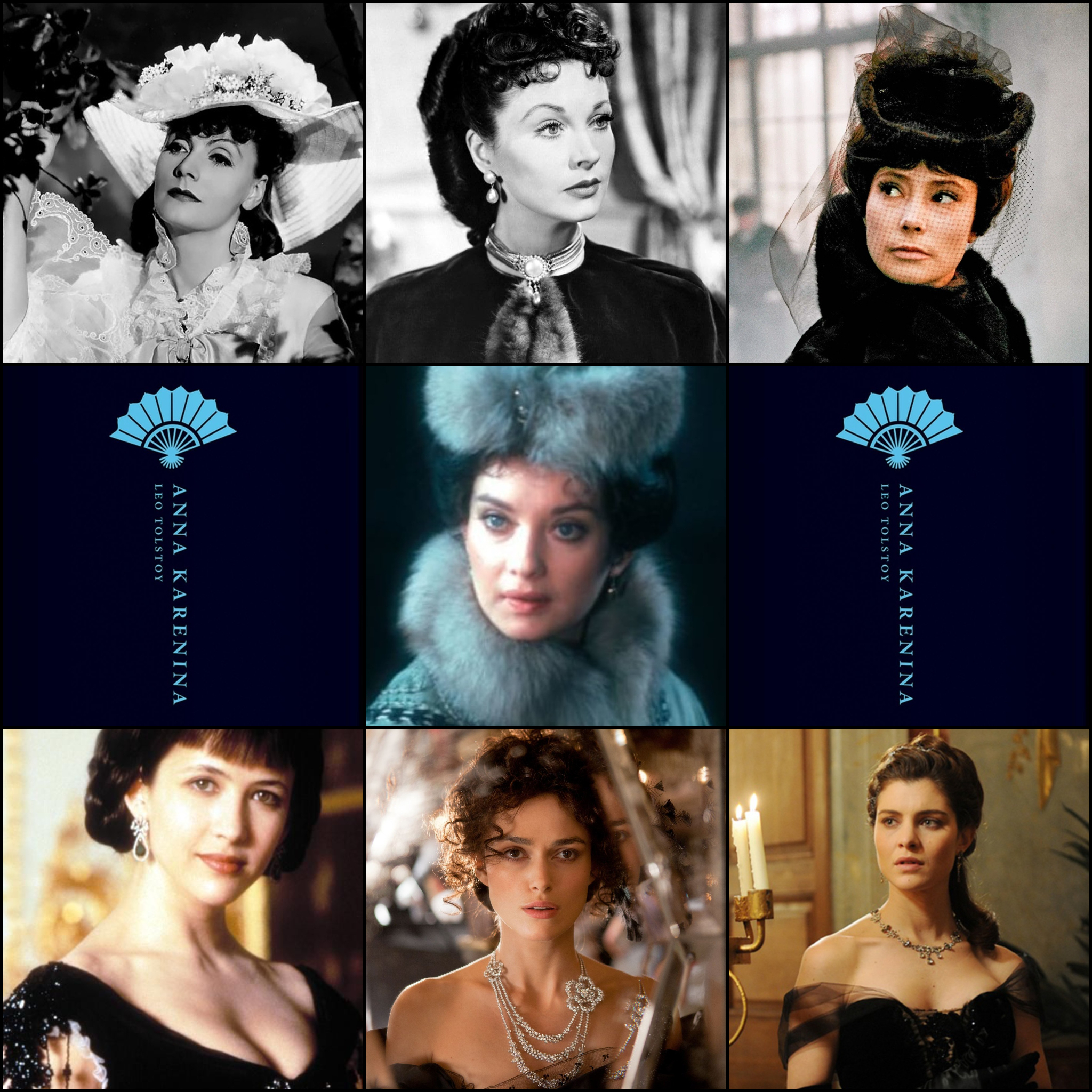
Something I have noticed is that adapters often have trouble with Karenin. The earlier films, 1935 and 1948 films especially, tend to present Karenin as some sort of monster (presumably to make Anna more sympathetic) whereas some later ones, particularly 2012 and 2013, very much soften Karenin, making him more sympathetic, and present Anna as irrational and selfish and Vronsky as some callous playboy. They more or less pick one side over the other, and simplify the story.   

But if you watch the 1977 series, you can see the different facets of the characters, you can see their complexity, you can see their contradictions. Tolstoy may have begun Anna Karenina intending to condemn adultery, condemn the fallen woman, but gradually had compassion for them all, and do we not, reading his novel? We have compassion for Anna, who marries without love and has the misfortune of falling in love with someone else, unable to get a divorce. We can see why Anna hates Karenin, but can feel his pain and humiliation. We understand Vronsky’s shame and see the pain he causes Karenin, but he does love Anna, unlike the callous lovers of Emma Bovary. All these characters are complex, and you can all see that in the performances of Nicola Pagett, Eric Porter, and Stuart Wilson. 

In Stuart Wilson’s performance as Vronsky, I see a man who initially lives for fun and pleasure and who is ennobled by love—he changes—Stuart Wilson is especially good in the scenes of Vronsky suffering, such as the sense of immense shame and humiliation after Anna’s childbirth, and the scene in which he confides in Dolly about their impossible situation—he conveys better than other actors Vronsky’s depth of feeling and his struggle as Anna becomes increasingly difficult. Eric Porter’s Karenin is also the best Karenin I have seen—I can see why Anna doesn’t love him and Seryozha is afraid of him, which I don’t see when the 2012 and 2013 versions soften the character—at the same time, the earlier actors tend to play Karenin as a cold man, without feelings, Eric Porter’s Karenin is a man who speaks of duty, honour, and later Christianity, because he rejects his own feelings. Most importantly, Nicola Pagett is better than all the Annas I have seen, partly thanks to the length of the production and partly thanks to her own performance—she has the charm and passion of Anna, she conveys the shame, the struggle, the self-doubt, the insecurities, the anguish, the paranoia, the contradictions in the character. 

The 1977 series reminds me of the qualities for which Anna Karenina is so dear to my heart. 

This adaptation of Anna Karenina still prioritises the Anna strand—Kitty’s time in Germany for example is cut, Levin’s “revelation” is also cut—but because of length, it can include more of the Levin strand than most other versions. I do very much like Robert Swann as Levin and Caroline Langrishe as Kitty—it’s great casting—she has the innocence and purity of Kitty that contrasts with the more mature and darker sexual charm of Anna. Those of you who prefer the Levin strand to the Anna strand may prefer that the 2013 version puts more emphasis on Levin and Kitty, but that version has the modern disease of quick cuts, constant camera movements, and quiet and badly written dialogue—the 1977 series has great dialogue, spoken clearly, and allows the camera to linger, allows the drama to unfold. 

In short, this is a great adaptation, pitch-perfect. This is something it has in common with the 1972 War and Peace (with Anthony Hopkins as Pierre), also by the BBC: those who are used to spectacular visuals and place the image above all else may complain that these adaptations are “stagey” and lacking in camerawork, but to me, it’s much more important that something is well-written, well-developed, well-acted—I would always choose great performances with basic cinematography, over spectacular cinematography with mediocre performances and hollow representations of characters, especially if it’s an adaptation of a novel—in both cases, the screenwriters (Donald Wilson for Anna Karenina and Jack Pulman for War and Peace) understand and respect the novel, and in both cases, there’s a strong cast. I often say that the 1972 War and Peace handles Tolstoy’s characters much better than Bondarchuk’s film series and its only flaw is Natasha—but there is no weak point in the 1977 Anna Karenina

It is my favourite Tolstoy adaptation. 

It took me years to search for the series. It’s now uploaded on Youtube, in good quality. What are you waiting for? 


PS: 11/6 is my birthday. 

Monday, 2 December 2024

Why do some great novels resist adaptation?

Yesterday I watched two Czechoslovakian films: Alice and When the Cat Comes (both of which I recommend). As I was watching Alice, Jan Švankmajer’s wonderfully dark and disturbing adaptation of Lewis Carroll’s Alice’s Adventures in Wonderland, I thought about classic novels that were adapted for the screen over and over again. 

And I thought, why are some great novels so much harder to adapt than others? 

I’m not talking about novels with an odd structure, an obvious challenge such as Moby Dick or The Sound and the Fury or One Hundred Years of Solitude. I’m also not talking about faithful adaptations—you can’t accuse me of being a purist—just film or TV adaptations that can stand on their own as works of art. Like Jan Švankmajer’s Alice. Or Dr Strangelove. Or Ran.

But clearly some novels seem to resist adaptation. Take Don Quixote for instance. This is one of the most important novels in the world, this is a novel that has been adapted a million times, and yet—perhaps I am ignorant—there is not a single adaptation that is considered a good film of Don Quixote. BFI has an article called “The troubled history of Don Quixote on film”, about the failures of Orson Welles and Walt Disney and Terry Gilliam to bring it (successfully) to the screen. Terry Gilliam in the end managed to make The Man Who Killed Don Quixote in 2019, but it’s not successful, is it? Critic score of 66% and audience score of 59% on Rotten Tomatoes. 

Anna Karenina, another favourite novel of mine, also doesn’t seem to work well on the screen. The challenge of the depth of Tolstoy’s characters is not the only reason. The 1972 adaptation of War and Peace, with Anthony Hopkins as Pierre, demonstrates that it’s possible to convey the depth of characters and the conflicts between them—the only flaw of that version is Natasha (many people love the Soviet version, but it’s only because they seem to be fine with Sergei Bondarchuk stripping away all psychological and philosophical depth and character development). But there is not a single good adaptation of Anna Karenina* and I have seen six different ones: Greta Garbo (1935), Vivien Leigh (1948), Tatiana Samoilova (1967), Sophie Marceau (1997), Keira Knightley (2012), and Vittoria Puccini (2013). There is always something wrong—with Anna or Vronsky or Karenin or all of them—not to mention that the Levin strand is almost always reduced to a mere subplot. 

But I guess the complexity of Tolstoy’s characters is the main reason. Filmmakers tend to go for a simpler version. 

Wuthering Heights is another hard one. Jane Eyre has an excellent adaptation in 2006, with Ruth Wilson as Jane and Toby Stephens as Mr Rochester. Some people seem to like the 2011 film with Mia Wasikowska, for some reason. But Wuthering Heights has not had a single good adaptation—we all agree, yes? The news of the version currently in the works doesn’t particularly cheer anyone up either. How could Emerald Fennel possibly cast Margot Robbie as Cathy and Jacob Elordi as Heathcliff? Madness. 


My favourite Emma: Kate Beckinsale. 

The case of Jane Austen is easier to understand. Almost all of her novels have had a good adaptation: Lady Susan has a brilliant adaptation in 2016, confusingly named Love and Friendship; Northanger Abbey has been adapted only once** in 2007, with Felicity Jones, which seems popular enough; Sense and Sensibility has the Oscar-winning film in 1995 with Emma Thompson and Kate Winslet; Pride and Prejudice has the 1995 series, with Jennifer Ehle and Colin Firth, leading to the Austen craze and the whole Janeite industry (though there are, oddly, some people who prefer the Keira Knightley film); Emma has a great adaptation in 1996 with Kate Beckinsale, which is my favourite, though the consensus is that the best one is Clueless; Persuasion has a celebrated version, also in 1995, with Amanda Root as Anne Elliot and Ciarán Hinds as Captain Wentworth. All filmmakers have left to do is to “ruin” them with some “subversive” adaptations, like Netflix has done with Persuasion and presumably will do again with Pride and Prejudice (well, for those who like that sort of thing, that’s the sort of thing they like). 

The one Jane Austen novel that has not had a good adaptation is Mansfield Park. But that is not hard to understand: modern filmmakers cannot handle a morally serious and sombre Jane Austen novel and a heroine so unlike the Strong Female Character trope of Hollywood—Fanny Price, strong in a different way, is not a girlboss or a kickass heroine—filmmakers keep feeling a misplaced urge to “improve” on the book.  

But I do wonder why Wuthering Heights hasn’t got a good adaptation. Is it only because filmmakers keep sanitising and romanticising the story? Or is there some fierce, intense quality to Emily Bronte’s story that makes it impossible to work on the screen? 

But I suppose people are going to attempt again and again. 


** Addendum: There is also a version in 1987 that I did not know about. Thanks, Brian. 

* updated on 13/6/2025: I have now watched a wonderful adaptation of Anna Karenina from 1977. 

Monday, 18 November 2024

Oh these shameless moderns!

1/ Over the past few months, I have been bombarded with Facebook ads for The Duchess (of Malfi), featuring Jodie Whittaker. 

What is it? you askwhy is “of Malfi” in brackets? It’s because this is a contemporary adaptation of Webster’s play. “A bloody revenge tragedy made marvellously modern”, says The Telegraph. The Duchess of Malfi stripped of its poetry, stripped of its language. Reduced to its plot. Reduced to something about “the patriarchy” and “female resistance.” 

One ad has the writer-director, Zinnie Harris, discussing “why she thinks John Webster’s classic text is still studied in school and remains relevant today.” 

I’d say The Duchess of Malfi endures because of its poetry, not because of its plot. Zinnie Harris herself mentions language and imagery—then why did she remove all of it? 

I’ll give you two quotes from Webster’s play:  

“BOSOLA Do you not weep?

Other sins only speak; murther shrieks out: 

The element of water moistens the earth, 

But blood flies upwards, and bedews the heavens. 

FERDINAND Cover her face. My eyes dazzle: she di’d young.”

(Act 5 scene 5) 

“ANTONIO […] In all our quest of greatness, 

Like wanton boys, whose pastime is their care, 

We follow after bubbles, blown in th’air. 

Pleasure of life, what is’t? only the good hours

Of an ague: merely a preparative to rest, 

To endure vexation…” 

(Act 5 scene 4)


2/ In 2022, Netflix released an adaptation of Persuasion. A “subversive new take on Jane Austen”, according to British Vogue. Persuasion Fleabag-ified. Anne Elliot regularly breaks the fourth wall and at some point says “Now we’re worse than exes, we’re friends.” Her sister Mary calls herself “an empath.” Someone says “It’s often said that if you’re a 5 in London, you’re a 10 in Bath.” Isn’t that relatable? British Vogue says “The introduction of direct-to-camera moments and doses of contemporary humour make Anne’s inner journey immediately relatable, in a way that might have been impossible under the standard conventions of the buttoned-up Regency drama.”

“Impossible”, they say—why do they think so many people love the book? 

But that’s not all. Carrie Cracknell, the director said “I’ve always loved casting in a color-conscious way. A conversation that I’ve had with lots of the actors that I’ve worked with over the years is how powerful it can be for a diverse audience to see themselves represented in historic cultural texts and stories, because in some way it sort of broadens the scope of the audience who can feel part of this story or can feel ownership over this story.” 

How marvellous! Where would we be without Carrie Cracknell and people like her? Since its publication in 1817, we pitiful people of colour have never felt that Persuasion was ours till Netflix condescended to help us feel included. 


3/ Today, at The Open Book in Richmond, I came across a book called She Speaks! What Shakespeare’s Women Might Have Said by Harriet Walter. 

“An incisive, funny, mischievously subversive homage to Shakespeare’s heroines, written by one of mine,” Meera Syal blurbs. 

Tamsin Greig says “With characteristic wit, compassion and fierce intelligence, she gives tantalising voice to the Bard’s female greats.” 

These are the opening lines of the introduction on the dust jacket:

“Dame Harriet Walter, renowned for her wonderful portrayals in Succession and Killing Eve, among others, is one of Britain’s most acclaimed Shakespearean actors. Now, having played most of the Bard’s female characters, audaciously she lets them speak their minds.” 

I’m sorry—do they not speak in the plays? 

One of the reasons Shakespeare is called the greatest writer of all time is that his range of characters is unequalled—he creates characters of different backgrounds, races, nationalities, classes, sexes, sexualities, religions, political views, points of view… and also different types of characters—he contains everything. Look at the female characters he created—look at Cleopatra and Lady Macbeth and Gertrude and Volumnia and Rosalind and Beatrice and Isabella and Viola and Portia and Imogen and Desdemona and Emilia and Hermione and Juliet’s nurse and so on and so forth—and Harriet Walter or the intro writer thinks she “lets them speak their minds”? That she imagines what “these women were really thinking”? And Walter thinks “the mirror that [Shakespeare] held up to nature reflected a predominantly male image of the world” and he needs her to “let a little sunlight in on some of his women’s stories”? 

The arrogance is incredible.