Pages

Showing posts with label photos. Show all posts

Thursday, 4 June 2026

Visiting Jane Austen’s House Museum

A few days ago, I finally managed to visit Jane Austen’s House Museum in Chawton, Hampshire. It was great. 

This is where Jane Austen revised her first three novels, and wrote her last three novels Pride and Prejudice, Mansfield Park, and Emma. The table’s much smaller than I thought! 

I don’t know what flowers Austen had in her garden back then, but here are a few photos of mine of the flowers now. 

Also wandered around Chawton. Tiny, charming village. 

In case anyone wonders if I have visited Shakespeare’s Birthplace Museum in Stratford-upon-Avon, here are a few photos from 2023. 

Sunday, 14 December 2025

On being back in Southeast Asia


Me doing the Mahanakhon skywalk. 

I have just returned from my work trips to Jakarta and Bangkok. 

It was strange, in a way, to be back in Southeast Asia for the first time since leaving Vietnam 16 years ago. Except for the February trip to Washington, DC, most of my travels had been within Europe. It almost felt like home—many things were familiar—and yet quite alien—as I couldn’t figure out the languages the way I can guess words in European languages. Many things reminded me of Vietnam: the crazy traffic and the mopeds and the insane electric poles and the vibrant street food culture, etc. Europeans probably don’t fully appreciate their walkable cities till they travel to Asia, or America. Jakarta for instance has the worst roads I’ve ever seen: the pavements are full of gaping mouths ready to swallow up your foot if you just get distracted for a second. Bangkok is less dense, less dangerous, but still mad. There’s a constant thought that I might get hit and see my ancestors any moment. Did you know that Bangkok’s roughly the same size as London? I didn’t know either, till recently. The public transport system however is not the same; I figured out that the best way to travel around—if you’re a bit crazy like me—was to use a Grab bike (a ride on a moped), or if the distance is too great and there’s heavy traffic, to combine the skytrain with a Grab bike. 

The best part is the food. There’s food everywhere. I’m convinced that Southeast and East Asia have the best food, especially if you consider everything—starters, main courses, desserts, snacks, fruits. I barely saw anything in Jakarta, being there for only a couple of days for a conference and having a lot to handle, but I enjoyed the food (to my own surprise). 

It was even better in Bangkok. After nearly two weeks there, my feelings are mixed. For a tourist, the city has a lot to offer: there’s so much to see, to eat, to experience. I ate pad thai and green curry and grilled meat and tom yum and jackfruit and Korean fried chicken. I got addicted to Thai milk tea and mango sticky rice. I tried Bangkok’s highest skywalk—78th floor, 310m high. I visited the Grand Palace (with its temple Wat Phra Kaew), and two other breathtaking temples (Wat Arun and Wat Pho). I took boat rides and tried tuk-tuks. I explored markets and shopping malls. It’s fun, for many reasons (and perhaps the closest to being in Vietnam now that I’m no longer able to return). 

But for someone interested in human rights, it is impossible to fully embrace Thailand because of the appalling behaviour of the government, because of the way they treat refugees, because of the way they collaborate with repressive regimes in the region and abet their transnational repression. I had been writing about the IDCs (Immigration Detention Centres) in Thailand. I was in Bangkok immediately after Thailand’s extradition of Y Quynh Bdap, a Montagnard human rights activist and UNHCR-recognised refugee, back to Vietnam. I visited Vietnamese refugees in Thailand, including some currently detained in the IDC. Most people don’t know about these things, and don’t care—even China’s atrocities don’t stop people from visiting and spending money there, how could I expect people to boycott Thailand “merely” for detaining refugees and allowing them to be beaten up by other detainees, or deporting human rights activists, or assisting Vietnamese authorities’ abductions of dissidents on their soil?—so I feel conflicted about “promoting” the fun stuff in Thailand. 

Oh well. Good experience though. 

Thursday, 25 September 2025

Frankenstein, Dracula, and some monster films I recently saw [updated]

As it turns out, this year I’ve seen quite a few monster films, mostly based on or inspired by the myths of Frankenstein or Dracula—let’s not get into a debate on whether vampires count as monsters—so I’d better jot down some brief thoughts. 


Nosferatu: A Symphony of Horror (1922): Pure monster, no eroticism, no romance. The best Nosferatu film, perhaps the best Dracula film. Orlok’s appearance at the door, Orlok on the ship, Orlok’s shadow on the wall, etc.—the film is full of striking, unforgettable images and Max Schreck remains bone-chilling and sinister after over 100 years. More sinister than Klaus Kinski and Bill Skarsgård.  

Nosferatu (2024): The film focuses on sex and shame, or rather, presents the vampire as an embodiment of sexual desire/ shame/ disgust, which perhaps appeals to fans of monster smut. I don’t like the look of Orlok. I don’t think it’s a good film either. Lily-Rose Depp is impressive but the characters are under-developed, there’s little change in tempo and no sense of pacing, the film feels drawn out.

Dracula (1931): This is another classic, but I don’t like it. Lots of overacting, especially Dwight Frye as Renfield; I don’t even like Bela Lugosi as Dracula (unpopular opinion, I guess?). There are some interesting shots, especially at the castle and the abbey. Can see some influence from Nosferatu

Daughters of Darkness (1971): Vampire film, no Dracula connection. Silly film, but Delphine Seyrig is so beautiful and elegant. 

Now that I’ve thought about it, I wonder why I have seen so many Dracula films over the years when I don’t care for horror and didn’t like Bram Stoker’s novel all that much. Off the top of my head: part of Hammer’s Dracula (1958); Brides of Dracula (1960); Count Dracula (1977); Coppola’s Dracula (1992); Nosferatu the Vampyre (1979). 


Frankenstein (1931): Quite different from Mary Shelley’s novel, but it’s an excellent film in its own right. Great cinematography, great production design, great makeup, great performance from Boris Karloff. One of the most visually arresting films in black and white. In a way, the film simplified the story, removing some of the complex ideas about upbringing, education, development, civilisation, etc. but then it gave us the most iconic image of Frankenstein’s monster and solidified the myth—my friend Himadri thinks the film has had more impact on public consciousness than the novel has, and he’s probably right.  

Bride of Frankenstein (1935): Another excellent film by James Whale. I must praise Jack Pierce for not only doing the fantastic makeup for Frankenstein’s monster (Boris Karloff), but also creating the iconic hairstyle for the bride (Elsa Lanchester). 

Young Frankenstein (1974): Not much to do with Mary Shelley’s novel, this is an affectionate pastiche of the Frankenstein films starring Boris Karloff. Gene Wilder and Marty Feldman are wonderful together. A perfect film, very funny, extremely quotable: “It’s Fronkensteen!”, “It’s pronounced Eye-gore”, “What hump?”, “Walk this way”, etc. Did you know Gene Hackman could be so funny? I didn’t. I laughed like a hyena.  

Son of Frankenstein (1939): This film is a sequel to the films by James Whale, but I watched it after Young Frankenstein. It’s quite all right as a film, featuring Boris Karloff and Bela Lugosi and Basil Rathbone. However, it suffers in comparison: next to James Whale’s films, Rowland V. Lee’s Son of Frankenstein doesn’t have such striking and iconic images; and I couldn’t watch it without thinking about the jokes and the parody in Young Frankenstein; the inspector in particular is so well-parodied that he seems rather ridiculous in the original. 

Poor Things (2023): Based on a novel by Alasdair Gray, inspired by the Frankenstein myth. As one would expect from Yorgos Lanthimos, it is weird and stylistically interesting, but it’s more disturbing than Frankenstein and the more I’ve thought about it, the more I dislike all the ideas about “feminism” and “female empowerment” in the film. Repugnant, even. 


Dr Jekyll and Mr Hyde (1931): What was in the air that in 1931, Hollywood produced Frankenstein and Dracula and Dr Jekyll and Mr Hyde? Stevenson’s novella is my favourite of the three books, but again the film is its own work of art—one of the major changes is the creation of two female characters—and it is a very fine film. Fredric March is very good as Jekyll and Hyde, and I especially like that the film gets right Stevenson’s idea that Jekyll and Hyde are not two sides of the same person—Hyde is the concentration of all the evil and dark impulses in Jekyll. 


Addendum: Adding some more stills so you can see how beautiful the B&W is. 

Frankenstein


Bride of Frankenstein


Son of Frankenstein

Saturday, 2 August 2025

Heracles by Euripides

1/ Another blasphemous play from Euripides. 

This is how the play starts: amidst the chaos in Thebes, Lycus attacks the town, kills King Creon, and seizes the crown; as Creon’s daughter Megara is married to Heracles but Heracles has gone to the underworld for the final labour, perhaps to never return, Lycus decides to kill them all—Megara, their 3 sons, and Heracles’s father Amphitryon. 

“CHORUS […] My voice full of grief and mourning,

Like the sad chant of an aged swan;

A ghost of a man, voice with no substance.

Like a figure seen in a dream…” 

(translated by Philip Vellacott) 

About half of the play is Amphitryon, Megara, and the Theban elders (the chorus) lamenting their fate and praying for rescue from Heracles or the gods. Amphitryon begs Lycus to spare them, but Megara doesn’t do so. 

“MEGARA […] I love my children – naturally;

I gave them birth, and care from childhood; and to me

Dying is fearful. Yet I count it foolishness

To struggle with the inevitable. Since we must die,

Let us not die shrivelled in fire, a mockery

To our enemies, which to me is a worse thing than death.

We owe a debt of honour to our royal house.

[…] When the gods spread misfortune like a net, to try

To struggle out is folly more than bravery.

For what will be will be; no one can alter it.” 

She accepts it with poise and dignity. Reminds me of Shakespeare’s Hermione. 

There are lots of good passages in this play: 

“MEGARA […] You weep,

My pretty flowers! Then, like a brown-winged honey-bee,

From all your weeping I’ll distil one precious tear,

And shed it for you…” 

It is moving. 

“AMPHITRYON […] Time as he flies has no care to preserve our hopes;

He’s bent on his own business. Look at me: I once

Was great in action, drew all eyes upon me; now

In one day Fortune has snatched from me everything,

As the wind blows a feather to the sky; all lost.

Wealth, reputation – who holds them with certainty?” 

Euripides gets us to care about Megara and the children, and builds it up so that we all hope for Heracles to return in time and thwart Lycus’s plan to kill the family. And Heracles does return in time! He then kills Lycus. But no, the story takes a different turn as Isis, under the command of Hera, gives him a fit of madness and makes him kill his own wife and children in a frenzy, only because Hera is Zeus’s wife and has always hated Heracles for being Zeus’s son. It is horrific. The play reminds me of Aias (also known as Ajax) by Sophocles (which I think is a more perfect play), but what Hera does to Heracles is so much worse than what Athena does to Aias: Heracles kills his own wife and children! 

“HERACLES […] She has achieved her heart’s desire,

Toppling to earth, pedestal and all, the foremost man

Of Hellas. Who could pray to such a god? For spite

Towards Zeus, for jealousy of a woman’s bed, she hurls

To ruin his country’s saviour, innocent of wrong!” 

What kinds of gods are these? But it’s not only Hera—Euripides doesn’t seem particularly fond of Zeus either. 

“AMPHITRYON Zeus! I once thought you were my powerful friend. You shared

My marriage, shared my fatherhood of Heracles.

All this meant nothing; for you proved less powerful

Than you had seemed; and I, a man, put you, a god,

To shame. I’ve not betrayed the sons of Heracles.

You knew the way to steal into my bed, where none

Invited you, and lie with someone else’s wife;

But those bound to you by every tie you cannot save.

This is strange ignorance in a god; or else, maybe,

Your very nature lacks a sense of right and wrong.” 

Zeus never appears. Never intervenes. He’s even worse than Apollo in Ion

Amphitryon and Heracles are not the only ones chastising the gods either: 

“MEGARA […] How dark and devious are the ways of gods to men!”

Euripides goes further:

“HERACLES Divinity’s impervious

To human feeling. I defy divinity.” 


2/ The good thing about living in London is that when I’m fascinated by a period, such as ancient Greece at the moment, I can just go to the British Museum and look at the artworks and artefacts from that period. 

This is me with a vase depicting characters from the Oresteia

This is part of the collection about the Labours of Heracles: 


Addendum: My friend Himadri added: 
“You mention Hermione, but I think the parallel with The Winter’s Tale goes further. Heracles destroys his family in a fit of madness: the madness comes from the gods, but no reason is given. Similarly, there is no reason given for the madness of Leontes, who also destroys his family. And both Leontes and Heracles must live not only with the loss, but also with the guilt.
Shakespeare knew Heracles. He must have done.” 

Saturday, 26 April 2025

The amateur’s freedom

By Claude Monet.

Recently my friend Himadri asked, if I were a literary academic, which area of literature I would specialise in. Probably Shakespeare or 19th century novels, British or Russian.

But as I told Himadri then, I’m so glad that literature is not my profession. 

Not a book reviewer or literary critic, I don’t have to read bad books, keep up with the currently hottest writers, or even pay attention to contemporary fiction. Not an academic, I don’t have to read jargon-heavy and ideology-driven critical texts or badly-written and barely-read literary works related to my field of study. Not a Shakespeare scholar, I don’t have to read Harold Bloom. 

A Twitter friend whom I have met in person studies female novelists before Jane Austen (or something like that), and has to read so much crap. My professor and literary critic uncle has been so used to reading for work that even now, when he has retired, can no longer read for pleasure. And I have read George Orwell’s essay about the miserable job of book reviewing (and the rush through books for a review). 

I’m happy for them but happy about my own freedom—the amateur’s freedom! I read the 1200-page The Tale of Genji and some other works of Heian literature because I felt like it. I read all of Shakespeare’s plays and sonnets and also Shakespearean criticism because I felt like it. I explored 17th century playwrights—not only Shakespeare’s contemporaries in England but also Molière and Spanish Golden Age playwrights—because I felt like it. And when I got bored, I stopped. And now, having noticed a gap in my own reading, I’ve been exploring 18th century novels since last year, but—look at the length!—have no intention of reading Clarissa anytime soon. Who can force me?  

What’s more, the amateur doesn’t have to write about every single book she reads.

Literature sustains me, reading helps me keep my sanity in this increasingly insane world, my library’s dukedom large enough, but that’s only the case because of the absolute freedom I’ve got. 


_____________________________________________________


My photo.

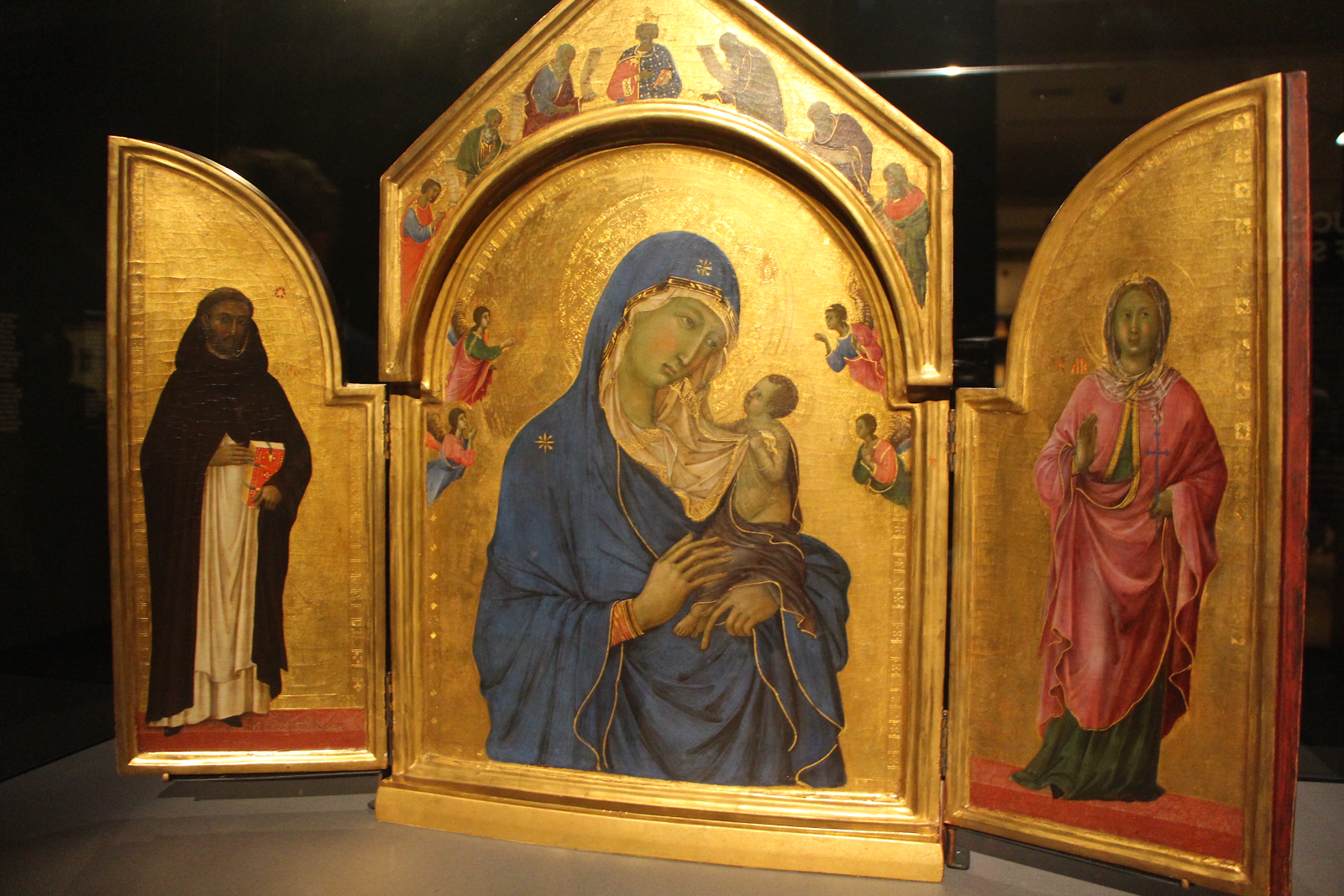
On a side note, a few weeks ago, Himadri and I went to an exhibition of Sienese art (14th century) at National Gallery, London. Not a fan, I’m afraid (some of you are probably puzzled). Looking at the art, I was also thinking that I’d been more or less going back in time in my reading—first contemporary fiction, then the 20th century, then the 19th century, then Shakespeare and the 16th and 17th centuries, then the 18th and more of the 17th—but to go back to literature before Shakespeare’s time, I might make a big jump all the way back to Ancient Greece and Rome. If we look at the period in-between—I’m talking about Western literature—nothing particularly interests me—I know, some of you might gasp in shock and horror, but not even Chaucer or Dante. The only literary works in this long span of time that arouse (some of) my interest are East Asian—Tang poetry, Heian literature, and Water Margin. You might convince me otherwise (though I doubt it). 

Wednesday, 23 April 2025

23/4

Today is meaningful for two reasons. One, it’s Shakespeare Day. Two, it’s 16 years since my mum and I moved to Norway (which means that I have now lived longer outside Vietnam than in Vietnam).

I never thought about it, but it’s interesting that the day my life turned to a new chapter—everything has been different since—was Shakespeare Day, the day celebrating the writer with whom I’m most obsessed. 


Anyway, here are some recent photos of me, taken by my bf.