I’m reading Sidney Lumet’s Making Movies, which I think is a very good and enjoyable book, especially for aspiring film directors.
Look at this:
 Isn’t that such a good “defence” of dialogue? The writer-director who has created the most memorable lines is Billy Wilder, who has 3 contenders for the best closing lines of all time—The Apartment (“Shut up and deal”), Some Like It Hot (“Nobody’s perfect”), and Sunset Boulevard (“All right, Mr. DeMille, I'm ready for my close-up”). Dialogue is not uncinematic. It is only uncinematic when it is superfluous exposition, and worst if it’s the director’s way of explaining the film to the audience (which is common in Christopher Nolan’s films).
Now look at this passage:
Isn’t that such a good “defence” of dialogue? The writer-director who has created the most memorable lines is Billy Wilder, who has 3 contenders for the best closing lines of all time—The Apartment (“Shut up and deal”), Some Like It Hot (“Nobody’s perfect”), and Sunset Boulevard (“All right, Mr. DeMille, I'm ready for my close-up”). Dialogue is not uncinematic. It is only uncinematic when it is superfluous exposition, and worst if it’s the director’s way of explaining the film to the audience (which is common in Christopher Nolan’s films).
Now look at this passage:
 That is fascinating and scary at the same time—would I be able to tell?
The book offers some invaluable insight and advice about directing. I admire Sidney Lumet immensely, and now love him even more as I read the book. He is not an auteur, he might not even be seen as a stylist, but does it matter? I would say that 12 Angry Men and Dog Day Afternoon are masterpieces, and Before the Devil Knows You’re Dead is a great, heartbreaking film that should be better known. Many of his other films are also highly acclaimed, such as Serpico, The Verdict, Network, Murder on the Orient Express, Long Day’s Journey into Night... Why are some other directors ranked higher just because their films are more stylistic or technically more impressive?
That leads me to another point: is the ability to work with actors not important? The directors who I think are masters at getting the best performances out of actors are Ingmar Bergman, Elia Kazan, Sidney Lumet, and Francis Ford Coppola. And perhaps Roman Polanski (Adrien Brody never had anything remotely as good as his performance in The Pianist).
Some other directors who are also good at working with actors are Billy Wilder, Clint Eastwood, Martin Scorsese, Zhang Yimou, Krzysztof Kieslowski… (I don’t include Kurosawa and Mizoguchi because Japanese acting is a different style).
As you follow a director’s work, you realise what their main strengths are—they are better at some aspects of filmmaking than others. Fellini’s main strengths, for example, are in blocking/staging, cinematography, and visual storytelling. Billy Wilder’s are in story, structure/ pacing, dialogue, and working with actors. Orson Welles’s are in cinematography (especially lighting), structure, editing, and sound. Luis Bunuel’s are in story/ plot, ideas, and pacing. Andrei Tarkovsky’s are in ideas, cinematography, sound, and atmosphere.
You also notice, not weaknesses, but that some aspects don’t interest a director as much as others. There isn’t much to say about cinematography and lighting in Luis Bunuel’s films, for example; or editing in Tarkovsky’s; or story in Wong Kar-wai’s.
It is not without reason that I think Ingmar Bergman’s the best director of all time, because his films do have everything—good story, interesting idea, depth, pacing, great cinematography (especially lighting), great sound, great editing (most notably in Persona), good production design (at least in Cries and Whispers and Fanny and Alexander), wonderful performances, good visual storytelling, experiments… But usually, directors have their strengths, and they may be weaker, or at least not as spectacular, in some other aspects of filmmaking, so why is it that directors who are good at techniques valued much more highly than directors who are good at drama (emotional complexity in a scene, and pacing for the film as a whole) and working with actors?
When a film looks good, it is visually pleasing, but at the end of the day, so what? I like good acting. I like touching stories. I like films that make me see life differently and learn something about myself. I never use the word “great” for directors like Quentin Tarantino or Wes Anderson—they’re good at what they do, and their films are entertaining, but have no depth and offer no more than that. But even if we talk about Stanley Kubrick, a director I admire very much when it comes to techniques (especially the production design, cinematography, and use of music), none of his films has ever touched me on an emotional, personal level like 12 Angry Men or Dog Day Afternoon has. In Dog Day Afternoon, people talk a lot about Al Pacino, who indeed delivers a fine performance, one of the best in his career, but we should also talk about John Cazale—for some reason, I can never forget the incredibly sad look on his face when Al Pacino asks where he wants to go if he could go anywhere, and he says “Wyoming”. 12 Angry Men shows Sidney Lumet’s talent at working with actors, and also his ability to make an engrossing film in an enclosed space. I’d choose Sidney Lumet over Kubrick anytime.
But that’s enough. Get Making Movies. It’s a good book. Even Roger Ebert said:
That is fascinating and scary at the same time—would I be able to tell?
The book offers some invaluable insight and advice about directing. I admire Sidney Lumet immensely, and now love him even more as I read the book. He is not an auteur, he might not even be seen as a stylist, but does it matter? I would say that 12 Angry Men and Dog Day Afternoon are masterpieces, and Before the Devil Knows You’re Dead is a great, heartbreaking film that should be better known. Many of his other films are also highly acclaimed, such as Serpico, The Verdict, Network, Murder on the Orient Express, Long Day’s Journey into Night... Why are some other directors ranked higher just because their films are more stylistic or technically more impressive?
That leads me to another point: is the ability to work with actors not important? The directors who I think are masters at getting the best performances out of actors are Ingmar Bergman, Elia Kazan, Sidney Lumet, and Francis Ford Coppola. And perhaps Roman Polanski (Adrien Brody never had anything remotely as good as his performance in The Pianist).
Some other directors who are also good at working with actors are Billy Wilder, Clint Eastwood, Martin Scorsese, Zhang Yimou, Krzysztof Kieslowski… (I don’t include Kurosawa and Mizoguchi because Japanese acting is a different style).
As you follow a director’s work, you realise what their main strengths are—they are better at some aspects of filmmaking than others. Fellini’s main strengths, for example, are in blocking/staging, cinematography, and visual storytelling. Billy Wilder’s are in story, structure/ pacing, dialogue, and working with actors. Orson Welles’s are in cinematography (especially lighting), structure, editing, and sound. Luis Bunuel’s are in story/ plot, ideas, and pacing. Andrei Tarkovsky’s are in ideas, cinematography, sound, and atmosphere.
You also notice, not weaknesses, but that some aspects don’t interest a director as much as others. There isn’t much to say about cinematography and lighting in Luis Bunuel’s films, for example; or editing in Tarkovsky’s; or story in Wong Kar-wai’s.
It is not without reason that I think Ingmar Bergman’s the best director of all time, because his films do have everything—good story, interesting idea, depth, pacing, great cinematography (especially lighting), great sound, great editing (most notably in Persona), good production design (at least in Cries and Whispers and Fanny and Alexander), wonderful performances, good visual storytelling, experiments… But usually, directors have their strengths, and they may be weaker, or at least not as spectacular, in some other aspects of filmmaking, so why is it that directors who are good at techniques valued much more highly than directors who are good at drama (emotional complexity in a scene, and pacing for the film as a whole) and working with actors?
When a film looks good, it is visually pleasing, but at the end of the day, so what? I like good acting. I like touching stories. I like films that make me see life differently and learn something about myself. I never use the word “great” for directors like Quentin Tarantino or Wes Anderson—they’re good at what they do, and their films are entertaining, but have no depth and offer no more than that. But even if we talk about Stanley Kubrick, a director I admire very much when it comes to techniques (especially the production design, cinematography, and use of music), none of his films has ever touched me on an emotional, personal level like 12 Angry Men or Dog Day Afternoon has. In Dog Day Afternoon, people talk a lot about Al Pacino, who indeed delivers a fine performance, one of the best in his career, but we should also talk about John Cazale—for some reason, I can never forget the incredibly sad look on his face when Al Pacino asks where he wants to go if he could go anywhere, and he says “Wyoming”. 12 Angry Men shows Sidney Lumet’s talent at working with actors, and also his ability to make an engrossing film in an enclosed space. I’d choose Sidney Lumet over Kubrick anytime.
But that’s enough. Get Making Movies. It’s a good book. Even Roger Ebert said:
“Invaluable… I am sometimes asked if there is 1 book a filmgoer could read to learn more about how movies are made and what to look for while watching them. This is the book.”
This is my list of favourite underrated films.
To explain, I don’t mention films such as Cries and Whispers—generally speaking, most people haven’t watched it, but it’s regarded as one of the peaks of Ingmar Bergman’s oeuvre and recognised as among the greatest films ever made.
By underrated films, I’m thinking of the films that are overlooked—the films that people don’t often include in the list of best films or films you should watch, and the films that people forget when talking about an important director.
The list (strong favourites in bold):
Letter from an Unknown Woman (1948), dir. Max Ophuls
In a Lonely Place (1950), dir. Nicholas Ray
Gion Bayashi/ A Geisha (1953), dir. Kenji Mizoguchi
Street of Shame (1956), dir. Kenji Mizoguchi
The Killing (1956), dir. Stanley Kubrick
Nights of Cabiria (1957), dir. Federico Fellini
The Bad Sleep Well (1960), dir. Akira Kurosawa
The Innocents (1961), dir. Jack Clayton
My Fair Lady (1964), dir. George Cukor
The Private Life of Sherlock Holmes (1970), dir. Billy Wilder
The Last Detail (1973), dir. Hal Ashby
The Phantom of Liberty (1974), dir. Luis Bunuel
Alice Doesn't Live Here Anymore (1974), dir. Martin Scorsese
3 Women (1977), dir. Robert Altman
On Golden Pond (1981), dir. Mark Rydell
My Left Foot (1989), dir. Jim Sheridan
Bound (1996), dir. The Wachowskis
Happy Together (1997), dir. Wong Kar-wai
Happiness (1998), dir. Todd Solondz
Memento (2000), dir. Christopher Nolan
Sideways (2004), dir. Alexander Payne
Fracture (2007), dir. Gregory Hoblit
This list would expand.
I’m still reading the Masters of Cinema series of Cahiers du Cinema.
Bill Krohn’s book about Stanley Kubrick isn’t particularly good. There is more praise than analysis, and when the author analyses a film, he often does on Freudian terms, which doesn’t quite work. Strangely, he talks a lot about repetitions, especially self-repetitions—when Kubrick’s different films have the same theme or a similar scene or image, as though you couldn’t find that in other directors. Most important of all, though perhaps personal, it doesn’t make me like Kubrick again.
The only thing I like about the book is that Bill Krohn mentions several times the influence of Orson Welles and Max Ophuls on Kubrick. Will that make Kubrick’s fans turn to Welles and Ophuls? I don’t know. But I like that Krohn points out, and talks at length, about the influence of Welles and Ophuls. Even though I used to admire Kubrick highly, his fans get on my nerves—they act as though Kubrick’s the 1st and only master of cinema, the best director of all time who changed cinema and influenced everyone. Lots of these people watch only new, contemporary films and Kubrick’s films. They call Kubrick the best because they don’t know of anyone else.
Another thing that annoys me about Kubrick’s fans is the way they read a lot into his films and develop crazy theories, because of the assumption that his films have no mistakes and no random coincidences—everything, even a continuity error, is a code or hidden message.
To clarify, I recognise Kubrick’s influence and still admire the technical aspects in his films, and I’m sure I will still enjoy The Killing and Dr Strangelove (2001: A Space Odyssey is something I admire more than enjoy, as I don’t get it). But his works lack the human aspect, so to speak, and the performances are always drained of life. The flat, deliberate, monotonous delivery of lines, and the clear enunciation of every single word, may work for certain kinds of characters and for certain kinds of films, but are always in his films, as though a trademark. The performances feel flat and contrived.
Humanity in Kubrick’s films is humanity in the general sense, the abstract sense; the most acclaimed performances in his films are for the caricatures, satires, and embodiment of ideas, as in Dr Strangelove or A Clockwork Orange, instead of the realistic performances. Kubrick doesn’t seem to be particularly interested in people as human beings, nor in emotions, relationships, and conflicts between people.
His Lolita is a failure, a ridiculous adaptation of Nabokov’s novel. His Spartacus has faded into oblivion, for a good reason, even if there are some good moments—the good and bad characters are too black and white and have no complexity. His Barry Lyndon is among the most beautiful films I have ever seen, each frame is like a painting, but it is cold and detached, and leaves me cold. His The Shining has excellent cinematography, production design, and mood, with some unnerving moments, but the performances don’t quite work, especially Jack Nicholson’s—and I don’t like how the character already seems to have some evil in him from the start.
I don’t remember Eyes Wide Shut.
Kubrick’s best films are the ones where he doesn’t deal with emotions and realistic performances, like 2001: A Space Odyssey, Dr Strangelove, and A Clockwork Orange (though Anthony Burgess’s fans probably disagree about the last one).
(To get an idea of my aesthetics: the directors that I think are best at working with actors include Ingmar Bergman, Elia Kazan, Clint Eastwood, and Francis Ford Coppola).
Personally, I’ll pick Billy Wilder over him any day.
Anyone who knows about Orson Welles’s career knows that The Magnificent Ambersons is widely hailed as another masterpiece, “culturally, aesthetically, and culturally significant”, but a tragic thing for Welles, as the film was taken away from him—changed, re-edited, re-shot, and replaced with a new ending. Welles said “They destroyed Ambersons, and the picture itself destroyed me”. More than 40 minutes was deleted from Welles’s original footage, and everything is gone forever. We now only have the film in its mutilated form.
As a film student aspiring to be a film director, I have always believed that a film should belong to the director—not the producer, not the studio, not the distributor, and not anyone else. I also think that a film should have only 1 director, unless you’re as close as the Coen brothers. Of course a film is a collaborative effort, and everyone is important, but the director should be able to have a unifying vision for the film and make all the creative decisions without being controlled or dictated to by someone else, such as a producer. The tragedy of The Magnificent Ambersons feels to me a lot more personal.

 Some days ago, I watched the film. In its bastardised form, The Magnificent Ambersons has many wonderful moments. Visually, it’s great to watch, especially the mise-en-scène and cinematography. Take the scene in the kitchen, George eating, aunt Fanny talking: Welles uses deep focus, everything in frame is in rich detail, from all the food on the table, the 2 actors, the pots and pans in shadow in the background, and the curtains far at the back. Instead of breaking it up into a series of shots and jumping back and forth between CUs of the 2 actors, as lots of directors would do, Welles covers the entire conversation in 1 continuous shot, which runs on as Isabel’s brother comes in, and he and George tease aunt Fanny about Eugene. The disadvantage of such a scene is that we can’t see each person’s face in CU, but we can see everyone in the frame reacting to each other at the same time.
That leads to another point: the performances are 1 of the main reasons I would always choose Orson Welles over Stanley Kubrick. There was a time I very much loved and admired Kubrick, which has now cooled down. Looking back, I was mostly dazzled by the technical aspects, particularly cinematography and set designs, and in love with his choice of music. But even then, I saw that Kubrick wasn’t very good at working with actors and getting subtle performances from them, or he didn’t particularly care about acting. His actors always have a way of speaking very slowly and enunciating every single word that I don’t like, and they seem to lack something. Today I still see Kubrick as a giant, but I’ve discovered other directors and my taste over time has changed. To me, Welles has everything that I once admired about Kubrick, and more—his films have feelings. The Magnificent Ambersons have great performances and some wonderful moments—when the spoilt brat George realises that the weird looking duck he has been talking to Lucy about is her dad; when Eugene is hurt by George’s rude remark about automobiles but tries to be calm; when George knows he has offended Eugene but pretends not to notice; or when Lucy hears George’s farewell and keeps smiling and pretends not to care, and George keeps trying to get a reaction out of her but fails; or most of the scenes of Agnes Moorehead as aunt Fanny.
However, as a whole, the film is uneven, especially in the ending. George is introduced from the start as a brat—spoilt, thoughtless, lazy, snobbish, self-centred, who never notices or pays attention to anything. He also has an inexplicable hostility towards Eugene. To me, there’s nothing particularly good or likeable about George, it’s hard to see how Lucy might like him and why they get engaged. Then in the later part of the film, there is a change. I’ve read that when Isabel is in her deathbed and Eugene wishes to see her, what Welles got is that George refuses to let them see each other and tells aunt Fanny to get rid of Eugene, and Fanny alone harshly tells Eugene to leave. In other words, George remains an arsehole till his mother’s last moments. What we have in the film is that George and Fanny don’t let Eugene in because the doctor has said that Isabel should rest in quiet, and they appear less awful, even more sympathetic. Then later when they are all in ruin and George gets a job, any risky job, to get money for himself and to take care of Fanny, somehow it feels abrupt, like he’s now a different person.
And then we get to the ending, a Hollywood-style happy ending that is completely wrong in tone, and out of place. One wonders what The Magnificent Ambersons would have been like if Orson Welles had had complete freedom.
In short, it’s an uneven film with a weak ending, but a Welles film is always visually satisfying, and always has much to learn from.
Some days ago, I watched the film. In its bastardised form, The Magnificent Ambersons has many wonderful moments. Visually, it’s great to watch, especially the mise-en-scène and cinematography. Take the scene in the kitchen, George eating, aunt Fanny talking: Welles uses deep focus, everything in frame is in rich detail, from all the food on the table, the 2 actors, the pots and pans in shadow in the background, and the curtains far at the back. Instead of breaking it up into a series of shots and jumping back and forth between CUs of the 2 actors, as lots of directors would do, Welles covers the entire conversation in 1 continuous shot, which runs on as Isabel’s brother comes in, and he and George tease aunt Fanny about Eugene. The disadvantage of such a scene is that we can’t see each person’s face in CU, but we can see everyone in the frame reacting to each other at the same time.
That leads to another point: the performances are 1 of the main reasons I would always choose Orson Welles over Stanley Kubrick. There was a time I very much loved and admired Kubrick, which has now cooled down. Looking back, I was mostly dazzled by the technical aspects, particularly cinematography and set designs, and in love with his choice of music. But even then, I saw that Kubrick wasn’t very good at working with actors and getting subtle performances from them, or he didn’t particularly care about acting. His actors always have a way of speaking very slowly and enunciating every single word that I don’t like, and they seem to lack something. Today I still see Kubrick as a giant, but I’ve discovered other directors and my taste over time has changed. To me, Welles has everything that I once admired about Kubrick, and more—his films have feelings. The Magnificent Ambersons have great performances and some wonderful moments—when the spoilt brat George realises that the weird looking duck he has been talking to Lucy about is her dad; when Eugene is hurt by George’s rude remark about automobiles but tries to be calm; when George knows he has offended Eugene but pretends not to notice; or when Lucy hears George’s farewell and keeps smiling and pretends not to care, and George keeps trying to get a reaction out of her but fails; or most of the scenes of Agnes Moorehead as aunt Fanny.
However, as a whole, the film is uneven, especially in the ending. George is introduced from the start as a brat—spoilt, thoughtless, lazy, snobbish, self-centred, who never notices or pays attention to anything. He also has an inexplicable hostility towards Eugene. To me, there’s nothing particularly good or likeable about George, it’s hard to see how Lucy might like him and why they get engaged. Then in the later part of the film, there is a change. I’ve read that when Isabel is in her deathbed and Eugene wishes to see her, what Welles got is that George refuses to let them see each other and tells aunt Fanny to get rid of Eugene, and Fanny alone harshly tells Eugene to leave. In other words, George remains an arsehole till his mother’s last moments. What we have in the film is that George and Fanny don’t let Eugene in because the doctor has said that Isabel should rest in quiet, and they appear less awful, even more sympathetic. Then later when they are all in ruin and George gets a job, any risky job, to get money for himself and to take care of Fanny, somehow it feels abrupt, like he’s now a different person.
And then we get to the ending, a Hollywood-style happy ending that is completely wrong in tone, and out of place. One wonders what The Magnificent Ambersons would have been like if Orson Welles had had complete freedom.
In short, it’s an uneven film with a weak ending, but a Welles film is always visually satisfying, and always has much to learn from.
For the 1950s: http://thelittlewhiteattic.blogspot.com/2017/08/my-favourite-films-from-1950s.html
The Bad Sleep Well (1960) by Akira Kurosawa
The Apartment (1960) by Billy Wilder
Psycho (1960) by Alfred Hitchcock
La Dolce Vita (1960) by Federico Fellini
Le Trou (1960) by Jacques Becker
Viridiana (1961) by Luis Buñuel
One, Two, Three (1961) by Billy Wilder
Breakfast at Tiffany’s (1961) by Blake Edwards
Yojimbo (1961) by Akira Kurosawa
Sanjuro (1962) by Akira Kurosawa
Ivan’s Childhood (1962) by Andrei Tarkovsky
The Exterminating Angel (1962) by Luis Buñuel
The Trial (1962) by Orson Welles
Winter Light (1963) by Ingmar Bergman
High and Low (1963) by Akira Kurosawa
8 1/2 (1963) by Federico Fellini
Knife in the Water (1963) by Roman Polanski
Charade (1963) by Stanley Donen
Woman in the Dunes (1964) by Hiroshi Teshigahara
Dr Strangelove (1964) by Stanley Kubrick
My Fair Lady (1964) by George Cukor
Persona (1966) by Ingmar Bergman
Blow-Up (1966) by Michelangelo Antonioni
2001: A Space Odyssey (1968) by Stanley Kubrick
The Graduate (1968) by Mike Nichols
Hour of the Wolf (1968) by Ingmar Bergman
Romeo and Juliet (1968) by Franco Zeffirelli
Following the previous post, here’s a list of my 3 favourite films of some directors. I also note how many of the directors’ films I’ve watched.
(I don’t include a director if I’ve only seen 5 films or less. You probably notice that I broke my own rule a few times).
Woody Allen:
Annie Hall
Crimes and Misdemeanors
Love and Death
(out of 18)
Martin Scorsese:
Taxi Driver
Mean Streets
The Aviator
(out of 17)
Ingmar Bergman:
Persona
Cries and Whispers
Wild Strawberries or The Seventh Seal
(out of 15)
Alfred Hitchcock:
Psycho
Dial M for Murder
Vertigo
(out of 15)
Billy Wilder:
Sunset Boulevard
The Apartment
Witness for the Prosecution
(out of 14)
Federico Fellini:
Nights of Cabiria
8 ½
Amarcord
(out of 10)
Clint Eastwood:
Million Dollar Baby
Changeling
True Crime
(out of 10)
Zhang Yimou:
Raise the Red Lantern
To Live
Red Sorghum or Ju Dou
(out of 10)
Stanley Kubrick:
Dr Strangelove
The Killing
2001: A Space Odyssey
(out of 9)
Joel& Ethan Coen:
No Country for Old Men
The Big Lebowski
Fargo
(out of 9)
Kenji Mizoguchi:
Gion bayashi, aka A Geisha
Ugetsu monogatari
Akasen chitai, aka Street of Shame
(out of 8)
Luis Bunuel:
The Exterminating Angel
The Discreet Charm of the Bourgeoisie
The Phantom of Liberty or Viridiana
(out of 8)
Wong Kar-wai:
Chungking Express
Happy Together
2046
(out of 8)
Tim Burton:
Edward Scissorhands
Corpse Bride
Sweeney Todd
(out of 8)
Akira Kurosawa:
Ran
The Bad Sleep Well
High and Low
(out of 7)
Francis Ford Coppola:
The Godfather
The Conversation
The Godfather Part II
(out of 7)
Steven Spielberg:
Catch Me If You Can
A.I. Artificial Intelligence
The Terminal
(out of 7)
Park Chan-wook:
The Handmaiden
Thirst
(out of 6)
Roman Polanski:
Chinatown
The Pianist
Knife in the Water
(out of 6)
Quentin Tarantino:
Pulp Fiction
Inglourious Basterds
Jackie Brown
(out of 6)
Ang Lee:
Sense and Sensibility
Brokeback Mountain
Crouching Tiger, Hidden Dragon
(out of 6)
Some of these are not great, some of these I can’t stand, but these are the most inventive/ unusual/ unconventional films I’ve ever seen—films that break rules (especially in narrative), films that tell stories in an unusual way, films that are experimental and audacious, films where the directors take the most advantages of film as opposed to other art forms and strive to expand the possibilities of cinema.
Wild Strawberries (1957) by Ingmar Bergman
La Dolce Vita (1960) by Federico Fellini
Breathless (1960) by Jean-Luc Godard
The Exterminating Angel (1962) by Luis Buñuel
8 1/2 (1963) by Federico Fellini
Persona (1966) by Ingmar Bergman
Blow-Up (1966) by Michelangelo Antonioni
2001: A Space Odyssey (1968) by Stanley Kubrick
Hour of the Wolf (1968) by Ingmar Bergman
The Milky Way (1969) by Luis Buñuel
Cries and Whispers (1972) by Ingmar Bergman
The Discreet Charm of the Bourgeoisie (1972) by Luis Buñuel
The Phantom of Liberty (1974) by Luis Buñuel
The Obscure Object of Desire (1977) by Luis Buñuel
3 Women (1977) by Robert Altman
Pulp Fiction (1994) by Quentin Tarantino
Festen (1998) by Thomas Vinterberg
Memento (2000) by Christopher Nolan
Songs from the Second Floor (2000) by Roy Andersson
Mulholland Drive (2001) by David Lynch
Irréversible (2002) by Gaspar Noé
À la folie... pas du tout (2002) by Laetitia Colombani
The Dance of Reality (2013) by Alejandro Jodorowsky
Birdman (2014) by Alejandro González Iñárritu
(Note that this is a list of favourites, so some great films may be absent, such as Rashomon or Tokyo Story).
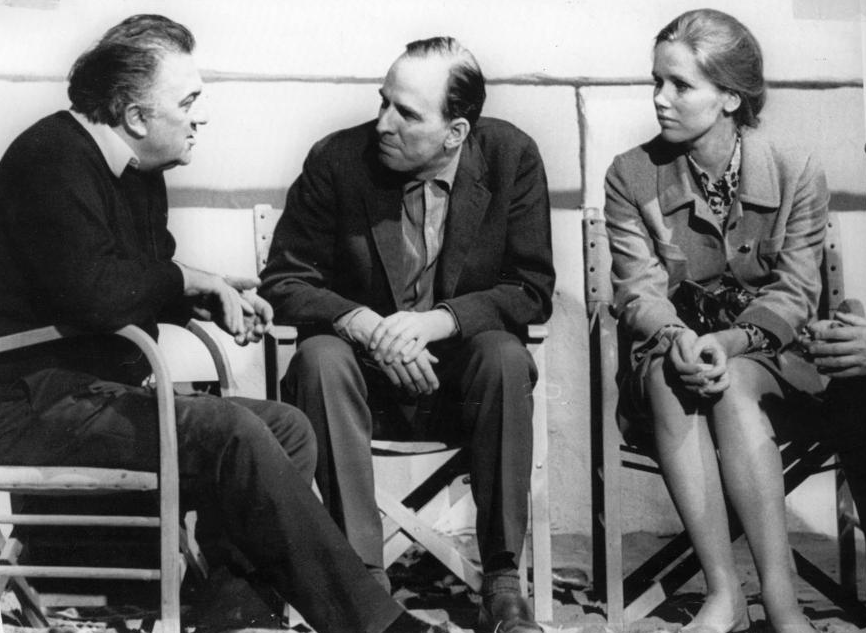 (A photo of Fellini and Bergman, with Liv Ullmann- source)
All about Eve (1950) by Joseph L. Mankiewicz
Sunset Boulevard (1950) by Billy Wilder
In a Lonely Place (1950) by Nicholas Ray
A Streetcar Named Desire (1951) by Elia Kazan
The Big Carnival aka Ace in the Hole (1951) by Billy Wilder
The Life of Oharu (1952) by Kenji Mizoguchi
Ugetsu Monogatari (1953) by Kenji Mizoguchi
A Geisha aka Gion bayashi (1953) by Kenji Mizoguchi
Summer with Monika (1953) by Ingmar Bergman
Roman Holiday (1953) by William Wyler
La Strada (1954) by Federico Fellini
On the Waterfront (1954) by Elia Kazan
Rear Window (1954) by Alfred Hitchcock
Dial M for Murder (1954) by Alfred Hitchcock
Smiles of a Summer Night (1955) by Ingmar Bergman
The Killing (1956) by Stanley Kubrick
The Trouble with Harry (1956) by Alfred Hitchcock
Street of Shame (1956) by Kenji Mizoguchi
Nights of Cabiria (1957) by Federico Fellini
Witness for the Prosecution (1957) by Billy Wilder
12 Angry Men (1957) by Sidney Lumet
Wild Strawberries (1957) by Ingmar Bergman
The Seventh Seal (1957) by Ingmar Bergman
An Affair to Remember (1957) by Leo McCarey
Vertigo (1958) by Alfred Hitchcock
Some Like It Hot (1959) by Billy Wilder
Anatomy of a Murder (1959) by Otto Preminger
So many great films in the 50s. Wonderful period.
My choice.
Why? Because I love lists.
- The 40s:
The Great Dictator (1940)
Casablanca (1942)
Gaslight (1944)
Brief Encounter (1945)
It's a Wonderful Life (1946)
The Killers (1946)
The Best Years of Our Lives (1946)
Bicycle Thieves (1948)
The Treasure of the Sierra Madre (1948)
The Heiress (1949)
- The 50s:
All about Eve (1950)
Sunset Boulevard (1950)
A Streetcar Named Desire (1951)
On the Waterfront (1954)
Witness for the Prosecution (1957)
12 Angry Men (1957)
Nights of Cabiria (1957)
Wild Strawberries (1957)
The Seventh Seal (1957)
Vertigo (1958)
- The 60s:
The Apartment (1960)
Psycho (1960)
Winter Light (1963)
8 ½ (1963)
The Woman in the Dunes (1964)
Dr. Strangelove or: How I Learned to Stop Worrying and Love the Bomb (1964)
My Fair Lady (1964)
Persona (1966)
Blowup (1966)
2001: A Space Odyssey (1968)
- The 70s:
The Private Life of Sherlock Holmes (1970)
Cries and Whispers (1972)
The Godfather (1972)
Last Tango in Paris (1972)
The Godfather Part II (1974)
The Conversation (1974)
Chinatown (1974)
Dog Day Afternoon (1975)
Taxi Driver (1976)
Annie Hall (1977)
- The 80s:
Raging Bull (1980)
On Golden Pond (1981)
Sophie's Choice (1982)
Ran (1985)
Rain Man (1988)
The Accused (1988)
My Left Foot (1989)
Monsieur Hire (1989)
Sex, Lies, and Videotape (1989)
Dekalog (1989)
- The 90s:
Goodfellas (1990)
The Double Life of Veronique (1991)
The Silence of the Lambs (1991)
Raise the Red Lantern (1991)
Three Colours: Blue (1993)
To Live (1994)
Pulp Fiction (1994)
The Shawshank Redemption (1994)
Happy Together (1997)
Festen (1998)
- The 2000s:
Memento (2000)
The Pianist (2002)
Spring, Summer, Fall, Winter... and Spring (2003)
2046 (2004)
Million Dollar Baby (2004)
Brokeback Mountain (2005)
Babel (2006)
There Will Be Blood (2007)
Before the Devil Knows You're Dead (2007)
The Curious Case of Benjamin Button (2007)
(originally posted on 17/10/2014).
Such a list only shows how little I've watched (very often, an excellent film is not mentioned here simply because I haven't watched it), but I'm shamelessly making and publishing it anyway. The ones in bold type are masterpieces and strong favourites, and will certainly remain in the list (in other words: will not be removed at any cost), the other films can be replaced when I discover/ remember something greater.
- The 40s:
The Great Dictator (1940)
The Philadelphia Story (1940)
Casablanca (1942)
Gaslight (1944)
Brief Encounter (1945)
It's a Wonderful Life (1946)
The Killers (1946)
The Best Years of Our Lives (1946)
The Bicycle Thief (1948)
The Heiress (1949)
- The 50s:
All about Eve (1950)
Sunset Boulevard (1950)
In a Lonely Place (1950)
A Streetcar Named Desire (1951)
On the Waterfront (1954)
The Killing (1956)
Witness for the Prosecution (1957)
12 Angry Men (1957)
Vertigo (1958)
Anatomy of a Murder (1959)
- The 60s:
The Apartment (1960)
Psycho (1960)
Vivre sa vie (1962)
The Insect Woman (1963)
8 ½ (1963)
The Woman in the Dunes (1964)
Dr. Strangelove or: How I Learned to Stop Worrying and Love the Bomb (1964)
My Fair Lady (1964)
Blowup (1966)
2001: A Space Odyssey (1968)
- The 70s:
The Private Life of Sherlock Holmes (1970)
The Godfather (1972)
Last Tango in Paris (1972)
The Godfather Part II (1974)
The Conversation (1974)
Chinatown (1974)
Dog Day Afternoon (1975)
Scent of a Woman (1975)
Taxi Driver (1976)
Autumn Sonata (1978)
- The 80s:
Raging Bull (1980)
On Golden Pond (1981)
Sophie's Choice (1982)
Scarface (1983)
Ran (1985)
Rain Man (1988)
The Accused (1988)
A Short Film About Love (1988)
My Left Foot (1989)
Monsieur Hire (1989)
- The 90s:
Goodfellas (1990)
The Silence of the Lambs (1991)
Raise the Red Lanterns (1991)
A Few Good Men (1992)
To Live (1994)
The Shawshank Redemption (1994)
Titanic (1997)
Happy Together (1997)
Central do Brasil (1998)
Magnolia (1999)
- The 2000s:
Memento (2000)
À la folie... pas du tout (2002)
The Pianist (2002)
Spring, Summer, Fall, Winter... and Spring (2003)
2046 (2004)
Million Dollar Baby (2004)
Brokeback Mountain (2005)
There Will Be Blood (2007)
Before the Devil Knows You're Dead (2007)
The Curious Case of Benjamin Button (2007)
Comment!
We all have certain genres, certain kinds of films or books that aren't really our thing, don't we? Not that they're generally bad or inferior to others, we're just not into them. But there are always exceptions. So here is the list of genres I'm generally not interested in*, and some exceptions** (= those I like, which means that the films I find good but don't particularly like, e.g Gravity, Interstellar, Clueless, Audition, The Fly, Moonrise Kingdom, Little Miss Sunshine... won't be included).
- Sci-fi films/ books, including dystopian works:
2001: A Space Odyssey (Stanley Kubrick)
A.I. Artificial Intelligence (Steven Spielberg)
A Clockwork Orange (Stanley Kubrick)
Never Let Me Go (Kazuo Ishiguro)
1984 (George Orwell)
Brave New World (Aldous Huxley)
- Superhero films:
The Dark Night (Christopher Nolan)
Iron Man (Jon Favreau)- 1
The Amazing Spider-Man (Marc Webb)- 1
- Action films:
The Bourne Identity (Doug Liman)
The Bourne Supremacy (Paul Greengrass)
The Bourne Ultimatum (Paul Greengrass)
Léon: The Professional (Luc Besson)
Mission: Impossible film series
The Fast and the Furious film series
Casino Royale (Martin Campbell)
- Crime/ mystery/ detective novels:
"Sherlock Holmes" stories (Arthur Conan Doyle)
The Moonstone (Wilkie Collins)
- Post-1960s romantic comedy films:
Play It Again, Sam (Herbert Ross)
10 Things I Hate About You (Gil Junger)
Silver Linings Playbook (David O. Russell)
Enchanted (Kevin Lima)
L'Étudiante (Claude Pinoteau)
Hors de prix (Pierre Salvadori)
Amélie (Jean-Pierre Jeunet)
- Teen films/ young adult fiction:
10 Things I Hate About You (Gil Junger)
The Virgin Suicides (Sofia Coppola)
Mean Girls (Mark Waters)
Juno (Jason Reitman)
The Perks of Being a Wallflower (Stephen Chbosky)- the film
The Catcher in the Rye (J. D. Salinger)***
- Children books/ films:
The Little Prince (Saint- Exupéry)
Tottochan: The Little Girl at the Window (Tetsuko Kuroyanagi)
Andersen's tales
Harry Potter books and films
- Cartoons/ animations:
Ratatouille (Brad Bird)
A Christmas Carol (Robert Zemeckis)
Corpse Bride (Tim Burton, Mike Johnson)
- Horror films:
Psycho (Alfred Hitchcock)
Ringu (Hideo Nakata)
The Tenant (Roman Polanski)
What's your list?
*: Don't be surprised to find many classics missing here. I'm generally not into these genres, you see.
**: By "some", I mean there are definitely some others I like but right now can't remember. So suggest some titles, maybe I just forgot about them.
***: I'm not sure it should be there. This book is not merely about teen angst, but if you count all books that have a teen protagonist then I suppose it can be included.
Currently reading "Notes from
underground" by Dostoyevsky, translated by Richard Pevear and Larissa
Volokhonsky.
1/ The 1st line of chapter 1 is: "I am a
sick man... I am a wicked man. An unattractive man."
Reminds me of the 1st line of "Invisible
man": "I am an invisible man..."
Besides this, and the fact that both
narrators stay underground, I haven't seen anything else these 2 books have in
common.
2/ The 1st line of chapter 2 is: "I
would now like to tell you, gentlemen, whether you do or do not wish to hear
it, why I never managed to become even an insect. I'll tell you solemnly that I
wanted many times to become an insect. But I was not deemed worthy even of
that."
Is this an inspiration for Kafka's "The
metamorphosis"?
3/ In chapter 7, Dostoyevsky launches attacks
on and makes fun of Henry Thomas Buckle, who naively asserts that "man gets softer from
civilisation and, consequently, becomes less bloodthirsty and less capable of
war".
Reminds me of something Allen Ginsberg said
that is quoted in "The electric kool-aid acid test" (Tom Wolfe), that
no one wants war and conflicts only arise from misunderstanding and if people
can just sit down and sort out the misunderstanding, they can avoid war. Such
childish, simplistic mindset!
4/ Chapter 8, which stresses over and over
again that human beings do not always use reason and cannot strictly follow
some rational calculations and do the most profitable things all the time
because we are human beings and not piano keys (an attack on utilitarianism?), makes me
think of Stanley Kubrick's film "A clockwork orange", in which the
leading character is 'cured' by a machine and meant to be a good citizen who
commits no crime, yet he no longer has free will and the machine has turned him
into a machine.
5/ Dostoyevsky's 'analysis' of the need for
or even the enjoyment of suffering is an answer to the people who insist on
forgetting sadness, avoiding negativity and looking at the bright side. This
need is essential to us, to our wholeness, our growth, as much as foibles,
stupidity and senselessness are a part of our nature which we cannot deny.
Update at 6.44pm:
6/ The bumping scene between the underground man and the officer in part 2 right away revokes images from "Invisible man". My hunch was right, there are more similarities between these 2 works. Though the word "invisible" doesn't appear in "Notes from underground", the same idea is there, the narrator is unseen.
On a side note: whether I can develop it and use for my essay is another story, because their invisibility is different. In Ralph Ellison's narrator's case, he's unseen in the sense that people look at him and see the reflections of their own stereotypes and prejudices, or see him as a representation, an emblem, of something, instead of seeing his individuality. The underground man, on the other hand, is unseen because of people's loathing or his inferior status (unsuccessful), according to him, or simply because he's alienated from society.
7/ Chapter 5 of part 2, an absurd situation with all the trouble about money, somehow makes me think of "Hunger", though I'm not sure if there's any equivalent scene in the Knut Hamsun book.
8/ The meeting of the former schoolmates, I can't read without thinking of a similar scene in "Mrs Dalloway" (Virginia Woolf). All the old feelings come back, all the dislike, all the feeling of inferiority and diffidence. Of course, closely linked to it is my own visualisation of future meetings between me and my former classmates (though the bright side is that such meetings are unlikely to happen, considering that I live in another country and they probably have left as well).
9/ "Notes from underground" has humour, a kind of Kafka-like humour that I didn't find in "Crime and punishment".
In fact, though for now I'm not able to put it into words, due to my own inadequacy, the more I read Kafka and Dostoyevsky, the more similar they appear, and I can see why Kafka regards Dostoyevsky as 1 of his blood relatives.
10/ Before I finish reading, I already feel the need to reread the whole book right after finishing it.
11/ If I'm not mistaken, "Taxi driver" was inspired by this book. Indeed, it's not difficult to see: alienation, loneliness, depression, self-loathing, misanthropy, bitterness, rage, contradiction, etc.
Update at 11.05pm:
12/ Another time the underground man compares himself to a fly, and another time, a bug.
13/ The comparison may be a bit forced, but the dinner scene is reminiscent of the film "Inside Llewyn Davis". Like the narrator here, Llewyn Davis is, by general standard, a loser, and he's aware of it, but at the same time still has a contradictory feeling, a feeling of superiority. He dislikes his present life and cannot get anywhere better, for he's not talented enough, but he has a contemptuous look when sitting in a corner, listening to other people, such as Jim and Jean, or when singing Jim's song.
Something I understand very well.
It's tragic, good taste, or the ability to recognise genius and distinguish between talent and the absence of it, doesn't always go hand in hand with talent.
But then I digress. That sentence fits "Inside Llewyn Davis" only, or, what do the Coen bros mean? is he meant to be a small talent, or a misunderstood artist? Maybe it only fits me. But definitely not the narrator in "Notes from underground". His intelligence and hypersensitivity are the reasons he cannot connect to the people around him.
14/ Intelligence and hypersensitivity and high consciousness. Now doesn't this sound like Salinger's Seymour Glass?
15/ Strange, now instead of writing an in-depth analysis of "Notes from underground", I throw out heaps of names in your face, like a pretentious ass. Can't help it though.
Update on 11/3, 11.58am:
16/ "What was to be done?" in chapter 5 of part 2 is clearly an allusion to "What is to be done?" by Nikolai Chernyshevsky, the book to which "Notes from underground" is said to respond.
17/ I notice the monologue about a father's love for his daughter in chapter 6 is like what Mr Norton says about his daughter in "Invisible man", except that in Ralph Ellison's book, the love is pushed to the extreme, bordering on incest.

