Pages

Showing posts with label Akira Kurosawa. Show all posts

Thursday, 9 April 2026

What makes a good screen adaptation?

I have seen 7 screen adaptations of Anna Karenina. That probably tells you I’m a bit mad. But as a lover of literature and cinema, I’m also fascinated by adaptations—what makes a good one? 

Let’s start with Anna Karenina. Among the 7 versions I have seen, the best is without doubt the 1977 series by the BBC, with Nicola Pagett. We all know filmmakers have to make cuts, we all know filmmakers have to simplify the story, but the problem with most adaptations of Anna Karenina is that they don’t convey the complexity of the characters—Karenin in early adaptations tends to be portrayed as a monster whereas Karenin in some later adaptations is portrayed more sympathetically, with Anna and Vronsky presented as shallow and selfish—the 1977 series is the only one which depicts the complexity and self-contradictions and multiple facets of Anna, Karenin, and Vronsky; the only one which reminds me of the qualities for which I love Tolstoy’s novel. 

If we talk about War and Peace, Bondarchuk’s film series from 1966-1967 is popular, but I would argue that it only focuses on the epic-ness of the book. It is technically spectacular but shallow and hollow, stripping the story of depth and complexity, removing Tolstoy’s philosophical and religious ideas, reducing Pierre’s search for meaning, simplifying the “thinking characters” (Pierre and Andrei), paying little attention to emotional conflicts between characters, etc. The 1972 series by the BBC, though imperfect, shows a much better understanding of Tolstoy’s characters and ideas, and respect for the text. 

This doesn’t mean I think only faithful adaptations are worthwhile, doesn’t mean I think filmmakers have to be slaves to the sources. When I complain about film adaptations, people sometimes accuse me of being a purist, but I’m not. I find it fascinating when a classic story is moved to a different setting, a different culture: the story of Dangerous Liaisons for instance is moved from 18th century France to feudal Korea in Untold Scandal, and modern-day America in Cruel Intentions; Fingersmith, set in the Victorian era, is adapted into South Korean film The Handmaiden

Sometimes it doesn’t work quite well: Bride and Prejudice does a few clever things, moving the story of Pride and Prejudice to modern-day India and making Mr Darcy American, and it’s fun enough, but it doesn’t have the sense of urgency of Jane Austen’s novel, either in the sisters getting married or in the Wickham sub-plot; the Mrs Bennet character is therefore just vulgar and annoying; and Lalita (the equivalent of Elizabeth Bennet) comes across as nationalistic and more confrontational than witty, which gets tiresome after a while. But sometimes it works wonders: in Ran and Arashi ga oka, Kurosawa and Yoshida take King Lear and Wuthering Heights respectively as a starting point, and create something different, something very Japanese, something that stands on their own. As I wrote in a recent blog post about Wuthering Heights, Arashi ga oka is its own thing—Onimaru is not Heathcliff; Kinu is not Catherine; Hidemaru is not Hindley; Mitsuhiko is not Edgar Linton; Tae is not Isabella; Yoshimaru is not Hareton; young Kinu is not Cathy—the characters can be mapped onto Emily Bronte’s characters but they are different and their relationships are different. And yet it captures the violence, savagery, eroticism, and strangeness of Emily Bronte’s novel, which the supposedly faithful adaptations of Wuthering Heights don’t do, as most adaptations only focus on the love story, reduce the malice and brutality, and often cut the second generation.

A similar example is Clueless: loosely based on Emma and set in an American high school, it is its own thing, loved by both Jane Austen’s fans and people who have no idea it’s inspired by a 19th century novel; yet at the same time, Amy Heckerling captures the essence of Austen’s novel much better than some supposedly faithful adaptations do. What I mean is that Emma might be snobbish, she might misperceive everything, she might make a mess of people’s lives, but she means well and wants to do good and has self-reflection—we also see this in Cher in Clueless, whereas Anya Taylor-Joy and especially Gwyneth Paltrow portray Emma as bitchy, catty, even two-faced, nothing like Austen’s character. 

The trouble is that most screen adaptations are not faithful adaptations which take the text seriously and show great understanding of the source story (such as the 1995 Pride and Prejudice); but they are also not interesting adaptations which take the novel as a starting point and become their own work of art (such as Jan Švankmajer’s Alice). Most adaptations are usually somewhere in the middle. 

Take for example the 2005 Pride and Prejudice: it doesn’t transcend its source material and become its own thing; what we have instead is a film which focuses on the attraction and romance but neglects the theme of pride and prejudice, and the development of Elizabeth and Mr Darcy; Matthew Macfadyen’s Darcy doesn’t show much change throughout the story; and Keira Knightley’s Elizabeth often behaves out of character (can you imagine Jane Austen’s Elizabeth eavesdropping on her family members then bursting in on them? Or watching Georgina behind a door then running away like an intruder, with no manners? Or snatching a letter from her father’s hand?).

Or, take the 1999 Mansfield Park: it takes liberties but doesn’t become an original work of art; it’s just an awkward adaptation by someone who doesn’t accept Fanny Price as written by Jane Austen and turns her into something else, and has her accepting Henry Crawford at first, going against the text.

The 2022 Persuasion also seems to be an odd thing that is neither approach: perhaps I shouldn’t comment as I haven’t seen the whole film, but from what I have seen, it is neither a faithful adaptation, depicting the Regency era, nor an independent film with the story moved to the modern era; instead, Carrie Cracknell has characters of different skin colours wearing Regency costumes but speaking modern slang, and changes the character of Anne Elliot beyond recognition (it is perhaps aimed at the audience of Bridgerton).

And this is something lots of people don’t seem to understand: whenever someone criticises a film adaptation for misrepresenting or betraying the text, some people just say fidelity is unimportant and the film is its own work of art, but most of the time it isn’t—most of the time it doesn’t have enough strengths and originality, most of the time it doesn’t transcend its source material—all we’ve got is just a poor film that doesn’t quite transfer a great work of art onto the screen. 


10 favourite adaptations of literary works (in chronological order): 

  • Rebecca (1940) 
  • The Innocents (1961), from The Turn of the Screw 
  • Tom Jones (1963) 
  • Woman in the Dunes (1964) 
  • Anna Karenina (1977) 
  • Ran (1985), from King Lear 
  • Arashi ga oka (1988), from Wuthering Heights 
  • Alice (1988), from Alice’s Adventures in Wonderland 
  • The Age of Innocence (1993)
  • Pride and Prejudice (1995) 

Sunday, 31 August 2025

Why read/ watch plays? (P.3): Plays vs films

Before we begin, I’m going to say that I’m talking about plays in the broad sense: not only live performances but also texts and filmed plays and audio recordings (“Let’s hear a play”); I however exclude musicals.

If we compare cinema and theatre (in the sense of live performance), we can all name the advantages of theatre: the nearness of the audience to the actors, the interaction and immediacy, the fact that no two performances are the same. But if we compare cinema and drama (in the broad sense), I’m afraid most people would only talk about the advantages of cinematic language: the language of image, large scenes, visual effects, and above all, editing and the close-up. It is derogatory when a film or TV series is described as “stagey”; what’s the equivalent for the other way around? 

I myself have loved literature and cinema all my life—my interest in drama is relatively new—but I love Shakespeare. That’s why I want to examine these questions: are films actually superior to plays, or is cinematic language superior to the language of drama, as the derogatory use of “stagey” seems to suggest? What do plays do better than films?

Now you may argue that the word “stagey” only suggests that a film should use cinematic language, but let’s look at the word when it’s used for TV. In the past, TV series, especially TV adaptations of classic novels, were modelled after theatre; now they’re modelled after films, meaning that they’re now meant and expected to be cinematic. Look at the 1972 War and Peace or 1977 Anna Karenina for example. Some people disparage them as stagey, and in some ways these TV series are closer to plays—lots of dialogue and minimal camerawork—but this also means that the screenwriters and directors pay more attention to dialogue and let the scenes unfold. Both series are excellent adaptations that take Tolstoy’s novels seriously and convey the complexity of the characters. Now if you look at the 2013 TV adaptation of Anna Karenina, you can see that it’s modelled after cinema and dialogue is devalued. And I can’t help asking, why do they keep moving the camera? Why do they cut every 4 seconds? (I counted) Why do they not let the scene unfold? I couldn’t even watch beyond 5-10 minutes of the 2018 King Lear for the same reasons, despite my admiration for Anthony Hopkins and Florence Pugh as actors. 

I’m not saying that screen adaptations of classic novels should be closer to plays, nor that they shouldn’t employ cinematic language. I’m also not saying that I’m mainly interested in drama driven by dialogue, driven by words (as my friend Himadri would probably say, who loves plays more than films). But dialogue is increasingly devalued in our mainly visual world—the word “stagey” reflects that—and that I find very sad. 

Films and plays do different things and have different strengths—I love both. In a film, the story and conflict are driven by many things, including dialogue (which some filmmakers unfortunately seem to forget). In a play, drama is driven by dialogue: what we say and what we don’t say and how we say it and how we hide or deceive with words. 

Persona or Cries and Whispers for instance has to be a film—it would not work as a novel or a play or an audio performance. Conversely, Rosmersholm has to be a play—you could of course turn it into a film, but its ambiguity and intricacies cannot be communicated by image or cinematic language. 

And when I watch Shakespeare, which I can’t watch live all the time (I’m just a poor girl, from a poor family), the choice would more often be a recording of a live performance, or a filmed play (like the BBC Television Shakespeare from the 1970s-80s), than a film adaptation. Sometimes a Shakespeare film respects the text, such as the 1993 and 2012 Much Ado About Nothing. Very often, Shakespeare’s words are heavily cut. Chimes at Midnight on its own is probably a passable film, but Orson Welles condenses into two hours the two Henry IV plays, with some bits from Richard II, Henry V, and The Merry Wives of Windsor. The result is a Falstaff—Welles—film with lots of supporting characters: all the others are underdeveloped, but even Falstaff is sentimentalised and simplified. 

Some Shakespeare films also indicate something like a fear of words. The 2015 Macbeth—perhaps I’m being unfair as I didn’t watch all of it—breaks into pieces the “Tomorrow, and tomorrow, and tomorrow” speech, mixing in flashbacks and battle scenes and special effects and drowning music. The main actors, Michael Fassbender and Marion Cotillard, also don’t know how to speak the words. 

Even when we look at Kurosawa’s adaptations of Shakespeare, Ran is a masterpiece, a work of art on its own separate from King Lear, but Throne of Blood is shallow compared to Macbeth: stripped of much dialogue, it is an exciting film, but doesn’t have the complexity of Macbeth; the main characters are reduced to a weak man urged on by an evil wife. Now you might say Throne of Blood uses cinematic language and I should judge it as a film, so I would say that it is not a profound, thought-provoking film. 

Now I have seen many film adaptations of plays, it would be interesting to watch play adaptations of films. 

Friday, 18 August 2023

My 10 favourite films (2023 list)

One film per director. 

Persona (dir. Ingmar Bergman)  

Sunset Boulevard (dir. Billy Wilder) 

Ran (dir. Akira Kurosawa) 

Casablanca (dir. Michael Curtis) 

A Star Is Born (dir. George Cukor) 

The Conversation (dir. Francis Ford Coppola) 

The Phantom of Liberty (dir. Luis Bunuel) 

The Flavour of Green Tea over Rice (dir. Yasujiro Ozu) 

Raise the Red Lantern (dir. Zhang Yimou) 

F for Fake (dir. Orson Welles) 


Wednesday, 22 September 2021

King Lear revisited

What can I possibly say about King Lear that hasn’t been said over the past 4 centuries? But I’m going to try anyway, and try to poke at it from different angles, because I first read King Lear several years ago at Universitetet i Oslo and didn’t like it very much at the time, and this is a rereading.


1/ I notice that Edmund uses a similar technique with Gloucester as Iago has used to manipulate Othello: he throws out something to get him intrigued, then pretends that it’s nothing or that he shouldn’t say, to make the listener more and more curious, then offers some fake proof and manipulates him in a subtle way. Contrast them both with Don John in Much Ado About Nothing: Don John is more direct and not so subtle, but he has a collaborator to add to his story, and also offers something that looks like more proof. 

Edmund and Iago are more similar, but unlike Iago, Edmund has his causes. 

“EDMUND Thou, Nature, art my goddess, to thy law

My services are bound. Wherefore should I

Stand in the plague of custom, and permit 

The curiosity of nations to deprive me,

For that I am some twelfth or fourteen moonshines

Lag of a brother? Why bastard? Wherefore base? 

When my dimensions are as well compact,

My mind as generous, and my shape as true, 

As honest madam’s issue? Why brand they us

With base? With baseness? Bastardy? Base? Base?

Who, in the lusty stealth of nature, take

More composition and fierce quality

Than doth, within a dull, stale, tired bed,

Go to th’ creating a whole tribe of fops

Got ‘tween asleep and awake? […]

Now, gods, stand up for bastards.” 

(Act 1 scene 2)

That is a great soliloquy. He is justifying his anger and his scheme, and he is convincing. I note that Edmund addresses Nature and gods, and later on Lear also addresses Nature and goddess when cursing Goneril.  

“LEAR […] Hear, Nature, hear; dear Goddess, hear: 

Suspend thy purpose of thou didst intend

To make this creature fruitful. 

Into her womb convey sterility.

Dry up in her the organs of increase,

And from her derogate body never spring

A babe to honor her. If she must teem,

Create her child of spleen, that it may live

And be a thwart disnatured torment to her.

Let it stamp wrinkles in her brow of youth,

With cadent tears fret channels in her cheeks,

Turn all her mother’s pains and benefits

To laughter and contempt, that she may feel

How sharper than a serpent’s tooth it is

To have a thankless child. Away, away!” 

(Act 1 scene 4)

That’s quite a curse (a bit much, no?). Ungrateful and despicable as Goneril is, I can’t help thinking that this says something about Lear.

I put these 2 passages next to each other because it’s interesting that both Edmund (the betrayer) and Lear (the betrayed) think Nature is on their sides.

The word “nature” (with its derivatives “natural” and “unnatural”) and “nothing” seem to be the 2 central words in King Lear, appearing over and over again throughout the play.


2/ More of Lear’s curses. 

“LEAR You nimble lightnings, dart your blinding flames

Into her scornful eyes! Infect her beauty,

You fen-sucked fogs, drawn by the pow’rful sun,

To all and blister her pride.

REGAN O the blest gods!

So will you wish on me when the rash mood is on.” 

(Act 2 scene 4)

Later in the same scene, when Goneril is present, he calls her “a disease that’s in my flesh”, “a boil/ A plague-sore, or embossèd carbuncle/ In my corrupted blood”. This is horrific—it’s hard to read these lines and not think there’s a misogynist in Lear. I’m not defending Goneril and Regan—their villainy and cruelty need not be stated—but Lear’s language is graphic and his curses heavily focus on the body, the female body.

I also can’t help wondering, how was Lear as a king, before renouncing his power? How was he as a father? 


3/ See the thunderstorm.  

“KENT […] Things that love night 

Love not such nights as these. The wrathful skies

Gallow the very wanderers of the dark

And make them keep their caves. Since I was man, 

Such sheets of fire, such bursts of horrid thunder, 

Such groans of roaring wind and rain, I never

Remember to have heard. Man’s nature cannot carry

Th’ affliction nor the fear.” 

(Act 3 scene 2) 

The scene matches, and exceeds, the intensity of the scene of Faustus in hell. Again Lear addresses Nature, but this time it’s different.  

“LEAR Blow, winds, and crack your cheeks. Rage, blow! 

You cataracts and hurricanoes, spout 

Till you have drenched our steeples, drowned the cocks. 

You sulph’rous and thought-executing fires,

Vaunt-couriers of oak-cleaving thunderbolts,

Singe my white head. And thou, all-shaking thunder,

Strike flat the thick rotundity o’ th’ world,

Crack Nature’s molds, all gremains spill at once,

That makes ingrateful man.” 

(ibid.)

This is no longer hatred of one person—Lear is raging against the whole world. It is significant (though Tolstoy doesn’t think so) that Shakespeare creates the subplot of Gloucester, Edmund, and Edgar: Lear’s plight is not the plight of a single man. 

Interestingly, I found this on Wikipedia:

“Edmund and Edgar were also the names of the sons of Malcolm III of Scotland who killed Macbeth. Historically Edmund of Scotland had betrayed his immediate family to support his uncle Donald III. Following the death of Malcolm III from being stabbed in the eye, they ordered the killing of Edmund's half brother Duncan II, the rightful heir, to take the Scottish throne. Edgar, Edmund's younger brother, then returned to Scotland and defeated them to become King. Edmund was then sent to an English monastery where he later died. Due to these clear parallels the choice of Edmund and Edgar as names may have been a nod by Shakespeare to the continued story of the Scottish throne following the events of Macbeth.” 

Macbeth is dated after King Lear though. 


4/ One of the (silly) complaints Tolstoy makes about King Lear is that the characters don’t act the way they should (i.e. realistically) and don’t talk in a natural way. I notice that in the scene where Lear, Kent, and the Fool enter the hovel to hide from the storm, the Fool is rather quiet and barely jokes—is that not realistic? 


5/ I think in my first reading of King Lear several years ago, I missed the significance of the idea of necessities.

Lear gives away his authority and power, and makes himself dependent on the kindness of his daughters Goneril and Regan, but still keeps 100 men. Goneril wants to reduce that by half, then causes trouble to make him leave, whereas Regan insists that she wouldn’t accept more than 25 men at her place. They ask him why he would need more than 25 of his own men, when he can be served by Goneril’s or Regan’s servants. 

“LEAR O reason not the need! Our basest beggars

Are in the poorest thing superfluous 

Allow not nature more than nature needs,

Man’s life is cheap as beast’s. Thou art a lady:

If only to go warm were gorgeous,

Why, nature needs not what thou gorgeous wear’st,

Which scarcely keeps thee warm…”  

(Act 2 scene 4)

There is a storm outside but the daughters don’t budge, so Lear leaves in a rage (dare I say… Lear storms out?). The cruel Regan orders to have the doors shut.

In the open heath in the storm and tempest, Lear’s idea of necessities is slightly changed. Kent suggests seeking shelter in a hovel. Lear turns to the Fool:  

“LEAR […] Come on, my boy. How dost, my boy? Art cold? 

I am cold myself. Where is this straw, my fellow? 

The art of our necessities is strange,

That can make vile things precious.” 

(Act 3 scene 2)  

In the hovel, Lear comes across Edgar, who is hiding from Gloucester’s men and disguising himself as mad Tom o’ Bedlam. Edgar is almost naked, having only some cloth to cover himself, and lives in the hovel.

“LEAR Thou wert better in a grave than to answer with thy uncovered body this extremity of the skies. Is man no more than this? Consider him well. Thou ow’st the worm no silk, the beast no hide, the sheep no wool, the cat no perfume. Ha! here’s three on’s are sophisticated. Thou are the thing itself; unaccommodated man is no more but such a poor, bare, forked animal as thou art. Off, off, you lendings! Come, unbutton here.

[Tearing off his clothes]”

(Act 3 scene 4)

(You may notice where the title of my graduation film No More Than This came from).

From the question of necessities, Shakespeare leads to the big question: What is it to be human? The betrayal, the loss, the suffering force Lear to see things and ask questions that never bothered him before, when he was king and everything revolved around him. 

Now compare this scene to the scene in the hut in Ran (Kurosawa’s loose adaptation of King Lear): the effect is very different that in Ran, the emperor Hidetora (now stripped off everything) meets a young man whom he himself blinded and whose family he killed. Hidetora is forced to face his own cruelties in the past, and feels guilt and remorse. In Shakespeare’s play, Lear meets Edgar and the encounter changes them both: Lear sees Edgar and asks “Is man no more than this?”; Edgar sees Lear suffering, and thinks “How light and portable my pain seems now”; they feel compassion for each other, and for all of humanity. 


6/ Evil in King Lear is extreme. When Goneril and Regan and others discover that Gloucester is a traitor, wanting to reinstate Lear to the throne:

“REGAN Hang him instantly.

GONERIL Pluck out his eyes.”

(Act 3 scene 7)

Having gouged out his eyes, Regan says:

“REGAN Go thrust him out at gates, and let him smell

His way to Dover.” 

(ibid.)

It is a horrible scene, I shuddered at that line. Earlier Lear asks:

“LEAR […] Is there any cause in nature that make these hard hearts?” 

(Act 3 scene 6)

But he probably can’t imagine how evil his daughters can be. But where are the gods?   

“GLOUCESTER […] As flies to wanton boys, are we to th’ gods, 

They kill us for their sport.” 

(Act 4 scene 1) 

It’s no surprise that Goneril and Regan turn against each other.


7/ The scene of Goneril and her husband Albany in Act 4 scene 2 reminds me of Lady Macbeth and Macbeth. Goneril calls Albany “milk-livered man”, Lady Macbeth refers to Macbeth’s “milk of human kindness”. 

I’ve never thought about how Shakespeare went from King Lear to Macbeth: there are similar themes, King Lear has a cosmic vision whereas in Macbeth, Shakespeare digs deeper into the mind; King Lear presents a vision of apocalypse, a world where all bonds are broken and things turn upside down, where father turns away daughter, brother turns against brother, daughters abandon father, son betrays father, servant turns against master, husband and wife fall out, sisters become jealous of each other, and so on, whereas Macbeth depicts the two main characters losing their soul and suffering the torments of hell on earth.

Lady Macbeth feels great guilt, Goneril and Regan are more evil. 

Now I’m idly wondering if it was the same boy actor in Shakespeare’s company who played both Lady Macbeth and either Goneril or Regan. Must have been.  


8/ In Act 4 scene 6, when the mad Lear appears in the field and starts rambling in front of Edgar and Gloucester, we get an idea of what it was like when he was king and everything revolved around him, and how much of a fall it has been after he gave away all power. It’s no wonder that this is his reaction earlier when Goneril starts treating him differently. 

“LEAR Does any here know me? This is not Lear. 

Does Lear walk thus? Speak thus? Where are his eyes?

Either his notion weakens, or his discernings

Are lethargied—Ha! Waking? ‘Tis not so.

Who is it that can tell me who I am?”

(Act 1 scene 4) 

But for me, the ramblings raise 2 questions. Firstly, what happened to Lear’s wife? There’s no mention of her. What was she like? 

Secondly, let’s look at this rant against women: 

“LEAR […] Behold yond simp’ring dame,

Whose face between her forks presages snow,

That minces virtue and does shake the head

To hear of pleasure’s name. 

The fitchew, nor the soilèd horse, goes to ‘t

With a more riotous appetite. 

Down from the waist they are Centaurs,

Though women all above: 

But to the girdle do the gods inherit,

Beneath is all the fiend’s.

There’s hell, there’s darkness, there is the sulphurous pit,

Burning, scalding, stench, consumption; fie, fie, fie! pah, pah! Give me an once of civet; good apothecary, sweeten my imagination: there’s money for thee.” 

(Act 4 scene 6) 

(fitchew= polecat, and slang for prostitute; soilèd= put to pasture, and hence wanton with feeding; Centaurs= lustful creatures, half man and half horse)

Why this rant against women? The undeniably evil Goneril and Regan are women, but so is good Cordelia. Why does Lear have such obsession, such disgust with the female body? 

I don’t buy the cheap explanation that the misogyny is Shakespeare’s—I have read, so far, 22 Shakespeare plays. So where does it come from? 


9/ This is one of the most moving exchanges in literature. 

“LEAR Be your tears wet? Yes, faith. I pray, weep not.

If you have poison for me, I will drink it. 

I know you do not love me, for your sisters

Have, as I do remember, done me wrong.

You have some cause, they have not.

CORDELIA No cause, no cause.” 

(Act 4 scene 7) 

The final scene, the final scene is heart-rending. That moment of Lear with Cordelia’s dead body:

“LEAR And my poor fool is hanged: no, no, no life?

Why should a dog, a horse, a rat, have life? 

And thou no breath at all? Thou’lt come no more,

Never, never, never, never, never…” 

(Act 5 scene 3) 

That made me cry. This and Desdemona’s death must be the most unbearable deaths in literature.

I love the play. 

Sunday, 21 March 2021

Brief thoughts on Throne of Blood

I wonder what I would have thought about Throne of Blood, had I not known Shakespeare’s play—but I do, and love Macbeth. Speaking as a fan of Kurosawa, especially Ran, I was disappointed. 


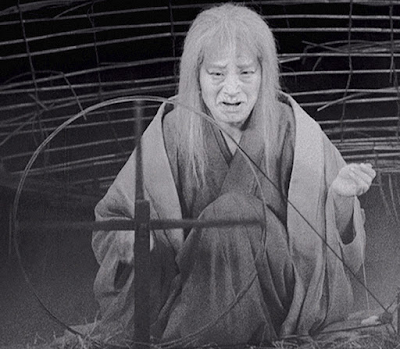
So what is the problem? I shall not talk about the loss of poetry, which is to be expected, and I personally have always been fascinated by film adaptations that move the story to a different setting, a different country and culture, such as Ran (loosely based on King Lear) or Untold Scandal (South Korean, based on Les Liaisons Dangereuses). In many ways, Throne of Blood is an admirable adaptation—the foggy atmosphere works perfectly, and the evil spirit spinning the thread in the deep forest, replacing Shakespeare’s 3 witches, is a haunting image. I just can’t help feeling the loss of poetry because part of its greatness is in the language, and many great lines are no longer there. 

More importantly, I just don’t think Throne of Blood has the psychological depth and complexity of Shakespeare’s play. Isuzu Yamada as Lady Asaji is striking—her face barely moves, almost like she’s not human; her cold-hearted ambition and evil make one think of Lady Kaede in Ran. Unlike Lady Macbeth, Lady Asaji doesn’t seem to struggle with herself or have any vulnerability for a large part of the film. Unlike Lady Macbeth, she doesn’t have to summon spirits to ask them to “fill me from the crown to the toe top-full/ Of direst cruelty. Make thick my blood/ Stop up the access and passage to remorse”, she doesn’t have to justify to herself why she doesn’t do the killing herself, she doesn’t sway from her purpose for a moment. Lady Asaji is too cold, too confident, too calculating and manipulative to descend into madness as in the play, which is why Kurosawa has to invent a reason—her baby, who ends up as a stillborn.


Washizu, played by Toshiro Mifune, doesn’t have the depth of Macbeth either. Because the character of the wife is changed, the nature of their relationship is also changed: in Shakespeare’s play, Lady Macbeth is the one who comes up with the plan and talks Macbeth into doing it, but Macbeth is still the one who commits the murder and she cannot, then afterwards he has to kill more and more people and she is the one to tell him “You must leave this”; the relationship between Washizu and Lady Asaji doesn’t seem to have that kind of complexity as she manipulates him the entire time, she talks him into killing the Lord and then convinces him to kill Niki (the equivalent of Banquo). Compared to Macbeth, Washizu appears weaker and completely controlled by his wife. 

The film also suffers from the loss of soliloquies. We do see Washizu reason against Lady Asaji’s scheme, we do see him struggle with himself, we do see him in shock after he kills the Lord (and realises the enormity of what he’s done). A bit is lost when we don’t have the “If it were done when 'tis done” speech, which shows that Macbeth not only knows all the arguments against killing Duncan but also knows perfectly well it would lead to more blood—he just can’t help it. 

But I think the film does suffer from the loss of 2 great soliloquies, the “Is this a dagger which I see before me” one and the “Tomorrow, and tomorrow, and tomorrow” one. Or perhaps a better way of putting it is that Throne of Blood still works well as a film, it just doesn’t have the psychological depth and complexity of Macbeth, and part of it is because it doesn’t have these soliloquies. 

What do you think? 

Monday, 1 July 2019

On reading Kurosawa’s autobiography

Kurosawa’s Something Like an Autobiography is a terrific book—he writes about his childhood, his life, and his path to become a film director, and the major events that shaped him. 
As a director’s autobiography, it’s more captivating and enjoyable than Bergman’s The Magic Lantern, not because Bergman’s book is tedious, but because a Japanese man’s life is most likely more interesting than a Swede’s. After all, Kurosawa was born in 1910 and lived through WW2, and he’s part of a samurai family! 

This is an essential read if you’re interested in Kurosawa, and Japanese cinema in general. I myself have seen Stray Dog, Rashomon, Ikiru, The Bad Sleep Well, Yojimbo, Sanjuro, High and Low, Ran, and Dreams—9 films. My only regret about the book is that Kurosawa only writes up to Rashomon (released in 1950), so we don’t get to read about the inspiration for, ideas behind, and circumstances of, the later films. 
Having said that, I have learnt quite a bit from the book. 
1/ He quotes Yamamoto Kajiro as saying “If you want to become a film director, first write scripts.” 
Then he goes on to say: 
“… Those who say an assistant director’s job doesn’t allow him any free time for writing are just cowards. Perhaps you can write only 1 page a day, but if you do it every day, at the end of the year you’ll have 365 pages of script. I began in this spirit, with a target of 1 page a day. There was nothing I could do about the nights I had to work till dawn, but when I had time to sleep, every after crawling into bed I would turn out 2 or 3 pages. Oddly enough, when I put my mind to writing, it came more easily than I had thought it would, and I wrote quite a few scripts.” 
Look at this quote from the addendum: 
“With a good script a good director can produce a masterpiece; with the same script a mediocre director can make a passable film. But with a bad script even a good director can’t possibly make a good film. For truly cinematic expression, the camera and the microphone must be able to cross both fire and water. That is what makes a real movie. The script must be something that has the power to do this.” 
2/ About editing: 
“When I reached a certain level of achievement in scriptwriting, Yama-san told me to start editing. I already knew that you can’t be a film director if you can’t edit. Film editing involves putting on the finishing touches. More than this, it is a process of breathing life into the work.”  
This is something I already know. Among the directors I’ve been reading recently, Kieslowski seems to think of filming as collecting raw material to be formed and created on the editing table, whereas Tarkovsky doesn’t seem to think much of editing (which you can tell from his films), and Sidney Lumet says a film is not created on an editing table, you can’t put together things that have not been filmed. I don’t disagree with Sidney Lumet—because I can edit, I think of the edit when writing scripts and planning the shots, and have myself experienced not getting enough shots/ cutaways as well as losing footage. But at the same time, editing is a very powerful tool. With editing, you can improve on an actor’s performance, improve on a scene, shift the focus/ change perspective, juxtapose images to create a new idea/ meaning, manipulate time, restructure the story, and so on. 
In my previous post, I shared Kurosawa’s story of editing Uma
Here he writes about editing Stray Dog
“For example, I understood that in novel-writing certain structural techniques can be employed to strengthen the impression of an event and narrow the focus upon it. What I learned was that in the editing process a film can gain similar strength through the use of comparable structural techniques. The story of Stray Dog begins with a young police detective on his way home from marksmanship practice at the headquarters’ range. He gets on a crowded bus, and in the unusually intense summer heat and crush of bodies his pistol is stolen. When I filmed this sequence and edited it according to the passage of chronological time, the effect was terrible. As an introduction to drama it was slow, the focus was vague and it failed to grip the viewer. 
Troubled, I went back to look at the way I had begun the novel. I had written as follows ‘It was the hottest day of that entire summer.’ Immediately I thought, ‘That’s it.’ I used a shot of a dog with its tongue hanging out, panting. Then the narration begins, ‘It was unbearably hot that day.’ After a sign on a door indicating ‘Police Headquarters, First Division’, I proceeded to the interior. The chief of the First Detective Division glares up from his desk. ‘What? Your pistol was stolen?’ Before him stands the contrite young detective who is the hero of the story. This new way of editing the opening sequence gave me a very short piece of film, but it was extremely effective in drawing the viewer suddenly into the heart of the drama.” 
3/ Life experience is extremely important. 
I think when people criticise student films, people often talk about performances and technical mistakes, which are understandable. But I think most of the time the greater issue is in the story, in the script, and that is mainly because of lack of life experience. 
4/ It’s better to write a script with someone else. Writing alone, you may suffer from one-sidedness; writing with someone else, you have 2 perspectives on a character. 
“Also, the director has a natural tendency to nudge the hero and the plot along into a pattern that is the easiest one for him to direct. By writing with about 2 other people, you can avoid this danger also.” 
5/ In writing a script, avoid explanatory passages. This is called exposition. 
6/ Kurosawa also says: 
“The camera should follow the actor as he moves; it should stop when he stops.” 
7/ Filming with multiple cameras is efficient, but not easy as it may sound—how do you move them? 
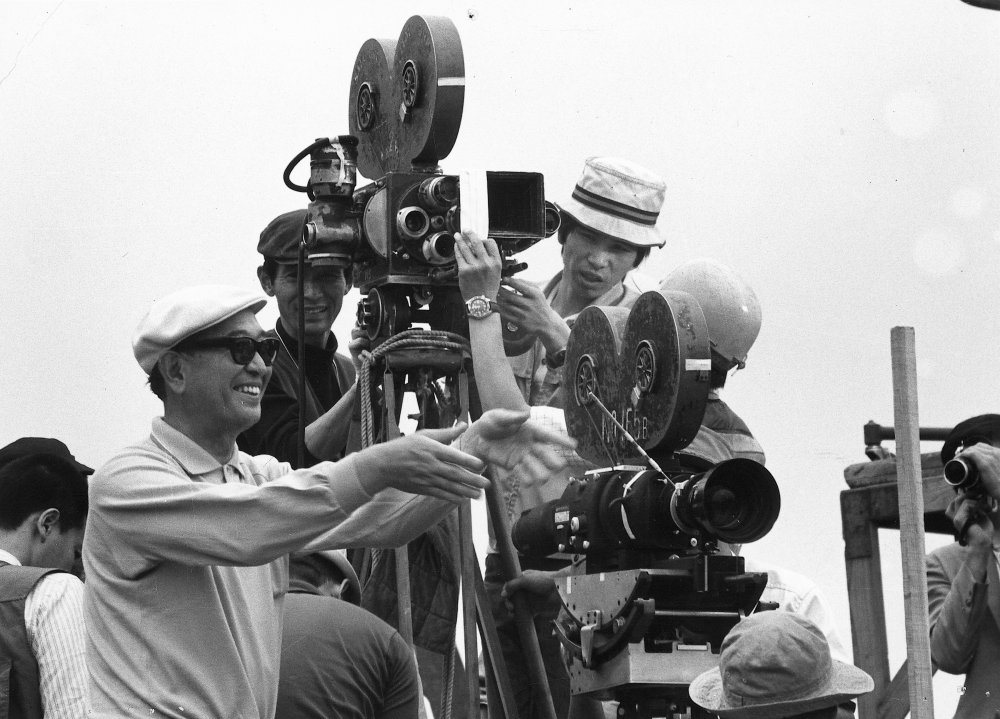
“As a general system, I put the A camera for the most orthodox positions, use the B camera for quick, decisive shots and the C camera as a kind of guerrilla unit.” 
8/ Kurosawa demands authenticity for sets and props, even if they don’t appear on camera. 
“The 1st Japanese director to demand authentic sets and props was Mizoguchi Kenji, and the sets in his films are truly superb. I learned a great deal about filmmaking from him, and the making of sets is among the most important. The quality of the set influences the quality of the actors’ performances. If the plan of a house and the design of the rooms are done properly, the actors can move about in them naturally. If I have to tell an actor ‘Don’t think about where this room is in relation to the rest of the house’, that natural ease cannot be achieved. For this reason, I have the sets made exactly like the real thing. It restricts the shooting, but encourages that feeling of authenticity.” 
In a way, this view is extreme. We all know that in films, for convenience and for freedom with camera angles, filmmakers can have moving walls or use a set without ceiling, or film at multiple locations and make them look like different parts of the same location. For example, for Dekalog 6/ A Short Film About Love, Kieslowski used 17 locations because he couldn’t find 2 apartments in 2 blocks opposite each other. 
Nevertheless, Kurosawa’s right that the quality of the set influences the quality of the actors’ performances. This is why I strongly dislike Hollywood’s excessive use of green screen and CGI. People excitedly share behind-the-scenes videos of Hollywood blockbusters, especially fantasy and sci-fi films, and I just think, what’s the fun of filming amidst all that green? 
9/ The last point is interesting—when choosing music for films, try counterpoint. Sometimes it can work a lot better.

Saturday, 29 June 2019

Kurosawa on film editing

I’ve been reading Akira Kurosawa’s Something Like an Autobiography (translated by Audie E. Bock). It’s a very good book, an essential book if you like Kurosawa’s films. 
Here is what he says about editing: 
“I learned a mountain of things about editing from Yama-san, but I think the most vital among them is the fact that when you are editing, you must have the intelligence to look at your own work objectively. The film that Yama-san had laboured painfully to shoot he would cut to pieces as if he were a total masochist. He’d always come into the editing room with a joyful look on his face and say things like, ‘Kurosawa, I thought it over last night, and we can cut that so-and-so scene’, or ‘Kurosawa, I thought it over last night and I want you to cut the 1st half of such-and-such a scene’, ‘We can cut’ ‘I want you to cut!’, ‘Cut!’ Yama-san in the editing room was a bona-fide mass murderer. I even thought on occasion if we were going to cut so much, why did we have to shoot it all in the 1st place? I, too, had laboured painfully to shoot the film, so it was hard for me to scrap my own work. 
But, no matter how much work the director, the assistant director, the cameraman or the lighting technicians put into a film, the audience never knows. What is necessary is to show them something that is complete and has no excess. When you are shooting, of course, you film only what you believe is necessary. But very often you realise only after having shot it that you didn’t need it after all. You don’t need what you don’t need. Yet human nature wants to place value on things in direct proportion to the amount of labour that went into making them. In film editing, this natural inclination is the most dangerous of all attitudes. The art of the cinema has been called an art of time, but time used to no purpose cannot be called anything but wasted time. Among all the teachings of Yama-san on film editing, this is the greatest lesson.” 
Yama-san is Yamamoto Kajiro, a Japanese film director who is now mostly known as the mentor of Kurosawa. 
Kurosawa goes on to talk about Uma (Horses), “which I had co-scripted and which Yama-san had put entirely in my hands for cutting.” 
“There is one place in the story where a foal has been sold and the mare frantically searched for her baby. Completely crazed, she kicks down her stable door and tries to crawl under the paddock fence. I edited the sequence most diligently to show her expressions and actions in a dramatic way. 
Bu when the edited scene was run through a projector, the feeling didn’t come through at all. The mother horse’s sorrow and panic somehow stayed flat behind the screen. Yama-san had sat with me and watched the film as I was editing any number of times, but he never said a word. If he didn’t say ‘That’s good’, I knew it meant it was no good. I was at an impasse, and in my despair I finally begged his advice. He said ‘Kurosawa, the sequence isn’t drama. It’s mono-no-aware.’ Mono-no-aware, ‘sadness at the fleeting nature of things’, like the sweet, nostalgic sorrow of watching the cherry blossoms fall—when I heard this ancient poetic term, I was suddenly struck by enlightenment as if waking from a dream. ‘I understand!’ I exclaimed and set about completely re-editing the scene. 
I put together only the long shots. It became a series of glimpses of a tiny silhouette of the galloping mare, her mane and tail flying in the wind on a moonlit night. All that alone proved sufficient. Even without putting in any sound, it seemed to make you hear the pathetic whinnying of the mother horse and a mournful melody of woodwinds.” 
That’s a very interesting point.

Saturday, 1 June 2019

On Sidney Lumet (and other directors)

I’m reading Sidney Lumet’s Making Movies, which I think is a very good and enjoyable book, especially for aspiring film directors. 
Look at this: 
Image may contain: text that says "dialogue. Dialogue is not uncinematic. So many of movies of the adore are con- stant streams of dialogue. course remember James Cag- ney squashing a grapefruit Mae Clarke's face. But does that affectionate memory than "Here's kid"? knows Chaplin anized feeder in Times is I've ever laughed harder gag. But at the end of Some Like It Hot, E. says to Jack Lemmon, nobody' perfect." The is no between the and the Why not the best of both? I'll go further. love long speeches. of the the studio resisted doing Network"
Isn’t that such a good “defence” of dialogue? The writer-director who has created the most memorable lines is Billy Wilder, who has 3 contenders for the best closing lines of all time—The Apartment (“Shut up and deal”), Some Like It Hot (“Nobody’s perfect”), and Sunset Boulevard (“All right, Mr. DeMille, I'm ready for my close-up”). Dialogue is not uncinematic. It is only uncinematic when it is superfluous exposition, and worst if it’s the director’s way of explaining the film to the audience (which is common in Christopher Nolan’s films). 
Now look at this passage: 
Image may contain: text
That is fascinating and scary at the same time—would I be able to tell? 
The book offers some invaluable insight and advice about directing. I admire Sidney Lumet immensely, and now love him even more as I read the book. He is not an auteur, he might not even be seen as a stylist, but does it matter? I would say that 12 Angry Men and Dog Day Afternoon are masterpieces, and Before the Devil Knows You’re Dead is a great, heartbreaking film that should be better known. Many of his other films are also highly acclaimed, such as Serpico, The Verdict, Network, Murder on the Orient Express, Long Day’s Journey into Night... Why are some other directors ranked higher just because their films are more stylistic or technically more impressive? 
That leads me to another point: is the ability to work with actors not important? The directors who I think are masters at getting the best performances out of actors are Ingmar Bergman, Elia Kazan, Sidney Lumet, and Francis Ford Coppola. And perhaps Roman Polanski (Adrien Brody never had anything remotely as good as his performance in The Pianist). 
Some other directors who are also good at working with actors are Billy Wilder, Clint Eastwood, Martin Scorsese, Zhang Yimou, Krzysztof Kieslowski… (I don’t include Kurosawa and Mizoguchi because Japanese acting is a different style). 
As you follow a director’s work, you realise what their main strengths are—they are better at some aspects of filmmaking than others. Fellini’s main strengths, for example, are in blocking/staging, cinematography, and visual storytelling. Billy Wilder’s are in story, structure/ pacing, dialogue, and working with actors. Orson Welles’s are in cinematography (especially lighting), structure, editing, and sound. Luis Bunuel’s are in story/ plot, ideas, and pacing. Andrei Tarkovsky’s are in ideas, cinematography, sound, and atmosphere. 
You also notice, not weaknesses, but that some aspects don’t interest a director as much as others. There isn’t much to say about cinematography and lighting in Luis Bunuel’s films, for example; or editing in Tarkovsky’s; or story in Wong Kar-wai’s.  
It is not without reason that I think Ingmar Bergman’s the best director of all time, because his films do have everything—good story, interesting idea, depth, pacing, great cinematography (especially lighting), great sound, great editing (most notably in Persona), good production design (at least in Cries and Whispers and Fanny and Alexander), wonderful performances, good visual storytelling, experiments… But usually, directors have their strengths, and they may be weaker, or at least not as spectacular, in some other aspects of filmmaking, so why is it that directors who are good at techniques valued much more highly than directors who are good at drama (emotional complexity in a scene, and pacing for the film as a whole) and working with actors? 
When a film looks good, it is visually pleasing, but at the end of the day, so what? I like good acting. I like touching stories. I like films that make me see life differently and learn something about myself. I never use the word “great” for directors like Quentin Tarantino or Wes Anderson—they’re good at what they do, and their films are entertaining, but have no depth and offer no more than that. But even if we talk about Stanley Kubrick, a director I admire very much when it comes to techniques (especially the production design, cinematography, and use of music), none of his films has ever touched me on an emotional, personal level like 12 Angry Men or Dog Day Afternoon has. In Dog Day Afternoon, people talk a lot about Al Pacino, who indeed delivers a fine performance, one of the best in his career, but we should also talk about John Cazale—for some reason, I can never forget the incredibly sad look on his face when Al Pacino asks where he wants to go if he could go anywhere, and he says “Wyoming”. 12 Angry Men shows Sidney Lumet’s talent at working with actors, and also his ability to make an engrossing film in an enclosed space. I’d choose Sidney Lumet over Kubrick anytime. 
But that’s enough. Get Making Movies. It’s a good book. Even Roger Ebert said: 
“Invaluable… I am sometimes asked if there is 1 book a filmgoer could read to learn more about how movies are made and what to look for while watching them. This is the book.”

Sunday, 2 December 2018

On remakes

1/ Generally speaking, the majority of remakes are unnecessary and/or bad. However, I’m not against remakes per se. 
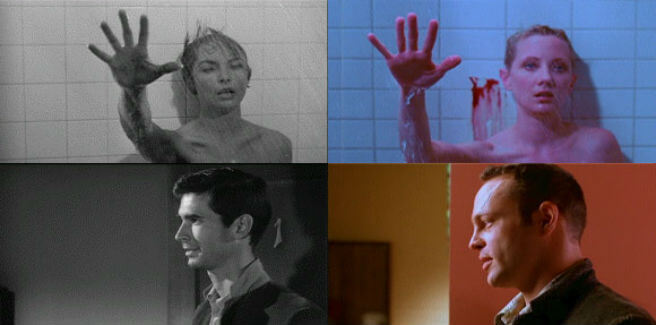
2/ I am, as a principle, against remakes that are unnecessary and offer nothing new. What does David Lee Fisher offer in his 2005 remake of The Cabinet of Dr Caligari, except sound? Even the visual style is the same. And what after all is the point of Gus van Sant’s shot-for-shot remake of Psycho—with colour? Everyone I know, and perhaps everyone, associates Psycho with Anthony Perkins, not Vince Vaughn. 

It’s because of this reason that I embrace the new Suspiria (which I intend to watch) and don’t understand some people’s complaint that Luca Guadagnino doesn’t want the same style and colour style of Dario Argento’s film.
Faithfulness may be a good thing for a film adaptation of a book (though it depends), but what do we need a remake for, if it offers nothing new? For filmgoers who only watch new films and refuse to watch B&W films and silent films? It is their problem that they deny history and the legacy of cinema, and miss out on masterpieces. 
3/ As a principle, I’m also against remakes of films that are already regarded as among the greatest films ever made.
For example, I keep hearing rumours about a Gone with the Wind remake. Why would you remake a film that got 10 Oscars? I can’t think of any reason. 
I’ve just discovered, though, that there’s a 2016 Ben-Hur. To be a precise, it’s not really a remake, but a 5th adaptation of the novel—however, the other adaptations are a silent short film, a silent film, and an animation, so this new film by Timur Bekmambetov would be directly compared to the William Wyler film, which got 11 Oscars. 
Even the 1995 TV version of A Streetcar Named Desire is not a wise idea, in my opinion. Glenn Jordan’s take on the play is different from Elia Kazan’s—closer to Tennessee Williams’s play, if I remember correctly, so in a sense it does offer something new. At the same time, how can you compare to the cast of the 1951 film, especially Vivien Leigh and Marlon Brando? Alec Baldwin was very brave to take on one of Marlon Brando’s best roles, and Jessica Lange looked more like she was playing Vivien Leigh as Blanche DuBois.  
4/ For some reason, all American remakes of Asian films I have seen are terrible. That includes The Departed, an acclaimed film which got Martin Scorsese an Oscar—the Hong Kong original Infernal Affairs is much better. 
Spike Lee’s remake of Oldboy I haven’t seen, but it looks like a big mistake, judging by the cast. The story is also, in some sense, very Asian. 
5/ However, I’m not against remakes in another language, country, and culture. In fact, when they’re good, I love them even more than standard remakes. 

The best remakes of this type that I can think of are The Handmaiden and Untold Scandal, South Korean remakes or adaptations of Western material—Fingersmith and Dangerous Liaisons respectively. They are excellent films on their own. As remakes/ adaptations, they retain the spirit of the original whilst adapting the story to the culture and traditions in South Korea, so they don’t feel foreign.
I haven’t seen A Fistful of Dollars, but I like the idea of it as a Western remake of Akira Kurosawa’s Yojimbo. Same with The Magnificent Seven and The Seven Samurai
I suppose the question here is whether the remake in another culture offers anything new (as in the case of The Handmaiden) or just takes good material and makes it in English for filmgoers who are too lazy to watch films with subtitles. In the latter case, those people should watch dubbed films instead, and I’m saying that despite being against dubbing. 
6/ Here’s an unpopular opinion: I think David Fincher’s The Girl with the Dragon Tattoo is better than the Swedish version.

Saturday, 1 December 2018

Underrated films: a list

This is my list of favourite underrated films. 
To explain, I don’t mention films such as Cries and Whispers—generally speaking, most people haven’t watched it, but it’s regarded as one of the peaks of Ingmar Bergman’s oeuvre and recognised as among the greatest films ever made. 
By underrated films, I’m thinking of the films that are overlooked—the films that people don’t often include in the list of best films or films you should watch, and the films that people forget when talking about an important director. 

The list (strong favourites in bold): 
Letter from an Unknown Woman (1948), dir. Max Ophuls 
In a Lonely Place (1950), dir. Nicholas Ray 
Gion Bayashi/ A Geisha (1953), dir. Kenji Mizoguchi 
Street of Shame (1956), dir. Kenji Mizoguchi 
The Killing (1956), dir. Stanley Kubrick 
Nights of Cabiria (1957), dir. Federico Fellini 
The Bad Sleep Well (1960), dir. Akira Kurosawa 
The Innocents (1961), dir. Jack Clayton 
My Fair Lady (1964), dir. George Cukor 
The Private Life of Sherlock Holmes (1970), dir. Billy Wilder 
The Last Detail (1973), dir. Hal Ashby 
The Phantom of Liberty (1974), dir. Luis Bunuel 
Alice Doesn't Live Here Anymore (1974), dir. Martin Scorsese 
3 Women (1977), dir. Robert Altman 
On Golden Pond (1981), dir. Mark Rydell 
My Left Foot (1989), dir. Jim Sheridan 
Bound (1996), dir. The Wachowskis 
Happy Together (1997), dir. Wong Kar-wai 
Happiness (1998), dir. Todd Solondz 
Memento (2000), dir. Christopher Nolan 
Sideways (2004), dir. Alexander Payne
Fracture (2007), dir. Gregory Hoblit 

This list would expand.

Monday, 30 July 2018

My new 10 (+1) favourite films; 30/7/2018

Persona by Ingmar Bergman 
Citizen Kane by Orson Welles 
Nights of Cabiria by Federico Fellini 
Yojimbo & Sanjuro by Akira Kurosawa 
Sunset Boulevard by Billy Wilder
The Discreet Charm of the Bourgeoisie by Luis Buñuel
Spring, Summer, Fall, Winter... and Spring by Kim Ki-duk 
Taxi Driver by Martin Scorsese
The Godfather by Francis Ford Coppola
Casablanca by Michael Curtis 


------------------------------------------------------------

Once in a while I make a new list of favourites to see what has changed and to keep notes over time. 
Now there have been only a few changes since last year: http://thelittlewhiteattic.blogspot.com/2017/06/my-new-10-favourite-films.htm
Ran is replaced with Yojimbo and Sanjuro. Choosing a favourite Kurosawa is difficult. I love Ran. I love The Bad Sleep Well. I love High and Low. The Bad Sleep Well is a perfect film, and a great example to learn from about the geometry of the scene—about staging and creating a shape in the frame. But finally I chose Yojimbo and Sanjuro (for how do you separate them?) for their dynamic quality and humour, and Toshiro Mifune’s charismatic hero, over the tragic The Bad Sleep Well.  
Persona and Citizen Kane, I love to the point of obsession. They are masterpieces, and I keep coming back to them for inspiration. Citizen Kane has everything you need to learn about cinema, especially in terms of blocking, cinematography, and editing; whilst Persona in particular and European art films in the 1950s-60s in general have changed my view of the possibilities of cinema and had a huge influence on me, especially with the idea of film as dream.


------------------------------------------------------------

On this date in 2007, Ingmar Bergman passed away. 
Today is also Emily Bronte's 200th birthday. 

Tuesday, 27 March 2018

My favourite films from the 1960s

For the 1950s: http://thelittlewhiteattic.blogspot.com/2017/08/my-favourite-films-from-1950s.html

The Bad Sleep Well (1960) by Akira Kurosawa
The Apartment (1960) by Billy Wilder 
Psycho (1960) by Alfred Hitchcock 
La Dolce Vita (1960) by Federico Fellini 
Le Trou (1960) by Jacques Becker
Viridiana (1961) by Luis Buñuel
One, Two, Three (1961) by Billy Wilder
Breakfast at Tiffany’s (1961) by Blake Edwards
Yojimbo (1961) by Akira Kurosawa 
Sanjuro (1962) by Akira Kurosawa
Ivan’s Childhood (1962) by Andrei Tarkovsky
The Exterminating Angel (1962) by Luis Buñuel  
The Trial (1962) by Orson Welles 
Winter Light (1963) by Ingmar Bergman 
High and Low (1963) by Akira Kurosawa
8 1/2 (1963) by Federico Fellini
Knife in the Water (1963) by Roman Polanski 
Charade (1963) by Stanley Donen
Woman in the Dunes (1964) by Hiroshi Teshigahara 
Dr Strangelove (1964) by Stanley Kubrick 
My Fair Lady (1964) by George Cukor 
Persona (1966) by Ingmar Bergman
Blow-Up (1966) by Michelangelo Antonioni
2001: A Space Odyssey (1968) by Stanley Kubrick
The Graduate (1968) by Mike Nichols 
Hour of the Wolf (1968) by Ingmar Bergman
Romeo and Juliet (1968) by Franco Zeffirelli

Thursday, 22 February 2018

The favourite 3

Following the previous post, here’s a list of my 3 favourite films of some directors. I also note how many of the directors’ films I’ve watched. 
(I don’t include a director if I’ve only seen 5 films or less. You probably notice that I broke my own rule a few times). 

Woody Allen:
Annie Hall 
Crimes and Misdemeanors 
Love and Death 
(out of 18) 

Martin Scorsese: 
Taxi Driver 
Mean Streets 
The Aviator 
(out of 17) 

Ingmar Bergman: 
Persona 
Cries and Whispers 
Wild Strawberries or The Seventh Seal 
(out of 15) 

Alfred Hitchcock: 
Psycho 
Dial M for Murder 
Vertigo 
(out of 15) 

Billy Wilder: 
Sunset Boulevard 
The Apartment 
Witness for the Prosecution 
(out of 14) 

Federico Fellini: 
Nights of Cabiria 
8 ½ 
Amarcord 
(out of 10) 

Clint Eastwood: 
Million Dollar Baby 
Changeling 
True Crime 
(out of 10) 

Zhang Yimou: 
Raise the Red Lantern 
To Live 
Red Sorghum or Ju Dou 
(out of 10) 

Stanley Kubrick: 
Dr Strangelove 
The Killing 
2001: A Space Odyssey 
(out of 9) 

Joel& Ethan Coen: 
No Country for Old Men 
The Big Lebowski 
Fargo 
(out of 9) 

Kenji Mizoguchi: 
Gion bayashi, aka A Geisha 
Ugetsu monogatari 
Akasen chitai, aka Street of Shame 
(out of 8) 

Luis Bunuel: 
The Exterminating Angel
The Discreet Charm of the Bourgeoisie 
The Phantom of Liberty or Viridiana 
(out of 8) 

Wong Kar-wai: 
Chungking Express 
Happy Together
2046
(out of 8) 

Tim Burton: 
Edward Scissorhands 
Corpse Bride
Sweeney Todd
(out of 8) 

Akira Kurosawa: 
Ran 
The Bad Sleep Well 
High and Low 
(out of 7) 

Francis Ford Coppola: 
The Godfather 
The Conversation 
The Godfather Part II 
(out of 7) 

Steven Spielberg: 
Catch Me If You Can 
A.I. Artificial Intelligence 
The Terminal 
(out of 7) 

Park Chan-wook: 
The Handmaiden 
Thirst 
(out of 6) 

Roman Polanski: 
Chinatown
The Pianist 
Knife in the Water 
(out of 6) 

Quentin Tarantino: 
Pulp Fiction 
Inglourious Basterds 
Jackie Brown 
(out of 6) 

Ang Lee: 
Sense and Sensibility 
Brokeback Mountain 
Crouching Tiger, Hidden Dragon
(out of 6)