Pages

Showing posts with label Sy Montgomery. Show all posts

Sunday, 10 January 2021

How to Be a Good Creature by Sy Montgomery

Why did I pick up The Soul of an Octopus? I must have read about it somewhere. It’s a wonderful, deeply affecting book, and it introduced me to Sy Montgomery, so lately I’ve been reading her book How to Be a Good Creature: A Memoir in Thirteen Animals

She was a weird kid.

“An only child, I never yearned for siblings. I didn’t need other kids around. Most children were loud and wiggly. They wouldn’t stay still long enough to watch a bumblebee. They ran and scattered the pigeons strutting on the sidewalk.

With rare exceptions, adult humans were not particularly memorable either. I would stare blankly at an adult I had seen many times, unable to place them, unless one of my parents could remind me of their pet.” (Ch.1) 

Sy Montgomery has the gift to understand animals, to communicate with them, to feel a closeness to them. I don’t. Apart from a turtle my grandma got when I was a kid, which didn’t live that long, I’ve never really had a pet because my family have always lived in apartments and we couldn’t have pets. My boyfriend and I don’t have pets now either, though his grandparents and my stepfather have cats and I play with them when I visit. But that’s all, so I do envy Sy Montgomery’s gift for understanding animals and I love the way she writes about them—with a sense of wonder and an infectious enthusiasm and lots of love. She sees each animal as an individual, with a personality, with likes and dislikes, with a soul. 

For example, look at this passage about emus: 

“I could easily tell them apart. One had a long scar on his right leg. I named him Knackered Leg. (Knackered is Australian slang I’d learned from a zookeeper. It means “messed up” and is more impolite than I then realized.) His injury might have been the reason he sat down most often of the three. Black Head seemed to be the most forward emu of the group, and took the lead most often. It was surely he who approached us straight on during my second meeting with them. Bald Throat had a whitish patch on his throat where the black feathers were sparse. He seemed skittish. When the wind would blow or a car would approach, he’d be the first to run.

[…] I knew, though, that they were not quite adult, because they lacked the turquoise neck patches that adorn the mature birds. And they were surely siblings, having left their father’s care (the male incubates the greenish-black eggs and takes care of the up to twenty chicks who hatch) only weeks or months earlier. Like me, they were just starting to explore their world.

What do they do all day? I wondered.” (Ch.2) 

She makes me curious too: what do they do all day? 

Emus are strange, fascinating birds. I’ve heard that Luis Bunuel liked emus, which is why he put them in The Phantom of Liberty. I didn’t know till I read this book that emus had 2 different sitting positions.  

Now look at this passage, about the emus: 

“They also had a sense of humor. One day I watched them approach the ranger’s dog, tied on a chain outside his house. The dog barked hysterically, but bold Black Head, head and shoulders raised high, continued approaching the straining animal head-on. Once Black Head was within twenty feet, he raised his wing stumps forward, hurled his neck upward, and leapt into the air with both feet kicking, repeating the behavior for perhaps forty seconds. Soon the other two joined him, and the dog went absolutely wild. The emus then raced off across the dog’s line of vision for about three hundred yards, before sitting down abruptly to preen—as if to congratulate themselves on the success of their prank.” (ibid.) 

Is that not fascinating? 

Sy Montgomery and her husband adopted a baby pig, called Christopher Hogwood (named after the conductor). This passage is about the pig and their little neighbours Kate and Jane, who were 10 and 7 respectively: 

“Kate and Jane also instituted Pig Spa. One spring day, Kate decided that the long ringlet of hair at the tip of Christopher’s tail needed to be combed. Then, of course, it needed to be braided. Inevitably for two preteen girls whose house was littered with hair scrunchies and smelled like bubble bath, the effort expanded to an entire beauty regimen for our pig.

We fetched warm buckets of soapy water from the kitchen, and more warm water for the rinse. We added products created for horses to apply to his hooves to make them shine. Grunting his contentment as he lay in his pool of soapy water, Christopher made clear he adored his spa—unless the water was chilly. Then he’d scream like he was being butchered—and we’d race back to the kitchen to fetch a more comfortable bath. He forgave us the instant the warm water touched his skin.” (Ch.3) 

Each chapter of the book is dedicated to an animal that has changed her life and what lessons they have taught her. Chapter 3 is particularly interesting because, while writing about the pig, Sy Montgomery also writes about her parents and the differences that broke their relationship. The differences between her and her pig do not matter—they love each other.  

This is the concluding passage in the chapter: 

“Chris loved his food. He loved the feel of the warm, soapy water of Pig Spa, the caress of little hands on the soft skin behind his ears. He loved company. No matter who you were—a child or an adult, sick or well, bold or shy, or whether you held out a watermelon rind or a chocolate donut or an empty hand to rub behind his ear—Christopher welcomed you with grunts of good cheer. No wonder everyone adored him.

Studying at the cloven feet of this porcine Buddha every day, I could not help but learn from a master how to revel in and savor this world’s abundance: the glow of warm sun on skin, the joy of playing with children. Also, his big heart, and huge body, made my sorrows seem smaller. After a lifetime of moving, Christopher Hogwood helped give me a home. And after my parents had disowned me, out of an assortment of unrelated, unmarried people and animals of many different species, Christopher helped create for me a real family—a family made not from genes, not from blood, but from love.” (ibid.) 

This is a delightful, heartwarming book. She writes well, and she can change the way you think. About a decade before How to be a Good Creature, she wrote a book about her pig, called The Good Good Pig: The Extraordinary Life of Christopher Hogwood

In the same chapter about Chris, Sy Montgomery also writes about their dog Tess, a border collie who was abandoned several times and previously had an accident that took her nearly a year to recover from multiple surgeries.

“She was only two years old when we took her home from Evelyn’s, but Tess had already seen a lifetime of pain, loss, and rejection.” (ibid.) 

This passage is heartbreaking: 

“…except for when we were playing her favorite sports (which worked out to be about once an hour), Tess was as wary of people as Chris was outgoing. She didn’t pee, poop, or eat without our specifically asking her to do so. She consented to petting, but seemed confused about the point. She didn’t bark for weeks, as if she were afraid to use her voice in the house. The first time we invited her up on our bed she looked at us in shocked disbelief. When we patted the covers, obediently she jumped up, but leapt back down again a second later, as if this couldn’t possibly be what we wanted.

Tess seemed to be guarding her emotions. But we knew we could change that.” (ibid.) 

And they did. 

Later in chapter 6, she writes again about Tess—in more detail. This is a deeply moving chapter with some great passages but I won’t put them here—you should read the book yourself. It is a great chapter. She makes me love a dog I have never known. She makes me envy her relationship with Tess. 

In How to be a Good Creature, Sy Montgomery alternates between her pets and the wild animals she has met. In chapter 7, she writes about tree kangaroos, echidnas, pademelons… Then in chapter 8, she writes about another pet dog: Sally, another black and white border collie that she believes Tess sent to her in a dream.  

“Despite being the same breed, Sally and Tess were almost complete opposites. Tess was a graceful athlete. Sally knocked things over. Tess loved her Frisbee and tennis ball but disdained other toys. Sally, as it turned out, became crazy for toys—except for the Frisbee, which she would catch only grudgingly to please Howard…” (Ch.8) 

Different from The Soul of an Octopus, How to be a Good Creature is a lot more personal. When she writes about wild animals, including those in capture like the octopuses, there is a sense of wonder and a sense of exploration as she interacts with an animal with which humans are not very familiar, especially animals that lack facial expressions or have expressions that we can’t read. Chapter 4 for example is about her transformative encounter with a pinktoe tarantula in a rainforest—transformative because the experience opens her up to the world of spiders that she has never known before, because it forever changes her perception of the small spiders she sees at home. 

Her writings about the pets are different—she feeds them, plays with them, loves them, and sees them as family. 

“I felt whole again. Sally made me unspeakably happy. I loved the softness of her fur, the cornmeal-like scent of her paws, the rolling cadence of her gait, the gusto with which she ate (even the stick of butter softening for the dinner table and the bowl of cereal abandoned for a moment to take a phone call)…” (ibid.) 

The three of them (her, her husband Howard, and Sally) sleep together in the same bed. 

“… And if Howard got up at night, Sally would immediately and deliberately rearrange herself to take up his sleeping lane, with her head on his pillow. When he got back, she’d give him a puffy smile. She thought this was a hilarious joke. And so did we.” (ibid.) 

This too is a great chapter, and Sally sounds like an adorable dog. 

Overall, How to Be a Good Creature is a wonderful little book, a good book to read in these depressing times. What are you waiting for? 

Friday, 5 April 2019

Octopuses’ strange way of being

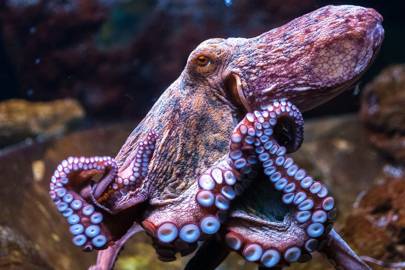
Why do I seem to be “obsessed” with octopuses? Because they are cool animals—they are masters of camouflage and escape, they have eyes similar to ours but can’t see colours, they are smart and so strange in many ways, and above all, if you read The Soul of an Octopus, they are curious and adventurous creatures that like play and get bored easily and can recognise human individuals, and they also have personalities. That’s my short answer. 
Now look at this: 
“The octopus is sometimes said to be a good illustration of the importance of a theoretical movement in psychology known as embodied cognition. […] 1 central idea is that our body itself, rather than our brain, is responsible for some of the “smartness” with which we handle the world.”
That is interesting, because an octopus has about 500 million neurons (look at this table for comparison with other animals), most of which are not in the brain but in the 8 arms. Each of the arms has some independence.
“But the doctrines of the embodied cognition movement do not really fit well with the strangeness of the octopus’s way of being. Defenders of embodied cognition often say that the body’s shape and organization encodes information. But that requires that there be a shape to the body, and an octopus has less of a fixed shape than other animals. The same animal can stand tall on its arm, squeeze through a hole little bigger than its eye, become a streamlined missile, or fold itself to fit into a jar. When advocates of embodied cognition such as Chiel and Beer give examples of how bodies provide resources for intelligent action, they mention the distances between parts of a body (which aid perception) and the locations and angles of joints. The octopus body has none of those things—no fixed distances between parts, no joints, no natural angles. […] In an octopus, the nervous system as a whole is a more relevant object than the brain: it’s not clear where the brain itself begins and ends, and the nervous system runs all through the body. The octopus is suffused with nervousness; the body is not a separate thing that is controlled by the brain or nervous system. 
The octopus, indeed, has a “different embodiment”, but one so unusual that it does not fit any of the standard views in this area. The usual debate is between those who see the brain as an all-powerful CEO and those who emphasize the intelligence stored in the body itself. Both views rely on a distinction between brain-based and body-based knowledge. The octopus lives outside both the usual pictures…” 
Isn’t that so interesting? 
That is from chapter 3 of Other Minds: The Octopus, the Sea, and the Deep Origins of Consciousness by Peter Godfrey-Smith. 
Whilst The Soul of an Octopus is more personal and poetic, in which Sy Montgomery mentions facts about the species but focuses more on her personal encounters with several octopuses, Other Minds is more scientific and study-based. The books have different approaches: The Soul of an Octopus is about octopuses as individuals, with different personalities and temperaments, memories and feelings, Other Minds focuses on consciousness, subjective experience, and the origins of it all. A lot of the book therefore deals with evolution, the ancestors of today’s animals (especially cephalopods), and theories and studies about the brain, neurons, and animals’ intelligence.  
Other Minds is more neutral (and academic), it doesn’t have the sense of wonder and infectious curiosity that you can find in The Soul of an Octopus. I’m not sure it can be enjoyable to someone who has no interest in octopuses and other cephalopods. But if you like them or have an interest in consciousness in animals, check it out.

Saturday, 9 March 2019

On finishing The Soul of an Octopus

Bill, 1 of the people working at the aquarium, makes the decision of switching tanks for Octavia and Karma.
“Bill had made the right choice. Though for many months, Octavia’s constant attentions to her eggs were rituals rich and full of meaning, at some point, her tending may have ceased to feel fulfilling. A wild octopus tending fertile eggs is surely rewarded, as are birds on the nest, by the signals that her eggs are alive, her embryos growing. Mother birds and their babies chirp and cheep to one another when the young are still in the egg; the mother octopus can see her babies developing inside the egg, starting with the dark eyes, and feel them moving. But Octavia had no such feedback. Perhaps the very sight of the eggs inspired her to try to protect them, the way a mother orangutan will continue to carry and even groom a dead infant, often for many days, and some dogs will refuse to leave the body of someone they love who has died. Perhaps, now that her eggs are no longer in view, Octavia at last was freed of duties she might have suspected were pointless but had felt compelled to perform. Perhaps now, at last, she could rest.”


(Source)

I have now finished reading The Soul of an Octopus. It’s such a wonderful book. I’ve just read about an encounter with a stump-armed female octopus in the ocean, followed by a visit with Octavia the octopus in the aquarium in her old age, in chapter 8 “Consciousness”.
The Soul of an Octopus is full of interesting facts and descriptions, but it is so captivating and affecting because everything is observed and described with such awe and wonder, such joy and gratitude, and such compassion, that I too am full of curiosity about octopuses and the ocean, and can no longer look at them the same way. In a sense, I feel changed as a person. Once in a while, you pick up a book, expecting nothing, then you’re surprised to find yourself changed because of it. Your perspective’s expanded, your thinking’s shifted.
Sy Montgomery learns, and wishes us to learn, about octopuses—creatures that are so alien and so different from us in everything. We don’t just read about what octopuses are like, she also makes us wonder what it’s like to be an octopus. Their experience of the world is completely different. At the same time, she doesn’t treat them like subjects of study, but like beings, with feelings—she treats them with respect, sensitivity, and tenderness, and seeks to understand them and have a connection with them.
With octopuses, Montgomery could do something Melville/Ishmael couldn’t do with whales—develop a connection, or even friendship, with them.
It’s interesting that I’m writing my dissertation about love and human contact (and motif of touch) in 3 Ingmar Bergman films, and now, The Soul of an Octopus has this passage:
“…We wished she had eaten, but we learned something new: Hunger was not the reason she had surfaced earlier, and it wasn’t what brought her now.
The reason she surfaced was abundantly clear. She had not interacted with us, or tasted our skin, or seen us above her tank for 10 full months. In less than 4 weeks, on a Saturday morning in May, Bill would find her, pale, thin, and still, dead at the bottom of her barrel. Yet, despite everything, we knew in that moment that Octavia had not only remembered us and recognized us; she had wanted to touch us again.”
That is so moving.
Everyone should read this book.

Wednesday, 27 February 2019

Mother octopus

I’ve just read a very sad chapter in The Soul of an Octopus
Female octopuses die a few months after laying their eggs—they spend all energy caring for and cleaning the eggs, and at some point, stop feeding, and slowly die. 
At the aquarium that Sy Montgomery visits for The Soul of an Octopus, the octopus Octavia lays eggs, and starts dying. 
“Octavia is puffed up, her skin not, as usual, creased or crinkled, thorny or warty, but smooth as a blown-up balloon. 
This looks decidedly wrong to me, like a giant tumor or an internal organ bloated with disease. My distress increases when I can’t see her gills, her funnel, or her eyes. She has turned her face to the wall, as a dog or cat often does when suffering.” (p.111, ch.4) 
Octavia changes colour, and devotes all the time and energy to caring for the eggs. She loses interest in interaction with people at the aquarium. Nothing else matters but the eggs. 
The sad part is that her eggs are not fertile. 
“… we watch Octavia, our alien, invertebrate friend, caring for her infertile eggs at the end of her life with a tenacity and tenderness at once heartbreaking and glorious.” (p.118, ch.4) 
“Though Octavia’s eggs will never hatch, it fills us with gratitude that Octavia tends them with diligence and grace. For when she dies, Octavia will do so in the act of loving as only a mature female octopus, at the end of her short, strange life, can love.” (p.119, ch.4) 
This is heartbreaking.

Monday, 25 February 2019

A difference between me and Sy Montgomery

Before going to the main point, I’d like to say that The Soul of an Octopus is a very good book. It is less about octopus facts than about the author’s personal accounts of her encounters with octopuses at New England Aquarium, written in lucid prose, full of feeling and tenderness. Now and then there’s a sense that there’s some exaggeration—like the over-enthusiasm of an octopus lover who glorifies everything about the creature, but the author has such an infectious curiosity and sense of wonder that you share the enthusiasm and want to know everything possible about octopuses and start seeing them in a different way. 
Now, on chapter 4, I’ve started to see a significant difference between me and Sy Montgomery—it is the fact that I’m not an animal lover. By this, I don’t mean that I dislike animals; I love dogs and cats, and like other “safe” animals like hamsters or rabbits, and so on, and even with dogs, prefer puppies and small dogs; I’m not a fan of insects nor arthropods, and don’t come near wild, untamed animals, especially those with venom or massive strength.
Part of it is ignorance, indifference, and fear. I have always been a city person, who can’t tell the difference between crocodiles and alligators, between leopards and jaguars, between rabbits and bunnies and hares, between frogs and toads, you get the idea. I can’t tell which kinds of snakes are venomous either. To me it’s simple—stay away from snakes. My interests have always been in other things. 
Part of it is that I think wild animals are wild animals. No matter how much you love them and care for them and understand them, they are still wild animals, driven by instinct, undomesticated, untamed, and unpredictable. Animal lovers usually say people are not much better, they may also kill you or ruin you in other ways, but at least people can communicate in language, and people know such things as law and concept of ethics. Animals follow instinct, they function and operate in their own ways, and don’t know anything about law or consequences. Wild animals are very different from us humans. 
On page 70-71, chapter 3, Sy Montgomery writes about Marion Fish, who “demonstrated the positive power of interesting, gentle, loving interaction between keepers and the animals in their care” by directly handing anacondas, without head restraint. “[T]he snakes are healthier and happier for it”, she says. 
That seems to work, I guess, but they are anacondas. What if 1 day they go crazy? What if they get irritated by something and take it out on a keeper? What would you do? 
Now, in chapter 4, Montgomery describes an episode where several people are having an interaction with a young octopus named Kali, suddenly she (Kali) hoses and then, for no obvious reason, bites Anna, a volunteer. 
It is an act of aggression. The bite isn’t serious, there is no venom, Anna feels fine afterwards. Montgomery says “Being bitten is an intimate interaction” and “a bite is proof of a kind of contact that—even when it goes wrong—at a time when most people are increasingly isolated from the natural world, we are privileged to experience.” 
Nobody understands why the octopus bit Anna. Montgomery’s theory is that Anna is on medication and the doctor has just changed prescription, so Kali could taste the difference and got confused. 
Even then that doesn’t change the fact that the octopus, unprovoked, bites someone it knows. If an octopus attacks again, you can never know, as you don’t know what they think. Montgomery may try to understand, and explain the behaviour, but it doesn’t change anything. 
Wild animals are still wild animals. At the beginning of the book, when an aquarist introduces Montgomery to an octopus, he also tells her never to let an octopus near her face. He has worked there for years, and knows enough not to let an octopus near the face. It could pull out your eye.

Saturday, 23 February 2019

Octopuses and colour

I’m on a break, after finishing filming on Monday night 18/2. 
Currently reading The Soul of an Octopus by Sy Montgomery.
There are lots of interesting facts and observations about octopuses in the book. 
Take this passage from chapter 2: 
“The ability of the octopuses and their kin to camouflage themselves is unmatched in both speed and diversity. Octopuses and their relatives put chameleons to shame. Most animals gifted with the ability to camouflage can assume only a tiny handful of fixed patterns. The cephalopods have a command of 30 to 50 different patterns per individual animal. They can change color, pattern, and texture in 7/10 of a second. On a Pacific coral reef, a research once counted an octopus changing 177 times in a single hour. 
[...] For its color palette, the octopus uses 3 layers of 3 different types of cells near the skin’s surface—all controlled in different ways. The deepest layer, containing the white leucophores, passively reflects background light. This process appears to involve no muscles or nerves. The middle layer contains the tiny iridophores, each 100 microns across. These also reflect light, including polarized right (which humans can’t see, but a number of octopuses’ predators, including birds, do). The iridophores create an array of glittering greens, blues, golds, and pinks. Some of these little organs seem to be passive, but other iridophores appear to be controlled by the nervous system. They are associated with the neurotransmitter acetylcholine, the 1st neurotransmitter to be identified in any animal. Acetylcholine helps with contraction of muscles; in humans, it is also important in memory, learning, and REM sleep. In octopuses, more of it “turns on” the greens and blues; less creates pinks and golds. The topmost layer of the octopus’s skin contains chromatophores, tiny sacks of yellow, red, brown, and black pigment, each in an elastic container that can be opened or closed to reveal more or less color. Camouflaging the eye alone—with a variety of patterns including a bar, a bandit’s mask, and a starburst pattern—can involve as many as 5 million chromatophores. Each chromatophore is regulated via an array of nerves and muscles, all under the octopus’s voluntary control. 
To blend with its surroundings, or to confuse predators or prey, an octopus can produce spots, stripes, and blotches of color anywhere on its body except its suckers and the lining of its funnel and mantle openings. […] And of course the octopus can also voluntarily control its skin texture—raising and lowering fleshy projections called papillae—as well as change its overall shape and posture.” 
Later in the same chapter: 
“… the octopus eye and our own are strikingly similar. Both have lens-based focusing, with transparent corneas, irises that regulate light, and retinas in the back of the eye to convert light to neural signals that can be processed in the brain. Yet there are also differences. The octopus eye, unlike our own, can detect polarized light. It has no blind spot. (Our optic nerve attaches to the back of the eye at the retina, creating the blind spot. The octopus’s optic nerve circles around the outside of the retina). Our eyes are binocular, directed forward for seeing what’s ahead of us, our usual direction of travel. The octopus’s wide-angle eyes are adapted to panoramic vision. And each eye can swivel independently, like a chameleon’s. Our visual acuity can extend beyond the horizon; an octopus can see only about 8 feet away. 
There is another important difference as well. Human eyes have 3 visual pigments, allowing us to see color. Octopuses have only one—which would make these masters of camouflage, commanding a glittering rainbow of colors, technically color-blind.” 
Isn’t that fascinating? It’s like reading about whales in Moby Dick
Like Ishmael in Moby Dick, Sy Montgomery has such an immense curiosity and sense of wonder that you feel captivated and feel changed as a person as you read the book—you start to wonder, what is it like to be an octopus? do they have consciousness? do they think? how do they feel about us? how do they see the world? do they dream? why are they so smart? 
Love this book.