Pages

Showing posts with label Tolstoy. Show all posts

Wednesday, 3 June 2026

On translation and anachronism

The other day, I tweeted about Tom Payne’s translation of The Art of Love: “Picked up this copy of “The Art of Love” but I had to quit after several pages. The translator used phrases like “girlfriend”, “safe sex”, “one-night stand”, etc. This is Ovid!” 

The tweet went semi-viral, attracting some obnoxious people who seem to think that nobody’s allowed to say a single word about a translation from Latin unless they know the language—a phenomenon that never occurred when I discussed translations of Russian, French, Japanese novels over the years—this strangely seems to only happen with Latin and ancient Greek. 

However, I also got many good comments from both people who agreed and disagreed with my complaint and knew Latin. And it led me to think more about this subject: how traditional or modern should a translation be? When is it too modern? When does it appear anachronistic? Because these things seem to be arbitrary, and most of the time, just come down to personal preference. 

When we want to read 19th century Russian novels, for example, we can go for a translation into 19th century English, as the Maudes and Constance Garnett were alive around the same time, or we can go for a modern translation. With Don Quixote, we can read Thomas Shelton if we want 17th century English (it’s also the version that Shakespeare read). But we do not have contemporary English translations—in the sense of “from the same period”—of Homer or Sophocles or Ovid—so all translations are modern—various levels of modernity. I can see the argument that a Victorian translation of Ovid is not any less anachronistic than a new translation—it may even impose Victorian sensibilities on the poems. I however do not buy the argument that because Ovid was modern for his time, he should be translated into today’s English, into the latest slang and colloquial terms (of course Ovid was contemporary to his contemporaries—what kind of argument is that?). However open and modern Ovid appears to us, he’s still a writer from ancient Rome and his works inevitably reflect the lifestyles and customs and values and beliefs of ancient Rome; it’s jarring to come across modern concepts in Ovid. Even if a word accurately conveys the meaning (which some people say “one-night stand” and “safe sex” here do), words don’t only have meanings—words also have connotations and associations—words have baggage. 

It might be arbitrary, and personal, that I prefer “Isn’t she exquisite?” (Aylmer and Louise Maude, revised by Amy Mandelker) to “She is gorgeous, isn’t she?” (Anthony Briggs) in War and Peace, but is it entirely arbitrary and personal when I say that “my ex” sticks out like a sore thumb in The Brothers Karamazov (Ignat Avsey)? Does it not take you out of the story when you read Don Quixote and come across “girlfriend”, “boyfriend”, or “a certain delicious je ne sais quoi” (Tom Lathrop)? Does it not make you stumble when you see “one-night stand” in a Roman poem? The entire translation may be in modern English, but some phrases stick out. Some phrases draw attention to themselves. 

Where we draw the line is the art of translation. Slang, I think, appears more obviously, distractingly anachronistic. 

Another thing to consider as well is that Homeric Greek or Shakespearean English for example wasn’t the way normal people talked. It’s one thing to modernise the language; why do some translators go for something colloquial and mundane when the original is highly literary? Is it not a fair point when readers—whether or not they know the original language—complain that Emily Wilson opts for phrases such as “a complicated man”, “tote bag”, “pep talk”, “playtime is over”, etc. in her translation of the Odyssey? Defenders of Emily Wilson have said “polytropos” means “complicated”, but “poly” means “many” and “tropos” means “turn”—surely Robert Fagles’s “the man of twists and turns” or Robert Fitzgerald’s “that man skilled in many ways of contending” is more interesting and evocative than Emily Wilson’s commonplace “a complicated man”? Those of us who do not know the original language and have to rely on translations may not be able to judge accuracy, but we can comment on other aspects of a translation: how it sounds in the target language, whether it’s good prose/ poetry, whether some choices appear anachronistic, whether we want to read it or switch to a different translation… And yet some people want to shut down the conversation, saying we’re not qualified to say anything if we don’t know the original. 

Let’s have a discussion.  

Sunday, 3 May 2026

My 10 favourite literary works

A list of the 10 literary works I think about, or revisit, most often: 

  • The Iliad 
  • The Odyssey 
  • King Lear 
  • Othello 
  • Shakespeare’s Sonnets 
  • Don Quixote 
  • War and Peace
  • Anna Karenina 
  • Moby-Dick 
  • Mansfield Park


This looks quite basic, does it? But the central figures of my personal canon do happen to be Homer, Shakespeare, and Tolstoy, so I can’t pretend they’re not, just to avoid being called pretentious. 

I refuse to choose between the Iliad and the Odyssey, the same way I refuse to choose between War and Peace and Anna Karenina

2 epic poems, 2 plays, 1 sonnet sequence, 5 novels (4 of which are over 700 pages). 2 in ancient Greek, 5 in the English language (4 English and 1 American), 1 in Spanish, 2 in Russian. 2 from the 8th century BC, 4 from the 17th century, 4 from the 19th century. All Western. 9 written by men.

If you have been reading my blog and/or my tweets, I’m sure I’ve been annoying enough about these works for any choices to be a surprise. Maybe the Sonnets, as I don’t blog about them, but I do revisit them often—there’s a Shakespeare sonnet for every mood (I went out yesterday and on the way home thought of Sonnet 34—guess what happened). The only surprises, I guess, are the exclusions of Greek tragedies (couldn’t pick one) and Chekhov’s stories (what do you do with short stories on such a list?)—a longer list of my personal canon would include Aeschylus, Sophocles, Euripides, The Tale of Genji, all of Shakespeare, Molière, the (dirty) poems of Hồ Xuân Hương, Tom Jones, Hong lou meng (better known as Dream of the Red Chamber or Story of the Stone), Wuthering Heights, Charles Dickens, John Keats, Madame Bovary, The Brothers Karamazov, the plays of Henrik Ibsen (especially The Wild Duck and Rosmersholm), the short stories of Akutagawa, the short stories of Flannery O’Connor, The Metamorphosis (Kafka), Invisible Man, Lolita, Pnin, the poems of Hàn Mặc Tử (especially Đau thương), etc. 

The only thing that bothers me, which is perhaps irrational, is that my literary tastes are strongly Western. I am Vietnamese, I can read well two languages (my Norwegian isn’t on the same level), I spent years promoting East Asian classics, but in the end, my favourite 18th century novel is still Tom Jones, not Hong lou meng; my favourite female writer is still Jane Austen, not Murasaki Shikibu; the central figures of my personal canon are still Homer, Shakespeare, and Tolstoy, not Nguyễn Du… Japanese cinema may be the one I know and love the best after English-language cinema, but in literature, my tastes are markedly Western. 

Does this mean I have lost my roots? Mất gốc? (The Vietnamese phrase carries much harsher overtones). 

I suppose the main thing is that I’m most fascinated by human nature and the human mind, and most interested in characters, which is probably also why I much prefer the Greeks to the Romans (you probably have noticed, with horror, the absence of Virgil and Ovid on my personal canon). Generally, Japanese writers—at least the ones I have read—don’t seem to explore the complexities and contradictions and irrationalities of people as we see in Western literature. Their characters are more opaque, even impressionistic; on the one hand, Japanese novels convey that sense of human mystery, the sense that we can never truly know another human being, which I like; but on the other hand, the characters also feel less alive, and don’t leave deep impressions on my mind like Akhilleus, Cleopatra, or Andrei Bolkonsky. The characters in Hong lou meng in comparison are alive, especially Shi Xiangyun (Sử Tương Vân) and Weng Xifeng (Vương Hy Phượng), but they don’t have the depth and complexity of Elektra, Hamlet, or Anna Karenina, and frankly I think Cao Xueqin takes a lot more pages to give life to a character (which Shakespeare can do in five words: “I was adored once too”). 

I’m also not much of a poetry person, despite liking the little I have read of Donne, Keats, Bùi Giáng, etc. I have The Oxford Book of English Verse, and lately have been slowly getting through The Oxford Book of Sonnets, trying to be less of a philistine, but unfortunately still have a strong taste for narratives and characters. My favourite poet (restricting to only those I can read in the original) is therefore a dramatic poet (and before you ask, I read Shakespeare’s sonnets as dramatic monologues, not autobiographical pieces). 

(If I were pretentious, as some people might call me, I would pretend to love poetry, but I acknowledge my failing).  

My tastes are also predominantly classic. When I first got into literature properly, I was mostly reading the 20th century, then slowly went further back, and further back. Over the years, those 20th century novels for some reason haven’t had a lasting impression, haven’t been part of my mental furniture—I barely remember much of F. Scott Fitzgerald, Gabriel Garcia Marquez, or Toni Morrison. But it’s not just because I read them in my late teens and early 20s, not just because I read them before finding my favourite writers—since my discovery of Tolstoy, Shakespeare, and others, I have read and enjoyed modern books only for them to have caused nothing but a few ripples in my mind—I haven’t found myself thinking about Muriel Spark, R. K. Narayan, or Soseki, for example. Even Marilynne Robinson’s Gilead, which I read only last September and considered highly, has left no imprints. Shouldn’t they resonate more, being more recent? But they don’t, and I don’t know why. My favourite 20th century writer right now is possibly Primo Levi, but that’s non-fiction. 

It’s curious which works of literature speak to us and haunt our minds. 

Tuesday, 9 September 2025

The Odyssey: “they denied us life together in our prime and flowering years” [updated]

Painting by Johann Heinrich Wilhelm Tischbein.

1/ As I picked up the Odyssey, I jokingly said to friends, let’s see what literature was like before the human’s invented (yes, I’m a Harold Bloom hater—why do you ask?).

I doubt anyone could read the Odyssey and think Odysseus is a two-dimensional character or has a flat personality. He’s an ingenious man, but sometimes brings trouble to himself and his men because of curiosity, or because of pride. He cleverly finds a way to escape from the Cyclops, but has to name himself, only to get cursed and wander for 10 years before he can return home. He is a great storyteller and a sharp-witted man, but can sometimes be dishonest. He loves his wife Penelope, but happily stays with the sorceress Kirke (or Circe) for a year. He wants to test Penelope, but gets insulted when she doesn’t immediately trust him. And in revenge he is brutal and savage. 

Most interestingly, Odysseus is the one narrating his own adventures—how much is true and how much is embellished? 


2/ Many people have talked about Homer’s use of epithets—“grey-eyed Athena”, “Odysseus, raider of cities”, “the great tactician”, “clear-headed Telemakhos”, and so on—which help with the metre of the poem and which also aid readers in keeping track of characters. 

I think this is something Tolstoy learnt from Homer when he had to work with hundreds of characters: Tolstoy may not use epithets, but he pins down a physical trait or a detail for each character and repeats it throughout the novel, so you can remember and follow the characters.  

Speaking of Tolstoy, he wrote in his essay on Shakespeare: 

“… However distant Homer is from us, we can, without the slightest effort, transport ourselves into the life he describes, and we can thus transport ourselves because, however alien to us may be the events Homer describes, he believes in what he says and speaks seriously, and therefore he never exaggerates, and the sense of measure never abandons him. This is the reason why, not to speak of the wonderfully distinct, lifelike, and beautiful characters of Achilles, Hector, Priam, Odysseus, and the eternally touching scenes of Hector’s leave-taking, of Priam’s embassy, of Odysseus’s return, and others—the whole of the “Iliad” and still more the “Odyssey” are so humanly near to us that we feel as if we ourselves had lived, and are living, among its gods and heroes. Not so with Shakespeare. From his first words, exaggeration is seen: the exaggeration of events, the exaggeration of emotion, and the exaggeration of effects. One sees at once that he does not believe in what he says, that it is of no necessity to him, that he invents the events he describes, and is indifferent to his characters—that he has conceived them only for the stage and therefore makes them do and say only what may strike his public; and therefore we do not believe either in the events, or in the actions, or in the sufferings of the characters. Nothing demonstrates so clearly the complete absence of esthetic feeling in Shakespeare as comparison between him and Homer.” 

(translated by V. Tchertkoff) 

I don’t think I need to comment on Tolstoy’s remarks on Shakespeare, but it’s fascinating to see that he loves Homer. Homer’s characters are indeed distinct—even the suitors don’t all speak one voice—and lifelike—I actually had more trouble trying to understand the characters in The Tale of Genji (about 1,000 years old) than the ones in the Odyssey (about 2,700 years old). 

Can’t wait to read the Iliad and compare it to War and Peace


3/ The Odyssey is in many ways a very masculine/ male-dominated book: it’s not only about Odysseus’s return home and destruction of the suitors, but also about his son’s coming-of-age. 

But Homer gets you to have sympathy for the women. Especially Penelope: 

“She answered:

“Eurýmakhos, my qualities—I know—

my face, my figure, all were lost or blighted

when the Akhaians crossed the sea to Troy,

Odysseus my lord among the rest.

If he returned, if he were here to care for me,

I might be happily renowned!

But grief instead heaven sent me—years of pain.

[…] The years he spoke of are now past; the night

comes when a bitter marriage overtakes me, 

desolate as I am, deprived by Zeus

of all the sweets of life.” 

(Book 18) 

(translated by Robert Fitzgerald) 

Here is a good woman, an intelligent woman, separated from her husband and unable to ward off the unwanted suitors. 

When she and Odysseus final reunite and she has to test him, she says: 

“… Think

what difficulty the gods gave: they denied us

life together in our prime and flowering years,

kept us from crossing into age together.” 

(Book 23) 

Homer may not tell Penelope’s story, but he gets us to think about her, to feel for her desolation and sorrow as her husband gets sent off to war for 10 years and goes missing for another 10 years, without any signs that he’s alive, let alone that he would ever return. How long had they even been married before he left? 

Homer clearly has lots of compassion for Penelope, but she’s not just a virtuous woman—she is intelligent—her cleverness matches Odysseus’s. 

And it’s not just Penelope. Nausikaa, though she appears briefly, seems like an intelligent girl. Kalypso has me interested—I mean, yes, she detains Odysseus against his will, but what after all is wrong with wanting a husband? And the scene of Odysseus meeting the ghost of his mother is one of the most moving scenes in the poem: 

“I bit my lip,

rising perplexed, with longing to embrace her,

and tried three times, putting my arms around her,

but she went sifting through my hands, impalpable

as shadows are, and wavering like a dream.

Now this embittered all the pain I bore,

and I cried in the darkness…”

(Book 11) 


4/ In the Postscript, Robert Fitzgerald argues—and I think makes a good case—that Penelope suspects the beggar and tests him long before he reveals himself to her. She asks him questions. She says things that sound like things she wants Odysseus to hear. 

Fitzgerald says: 

“During the day, before the evening, Penélopê has been told first that her husband is alive, second that he is on the island, and third that he is coming soon. She has been waiting for ten years with no such authentic news and no such startling expectations and had made the suitors wait for nearly four. Are we, the audience, to believe that she wouldn’t wait a few days longer to see if her husband turns up? Is it conceivable that, instead of waiting, the woman so distinguished for tenacity would this very evening give up the waiting game and seriously propose to marry the next day? How could she come to this abrupt decision in the course of her evening scene with Odysseus unless she realized that the stranger before her was indeed her husband?” 

And whilst Odysseus and Telemakhos have no exact plan to take down the suitors, Penelope is the one who comes up with the idea of a contest with the bow*—she is the one who supplies Odysseus with a weapon to kill the suitors. 


5/ Homer also gets us to care about the slaves, especially Eumanois the swineherd, and Odysseus’s old nurse Eurykleia. Does he have to tell us their backstories? No, it doesn’t advance the plot. But he tells their stories and gets us to care about all these characters, and it makes the Odyssey a much vaster, richer world. 


I have now finished reading the Odyssey, after nearly 2 weeks. It is magnificent. 


* Update on 10/9: I’ve now realised, upon rereading some parts of the Odyssey, that I missed and misunderstood a few lines in the poem: the idea of the bow comes entirely from Penelope and she tells him beforehand. I am convinced that Penelope suspects him long before he reveals himself to her. 

This is an interesting essay by Eva Brann, making the same point. I especially like this bit: 

“For the true crux of this last adventure was not the testing of Penelope by Odysseus, but that of Odysseus, so slow to come home, by Penelope, and her question was never: is this Odysseus? but: is it an Odysseus who cherishes live roots deep in the house? But now she comes to him, Homer says, as if she had reached land after a shipwreck (XXIII 239). His wife, by masking her immediate penetration of Odysseus’ factual incognito, has raised the occasion of his return into a test of the wanderer’s truth to his roots; she has assured herself that the “great token” still holds its meaning.” 

Saturday, 6 September 2025

The Odyssey: “won’t you ever […] abandon your deceptions and the lying tales you adore from the very ground up?”

A Grecian vase depicting Odysseus and the Sirens (why is Odysseus naked though?). 

1/ Here is something interesting Homer does in the Odyssey: we first see Odysseus with Kalypso and know he has been held captive there for 7 years; we see him try to survive in the sea till he gets to the island of Alkinoos (better known as Alcinous) and Nausicaa (Alkinoos’s daughter); Odysseus tells his own story of the journey home over the past 10 years (Books 9-12); after all the hospitalities, the king Alkinoos helps Odysseus go home; upon setting foot on his homeland Ithake (better known as Ithaca), which he doesn’t recognise after being away for 20 years, Odysseus sees a man, who he doesn’t realise is Athene, and makes up a story about himself, only for Athene to reveal herself and tease him. The quote in the headline comes from that scene (translated by Peter Green). 

Note that. Not only does Odysseus make up a story on the spot—who asks?—but it’s richly detailed. 

Does that not make you see the Odyssey in a different light? All the adventures are narrated by Odysseus himself: all the encounters with the Lotus-Eaters and the Kyclopes (Cyclops) and Kirke (Circe) and the spirits and the Sirens and Skylle (Scylla) and Charybdis and the sun god Helios. “Unreliable narrator” may be a modern concept but “liar” is not—perhaps Sophocles and Euripides thought that too as they didn’t seem to like Odysseus (though they also had other sources apart from Homer). I’m not saying that Odysseus makes up everything—this is a world in which gods and nymphs and monsters exist—but surely he embellishes his tales and makes himself look better.

(I should probably read the Iliad before saying much nonsense about Odysseus though). 


2/ Apart from being the greatest works of Western literature, what do the Odyssey, Don Quixote, and the plays of Shakespeare have in common? They all feature some kind of transformation: metamorphosis or disguise or acting. (Almost) every single Shakespeare play has some disguise, some acting or pretending, some version of “I am not what I am”: women dressing up as men, noblemen disguising as commoners, sane men acting mad, women pretending to die, and so on; and of course, some characters play a role without putting on any disguise, like Edmund or Iago. In Don Quixote, a hidalgo named Alonso Quixano decides to become an errant knight and transforms himself into Don Quixote; some other characters wear disguise and make up stories to trick him, or play pranks on him and Sancho. In the Odyssey, Athene assumes different shapes as she guides Odysseus and his son Telemachos on their journeys (I didn’t realise till now that the word “mentor” came from the Odyssey); Odysseus famously disguises himself as a beggar upon his return to Ithake, to figure out what’s going on in his household (which reminds me of Henry V), but before that he already pretends to be someone else a few times, such as in his trickery of the Kyclopes. 

Odysseus is an actor as well as a storyteller. 

It probably adds to the vitality and complexity of these characters that they transform themselves, reinvent themselves. 


3/ Speaking of storytelling, I have never understood readers who complain about things which don’t advance the plot or which don’t have anything to do with the main character. That complaint I have seen many times over the years about many of my favourite novels; now I see it in some reviews of the Odyssey

Why such a hurry? Take your time, enjoy the journey, get to know the people you meet on the way. 

Moby Dick is such an exhilarating masterpiece because of those digressions, because of those meditations on whales, because of Ishmael’s quest to understand the whale and understand life. War and Peace feels so rich and full of life because Tolstoy fleshes out all the characters, because he gets us to know even the most insignificant characters. The Odyssey feels so vast because all the characters that Odysseus or Telemachos comes across have their own adventures and their own stories. 


4/ One thing that makes me feel uncomfortable—if that’s the right word—about the Odyssey is how much the gods interfere with human affairs and how much is fated. I know it’s the ancient Greece. I know it’s their belief. But I can’t help feeling uneasy—perhaps even slightly cheated—that the protagonist doesn’t come up with everything himself: it’s Athene who tells Telemachos to set sail in search of his father; it’s Athene who guides him along the way; it’s Athene who later tells Telemachos to come back; it’s Athene who gets Zeus to help Odysseus leave Kalypso; it’s Athene who appears as a little girl and guides Odysseus on the island of Nausicaa; it’s Athene who gives advice and disguises Odysseus as he’s back in Ithake; and so on.

I don’t mind that Kirke advises Odysseus how to survive the Sirens, or how to escape the dangerous path between Skylle and Charybdis—how would Odysseus know otherwise?—and Odysseus and his men still have to do everything they can to fight the monsters and survive in the sea. But it makes me feel uneasy nevertheless about the belief and depiction of human beings as so insignificant, so helpless, unable to escape their fate and unable to fight against the caprices of the gods.  


5/ The poster doesn’t make me particularly hopeful about Christopher Nolan’s upcoming adaptation of the Odyssey. The tagline is “Defy the gods.” 

Saturday, 30 August 2025

Why read plays? (P.2): Plays vs novels

I know, I wrote that the last blog post was my response once and for all to the mantra “Plays are meant to be seen, not read.” But I want to write about a different aspect: Why read plays? What do plays offer that novels do not? 

(Ibsen staring into your soul). 

Considering the popularity of novels, I think we can all name the advantages of novels. Some might argue that novels dig deeper into characters’ minds and have more psychological depth, but I don’t agree—look at Shakespeare—Hamlet and Macbeth and Brutus and many other characters question themselves, struggle with themselves, and people have analysed them for 400 years. But scope is one advantage: a play cannot have hundreds of characters and a wide range of experiences like War and Peace. Length and span are another: The Winter’s Tale might be an exception in making a jump of 16 years, but it doesn’t cover 16 years; War and Peace spans from 1805 to 1813, then jumps to 1820.

However, plays have their own strengths—I’m not even talking about plays as performance, but as text. Plays show a clash of perspectives. I won’t talk again about the range of views in Shakespeare—I think I’ve been annoying enough about this subject—you all know what I would say. Instead, look at Ibsen. In The Wild Duck, he shows the contrast between a character who thinks human beings need delusion and can’t cope with much of the truth, and a character who tears down a marriage to set it on a new foundation of truth and destroys everything. In An Enemy of the People, he depicts a man of integrity, a man of courage standing up for the truth, but at the same time also lets us see the concerns of the townspeople, and makes us feel uneasy about the heroic man. In Rosmersholm, he depicts three different people—or four if you count Mrs Helseth—grappling with a suicide and questioning, blaming themselves. What actually happened? Who is to blame? 

Occasionally you find a novel with the same quality. Tolstoy for instance enters different characters’ minds and depicts their different—clashing—perspectives. William Faulkner has multiple characters narrating the story, in The Sound and the Fury and As I Lay Dying. But even when a novelist switches between different perspectives, there is narration—there is someone shaping how you see characters and events—you are always aware of the authorial presence. The closest a novel gets to a play in this aspect is the epistolary form: in Dangerous Liaisons, the finest epistolary novel I’ve read, you see the different perspectives, you see the manipulators set out their plan and see them at work, you read between the lines and imagine the effect on the receiver of each letter. 

Normally, a novel focuses on a single point of view, or has an omniscient or objective point of view. In the former case—when the story is narrated by the protagonist (such as Jane Eyre) or an observer/ another character (such as Nick Carraway in The Great Gatsby), or it has a third-person narrator but mainly focuses on a single perspective (such as Jane Austen’s novels)—we see everything through that one perspective. With the third-person narrator who focuses on one character’s point of view, we can see the author: Jane Austen’s use of free indirect discourse for instance creates a double perspective, a dual voice—the narrator’s voice blending in with the character’s voice. But even when a novel has a first-person narrator, you can see the author somewhere between the lines: even though Lolita is seen through the eyes of Humbert Humbert, we can see—even without the framing device—that Nabokov is not Humbert Humbert. 

In the latter case, when the story has an omniscient or objective point of view, there is a narrator guiding the reader, which you don’t get in plays. Take Rosmersholm, for instance. What goes on in Rebecca’s mind when she cries out in joy and then rejects Rosmer’s proposal? And because there is no narrator and we are restricted to what the characters say, Ibsen gets us to see the situation in a certain way in the first two acts then turns everything upside down in Act 3. Even then, we only have fragments and there are things we would never know. What actually happened? What’s the truth about the relationship between Rosmer and Beata? What was on Beata’s mind when she decided to kill herself? 

Himadri (Argumentative Old Git) says: 

“I think Ibsen makes use of the fact that there *is* no narrator - no-one to interpret things, even by implication.

[…] This communicates a sense of mystery - not in the sense that the narrator isn’t giving us answers, but in the sense that there is no answer to give that may be articulated.

I don’t know to what extent this is possible in a novel.

A sense of the mystery of our human lives, of its inscrutability, is difficult to convey in a novel, where you’re aware of the authorial presence, even if the authors do their best to keep themselves in the background.”

Even in An Enemy of the People, a play that seems more straightforward than other Ibsen plays, there is a sense of mystery: what happens in Dr Stockman’s mind between Act 3 and Act 4 that he, when he has the chance to speak to people in town, decides not to speak about his findings about the baths but, instead, to have a rant about “the common man”? And more importantly, as Himadri has put it, why is the truth about the endangerment to public health so important to Dr Stockman, considering his contempt for the public? 

That sense of mystery is one of the fascinating things about Shakespeare. Why does Hamlet not act? What goes on in his mind when he tells Ophelia “Get thee to a nunnery”? Why does Iago hate Othello so much that he sets out to destroy him? Does he actually suspect Othello of having slept with his wife? What does Viola see in Orsino? Where does Leontes’s jealousy come from? 

Let’s have a discussion. 

Tuesday, 10 June 2025

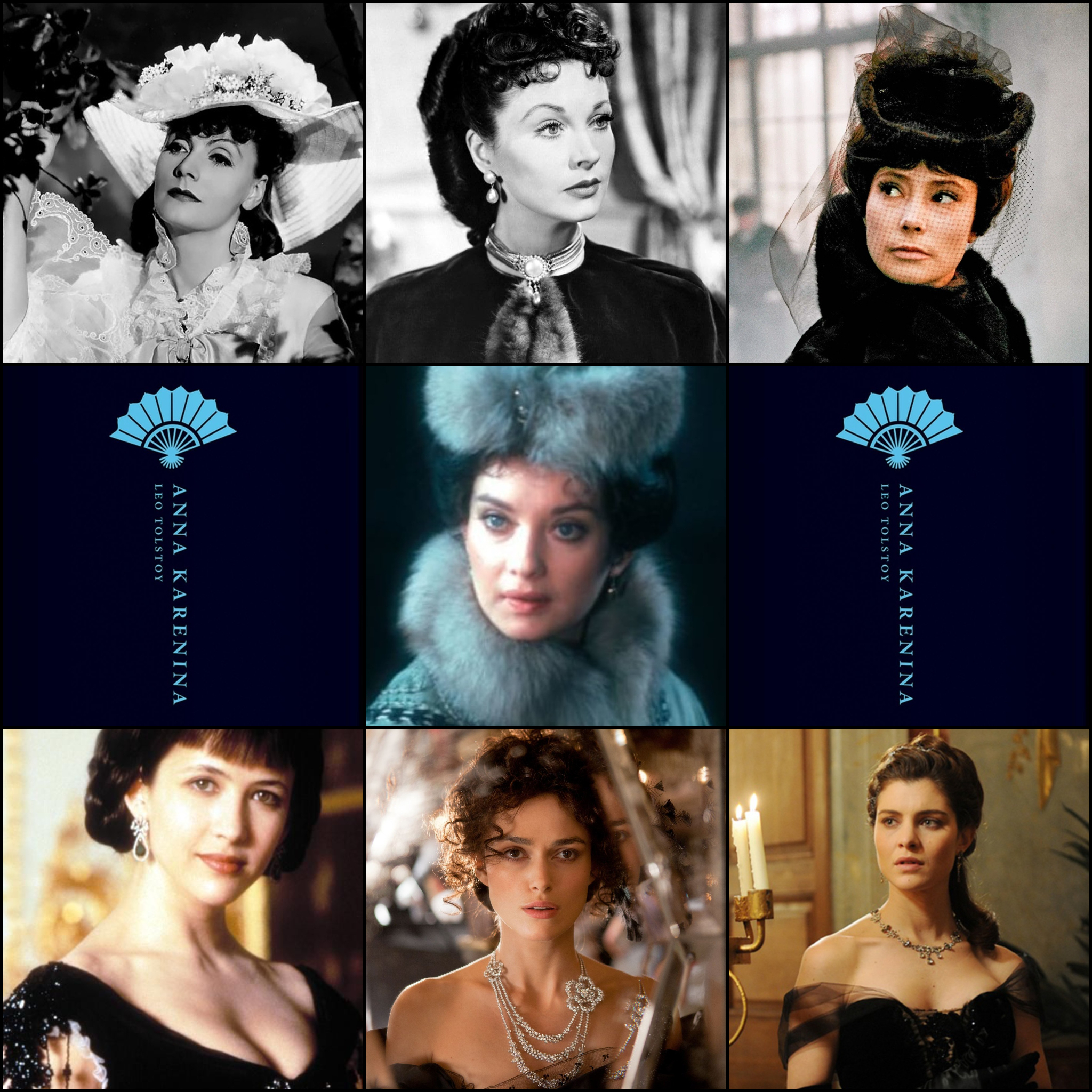
On Anna Karenina (1977), the 7th and best adaptation I’ve seen of Tolstoy’s novel

My collage of all the 7 Annas I have seen (in chronological order). 


One common problem with adaptations of Anna Karenina is that, because of length, they have to cut many things and thus cannot convey the complexity of the characters and their relationships. The Greta Garbo film (1935) is 1 hour 35 minutes, the Vivien Leigh film (1948) is 2 hours 19 minutes, the Tatiana Samoilova film (1967) is 2 hours 25 minutes, the Sophie Marceau film (1997) is 1 hour 48 minutes, the Keira Knightley film (2012) is 2 hours 9 minutes, the Vittoria Puccini film (2013) is 3 hours 15 minutes—the novel is over 900 pages!—the 1977 series is 10 episodes, totalling 8 hours 20 minutes. 

Something I have noticed is that adapters often have trouble with Karenin. The earlier films, 1935 and 1948 films especially, tend to present Karenin as some sort of monster (presumably to make Anna more sympathetic) whereas some later ones, particularly 2012 and 2013, very much soften Karenin, making him more sympathetic, and present Anna as irrational and selfish and Vronsky as some callous playboy. They more or less pick one side over the other, and simplify the story.   

But if you watch the 1977 series, you can see the different facets of the characters, you can see their complexity, you can see their contradictions. Tolstoy may have begun Anna Karenina intending to condemn adultery, condemn the fallen woman, but gradually had compassion for them all, and do we not, reading his novel? We have compassion for Anna, who marries without love and has the misfortune of falling in love with someone else, unable to get a divorce. We can see why Anna hates Karenin, but can feel his pain and humiliation. We understand Vronsky’s shame and see the pain he causes Karenin, but he does love Anna, unlike the callous lovers of Emma Bovary. All these characters are complex, and you can all see that in the performances of Nicola Pagett, Eric Porter, and Stuart Wilson. 

In Stuart Wilson’s performance as Vronsky, I see a man who initially lives for fun and pleasure and who is ennobled by love—he changes—Stuart Wilson is especially good in the scenes of Vronsky suffering, such as the sense of immense shame and humiliation after Anna’s childbirth, and the scene in which he confides in Dolly about their impossible situation—he conveys better than other actors Vronsky’s depth of feeling and his struggle as Anna becomes increasingly difficult. Eric Porter’s Karenin is also the best Karenin I have seen—I can see why Anna doesn’t love him and Seryozha is afraid of him, which I don’t see when the 2012 and 2013 versions soften the character—at the same time, the earlier actors tend to play Karenin as a cold man, without feelings, Eric Porter’s Karenin is a man who speaks of duty, honour, and later Christianity, because he rejects his own feelings. Most importantly, Nicola Pagett is better than all the Annas I have seen, partly thanks to the length of the production and partly thanks to her own performance—she has the charm and passion of Anna, she conveys the shame, the struggle, the self-doubt, the insecurities, the anguish, the paranoia, the contradictions in the character. 

The 1977 series reminds me of the qualities for which Anna Karenina is so dear to my heart. 

This adaptation of Anna Karenina still prioritises the Anna strand—Kitty’s time in Germany for example is cut, Levin’s “revelation” is also cut—but because of length, it can include more of the Levin strand than most other versions. I do very much like Robert Swann as Levin and Caroline Langrishe as Kitty—it’s great casting—she has the innocence and purity of Kitty that contrasts with the more mature and darker sexual charm of Anna. Those of you who prefer the Levin strand to the Anna strand may prefer that the 2013 version puts more emphasis on Levin and Kitty, but that version has the modern disease of quick cuts, constant camera movements, and quiet and badly written dialogue—the 1977 series has great dialogue, spoken clearly, and allows the camera to linger, allows the drama to unfold. 

In short, this is a great adaptation, pitch-perfect. This is something it has in common with the 1972 War and Peace (with Anthony Hopkins as Pierre), also by the BBC: those who are used to spectacular visuals and place the image above all else may complain that these adaptations are “stagey” and lacking in camerawork, but to me, it’s much more important that something is well-written, well-developed, well-acted—I would always choose great performances with basic cinematography, over spectacular cinematography with mediocre performances and hollow representations of characters, especially if it’s an adaptation of a novel—in both cases, the screenwriters (Donald Wilson for Anna Karenina and Jack Pulman for War and Peace) understand and respect the novel, and in both cases, there’s a strong cast. I often say that the 1972 War and Peace handles Tolstoy’s characters much better than Bondarchuk’s film series and its only flaw is Natasha—but there is no weak point in the 1977 Anna Karenina

It is my favourite Tolstoy adaptation. 

It took me years to search for the series. It’s now uploaded on Youtube, in good quality. What are you waiting for? 


PS: 11/6 is my birthday. 

Friday, 4 April 2025

On “AI art” and the artist’s vision

(An image created by MidJourney that caused controversy a few years ago when winning a photography/ digital art award). 


1/ I once saw a tweet saying “the brain is literally a computer and there are a lot of people who deny this for some reason.” In response, someone called Duncan Reyburn (@duncanreyburn) wrote:  

“Amazing inability to see the difference between an analogy and an identity here. Left-hemispheric overreach. Computers have no intentionality, for one thing, and also no capacity to feel their own being, to sense their own life, to transcend their own limitations, to be porous to vibes, etc.

To reason properly, you have to be able to spot not just similarity but also difference. You need to assume that your own immediate, conscious assumptions are shutting the door to some pretty important aspects of meaning.” 

I thought of that exchange when I was talking to my friend Himadri recently about “AI art” and he said: 

“It’s an interesting question: given all the possible uses for AI, why are so many people so insistent that it can produce art, and that, some day AI will produce works of the level of Caravaggio, Mozart, Tolstoy? I think the reason is this:

There are many who are very deeply wedded to the idea that humans are no more than machines. Incredibly sophisticated machines, but machines nonetheless. They absolutely hate the idea that humans can have souls - that is, that humans can have some element in them that are beyond rational analysis, beyond rational explanation. If AI can replicate the greatest works of art, they will be proved right. Even Caravaggio and Rembrandts were mere machines.”

But why? I don’t understand. The enthusiastic cheering for “AI art” is deeply anti-art and anti-human. 


2/ A couple of years ago, I had a discussion with someone, also on Twitter, who said that there’s no difference between “AI art” and art made by humans, because “all art is a mash-up of previous art.” 

I wouldn’t be surprised if that’s the way all AI-loving tech bros think. But as I pointed out back then, artists don’t just take something from other artists, they have something of their own—their own experiences and vision of life and obsessions and antipathies and regrets and fears and desires and hangups—artists may also break the rules and do something new and transcend the boundaries—all these things are beyond AI. 

Apart from a profound misunderstanding of art and its creation, I can’t help thinking that some people have had their thinking distorted by decades (or perhaps a century?) of sci-fi (a genre I have never particularly liked) and it has made them believe that AI (such as we currently have) could be conscious. It is not. And if you use AI to generate something, you’re not the artist—you’re the equivalent of a commissioner. 


3/ When I read, I’m not only interested in characters, details, imagery, metaphors, motifs, language, style, etc—I’m also interested in the author’s vision. 

When people say that a reader is either a Tolstoy person or a Dostoyevsky person, for example, it’s because they don’t just have different writing styles but also have different visions of life: Dostoyevsky writes about the abnormal and the extreme, Tolstoy writes about a wide range of “normal” people; Dostoyevsky believes in free will, Tolstoy believes in determinism; Dostoyevsky depicts life as made up of dramatic moments and great decisions determining the trajectory of one’s life, Tolstoy sees life as formed by all the little decisions one makes every moment; they are opposite. Then you read Chekhov and he again has a different vision of life: Tolstoy and Dostoyevsky are both religious whereas Chekhov is a humanist (if you’re new here, I’m a Tolstoy and Chekhov girl). 

These things fascinate me. Chekhov, Jane Austen, and Flannery O’Connor all strike me as having no illusions about human nature, for instance, but Chekhov looks at people with warmth and compassion, Jane Austen laughs at them, and Flannery O’Connor coldly dissects and studies them. 

It’s also because I’m interested in the artist’s vision that in painting, I have zero interest in photorealism: the skills are impressive, but so what? All I see is someone painstakingly reproducing what the camera “sees”. Most of my favourite artists are not realistic as such—Egon Schiele, Van Gogh, Monet, Cézanne, Turner, etc.—even the more “realistic” ones such as Rembrandt or Sargent, I like them not because they depict people with great accuracy, but because their subjects feel alive and because I love Rembrandt’s use of lighting and Sargent’s way of focusing on the face but using broad brushstrokes and a more impressionistic style for the clothes and surroundings. 

But it’s not just me. Who would be interested in “art” made by machine, made by something that doesn’t see the world, doesn’t experience things, doesn’t have feelings? I don’t think most people are. The only people (I see) enthusiastically promoting and cheering for “AI art” are the tech people who are not really interested in art in the first place. 

Sunday, 23 February 2025

David Copperfield: some thoughts on characters (with mention of Tolstoy)

1/ Now that I’ve finished reading David Copperfield after about 6 weeks (though I did take a break and spent a few days reading The Sorrows of Young Werther) and so far mostly written about Dickens’s writing style, I should jot down some thoughts on the characters. 

The greatest character in David Copperfield is, without doubt, Uriah Heep. Repulsive Heep! Fawning, obsequious Heep! Scheming, villainous Heep! From his physical attributes to his voice, to his personality, to his evil—this is one of the most memorable villains in fiction.

After that, the most brilliant characters in the book are Betsey Trotwood, Miss Mowcher, and Rosa Dartle. The Murdstones and the Micawbers and Mr Dick are also very good—only Dickens could create such characters and give them so much life, so much presence—but I especially love these three. All those detractors who sneeringly say Dickens only creates caricatures, that he cannot write characters with depth—have they not seen Betsey Trotwood? And Miss Mowcher? As we often see in Dickens, Betsey Trotwood first appears as a caricature and gradually becomes a complex, multifaceted character: when we first see her, she’s an eccentric woman, an intimidating woman who terrifies everyone and keeps yelling “Donkeys!”, fighting donkeys off the little piece of green before her house; but she changes, she grows, she develops; the intimidating woman turns out to be a generous great aunt, a pitiful wife, a wonderful woman, and she is especially lovable in her gentleness towards Dora. 

Dickens does something similar with Miss Mowcher, except that it’s more extraordinary: Betsey Trotwood has lots of space to develop throughout the novel, whereas Miss Mowcher is a minor character who has about two big scenes. When we first see her, she’s a dwarf hairdresser and a friend of James Steerforth—she’s witty, she’s talking nonstop, she’s captivating David’s attention and also ours. 

“… ‘No,’ said Steerforth, before I could reply. ‘Nothing of the sort. On the contrary, Mr Copperfield used—or I am much mistaken—to have a great admiration for her.’

‘Why, hasn’t he now?’ returned Miss Mowcher. ‘Is he fickle? Oh, for shame! Did he sip every flower, and change every hour, until Polly his passion requited?—Is her name Polly?’

The Elfin suddenness with which she pounced upon me with this question, and a searching look, quite disconcerted me for a moment.

‘No, Miss Mowcher,’ I replied. ‘Her name is Emily.’

‘Aha?’ she cried exactly as before. ‘Umph? What a rattle I am! Mr. Copperfield, ain’t I volatile?’

[…] ‘Very well: very well! Quite a long story. Ought to end “and they lived happy ever afterwards”; oughtn’t it? Ah! What’s that game at forfeits? I love my love with an E, because she’s enticing; I hate her with an E, because she’s engaged. I took her to the sign of the exquisite, and treated her with an elopement, her name’s Emily, and she lives in the east? Ha! ha! ha! Mr Copperfield, ain’t I volatile?’” (ch.22) 

She has such a vivid existence that I would be happy even if she stayed the same. But later, Dickens removes the layer and lets us see the real Miss Mowcher: 

“Miss Mowcher sat down on the fender again, and took out her handkerchief, and wiped her eyes.

‘Be thankful for me, if you have a kind heart, as I think you have,’ she said, ‘that while I know well what I am, I can be cheerful and endure it all. I am thankful for myself, at any rate, that I can find my tiny way through the world, without being beholden to anyone; and that in return for all that is thrown at me, in folly or vanity, as I go along, I can throw bubbles back. If I don’t brood over all I want, it is the better for me, and not the worse for anyone. If I am a plaything for you giants, be gentle with me.’” (ch.32) 

A magnificent scene, an unforgettable character. 

But even with the characters called caricatures, the ones who don’t have another side and don’t change, Dickens makes them so individual and gives them such a vivid existence that they cease to be mere types. Just look at them. Mr Murdstone is not just a cold, hard man who breaks his wives and reduces them to a state of imbecility. Mr Micawber is not just a poor man who keeps getting into financial troubles. Dickens gives them all individual voices and phrases, and thickens his characterisation with such details, such “unnecessary” details that they feel full of life within the world of his book. 

Among those characters who don’t change, who don’t have another side is Rosa Dartle. Throughout the novel, she remains the same as a haughty, snobbish, and bitter woman who loves James Steerforth and has burning hatred in her heart for everyone else, especially for Emily but also for Steerforth. But she suffers, and that pain gives life to the character. 

Later in Little Dorrit, Dickens goes further as he creates several characters—mostly women—who nurse a grievance and destroy their own lives because of it, such as Miss Wade, Fanny Dorrit, Harriet Beadle, Mrs Clennam, and so on. They’re in a prison of their own making. 


2/ I have called Dora Spenlow insufferable, and she is, but she is redeemed in her last moments—she gains awareness at last, and it’s a moving scene.

In an earlier blog post, I wrote that the second half of the book was less enjoyable. I still think that way, despite Uriah Heep. There’s a magical quality, a fairytale-like quality to the childhood section of the book that is absent in the adulthood section. More importantly, I think the adulthood section suffers because of Dora and because of David Copperfield. 

Let’s compare Dickens and Tolstoy. Levin is Tolstoy’s self-insert in Anna Karenina—I know some readers don’t like Levin, but this is not a flattering portrayal of himself—Levin sometimes gets silenced in debates and cannot argue his points, he recoils at his brother’s suffering and becomes helpless, he’s hot-tempered, he keeps questioning everything and continues to question even after his conversion at the end of the book, he has many flaws… 

If Pierre, as some people say, is Tolstoy’s self-insert in War and Peace, that is also not a flattering portrait—Pierre may be a good man, a lovable man, but he initially engages in all sorts of debauchery; he is weak-willed, naïve, idealistic, and impressionable; he jumps from one idea to another… I think it’s better to say that Tolstoy puts himself into Pierre, Andrei, and Nikolai, and all these characters are flawed and full of weaknesses—Andrei can even be quite cold and cruel. 

I’d go even further: I’d say that there’s something of Tolstoy himself in the main character of The Kreutzer Sonata. Many people hate this novella because they see the similarities in some ideas between the two, because they see Tolstoy as a misogynist. But Tolstoy is obviously not Pozdnyshev: he’s not a (wife) murderer, and Pozdnyshev would never be able to write Anna Karenina. What Tolstoy does in The Kreutzer Sonata is that he examines his own ideas about love, sex, men and women, and pushes his own ideas to the extreme—to use Ibsen’s phrase, he sits in judgement on himself—and he is utterly brutal about it. 

Now if we go back to Dickens, David Copperfield is a semi-biography and I think we would all agree that David is a nice, tame, whitewashed version of Dickens. The adult David is so dull because he’s too good. Yes, he has some small flaws, he’s a helpless husband just as Dora’s a helpless wife, but it’s tame. The real Dickens was awful to his wife. 

I’m of course not dismissing David Copperfield because of Dickens’s personal life—it’s in many ways a wonderful novel—I’m also not wishing David Copperfield had been a different book, truer to life—I’m merely pointing out what I saw as a difference between Dickens and Tolstoy. 

Saturday, 28 December 2024

On picking a translation

Under my last blog post, I got a comment from Thomas Parker asking how I selected translations, so let’s jot down some thoughts. 


1/ Anyone who loves Russian literature knows about the translation wars. Anna Karenina and War and Peace each have about a dozen translations—how do we choose? Here are my rules: never Constance Garnett (except her Chekhov); never Richard Pevear and Larissa Volokhonsky. Garnett, because she has a reputation for being fast and making mistakes and throwing out difficult passages. Pevear and Volokhonsky, because their sentences are clunky and I’m no fan of the literalist school of translation (nor am I a fan of their pumping out one translation after another of books that have been translated a million times—how convenient—contrast them with Robert Chandler, who introduced the Anglophone world to Vasily Grossman). 

Anna Karenina I’ve read in two translations—Aylmer and Louise Maude, and Rosamund Bartlett—both were enjoyable, I preferred the latter’s prose. 

War and Peace I’ve also read in two translations, and I tend to recommend Aylmer and Louise Maude, revised by Amy Mandelker. Other versions may modernise the language or anglicise the names or remove the French passages or remove the feminine endings in names—the Maude-Mandelker seems to be the best option—I want something close to the original without being clunky or awkwardly literal. 

My choice of Ignat Avsey for The Brothers Karamazov went against my general preference and habit (I’m full of contradictions), largely because of my struggle to get into Dostoyevsky in the translation of David McDuff. Next time will be a different version. It flowed well and I ended up loving the book, but once in a while something stuck out like a sore thumb, such as the phrase “my ex”. 


2/ It’s because of my wish for something close to the original that I read The Tale of Genji as translated by Royall Tyler. Madness. But Murasaki Shikibu referred to her characters by title or nickname or relation to someone else—the characters have no names—Royall Tyler retains the same effect and it reflects the world in which Murasaki and her characters live.  

As for you, read Seidensticker if you wish. No strong opinion there. But I would advise against Washburn—I know I’m no expert, but The Tale of Genji is a very subtle novel and Washburn removes all subtlety—he explicitly states that he incorporates explanations into the text itself rather than use notes. 


3/ If I read Chinese literature, which you may have noticed I don’t often do, it’s a matter of course that I would always go for a Vietnamese translation rather than an English one. 

So I might not be able to read Hong lou meng in the original, but at least I’m closer, much closer to it than an English speaker is. 


4/ More is lost in translation of poetry. Perhaps all is lost. Nguyễn Du in translation is no longer Nguyễn Du. Is Hàn Mặc Tử? Is Bùi Giáng? 

People ask me what I recommend for Truyện Kiều and I never know what to say except to stay away from Timothy Allen. 


5/ I haven’t read Pushkin, but then I also don’t read poetry in translation. 

But I don’t read poetry anyway, you’re going to say— but I do a little and will do more—even if I am to take the extreme position of never reading poetry in translation, there’s still a world of Vietnamese poetry and English poetry to read. 


6/ I might contradict myself and read Tang poetry in (Vietnamese) translation. 


7/ I’m sad I can’t read Cervantes, Flaubert, Proust, Pushkin, Homer… in the original. English native speakers complaining about Shakespeare’s English and saying that the rest of the world have the “advantage” of reading/ watching his plays in translation is something I could never understand.  

Monday, 2 December 2024

Why do some great novels resist adaptation?

Yesterday I watched two Czechoslovakian films: Alice and When the Cat Comes (both of which I recommend). As I was watching Alice, Jan Švankmajer’s wonderfully dark and disturbing adaptation of Lewis Carroll’s Alice’s Adventures in Wonderland, I thought about classic novels that were adapted for the screen over and over again. 

And I thought, why are some great novels so much harder to adapt than others? 

I’m not talking about novels with an odd structure, an obvious challenge such as Moby Dick or The Sound and the Fury or One Hundred Years of Solitude. I’m also not talking about faithful adaptations—you can’t accuse me of being a purist—just film or TV adaptations that can stand on their own as works of art. Like Jan Švankmajer’s Alice. Or Dr Strangelove. Or Ran.

But clearly some novels seem to resist adaptation. Take Don Quixote for instance. This is one of the most important novels in the world, this is a novel that has been adapted a million times, and yet—perhaps I am ignorant—there is not a single adaptation that is considered a good film of Don Quixote. BFI has an article called “The troubled history of Don Quixote on film”, about the failures of Orson Welles and Walt Disney and Terry Gilliam to bring it (successfully) to the screen. Terry Gilliam in the end managed to make The Man Who Killed Don Quixote in 2019, but it’s not successful, is it? Critic score of 66% and audience score of 59% on Rotten Tomatoes. 

Anna Karenina, another favourite novel of mine, also doesn’t seem to work well on the screen. The challenge of the depth of Tolstoy’s characters is not the only reason. The 1972 adaptation of War and Peace, with Anthony Hopkins as Pierre, demonstrates that it’s possible to convey the depth of characters and the conflicts between them—the only flaw of that version is Natasha (many people love the Soviet version, but it’s only because they seem to be fine with Sergei Bondarchuk stripping away all psychological and philosophical depth and character development). But there is not a single good adaptation of Anna Karenina* and I have seen six different ones: Greta Garbo (1935), Vivien Leigh (1948), Tatiana Samoilova (1967), Sophie Marceau (1997), Keira Knightley (2012), and Vittoria Puccini (2013). There is always something wrong—with Anna or Vronsky or Karenin or all of them—not to mention that the Levin strand is almost always reduced to a mere subplot. 

But I guess the complexity of Tolstoy’s characters is the main reason. Filmmakers tend to go for a simpler version. 

Wuthering Heights is another hard one. Jane Eyre has an excellent adaptation in 2006, with Ruth Wilson as Jane and Toby Stephens as Mr Rochester. Some people seem to like the 2011 film with Mia Wasikowska, for some reason. But Wuthering Heights has not had a single good adaptation—we all agree, yes? The news of the version currently in the works doesn’t particularly cheer anyone up either. How could Emerald Fennel possibly cast Margot Robbie as Cathy and Jacob Elordi as Heathcliff? Madness. 


My favourite Emma: Kate Beckinsale. 

The case of Jane Austen is easier to understand. Almost all of her novels have had a good adaptation: Lady Susan has a brilliant adaptation in 2016, confusingly named Love and Friendship; Northanger Abbey has been adapted only once** in 2007, with Felicity Jones, which seems popular enough; Sense and Sensibility has the Oscar-winning film in 1995 with Emma Thompson and Kate Winslet; Pride and Prejudice has the 1995 series, with Jennifer Ehle and Colin Firth, leading to the Austen craze and the whole Janeite industry (though there are, oddly, some people who prefer the Keira Knightley film); Emma has a great adaptation in 1996 with Kate Beckinsale, which is my favourite, though the consensus is that the best one is Clueless; Persuasion has a celebrated version, also in 1995, with Amanda Root as Anne Elliot and Ciarán Hinds as Captain Wentworth. All filmmakers have left to do is to “ruin” them with some “subversive” adaptations, like Netflix has done with Persuasion and presumably will do again with Pride and Prejudice (well, for those who like that sort of thing, that’s the sort of thing they like). 

The one Jane Austen novel that has not had a good adaptation is Mansfield Park. But that is not hard to understand: modern filmmakers cannot handle a morally serious and sombre Jane Austen novel and a heroine so unlike the Strong Female Character trope of Hollywood—Fanny Price, strong in a different way, is not a girlboss or a kickass heroine—filmmakers keep feeling a misplaced urge to “improve” on the book.  

But I do wonder why Wuthering Heights hasn’t got a good adaptation. Is it only because filmmakers keep sanitising and romanticising the story? Or is there some fierce, intense quality to Emily Bronte’s story that makes it impossible to work on the screen? 

But I suppose people are going to attempt again and again. 


** Addendum: There is also a version in 1987 that I did not know about. Thanks, Brian. 

* updated on 13/6/2025: I have now watched a wonderful adaptation of Anna Karenina from 1977. 

Wednesday, 16 October 2024

The BBC’s 100 greatest British novels, and some top 5

What’s up with me and lists these days? I don’t know. Getting listless, I guess. But once in a while, I think it’s good to look at some lists and see the holes in one’s reading. 

The premise: “What does the rest of the world see as the greatest British novels?” 

I use a strikethrough for the books I have read. The tick is when I have seen a screen adaptation. 

100. The Code of the Woosters (PG Wodehouse, 1938)

99. There but for the (Ali Smith, 2011)

98. Under the Volcano (Malcolm Lowry,1947)

97. The Chronicles of Narnia (CS Lewis, 1949-1954) ✔

96. Memoirs of a Survivor (Doris Lessing, 1974)

95. The Buddha of Suburbia (Hanif Kureishi, 1990)

94. The Private Memoirs and Confessions of a Justified Sinner (James Hogg, 1824)

93. Lord of the Flies (William Golding, 1954) ✔

92. Cold Comfort Farm (Stella Gibbons, 1932) ✔

91. The Forsyte Saga (John Galsworthy, 1922)

90. The Woman in White (Wilkie Collins, 1859)

89. The Horse’s Mouth (Joyce Cary, 1944)

88. The Death of the Heart (Elizabeth Bowen, 1938)

87. The Old Wives’ Tale (Arnold Bennett,1908)

86. A Legacy (Sybille Bedford, 1956)

85. Regeneration Trilogy (Pat Barker, 1991-1995)

84. Scoop (Evelyn Waugh, 1938)

83. Barchester Towers (Anthony Trollope, 1857)

82. The Patrick Melrose Novels (Edward St Aubyn, 1992-2012)

81. The Jewel in the Crown (Paul Scott, 1966)

80. Excellent Women (Barbara Pym, 1952)

79. His Dark Materials (Philip Pullman, 1995-2000)

78. A House for Mr Biswas (VS Naipaul, 1961)

77. Of Human Bondage (W Somerset Maugham, 1915)

76. Small Island (Andrea Levy, 2004)

75. Women in Love (DH Lawrence, 1920)

74. The Mayor of Casterbridge (Thomas Hardy, 1886)

73. The Blue Flower (Penelope Fitzgerald, 1995)

72. The Heart of the Matter (Graham Greene, 1948)

71. Old Filth (Jane Gardam, 2004)

70. Daniel Deronda (George Eliot, 1876)

69. Nostromo (Joseph Conrad, 1904)

68. A Clockwork Orange (Anthony Burgess, 1962) ✔

67. Crash (JG  Ballard 1973)

66. Sense and Sensibility (Jane Austen, 1811) ✔

65. Orlando (Virginia Woolf, 1928) ✔

64. The Way We Live Now (Anthony Trollope, 1875)

63. The Prime of Miss Jean Brodie (Muriel Spark, 1961) ✔

62. Animal Farm (George Orwell, 1945)

61. The Sea, The Sea (Iris Murdoch, 1978)

60. Sons and Lovers (DH Lawrence, 1913)

59. The Line of Beauty (Alan Hollinghurst, 2004)

58. Loving (Henry Green, 1945)

57. Parade’s End (Ford Madox Ford, 1924-1928)

56. Oranges Are Not the Only Fruit (Jeanette Winterson, 1985)

55. Gulliver’s Travels (Jonathan Swift, 1726)

54. NW (Zadie Smith, 2012)

53. Wide Sargasso Sea (Jean Rhys, 1966)

52. New Grub Street (George Gissing, 1891)

51. Tess of the d’Urbervilles (Thomas Hardy, 1891)

50. A Passage to India (EM Forster, 1924)

49. Possession (AS Byatt, 1990)

48. Lucky Jim (Kingsley Amis, 1954)

47. The Life and Opinions of Tristram Shandy, Gentleman (Laurence Sterne, 1759)

46. Midnight’s Children (Salman Rushdie, 1981)

45. The Little Stranger  (Sarah Waters, 2009)

44. Wolf Hall (Hilary Mantel, 2009)

43. The Swimming Pool Library (Alan Hollinghurst, 1988)

42. Brighton Rock (Graham Greene, 1938)

41. Dombey and Son (Charles Dickens, 1848)

40. Alice’s Adventures in Wonderland (Lewis Carroll, 1865) ✔

39.  The Sense of an Ending (Julian Barnes, 2011)

38. The Passion (Jeanette Winterson, 1987)

37. Decline and Fall (Evelyn Waugh, 1928)

36. A Dance to the Music of Time (Anthony Powell, 1951-1975)

35. Remainder (Tom McCarthy, 2005)

34. Never Let Me Go (Kazuo Ishiguro, 2005) ✔

33. The Wind in the Willows (Kenneth Grahame, 1908)

32. A Room with a View (EM Forster, 1908) ✔

31. The End of the Affair (Graham Greene, 1951) ✔

30. Moll Flanders (Daniel Defoe, 1722)

29. Brick Lane (Monica Ali, 2003)

28. Villette (Charlotte Brontë, 1853)

27. Robinson Crusoe (Daniel Defoe, 1719)

26. The Lord of the Rings (JRR Tolkien, 1954) ✔

25. White Teeth (Zadie Smith, 2000)

24. The Golden Notebook (Doris Lessing, 1962)

23. Jude the Obscure (Thomas Hardy, 1895) ✔

22. The History of Tom Jones, a Foundling (Henry Fielding, 1749)

21. Heart of Darkness (Joseph Conrad, 1899)

20. Persuasion (Jane Austen, 1817) ✔

19. Emma (Jane Austen, 1815) ✔

18. Remains of the Day (Kazuo Ishiguro, 1989) 

17. Howards End (EM Forster, 1910) ✔

16. The Waves (Virginia Woolf, 1931)

15. Atonement (Ian McEwan, 2001)

14. Clarissa (Samuel Richardson,1748)

13. The Good Soldier (Ford Madox Ford, 1915)

12. Nineteen Eighty-Four (George Orwell, 1949)

11. Pride and Prejudice (Jane Austen, 1813) ✔

10. Vanity Fair (William Makepeace Thackeray, 1848)

9. Frankenstein (Mary Shelley, 1818)

8. David Copperfield (Charles Dickens, 1850) ✔

7. Wuthering Heights (Emily Brontë, 1847) ✔

6. Bleak House (Charles Dickens, 1853)

5. Jane Eyre (Charlotte Brontë, 1847) ✔

4. Great Expectations (Charles Dickens, 1861) ✔

3. Mrs. Dalloway (Virginia Woolf, 1925)

2. To the Lighthouse (Virginia Woolf, 1927)

1. Middlemarch (George Eliot, 1874) ✔


Just about a quarter. But I don’t really feel much guilt, as many titles here are recent and therefore of little interest to me.  
If I were to name the 5 greatest British novels, I would probably say: 
  • Bleak House 
  • Wuthering Heights 
  • Middlemarch 
  • Emma 
  • Alice’s Adventures in Wonderland and Through the Looking-Glass (as one book—yes, I’m cheating) 
These are all 19th century novels, I know, that’s my century. Perhaps my picks will be different when I have read Tom Jones and Tristram Shandy—we’ll see. But my choice for the greatest British novel, contrary to consensus, would be Bleak House. I know people praise Middlemarch for its psychological insight, rightly so, but my vote goes to Bleak House for its language, for its metaphors and motifs and patterns, for its multiple strands of stories and the two narrators, for its large canvas and intricate plot—Bleak House is, in my opinion, more inventive and artistically more interesting than Middlemarch
As we’re here, I might as well name my choices for 5 greatest Russian novels:
  • Anna Karenina 
  • War and Peace 
  • The Brothers Karamazov 
  • Dead Souls 
  • The Gift 
The last one is subject to change— I haven’t read Eugene Onegin, I haven’t read Demons, I haven’t read Oblomov, I haven’t read The Master and Margarita, I haven’t read Platonov, I haven’t read Andrei Bely, etc.—we’ll see. But the two Tolstoy novels and The Brothers Karamazov are going to stay there. 
I haven’t read enough to talk about French novels, so here are my 5 greatest American novels: 
  • Moby Dick 
  • Lolita 
  • Invisible Man
  • The Sound and the Fury 
  • The Age of Innocence 
This is an uncertain list, at least the last two. Moby Dick however is one of the three novels with which I’m most obsessed, and my pick for the Great American Novel. Planning to sail again with Ishmael this year. Lolita and Invisible Man are both great. For the last spot, on a different day, I might swap The Age of Innocence for The Portrait of a Lady, or The Scarlet Letter. But also, there are quite a few important American novels I haven’t read. 
Give me your top 5. We’re talking about greatest novels, not favourites. 
Also tell me about other countries too. 5 greatest Indian novels. Spanish. Italian. French. Japanese. Chinese. Whatever.  

Sunday, 28 July 2024

The appeal of Chekhov

Nabokov says in Strong Opinions

“The word “genius” is passed around rather generously, isn’t it? At least in English, because its Russian counterpart, geniy, is a term brimming with a sort of throaty awe and is used only in the case of a very small number of writers, Shakespeare, Milton, Pushkin, Tolstoy. To such deeply beloved authors as Turgenev and Chekhov Russians assign the thinner term, talánt, talent, not genius. […] Genius still means to me, in my Russian fastidiousness and pride of phrase, a unique, dazzling gift, the genius of James Joyce, not the talent of Henry James.” 

And yet: 

“Mr. Karlinsky has put his finger on a mysterious sensory cell. He is right, I do love Chekhov dearly. I fail, however, to rationalize my feeling for him: I can easily do so in regard to the greater artist, Tolstoy, with the flash of this or that unforgettable passage (“…  how sweetly she said: ‘and even very much’ ”—Vronsky recalling Kitty’s reply to some trivial question that we shall never know), but when I imagine Chekhov with the same detachment all I can make out is a medley of dreadful prosaisms, ready-made epithets, repetitions, doctors, unconvincing vamps, and so forth; yet it is his works which I would take on a trip to another planet.”

Nabokov makes a similar point in Lectures on Russian Literature

“Russian critics have noted that Chekhov’s style, his choice of words and so on, did not reveal any of those special artistic preoccupations that obsessed, for instance, Gogol or Flaubert or Henry James. […] Thus Chekhov is a good example to give when one tries to explain that a writer may be a perfect artist without being exceptionally vivid in his verbal technique or exceptionally preoccupied with the way his sentences curve. […] The magical part of it is that in spite of his tolerating flaws which a bright beginner would have avoided, in spite of his being quite satisfied with the man-in-the street among words, the word-in-the-street, so to say, Chekhov managed to convey an impression of artistic beauty far surpassing that of many writers who thought they knew what rich beautiful prose was.”

Unlike Nabokov, I do think Chekhov has genius—like Tolstoy, Dostoyevsky, and Gogol—whereas Turgenev has talent. But I too find it difficult to talk about Chekhov’s greatness, to rationalise my love for his writings.

When I read Alice Munro for the first time last year—a darling of Book Twitter, until the recent explosion—I enjoyed the stories a lot, but I remember thinking she’s very good but not Chekhov good. Alice Munro is also a subtle writer, writing about the lives of ordinary people and the little moments that are full of meaning. In a way, she should perhaps appeal more to me, writing about women, and she’s contemporary—TSK on Twitter said “being closer to us in time, her stories are fresher and more alive”—and yet I have never felt a connection with Alice Munro the way I feel about Chekhov (and now I clearly won’t). 

But it’s not just Alice Munro. I just love Chekhov more than any other short story writers; and in literature in general, I feel closer to Chekhov than anyone else, even Shakespeare and Tolstoy. 

Why? 

Part of it must be the authorial persona. Some writers—like Chekhov, Cervantes—have a more lovable persona than others—like Tolstoy, George Eliot. Tolstoy the artist may be able to depict a wide range of perspectives and inhabit the mind of more or less any character* but you can tell—you can feel on the page—that Tolstoy the man is judgemental. Same with George Eliot. 

It’s not that Chekhov doesn’t judge or doesn’t condemn. That is something people like to repeat when they talk about Chekhov, but all you have to do is to read “Ward No.6” or “In the Ravine” and you can see that isn’t true—Chekhov’s moral sense is clear, as he writes about people’s egotism, callousness, and cruelty to each other. But he is compassionate and humane. He makes us feel understood. He provides solace in moments of despair. 

He conveys, better than anyone, those brief moments of sadness that we sometimes feel. Take, for example, this passage from “The Beauties”: 

“I felt this beauty rather strangely. It was not desire, nor ecstacy, nor enjoyment that Masha excited in me, but a painful though pleasant sadness. It was a sadness vague and undefined as a dream. For some reason I felt sorry for myself, for my grandfather and for the Armenian, even for the girl herself, and I had a feeling as though we all four had lost something important and essential to life which we should never find again. My grandfather, too, grew melancholy; he talked no more about manure or about oats, but sat silent, looking pensively at Masha.” 

Later, in the same story: 

“On the platform between our carriage and the next the guard was standing with his elbows on the railing, looking in the direction of the beautiful girl, and his battered, wrinkled, unpleasantly beefy face, exhausted by sleepless nights and the jolting of the train, wore a look of tenderness and of the deepest sadness, as though in that girl he saw happiness, his own youth, soberness, purity, wife, children; as though he were repenting and feeling in his whole being that that girl was not his, and that for him, with his premature old age, his uncouthness, and his beefy face, the ordinary happiness of a man and a passenger was as far away as heaven....” 

(translated by Constance Garnett) 

I’m not a guard with a “battered, wrinkled, unpleasantly beefy face”, but I recognise that melancholy feeling.

This is why, when I feel down, I turn to Chekhov. 

Chekhov appeals to me also because he’s a humanist, and humane. Tolstoy and Dostoyevsky constantly write about God and constantly wrestle with their faith; Chekhov doesn’t pretend to know the answers to any of those big questions, but he’s capable of depicting goodness without faith, and conveying—in life as well as in writings—a sense of purpose without religion. He also rejects ideology, and rejects extremes. 

If anyone asks who my literary heroes are, my immediate answer would be Chekhov. I might perhaps also mention Vasily Grossman or Primo Levi—it might be a bit too early to say—but my one literary hero would be Chekhov. 

What about you? Why do you like Chekhov? 


*: except Hélène.