Pages

Saturday, 20 August 2022

Henry VI, Part 2

1/ Compared to Part 1, Part 2 does sound a lot more like Shakespeare. For example, look at the metaphor used by the Duke of York when he bemoans the King giving away Anjou and Maine for his marriage to Margaret: 

“YORK […] Pirates may make cheap pennyworths of their pillage, 

And purchase friends, and give to courtesans, 

Still reveling like lords till all be gone; 

While as the silly owner of the goods 

Weeps over them and wrings his hapless hands, 

And shakes his head and trembling stands aloof, 

While all is shared and all is borne away, 

Ready to sterve and dare not touch his own…” 

(Act 1 scene 1) 

When Eleanor, Duchess of Gloucester, tells her husband about her dream of them being King and Queen, he chides her. She later thinks to herself: 

“DUCHESS […] While Gloucester bears this base and humble mind.

Were I a man, a duke, and next of blood, 

I would remove these tedious stumbling-blocks

And smooth my way upon their headless necks; 

And, being a woman, I will not be slack 

To play my part in Fortune’s pageant…”

(Act 1 scene 2) 

Does she not make you think of Lady Macbeth? 

The first few scenes also show that some of the themes that occupy Shakespeare’s mind throughout his career have been there from the beginning: political forces, power, ambition, truth, slander, and so on. 

Jonathan Bate writes in The Genius of Shakespeare

“His own political position cannot be inferred from the drama; what can, however, be inferred is that he was a great deal more interested in political forces than Marlowe was.” (Ch.4) 


2/ There are two main debates among scholars about Part 1

The first is about authorship: the consensus is that it’s a collaboration, I have no doubt. It is imbalanced, there are clearly different hands involved, and Part 2 is significantly better. The questions are how much was Shakespeare’s; who the other playwrights were; whether they wrote different scenes in isolation or, like modern TV writers, sat in the same room and bounced ideas off each other until nobody knew who came up with what…

I personally think Shakespeare wrote parts of Act 2 and Act 4. Edward Burns, the editor of the third series Arden King Henry VI, Part 1, also thinks so.

The second debate is about whether Part 1 was the first play in a 4-part cycle, or a prequel quickly produced after the success of the other plays. Edward Burns thinks it’s the latter, but I have to read arguments from different sides before I can come back to this point.  


3/ In the blog post about Part 1, I complained about Joan la Pucelle as a character, and I also thought Margaret wasn’t interesting. It’s not the case with the female characters in Part 2: they’re full of life. 

The scene of the Duke of Gloucester with his wife Eleanor, now being punished, is very good. 

“DUCHESS […] Ah, Humphrey, can I bear this shameful yoke? 

Trowest thou that e’er I’ll look upon the world

To count them happy that enjoys the sun? 

No, dark shall be my light and night my day; 

To think upon my pomp shall be my hell…” 

(Act 2 scene 4) 

I like the bird metaphors: 

“DUCHESS […] And York, that impious Beaufort, that false priest,

Have all limbed bushes to betray thy wings; 

And fly thou how thou canst, they’ll tangle thee. 

But fear not thou, until thy foot be snared,

Nor never seek prevention of thy foes.” 

(ibid.) 

Gloucester’s response is naïve. 

Margaret is also full of life:

“QUEEN Not all these lords do vex me half so much

As that proud dame, the Lord Protector’s wife:

She sweeps it through the court with troops of ladies, 

More like an empress than Duke Humphrey’s wife.

Strangers in court do take her for the Queen: 

She bears a duke’s revenues on her back, 

And in her heart she scorns our poverty.

Shall I not live to be avenged on her?...” 

(Act 1 scene 3) 

Much more interesting than Margaret in Part 1. But perhaps I’m being unfair: after all, Margaret here is a queen, whereas in Part 1, she was a poor king’s daughter, taken prisoner by Suffolk.


4/ I like the metaphors. Part 2, as I said, sounds a lot more like Shakespeare. 

For example, when Margaret tries to poison the King’s mind about Gloucester, she says: 

“QUEEN […] Now ’tis the spring, and weeds are shallow-rooted;

Suffer them now, and they’ll o’ergrow the garden, 

And choke the herbs for want of husbandry…” 

(Act 3 scene 1) 

Her slander is followed and echoed by Suffolk’s. Note the metaphor: 

“SUFFOLK […] The fox barks not when he would steal the lamb…” 

(ibid.) 

In his response, the King combines both the garden metaphor and the animal metaphor: 

“KING My lords, at once: the care you have of us, 

To mow down thorns that would annoy our foot, 

Is worthy praise: but, shall I speak my conscience, 

Our kinsman Gloucester is as innocent

From meaning treason to our royal person 

As is the sucking lamb or harmless dove…” 

(ibid.) 

Margaret follows up with the same imagery: 

“QUEEN Ah, that’s more dangerous than this fond alliance! 

Seems he a dove? His feathers are but borrowed,

For he’s disposèd as the hateful raven.

Is he a lamb? His skin is surely lent him,

For he’s inclined as is the ravenous wolves.

Who cannot steal a shape, that means deceit?

Take heed, my lord: the welfare of us all

Hangs on the cutting short that fraudful man.” 

(ibid.) 

Clever, scheming woman. I like the way Shakespeare depicts the various factions setting aside their conflicts for the moment and joining forces to get rid of a common enemy—the most honourable man at court—throwing out all sorts of allegations about him that they themselves know to be untrue. It is fascinating. 

When Margaret and the others plan Gloucester’s death, the conversation is full of animal imagery: crocodile, snake, eagle, chicken, kite, fox. And when the news comes that Gloucester is dead, the King also evokes animals in his speech: raven, wren, serpent, basilisk. The animal metaphors recur throughout the entire play. 

Margaret’s long speech in response to the King is fantastic. Queen Margaret is perhaps Shakespeare’s first great female character. She is scheming, ruthless, manipulative—more like Iago or Edmund than Lady Macbeth, Goneril, or Regan.

I especially like this bit: 

“QUEEN […] What did I then, but cursed the gentle gusts

And he that loosed them forth their brazen caves, 

And bid them blow towards England’s blessèd shore, 

Or turn our stern upon a dreadful rock?

Yet Aeolus would not be a murderer, 

But left that hateful office unto thee. 

The pretty vaulting sea refused to drown me, 

Knowing that thou wouldst have me drowned on shore

With tears as salt as sea, through thy unkindness; 

The splitting rocks cow’red in the sinking sands,

And would not dash me with their ragged sides, 

Because thy flinty heart, more hard than they, 

Might in thy palace perish Margaret…” 

(Act 3 scene 2) 

Shakespeare is a master of rhetoric. 

I also like that Shakespeare gives Margaret and Suffolk a tender parting scene. From the earlier plays, he depicts a wide range of voices and perspectives, and portrays all the characters with depth and complexity. Even a ruthless villain like Margaret has a tender side. 


5/ The language in this play cannot compare to the language in Richard II or the 2 parts of Henry IV, of course, but the imagery is so much better than in Part 1

“LIEUTENANT The gaudy, blabbing and remorseful day 

Is crept into bosom of the sea, 

And now loud-howling wolves arouse the jades 

That drag the tragic melancholy night; 

Who, with their drowsy, slow, and flagging wings 

Clip dead men’s graves, and from their misty jaws 

Breathe foul contagious darkness in the air…” 

(Act 4 scene 1)

That is when the ship carrying Suffolk is attacked. 


6/ Besides Margaret, Jack Cade is another great creation. In The Genius of Shakespeare, Jonathan Bate discusses Jack Cade as something new, original—especially compared to Marlowe. 

It’s true that it’s something new Shakespeare did that Marlowe didn’t do; I haven’t read enough contemporary plays to know if it’s something original to Shakespeare at the time. But I’ve always loved that Shakespeare contains everything, high and low: not just all classes and all kinds of people, but both high, sophisticated language and common language, puns, and smutty jokes. His mind encompasses everything. 

(Tolstoy hates this, calling it vulgarity). 

Jack Cade doesn’t appear in many scenes, but he’s a compelling and memorable character. 

“CADE […] Dost thou use it to write thy name? Or hast thou a mark to thyself, like an honest plain-dealing man?” 

(Act 4 scene 2) 

Would anyone in the audience at the time have identified with Cade? 

The clerk can write. 

“CADE Away with him, I say! Hang him with his pen and ink-horn about his neck.” 

(ibid.) 

For those of you who haven’t read the play, or have read it but don’t remember, this scene contains the famous line “The first thing we do, let’s kill all the lawyers.” 

Later, the scene of Jack Cade and his gang throwing false accusations at Lord Say is a nice echo of the people at court making false allegations about Gloucester. 

Jonathan Bate draws my attention to something interesting in Cade’s speech to Lord Say: 

“CADE […] Thou hast most traitorously corrupted the youth of the realm in erecting a grammar school: and whereas before, our forefathers had no other books but the score and the tally, thou hast caused printing to be used, and contrary to the King, his crown and dignity, thou hast built a paper-mill…” 

(Act 4 scene 7) 

Bate writes in The Genius of Shakespeare

“There is some purposeful anachronism at work here: the first printing-press in England was established by William Caxton in 1477, twenty-seven years after Cade’s rebellion, and the first paper-mill was new at the time of the play (it was built in 1588). The Lord Say may have established a grammar school (that at Sevenoaks in Cade’s native Kent), but the great expansion of grammar schools belongs to the mid-sixteenth century. The corruption which Cade alludes to is really the enfranchisement from which Shakespeare benefited in his own youth. His father signed his name with a mark and almost certainly did not go to school. Shakespeare owed his reading, his writing, his ticket out of Stratford, and his new profession as a dramatist to exactly those innovations which Cade condemns: education and print.” (Ch.4) 

Is that not fascinating? 

Tony Tanner also points out that Shakespeare’s Jack Cade is different from Jack Cade in the sources. He explains the differences, and says: 

“At this point in his pattern, having shown all English law and order gone to the grave with Humphrey, Shakespeare hardly wants the sudden appearance of a reasonable, civilized, and literate mob-leader, with a manifest respect for law and letters. […] So Shakespeare turned back to the Wat Tyler rebellion of 1381, and took just what he needed for his plan—the killing of the lawyers, the destruction of the Savoy and the Inns of Court, and the burning of the records of the realm.” (Introduction) 

My only complaint about the Cade plot is that the resolution isn’t very satisfying. 


7/ The entire tragedy of the King is summed up in these lines:

“KING Was ever king that joyed an earthly throne, 

And could command no more content than I? 

No sooner was I crept out of my cradle

But I was made a king, at nine months old. 

Was never subject longed to be a king

As I do long and wish to be a subject.” 

(Act 4 scene 9)

He’s a good man, a moral man, but being king isn’t his thing. 

I like the way Shakespeare explores politics and examines different kinds of kings in his history plays. 

“Uneasy lies the head that wears a crown.” 

(Henry IV, Part 2)

This is an excellent play. 

Monday, 8 August 2022

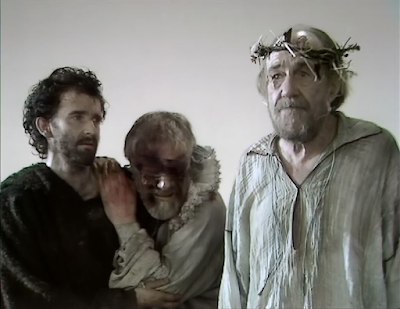
On the 1982 BBC King Lear

After the 2016 version starring Don Warrington, this is the second King Lear I’ve seen. Or third, if you count the Russian film directed by Grigori Kozintsev. Or even fourth, if you count Kurosawa’s Ran

A central difference between Michael Hordern in the BBC production and Don Warrington—and I suppose most other Lears—is that Michael Hordern’s Lear is not monumental, not larger-than-life, not striving against cosmic forces. He plays Lear as old, frail, and feeble-minded, and this version seems to be a King Lear on a small scale.   


Some people may find it a disappointment, but I do like this different approach. It works. His entire performance is great, but there are three scenes I find particularly magnificent: the scene in the storm, the meeting between Lear and blind Gloucester, and the final scene with Cordelia. There is no need to talk about the final scene—the line “Why should a dog, a horse, a rat have life,/ And thou no breath at all?” always brings tears to my eyes. But the scene of mad Lear meeting blind Gloucester is particularly good: it is a tragic scene, a cruel scene, but at the same time there’s a kind of terrible comedy in it. 

“LEAR I remember thine eyes well enough. Dost thou squiny at me? No, do thy worst, blind Cupid! I'll not love. Read thou this challenge; mark but the penning of it.” 

(Act 4 scene 6) 

Michael Hordern and Norman Rodway (Gloucester) play the scene just right: it’s terrible and at the same time funny—a dark, terrible kind of funny. 

I also love the way he says the line “Let me wipe it first; it smells of mortality.”

Another performance worthy of praise is Anton Lesser playing Edgar. When reading the text, I think there isn’t much to the role of Edgar, and yet in the hands of a fantastic actor such as Anton Lesser, he’s transformed into something more tragic, more haunting. He’s even more interesting than Edmund, portrayed by Michael Kitchen.

In the 2016 version (directed by Michael Buffong and featuring Don Warrington in the titular role), my main complaint is about Fraser Ayres as Edmund—partly because he overacts, partly because he lacks the attractiveness of Edmund. In the 1982 version, Michael Kitchen is attractive—one can understand why Goneril and Regan both fall in love with him and plot against each other—but it’s a bland, unmemorable performance.

However, that’s not my main complaint about the 1982 version—it’s the lack of comedy. King Lear is a tragedy, a bleak, devastating play, but there’s comedy in it, and I think the main problem is Frank Middlemass’s performance as the Fool. Jonathan Miller’s decision to have an old Fool, someone who has probably grown up with Lear, is an interesting one and it could work. The scene on the heath feels very different when the Fool is as old and frail as Lear. But to me, Frank Middlemass isn’t funny, so in many scenes, the Fool comes across as angry, bitter, and moralising. I much prefer Miltos Yerolemou in the 2016 version. 

The unfunny Fool almost ruins the first half of the play for me, and yet the second half is overwhelming. If you really think about it, King Lear is in some ways not very logical and realistic—some of Tolstoy’s complaints are perfectly valid—but it has a strange, overwhelming power I can’t quite explain. By the end, I’m devastated. And the 1982 version gets that right.

It is largely thanks to Michael Hordern and Anton Lesser. I also like Penelope Wilton—her girlish smile as she watches her husband gouge out Gloucester’s eyes and urges him “One side will mock another; the other too” is unnerving. And Brenda Blethyn is closer to my idea of Cordelia than Pepter Lunkuse in the 2016 version.

Despite some imperfections, the 1982 King Lear is excellent. 

Sunday, 7 August 2022

Henry VI, Part 1

This is one of the candidates for the title of Shakespeare’s Worst Play. What do I think? Let’s see. I don’t have a lot to say, but I’m going to poke at it from different directions. 


1/ Generally speaking, when you’re spoilt by Shakespeare, the language here is not very good. But once in a while, I come across something interesting. 

“BEDFORD […] Our isle be made a nourish of salt tears, 

And none but women left to wail the dead…” 

(Act 1 scene 1) 

The king, my lord, is dead. 

“PUCELLE […] Glory is like a circle in the water, 

Which never ceaseth to enlarge itself 

Till by broad spreading it disperse to nought…” 

(Act 1 scene 2) 

The Christopher Marlowe chapter in Jonathan Bate’s The Genius of Shakespeare is good to (re)read whilst reading this play: we know Marlowe tends to write 2 kinds of characters—the overreacher and the Machiavellian schemer—and Bate says Shakespeare created “a figure who was both Faustus-like conjuror and cunning schemer: Joan la Pucelle”.

Bate then says, by dramatising the war between Talbot and Joan, Shakespeare doesn’t let a single character dominate the play, as Marlowe generally does. 

“TALBOT My thoughts are whirlèd like a porter’s wheel; 

I know not where I am, nor what I do. 

A witch, by fear, not force, like Hannibal, 

Drives back our troops and conquers as she lists; 

So bees with smoke and doves with noisome stench 

Are from their hives and houses driven away. 

They called us for our fierceness English dogs; 

Now, like to whelps, we crying run away…” 

(Act 1 scene 5) 

On a side note, this is silly:  

“TALBOT […] Pucelle or pussel, Dolphin or dogfish, 

Yours hearts I’ll stamp out with my horse’s heels, 

And make a quagmire of your mingled brains…” 

(ibid.) 


2/ Look at this passage: 

“TALBOT I laugh to see your ladyship so fond

To think that you have aught but Talbot’s shadow 

Wherein to practice your severity.

COUNTESS Why, art not thou the man?

TALBOT I am indeed.

COUNTESS Then have I substance too.

TALBOT No, no, I am but shadow of myself: 

You are deceived, my substance is not here, 

For what you see is but the smallest part

And least proportion of humanity […] 

COUNTESS This is a riddling merchant for the nonce; 

He will be here; and yet he is not here. 

How can these contrarieties agree?” 

(Act 2 scene 3) 

Perhaps I’m talking rubbish, but I can’t help thinking that even though this exchange is not very well phrased, this kind of doublespeak is very Shakespearean: like “so foul and fair a day I have not seen” in Macbeth, or “brown and not brown”, “true and not true” in Troilus and Cressida


3/ Almost all of a sudden, I came across something that sounded more like Shakespeare: 

“MORTIMER Kind keepers of my weak decaying age, 

Let dying Mortimer here rest himself. 

Even like a man new halèd from the rack, 

So fare my limbs with long imprisonment, 

And these gray locks, the pursuivants of death, 

Nestor-like agèd in an age of care, 

Argue the end of Edmund Mortimer.

These eyes, like lamps, whose wasting oil is spent, 

Wax dim, as drawing to their exigent; 

Weak shoulders, overborne with burthening grief,

And pithless arms, like to a withered vine

That droops his sapless branches to the ground. 

Yet are these feet, whose strengthless stay is numb,

Unable to support this lump of clay, 

Swift-wingèd with desire to get a grave, 

As witting I no other comfort have…” 

(Act 2 scene 5) 

The whole scene between Mortimer and his nephew Richard Plantagenet (later Duke of York) is very good, but I’m pasting here this passage because, even though it’s not on the level of, say, Richard II or Henry IV, it sounds more like Shakespeare than many other passages, especially in the early part of the play: “wasting oil”, “wax dim”, “burthening grief”, “pithless arms”, “withered vine”, “sapless branches”, etc.

In Act 4, the language becomes more interesting and the play is full of energy, as there are two things going on: the English court is deeply divided into two factions (York vs Somerset), and the Duke of Burgundy has joined France. The scenes between Talbot and his son John especially are good. 


4/ The Earl of Suffolk meets Margaret and wants her, even though he is married. He later makes the match for her and King Henry VI, with the intention of keeping her near him and controlling both her and the King. In the scene of their first meeting, one thing caught my attention: 

“SUFFOLK [Aside] She’s beautiful and therefore to be wooed; 

She is a woman, therefore to be won.” 

(Act 5 scene 3) 

This is similar to a few lines in Titus Andronicus, another of Shakespeare’s weakest plays:  

“DEMETRIUS Why makes thou it so strange? 

She is a woman, therefore may be wooed; 

She is a woman, therefore may be won; 

She is Lavinia, therefore must be loved…” 

(Act 2 scene 1) 


5/ It is helpful to read Tony Tanner’s essay, as he explains both the historical context and the context of theatre development (with the influence of morality plays). He also, as usual, tells us what Shakespeare does with his sources. 

“In no other history play does Shakespeare so freely disrupt and alter the time sequence of his Chronicle material. He brings events together that were years apart, he inverts the order of their happening; he makes sudden what was slow; he makes simultaneous what was separate. He expands and contracts; he omits—and invents. […] Shakespeare is tightening his pattern—pointing up the conflict between the once heroic English and the devious, effeminate French; the undermining of chivalric ideals, the decay of feudal loyalties, and loss of old values; the fading of the old, noble heroic ethos, and the rise of a generation driven by ruthlessness, expediency, and cunning; and (this is not so commonly noted) the capitulation—on certain fronts—of the masculine to the feminine.” (Introduction)  

Tony Tanner also mentions the pattern of 3 throughout the play, which I didn’t notice. You have to read the essay for yourself. Even for a weak, imbalanced play such as Henry VI, Part 1, Tanner has a lot of interesting things to say. 


6/ One final comment: Tony Tanner mentions the 3 French women in the play—Joan la Pucelle, the Countess of Auvergne, and Margaret of Naples.

The Countess only appears in one scene and I shouldn’t comment on Margaret, whom I expect to become more interesting in the rest of the tetralogy, but I don’t think Joan is good. I’m not comparing her to Lady Macbeth or Cleopatra or Rosalind; in an early play such as The Comedy of Errors, Adriana and Luciana are rather complex and full of life; even in Titus Andronicus, the villainess Tamora is humanised by her love, pain, and anger for her son at the beginning of the play, and she seems to love Aaron. Joan la Pucelle lacks something in comparison. 

I suppose Shakespeare does add something interesting, when Joan sees her father before her execution and denies knowing him—we can see her shame and, in a way, her vulnerability. But I still don’t think Joan is particularly good as a character. 

Monday, 25 July 2022

Imagery in My Antonia

Let’s start with some personal news. Those of you who don’t follow me on Twitter or Facebook may have been wondering where I’ve been the past few weeks. Guess what, I’ve moved to London for work. 

Now let’s talk about My Antonia

My Antonia has a frame story in which “the author” and a guy named Jim Burden want to write a book about Antonia (stress on the first syllable). Jim Burden jots down some notes, which turn into a memoir, and that is the book we read. Jim Burden at the age of 10 moved to Nebraska to live with his grandparents, after his parents’ deaths, and there he met Antonia and her family from Bohemia. The title is slightly misleading—it is about her, but it’s also about Jim Burden’s life and about other people in Nebraska, especially in Black Hawk.

Willa Cather’s novel is a novel about people. As I assume people generally write about characters, I’ll write about something else. 

“There seemed to be nothing to see; no fences, no creeks or trees, no hills or fields. If there was a road, I could not make it out in the faint starlight. There was nothing but land: not a country at all, but the material out of which countries are made.” (B.1, ch.1) 

I like that. 

“Perhaps the glide of long railway travel was still with me, for more than anything else I felt motion in the landscape; in the fresh, easy-blowing morning wind, and in the earth itself, as if the shaggy grass were a sort of loose hide, and underneath it herds of wild buffalo were galloping, galloping …” (B.1, ch.2) 

Is that not good? 

“All about me giant grasshoppers, twice as big as any I had ever seen, were doing acrobatic feats among the dried vines.” (ibid.) 

See how Willa Cather writes about the seasons: 

“There was only—spring itself; the throb of it, the light restlessness, the vital essence of it everywhere; in the sky, in the swift clouds, in the pale sunshine, and in the warm, high wind—rising suddenly, sinking suddenly, impulsive and playful like a big puppy that pawed you and then lay down to be petted.” (B.1, ch.17) 

That’s spring, here’s winter: 

“Winter lies too long in country towns; hangs on until it is stale and shabby, old and sullen. […] in Black Hawk the scene of human life was spread out shrunken and pinched, frozen down to the bare stalk.” (B.2, ch.7) 

I also love the way she describes the weather. 

“The long fingers of the sun touched their foreheads.” (B.2, ch.9) 

This is a particularly striking image of the sun: 

“Presently we saw a curious thing: There were no clouds, the sun was going down in a limpid, gold-washed sky. Just as the lower edge of the red disc rested on the high fields against the horizon, a great black figure suddenly appeared on the face of the sun. We sprang to our feet, straining our eyes toward it. In a moment we realized what it was. On some upland farm, a plough had been left standing in the field. The sun was sinking just behind it. Magnified across the distance by the horizontal light, it stood out against the sun, was exactly contained within the circle of the disc; the handles, the tongue, the share—black against the molten red. There it was, heroic in size, a picture writing on the sun.” (ibid.) 

The sun and the moon:

“As we walked homeward across the fields, the sun dropped and lay like a great golden globe in the low west. While it hung there, the moon rose in the east, as big as a cartwheel, pale silver and streaked with rose color, thin as a bubble or a ghost-moon.” (B.4, ch.4) 

The evening star: 

“On the edge of the prairie, where the sun had gone down, the sky was turquoise blue, like a lake, with gold light throbbing in it. Higher up, in the utter clarity of the western slope, the evening star hung like a lamp suspended by silver chains—like the lamp engraved upon the title-page of old Latin texts, which is always appearing in new heavens, and waking new desires in men.” (B.3, ch.2) 

The writing is so good. 

“Misfortune seemed to settle like an evil bird on the roof of the log house, and to flap its wings there, warning human beings away.” (B.1, ch.8) 

The book is full of fascinating metaphors and similes. 

“Now there was a place where the girls could wear their new dresses, and where one could laugh aloud without being reproved by the ensuing silence. That silence seemed to ooze out of the ground, to hang under the foliage of the black maple trees with the bats and shadows.” (B.2, ch.8) 

Sound: 

“Now it was broken by light-hearted sounds. First the deep purring of Mr. Vanni’s harp came in silvery ripples through the blackness of the dusty-smelling night…” (ibid.) 

Silence “[oozes] out of the ground and sound comes “in silvery ripples”. 

The way Willa Cather describes people is also interesting. For example, this is Mr Shimerda, Antonia’s father: 

“He took the bag from his belt and showed us three rabbits he had shot, looked at Ántonia with a wintry flicker of a smile and began to tell her something.” (B.1, ch.6) 

This is Pavel, one of the two Russians (note the crazy story of the wolves): 

“He must once have been a very strong man, but now his great frame, with big, knotty joints, had a wasted look, and the skin was drawn tight over his high cheek-bones.” (B.1, ch.5) 

This is the black prodigy pianist: 

“When he was sitting, or standing still, he swayed back and forth incessantly, like a rocking toy. At the piano, he swayed in time to the music, and when he was not playing, his body kept up this motion, like an empty mill grinding on.” (B.2, ch.7) 

Gross, but this is also an interesting comparison: 

“The dead man was frozen through, “just as stiff as a dressed turkey you hang out to freeze,”…” (B.1, ch.9) 

My Antonia is a very good book. 

Monday, 4 July 2022

Brief thoughts on Orson Welles’s Macbeth

The first thing that needs to be said is that Orson Welles makes quite a few changes: he removes blocks of text (making the film 107 minutes), reassigns lines to other speakers or moves them around, adds an element of voodoo to the witches, brings them back at the end of the film, depicts things that happen off-stage in Shakespeare’s play (such as Lady Macbeth’s suicide), lets some characters appear in scenes in which they aren’t present in the play (such as Macbeth in the sleepwalking scene), and so on.


Many of the changes work fine, better than the way Joel Coen plays around with the character of Ross in the 2021 film.  

The most significant changes are to do with the character of Lady Macbeth. In the play, we can see that right from the beginning, Lady Macbeth thinks of murder in abstract terms and isn’t as strong as she seems—that’s why she has to summon spirits to “Unsex me here/ And fill me from the crown to the toe top-full/ Of direct cruelty”, that’s why she doesn’t do the killing herself and tries to justify it to herself—Lady Macbeth starts to break when she realises the enormity of what they have done. Macbeth and his wife gradually lose their minds as they’re further and further stepped in blood, and suffer torments of hell whilst on earth. 

In the 1948 film, Welles establishes a closer relationship between Lady Macbeth and Lady Macduff, and has both the Macbeths present when the Macduff family is getting killed. It seems as though the horrors of watching Lady Macduff and the children getting murdered are the final thing that pushes Lady Macbeth over the edge. 

This is an interesting choice and could work, if not for Jeanette Nolan. Judi Dench spoils you for other performances, but Jeanette Nolan really is not good as Lady Macbeth and has no intensity in her performance—after all, it’s her film debut. I can’t help wondering what Vivien Leigh would have done with the role, as she was Welles’s first choice though he didn’t ask her because he thought Laurence Olivier would not support it. And Vivien Leigh was a Shakespearean actress. 

As for Orson Welles as Macbeth, he’s quite good. He’s not on the level of Ian McKellen (who is?), but he’s conflicted, tortured, tormented—much better than Denzel Washington in the 2021 film.

One thing I find particularly interesting about the film is its clear influence on Joel Coen’s The Tragedy of Macbeth. Both films are in B&W; Welles’s film is in a studio and looks like a stage, Coen’s is filmed on a soundstage; both films take the expressionistic approach and embrace artifice; both films play with shadows, smoke, and water. Any more comparison would be unjust to Welles and his crew, as they had a relatively small budget and shot everything in 23 days, but I do think the atmosphere of the film is good. They make up for it with the use of sound.

Overall, this is an interesting film, with sadly a weak Lady Macbeth. 

Saturday, 25 June 2022

Rereading War and Peace: Epilogue

1/ Tolstoy starts the epilogue by talking about historians’ criticisms of Alexander I. 

“In what does the substance of those reproaches lie?

It lies in the fact that an historic character like Alexander I, standing on the highest possible pinnacle of human power with the blinding light of history focused upon him […] had not the same conception of the welfare of humanity fifty years ago as a present-day professor who from his youth upwards has been occupied with learning—that is with books and lectures and with taking notes from them.” (Epilogue 1, ch.1) 

This is interesting. He goes on: 

“But even if we assume that fifty years ago Alexander I was mistaken in his view of what was good for the people, we must inevitably assume that the historian who judges Alexander will also, after the lapse of some time, turn out to be mistaken in his view of what is good for humanity. This assumption is all the more natural and inevitable because, watching the movement of history, we see that every year, and with each new writer, opinion as to what is good for mankind changes; so that what once seemed good, ten years later seems bad, and vice versa. And what is more, we find at one and the same time quite contradictory views as to what is bad and what is good in history: some people regard giving a constitution to Poland and forming the Holy Alliance as praiseworthy in Alexander, while others regard it as blameworthy.” (ibid.) 

Not hard to see what Tolstoy would have thought about the idiots today who mock others as being “on the wrong side of history”. 


2/ In the epilogue, a few images reappear. 

We see the theatre metaphor again: 

“This man is still needed to justify the final collective act.

That act is performed.

The last role is played. The actor is bidden to disrobe and wash off his powder and paint: he will not be wanted any more.

And some years pass during which he plays a pitiful comedy to himself in solitude on his island, justifying his actions by intrigues and lies when the justification is no longer needed, and displaying to the whole world what it was that people had mistaken for strength as long as an unseen hand directed his actions.

The manager, having brought the drama to a close and stripped the actor, shows him to us.” (Epilogue 1, ch.4) 

“This man” is Napoleon, in case you’re not sure. 

The bee image, earlier seen in the analogy between an abandoned Moscow and a queenless hive, appears again as Tolstoy talks about the unknowability of purpose.

The comparison of Sonya to a cat, which I noted in Vol.1 P.1, also recurs: 

“She seemed to be fond not so much of individuals as of the family as a whole. Like a cat, she had attached herself not to the people but to the home.” (Epilogue 1, ch.8) 

Because of its smaller scope, Tolstoy can later build a neater, more consistent network of motifs in Anna Karenina. War and Peace has its own qualities, but Anna Karenina is more artful. 


3/ In the epilogue, Tolstoy condenses years into a few chapters and shows the changes of characters.

I like the maturity and sacrifice of Nikolai after his father’s death. I like the pride of both Nikolai and Marya, and the sequence of them meeting each other again is wonderful. But the interesting thing I want to note is that in the epilogue, Nikolai seems very much like Levin, and thus like the author himself. His reading, his work on the farm, his relationship with the serfs, his temper, and his relationship with his wife are very much like Levin’s. 

“Countess Marya was jealous of this passion of her husband’s and regretted that she could not share it; but she could not understand the joys and vexations he derived from that world, to her so remote and alien.” (Epilogue 1, ch.7)

That sounds like Kitty and Levin and, from what I know, Sonya and Tolstoy.

I personally feel sorry for Sonya in War and Peace. Compared to Marya, she may not be so deep, she’s also small-minded, and very conscious of her own sacrifice, but I still feel sorry for her. 


4/ People tend to complain about what Tolstoy did to Natasha in the epilogue. So did I, when I read the book for the first time 8 years ago.

It is certainly disappointing to see a charming, vivacious girl like Natasha turn out the way she does at the end—fat, boring, her whole life revolving around her husband and children—especially when she’s only 28 in those chapters. But I no longer see it as a failure on Tolstoy’s part, nor something incredible and incomprehensible.

I’m copying here Himadri’s reading of the epilogue, as I can’t express it anywhere near as well: 

“What comes out of that epilogue is that *all* human dreams and aspirations end in disappointment. Pierre had thought he had attained great wisdom: we see him again eight years later, and find that he hasn’t. The Countess Rostova, whom we had seen as a dominant figure in the family, is now a pathetic nobody, possibly going senile. Nikolai is effective as landowner, but nothing special. Maria too seems to have inherited little of her father’s brilliance. That’s how all human aspirations end. There’s a marvellous moment where Andrei’s son, who had never known his father but idolises the image he has of him, says to his Uncle Pierre that his father, Andrei, had he been alive, would have agreed with him, and Pierre turns away embarrassed, for he knows Andrei wouldn’t. None of this is betrayal as such of our former selves: it is simply the dying of the flame that comes with the years. That is the overriding mood of this epilogue, and it is superb. This is what the passing years do to us.” 

The dying of the flame over the years is the subject of Chekhov’s fiction a few times, such as in “Ionych”. 

On a side note, it’s wonderful to read Tolstoy (and Shakespeare) with a great, insightful reader such as Himadri. 


5/ Lots of readers complain about the second epilogue, call it unnecessary and superfluous, and tell others to skip it.

Before getting into details, I’m going to say that it’s not superfluous: whatever you think about Tolstoy’s ideas, War and Peace is intended to be more than a novel and these philosophical essays have been part of the book since the third volume; outside the essay chapters, Tolstoy continues arguing with historians about war, history, and Napoleon in the history chapters and even in the fictional battle scenes; these ideas run through the book and therefore he closes the book with them. More importantly, whether or not you agree with Tolstoy, he raises interesting questions about history, war, the concept of genius or a great man, causes, purposes, free will, necessity, and so on. 

“We learn that Luther had a hot temper and said such and such things; we learn that Rousseau was suspicious and wrote such and such books; but we do not learn why after the Reformation the peoples massacred one another, nor why during the French Revolution they guillotined one another.” (Epilogue 2, ch.4) 

Is this not an interesting question? About why people go to war and kill each other? 

Tolstoy opposes the Great Man theory of history, and people tend to argue against him by saying that the 20th century would have been different without Hitler, Lenin, or Mao Zedong, but my (limited) understanding is that Tolstoy doesn’t really say that history would have been exactly the same whether or not Napoleon existed. My understanding is that Tolstoy mainly opposes two things: one, the concept of military genius, and two, historians’ attribution of every victory and defeat to one man.

“The activity of a commander-in-chief does not at all resemble the activity we imagine to ourselves when we sit at ease in our studies examining some campaign on the map, with a certain number of troops on this and that side in a certain known locality, and begin our plans from some given moment. A commander-in-chief is never dealing with the beginning of any event—the position from which we always contemplate it. The commander-in-chief is always in the midst of a series of shifting events and so he never can at any moment consider the whole import of an event that is occurring.” (Vol.3, P.3, ch.2) 

Tolstoy argues, and shows in the novel that the concept of military genius doesn’t make sense when the enemy’s movements cannot be predicted and things don’t go according to plan: things may go wrong, there may be delays, people may not be where they are meant to be and cannot get a command in time, troops may take longer to arrive at a certain point, some officers may disobey, and so on and so forth. 

“When, for instance, we say that Napoleon ordered armies to go to war, we combine in one simultaneous expression a whole series of consecutive commands dependent one on another. 

[…] For a command to be certainly executed it is necessary that a man should command what can be executed. But to know what can and what cannot be executed is impossible, not only in the case of Napoleon’s invasion of Russia, in which millions participated, but even in the simplest event, for in either case millions of obstacles may arise to prevent its execution.” (Epilogue 2, ch.6) 

There are a million different factors, that’s what Tolstoy’s saying. 

“I do not know why a certain event occurs; I think that I cannot know it; so I do not try to know it and I talk about chance. I see a force producing effects beyond the scope of ordinary human agencies; I do not understand why this occurs and I talk of genius.” (Epilogue 1, ch.1) 

The other thing to which Tolstoy objects is the way historians attribute victory or defeat or a change of events in a war to one man.  

“Many historians say that the French did not win the battle of Borodino because Napoleon had a cold, and that if he had not had a cold the orders he gave before and during the battle would have been still more full of genius and Russia would have been lost and la face du monde eût été changée.” (Vol.3, P.2, ch.28) 

Or: 

“Napoleon’s historians describe to us his skilled manoeuvres at Tarutino and Malo-Yaroslavets, and make conjectures as to what would have happened had Napoleon been in time to penetrate into the rich southern provinces.” (Vol.4, P.2, ch.18) 

Tolstoy also talks about the way historians select facts that fit a narrative: 

“… all these hints at what happened, both from the French side and the Russian, are advanced only because they fit in with the event. Had that event not occurred these hints would have been forgotten, as we have forgotten the thousands and millions of hints and expectations to the contrary which were current then but have now been forgotten because the event falsified them.” (Vol.3, P.2, ch.1) 

Tolstoy hates Napoleon and seems to want to reduce him to something small, but I think these essays are more like his reaction to the historians of his day. 

“‘Greatness’, it seems, excludes the standards of right and wrong. For the ‘great’ man nothing is wrong; there is no atrocity for which a ‘great’ man can be blamed.

‘C’est grand!’ say the historians, and there no longer exists either good or evil, but only ‘grand’ and ‘not grand’.” (Vol.4, P.3, ch.18) 


6/ I started rereading War and Peace on 3/5, so it’s been over 7 weeks, and apart from a couple of days I was rereading Jane Austen’s Sanditon when I was at Filey beach for my birthday, I’ve been reading the same book.

This rereading confirms that Anna Karenina and War and Peace are the two novels dearest to my heart. I would say that Anna Karenina is stylistically a greater novel—it is perfect—but I like Andrei, Pierre, and Nikolai more than Levin, Vronsky, or Karenin, and like Natasha and Marya more than Anna or Kitty, and some moments of War and Peace would stay with me forever. Like Andrei looking at the sky at Austerlitz, or Natasha doing a folk dance in the peasants’ house, or Pierre watching his dying father. 

I love both novels, in different ways. 

Wednesday, 22 June 2022

Rereading War and Peace: Vol.4, P.3-4

1/ In Part 3 of Volume 4, we meet again Petya, the youngest of the Rostovs. His naïve enthusiasm is reminiscent of the naïveté in the young Nikolai (his brother) but it’s more reckless and childish—in War and Peace, as in Hong lou meng, some characters may have similarities but they are all distinct. 

In an earlier blog post, I wrote that there’s a sense of enchantment in the scene of Nikolai and Natasha reminiscing about their childhood and in the scene of the Rostovs in the troikas.

Again, Tolstoy conveys a sense of enchantment when Petya is dreaming before a battle:

“The big dark blotch might really be the watchman’s hut or it might be a cavern leading to the very depths of the earth. Perhaps the red spot was a fire, or it might be the eye of an enormous monster. Perhaps he was really sitting on a wagon but it might very well be that he was not sitting on a wagon but on a terribly high tower from which, if he fell, he would have to fall for a whole day or a whole month, or go on falling and never reach the bottom. Perhaps it was just the Cossack, Likhachov, who was sitting under the wagon, but it might be the kindest, bravest, most wonderful, most splendid man in the world, whom no one knew of. It might really have been that a hussar came for water and went back into the hollow, but perhaps he had simply vanished—disappeared altogether and dissolved into nothingness.

Nothing Petya could have seen now would have surprised him. He was in a fairy kingdom where everything was possible.” (Vol.4, P.3, ch.10)

It is magical. And that makes his death more heartbreaking.

This is a character who for a large part of the book has been minor, who has always been in the background, known mostly as the youngest Rostov. Tolstoy makes him come alive mostly through two sequences: first, when he wants to enter the army and tries to petition to the Tsar; and second, when he is in the army and attaches himself to Denisov’s regiment, and insists on always putting himself forward and always tries to be heroic. Petya feels vividly real, and his death is shocking in its suddenness. 

And when the news reaches the Rostov family, the scene is heart-rending. 


2/ This is Pierre after his imprisonment and the influence of Karataev: 

“While imprisoned in the shed Pierre had learned, not with his intellect but with his whole being, by life itself, that man is created for happiness, that happiness is within him, in the satisfaction of simple human needs, and that all unhappiness arises not from privation but from superfluity. And now during these last three weeks of the march he had learned still another new, consolatory truth—that there is nothing in the world that is terrible. He had learned that, as there is no condition in which man can be happy and entirely free, so there is no condition in which he need be unhappy and not free. He learned that suffering and freedom have their limits and that those limits are very near together; that the person in a bed of roses with one crumpled petal suffered as keenly as he now, sleeping on the bare damp earth with one side growing chilled while the other was warming; and that when he had put on tight dancing shoes he had suffered just as he did now when he walked with bare feet that were covered with sores—his footgear having long since fallen to pieces...” (Vol.4, P.3, ch.12) 

This is one of those passages in War and Peace that I imagine Chekhov reading and mumbling to himself “Lev Nikolayevich writes some shit sometimes”. 

(If you haven’t read “Ward No.6”, you should). 

I like this though: 

“There was a new feature in Pierre’s relations with Willarski, with the princess, with the doctor, and with all the people he now met, which gained for him the general goodwill. This was his acknowledgement of the impossibility of changing a man’s convictions by words, and his recognition of the possibility of everyone thinking, feeling, and seeing things each from his own point of view. This legitimate peculiarity of each individual, which used to excite and irritate Pierre, now became a basis of the sympathy he felt for, and the interest he took in, other people.” (Vol.4, P.4, ch.13) 


3/ I have said that Tolstoy’s metaphors/ similes tend to be direct (there are exceptions, as I’ve pointed out on this blog), but sometimes I’m still surprised at how commonplace an image is. 

“… All the profound plans about cutting off and capturing Napoleon and his army were like the plan of a market-gardener who, when driving out of his garden a cow that had trampled down the beds he had planted, should run to the gate and hit the cow on the head. The only thing to be said in excuse of that gardener would be that he was very angry. But not even that could be said for those who drew up this project, for it was not they who had suffered from the trampled beds.” (Vol.4, P.3, ch.19) 

His metaphors are straight-to-the point: 

“The Russian army had to act like a whip to a running animal. And the experienced driver knew it was better to hold the whip raised as a menace than to strike the running animal on the head.” (ibid.)

The French army is again compared to an animal. 


4/ There is, let’s say, a gentleness in Tolstoy. 

I like that the old Bolkonsky, as he’s dying, has the chance to say to Marya some words of tenderness he never said to her. 

I also like that Natasha and Andrei have some sort of reconciliation before he dies, that she has the chance to make up for wronging him, and that Andrei dies having near himself his sister Marya and the girl he loves. 


5/ The last sequence of War and Peace (before the Epilogues) is so good, especially the first meeting of Pierre with Marya and Natasha after the war. Tolstoy is good at both conversations between two characters and group scenes; and he’s also good at scenes of three people. One example is at the beginning of the book, when Lise has an outburst with Andrei in Pierre’s presence. The scene of Pierre, Natasha, and Marya is magnificent as there are many things happening at the same time and Tolstoy lets us see all three points of view: we see Natasha talking, for example, and at the same time see Pierre listening to her and thinking about her, and we also see Marya watching both of them. It is especially moving when Natasha, for the very first time, talks about her few weeks nursing Andrei.

I personally find it interesting that Tolstoy chooses to have Natasha and Pierre reunite and rekindle their feelings whilst Marya is present. Imagine a different scenario, without Marya: it’s perfectly possible. But Tolstoy brings in another perspective and adds some “complications” to the happiness of Pierre and Natasha. 

“The change that took place in Natasha at first surprised Princess Marya; but when she understood its meaning it grieved her. ‘Can she have loved my brother so little as to be able to forget him so soon?’ she thought when she reflected on the change. But when she was with Natasha she was not vexed with her and did not reproach her. The reawakened power of life that had seized Natasha was so evidently irrepressible and unexpected by her, that in her presence Princess Marya felt that she had no right to reproach her even in her heart.” (Vol.4, P.4, ch.20) 

The narrator says Marya doesn’t reproach Natasha, but I can’t look at it without thinking of Hamlet’s “Frailty, thy name is woman” speech. 

What do you think? 


I have now finished reading the main text of War and Peace, having the epilogues left. 

Monday, 20 June 2022

Rereading War and Peace: Vol.4, P.1-2

1/ In the previous blog post, I wrote that there’s a problem in Tolstoy’s portrayal of Hélène, and wondered if there would be anything different when she’s dying. There’s not. And Hélène doesn’t die in the arms of the author, though I don’t know if Tolstoy doesn’t want to write about it or it’s because of the censor. 


2/ There’s a memorable moment in the book that many people talk about when they talk about War and Peace—when Pierre is watching an execution: 

“… Like the others this fifth man seemed calm; he wrapped his loose cloak closer and rubbed one bare foot with the other.

When they began to blindfold him he himself adjusted the knot which hurt the back of his head; then when they propped him against the bloodstained post, he leaned back and, not being comfortable in that position, straightened himself, adjusted his feet, and leaned back again more comfortably. Pierre did not take his eyes from him and did not miss his slightest movement.” (Vol.4, P.1, ch.11) 

It is a haunting scene, especially that detail.

James Wood writes: 

“What strikes us nowadays is the mysterious pointlessness of the man fiddling with his blindfold just before death. It was surely with the help of Tolstoy’s instruction that George Orwell watched a condemned Burmese man, in his essay “A Hanging,” walk toward the gallows and swerve to avoid a puddle on the way. Both Tolstoy and Orwell are making a point about uniqueness and typicality. The human animal will tend to look after its own interests, even when the gesture is so useless that it looks like a decision not typical but radically individual.” (The Fun Stuff and Other Essays

The more fascinating thing I find is that such an image has been used by the narrator earlier:  

“As a criminal who is being led to execution knows that he must die immediately, but yet looks about him and straightens the cap that is awry on his head, so Moscow involuntarily continued its wonted life, though it knew that the time of its destruction was near when the conditions of life to which its people were accustomed to submit would be completely upset.” (Vol.3, P.3, ch.12) 


3/ Nikolai meets Marya again and falls more deeply in love with her:  

“When he met her again in Voronezh the impression she made on him was not merely pleasing but powerful. Nikolai had been struck by the peculiar moral beauty he observed in her at this time. He was however preparing to go away and it had not entered his head to regret that he was thus depriving himself of chances of meeting her. But that day’s encounter in church had, he felt, sunk deeper than was desirable for his peace of mind. That pale, sad, refined face, that radiant look, those gentle graceful gestures, and especially the deep and tender sorrow expressed in all her features, agitated him and evoked his sympathy. In men Rostov could not bear to see the expression of a higher spiritual life (that was why he did not like Prince Andrei) and he referred to it contemptuously as philosophy and dreaminess, but in Princess Marya that very sorrow which revealed the depth of a whole spiritual world foreign to him, was an irresistible attraction.” (Vol.4, P.1, ch.7) 

I don’t think there’s anything false in the way Nikolai and Marya fall in love, albeit rather quickly, almost at first sight. The scene of them meeting by chance again is also fine. But there’s something in the phrase “moral beauty” that gets on my nerves. The passage above comes from the translation by Aylmer and Louise Maude, revised by Amy Mandelker. Anthony Briggs also translates it as “moral beauty” (“Nikolay was deeply affected by the singular moral beauty that he could now see in her”). 

There’s also something false in the line “In men Rostov could not bear to see the expression of a higher spiritual life (that was why he did not like Prince Andrei) and he referred to it contemptuously as philosophy and dreaminess”. Nikolai and Andrei have only met once (not counting Nikolai seeing Andrei from afar when they’re watching the Tsar), and I’ve always thought that Nikolai dislikes Andrei because the latter happens to walk in on the former recounting his military exploits, with some embellishments, to Boris and he (Andrei) seems contemptuous. Nikolai feels exposed and embarrassed, then insulted when Andrei asks him about the battle. It’s a short meeting. I don’t buy the idea that Nikolai dislikes “the expression of a higher spiritual life” in Andrei, whatever that means. 


4/ I wrote before that one major difference between War and Peace and Vanity Fair, which is also about the Napoleonic Wars, was that Thackeray stayed behind and didn’t follow the characters going to war. Another difference is that Thackeray doesn’t really write about death: the only death that has a strong impact is George Osborne’s, the other deaths generally happen off-stage and barely ruffle the emotional lives of other characters. In War and Peace, there are several deaths, most of them get Tolstoy’s and therefore our attention, and they are arguably some of the greatest death scenes in literature, especially Lise’s and Andrei’s deaths. 

It is for powerful scenes like these that one puts up with certain frustrations from reading War and Peace. And the scene of Natasha and Marya watching Andrei die is particularly powerful and moving when the reader has watched someone close to them die (in my case, my grandma).  


5/ In the previous blog post, I mentioned this comparison: 

“As a hungry herd of cattle keeps well together when crossing a barren field, but gets out of hand and at once disperses uncontrollably as soon as it reaches rich pastures, so did the army disperse all over the wealthy city.” (Vol.3, P.3, ch.26)

The French army is later again compared to cattle: 

“That army, like a herd of cattle run wild and trampling underfoot the provender which might have saved it from starvation, disintegrated and perished with each additional day it remained in Moscow. But it did not go away.” (Vol.4, P.2, ch.10) 

Tolstoy also compares it to a beast: 

“The beast wounded at Borodino was lying where the fleeing hunter had left him; but whether he was still alive, whether he was strong and merely lying low, the hunter did not know. Suddenly the beast was heard to moan.

The moan of that wounded beast (the French army) which betrayed its calamitous condition, was the sending of Lauriston to Kutuzov’s camp with overtures for peace.” (Vol.4, P.2, ch.2) 

And “a wounded animal” and “wild beast”: 

“The plight of the whole army resembled that of a wounded animal which feels it is perishing and does not know what it is doing. To study the skilful tactics and aims of Napoleon and his army from the time it entered Moscow till it was destroyed, is like studying the dying leaps and shudders of a mortally wounded animal. Very often a wounded animal, hearing a rustle, rushes straight at the hunter’s gun, runs forward and back again, and hastens its own end. Napoleon, under pressure from his whole army, did the same thing. The rustle of the battle of Tarutino frightened the beast, and it rushed forward onto the hunter’s gun, reached him, turned back, and finally—like any wild beast—ran back along the most disadvantageous and dangerous path, where the old scent was familiar.” (ibid.)

The image of the wounded beast reappears later, but I want to draw attention to the following paragraph: 

“During the whole of that period Napoleon, who seems to us to have been the leader of all those movements—as the figurehead of a ship may seem to a savage to guide the vessel—acted like a child who, holding a couple of strings inside a carriage, thinks he is driving it.” (ibid.)

Tolstoy combines 2 similes in the same sentence, and repeats the comparison of Napoleon to a child from earlier in the same chapter: 

“The mining of the Kremlin only helped towards fulfilling Napoleon’s wish that it should be blown up when he left Moscow—as a child wants the floor on which he has hurt himself to be beaten.” (ibid.) 


6/ I’m probably talking rubbish, in which case ignore me, but I can’t help wondering if Pierre keeps looking for spiritual guidance, first from Bazdeev (the Mason) then from Karataev (the old soldier), because he was an illegitimate child and needs some sort of father figure. Levin from Anna Karenina also searches for the meaning of life, but he doesn’t seek a guide or a mentor. 

“[Pierre] had long sought in different ways that tranquillity of mind, that inner harmony, which had so impressed him in the soldiers at the battle of Borodino. He had sought it in philanthropy, in Freemasonry, in the dissipations of town life, in wine, in heroic feats of self-sacrifice, and in romantic love for Natasha; he had sought it by reasoning—and all these quests and experiments had failed him. And now without thinking about it, he had found that peace and inner harmony only through the horror of death, through privation, and through what he recognized in Karataev.” (Vol.4, P.2, ch.12)

We know that’s temporary and Pierre is never fully satisfied with any answer, just as Levin never is, but it’s interesting to follow Pierre and think with him as he searches for meaning. 

Saturday, 18 June 2022

Rereading War and Peace: Vol.3, P.2-3

1/ In an earlier blog post, I wrote that Tolstoy a few times compared things to the stage. The theatre metaphors reappear in this part. 

“The actors of 1812 have long since left the stage, their personal interests have vanished leaving no trace, and nothing remains of that time but its historic results.” (Vol.3, P.2, ch.1) 

More:

“In this letter Prince Andrei pointed out to his father the danger of staying at Bald Hills, so near the theatre of war and on the army’s direct line of march, and advised him to move to Moscow.” (Vol.3, P.2, ch.2) 

The phrase “the theatre of war” appears 3 more times in the same chapter.

This is interesting: 

“Amid the powder-smoke slowly dispersing over the whole space through which Napoleon rode, horses and men were lying in pools of blood, singly or in heaps. Neither Napoleon nor any of his generals had ever before seen such horrors or so many slain in such a small area. The roar of guns, that had not ceased for ten hours, wearied the ear and gave a peculiar significance to the spectacle, as music does to tableaux vivants.” (Vol.3, P.2, ch.34) 

I like that. There’s something strange and striking I can’t quite explain about the comparison to tableaux vivants.

The theatre metaphor comes up again later, when Napoleon is in a deserted Moscow. The narrator ends the chapter with: 

“Le coup de théâtre avait raté.” (Vol.3, P.3, ch.20) 

Translation: “The coup de théâtre had not come off.”

There are some other interesting similes in War and Peace

“Once more something whistled, but this time quite close, swooping downwards like a little bird; a flame flashed in the middle of the street, something exploded, and the street was shrouded in smoke.” (Vol.3, P.2, ch.4)

The comparison to little birds has appeared before: 

“… at that instant, as if to punish him for those words, bullets flew hissing across the regiment and across Kutuzov’s suite like a flock of little birds.” (Vol.1, P.3, ch.16) 

And it appears again: 

“‘Look out!’ came a frightened cry from a soldier and, like a bird whirring in rapid flight and alighting on the ground, a shell dropped with little noise within two steps of Prince Andrei and close to the battalion commander’s horse.” (Vol.3, P.2, ch.36) 

People don’t often talk about Tolstoy’s metaphors and generally focus more on his characters or his ideas, but once in a while there is something unusual. 

“The old man was still sitting in the ornamental garden, like a fly on the face of a loved one who is dead…” (Vol.3, P.2, ch.5) 

This is Alpatych, the old servant staying at Bald Hills after everyone else has left. He is now talking to Andrei. 

This is an even stranger metaphor:

“[Natasha] was also happy because she had someone to adore her: the adoration of others was a lubricant the wheels of her machine needed to make them run freely—and Petya adored her.” (Vol.3, P.3, ch.12)

Isn’t that such a dry, mechanical metaphor for someone like Natasha? 


2/ Tolstoy’s depiction of the relationship between old Bolkonsky and Marya is magnificent, especially in the last moments. It is a moving scene, and his depiction of the frailty of an old man makes me think of Lear (especially the reunion with Cordelia), and of Sir Leicester from Bleak House

One of the things I love about War and Peace is how similar the children are to their parents: Boris is a social climber and opportunist like his mother Anna Mikhailovna Drubetskaya; Hélène and Anatole are base, unprincipled, and deceitful like their father Vasili Kuragin; Nikolai and Natasha have the love and warmth and simplicity of old Rostov; Andrei and Marya are also like the old Bolkonsky, even though they themselves find him difficult.  

Andrei has the pride of a Bolkonsky, and the contempt for frivolous society. More importantly, there’s something hard and cruel about him sometimes, as in his father. Look at the scene where Pierre meets Andrei for the first time after the engagement is broken off: 

“‘I much regret her illness,’ said Prince Andrei; and he smiled like his father, coldly, maliciously, and unpleasantly.

‘So Monsieur Kuragin has not honoured Countess Rostova with his hand?’ said Prince Andrei, and he snorted several times.

‘He could not marry, for he was married already,’ said Pierre.

Prince Andrei laughed disagreeably, again reminding one of his father.” (Vol.2, P.5, ch.21) 

Andrei’s coldness to Natasha and his earlier coldness to Lise are not different from the coldness we have seen in his father.

Marya also inherits something from the old prince: 

“To her consternation she detected in herself in relation to Nikolushka some symptoms of her father’s irritability. However often she told herself that she must not get irritable when teaching her nephew, almost every time that, pointer in hand, she sat down to show him the French alphabet, she so longed to pour her own knowledge quickly and easily into the child—who was already afraid that Auntie might at any moment get angry—that at his slightest inattention she trembled, became flustered and heated, raised her voice, and sometimes pulled him by the arm and put him in the corner. Having put him in the corner she would herself begin to cry over her cruel, evil nature…” (Vol.2, P.5, ch.2) 

She also has the Bolkonsky pride: 

“Princess Marya was the same as always, but beneath her sympathy for her brother Pierre noticed her satisfaction that the engagement had been broken off. Looking at them Pierre realized what contempt and animosity they all felt for the Rostovs, and that it was impossible in their presence even to mention the name of her who could give up Prince Andrei for anyone else.” 

The difference is that she’s more religious, and more understanding. I wonder what the mother was like. 


3/ One of the advantages War and Peace has over history books is that Tolstoy shows the war as seen through different eyes: the perspective of the inexperienced, idealistic Nikolai is contrasted with the experience of Andrei, who feels more at home in the army than in society; Nikolai’s idealism and his adoration, bordering on worship, of the Tsar (“He felt that at a single word from that man all this vast mass (and he himself an insignificant atom in it) would go through fire and water, commit crimes, die, or perform deeds of highest heroism, and so he could not but tremble and his heart stand still at the imminence of that word”—Vol.1, P.3, ch8) are contrasted with the pragmatic, opportunistic way Boris looks at the war and the military (“He was conscious that here he was in contact with the springs that set in motion the enormous movements of the mass of which in his regiment he felt himself a tiny, obedient, and insignificant atom”—Vol.1, P.3, ch.9); we see the difference between the young, naïve, and boastful Nikolai when he first joins the army and the older, more experienced Nikolai in the war of 1812; the young Nikolai’s feeling is mirrored by the childish enthusiasm of Petya; Tolstoy shows the perspectives of simple soldiers such as Nikolai, higher-up officers such as Andrei, and leaders such as Napoleon; he also depicts the war through the eyes of a non-military man, like Pierre.

It’s a rich, colourful account of the war. Pierre may be a stand-in for Tolstoy in many ways (as Levin later is in Anna Karenina), but Andrei is a mouthpiece for Tolstoy’s thoughts about the Great Man theory of history. Both Pierre and Andrei (and many other characters in War and Peace) are still more vividly real and complex than almost any other writer’s characters however—even when they share some similarities with the author, they seem to have a will of their own. 

To go back to Tolstoy’s descriptions of the war, sometimes there’s a beautiful image like this: 

“Above the Kolocha, in Borodino and on both sides of it, especially to the left where the Voina flowing between its marshy banks falls into the Kolocha, a mist had spread which seemed to melt, to dissolve and to become translucent when the brilliant sun appeared and magically coloured and outlined everything. The smoke of the guns mingled with this mist, and over the whole expanse and through that mist the rays of the morning sun were reflected, flashing back like lightning from the water, from the dew, and from the bayonets of the troops crowded together by the river banks and in Borodino.” (Vol.3, P.2, ch.30) 


4/ The scene of Pierre meeting Andrei before the Battle of Borodino and the scene of Andrei feeling compassion for Anatole are wonderful moments. But I want to draw your attention to something else less talked about.

The philosophy chapters and the history chapters, when we don’t see the major characters—the characters we know and care about, can be quite dry. But sometimes Tolstoy does something interesting. For example, in the scene where the Council of War discuss whether or not to abandon Moscow (Vol.3, P.3, ch.4), he depicts it from the perspectives of various military leaders but also writes the point of view of Malasha, the six-year-old granddaughter of a peasant named Andrei Savostyanov, who in her mind calls Kutuzov “Grandad”. Strictly speaking, Malasha’s perspective of the discussion adds nothing to the plot, but it’s a nice touch. It’s unexpected and refreshing.


5/ I can’t help thinking that there’s something lacking in the characterisation of Hélène. I don’t mean depth—she’s a nasty airhead—she’s not Becky Sharp. 

But something seems to be lacking, and I suppose it’s because Tolstoy seems to be harsher, much harsher on her than on Dolokhov or Anatole or Prince Vasili, almost as hostile as towards Napoleon. In War and Peace, Tolstoy seems able to understand everyone, to see things from their point of view, and to depict a vast range of characters without judgment. An exception is Napoleon—we can all see Tolstoy’s hatred and contempt for the man—but I think Hélène is another exception. With Prince Vasili and Anatole, Tolstoy enters their minds and depicts their points of view and presents them as they are, but when he writes Hélène, who is exactly the same as Anatole in callousness and depravity, he seems to be looking at her from the outside and not the inside. 

“Had Hélène herself shown the least sign of hesitation, shame, or secrecy, her cause would certainly have been lost; but not only did she show no signs of secrecy or shame, on the contrary, with good-natured naïveté she told her intimate friends (and these were all Petersburg) that both the prince and the magnate had proposed to her, and that she loved both and was afraid of grieving either.

A rumour immediately spread in Petersburg, not that Hélène wanted to be divorced from her husband (had such a report spread many would have opposed so illegal an intention) but simply that the unfortunate and interesting Hélène was in doubt which of the two men she should marry. The question was no longer whether this was possible, but only which was the better match and how the matter would be regarded at court. There were, it is true, some rigid individuals unable to rise to the height of such a question, who saw in the project a desecration of the sacrament of marriage, but there were not many such and they remained silent, while the majority were interested in Hélène’s good fortune and in the question which match would be the more advantageous. Whether it was right or wrong to re-marry while one had a husband living they did not discuss, for that question had evidently been settled by people ‘wiser than you or me’, as they said, and to doubt the correctness of that decision would be to risk exposing one’s stupidity and incapacity to live in society.” (Vol.3, P.3, ch.7) 

Tolstoy is very clearly and very strongly condemning Hélène. I went back and reread: Tolstoy seems softer on Anatole when the guy seduces Natasha, despite knowing about her engagement and despite being married himself. 

Perhaps it’d be different when Hélène is dying. I suppose we’ll see. 


6/ I love Tolstoy’s comparison of an abandoned Moscow to a queenless hive. 

“The bees circle round a queenless hive in the hot beams of the midday sun as gaily as around the living hives; from a distance it smells of honey like the others, and bees fly in and out in the same way. But one has only to observe that hive to realize that there is no longer any life in it. […] From the alighting-board, instead of the former spirituous fragrant smell of honey and venom, and the warm whiffs of crowded life, comes an odour of emptiness and decay mingling with the smell of honey.” (Vol.3, P.3, ch.20)

This extended metaphor is much longer than anything I’ve seen so far in War and Peace: Tolstoy spends nearly 2 pages talking about Moscow as a queenless hive.

“All is neglected and foul. Black robber-bees are swiftly and stealthily prowling about the combs, and the short home-bees, shrivelled and listless as if they were old, creep slowly about without trying to hinder the robbers, having lost all desire and all sense of life. Drones, bumble-bees, wasps, and butterflies, knock awkwardly against the wall of the hive in their flight. Here and there among the cells containing dead brood and honey an angry buzzing can sometimes be heard.” (ibid.) 

This reminds me of the “digressions” in Moby Dick. Tolstoy himself kept bees, so he spent nearly 2 pages talking about bees. It’s an apt metaphor though, that I can’t deny. 

There are more comparisons to animals: 

“Like a monkey which puts its paw into the narrow neck of a jug, and having seized a handful of nuts will not open its fist for fear of losing what it holds, and therefore perishes, the French when they left Moscow had inevitably to perish because they carried their loot with them, yet to abandon what they had stolen was as impossible for them as it is for the monkey to open its paw and let go of its nuts.” (Vol.3, P.3, ch.26) 

And:

“As a hungry herd of cattle keeps well together when crossing a barren field, but gets out of hand and at once disperses uncontrollably as soon as it reaches rich pastures, so did the army disperse all over the wealthy city.” (ibid.) 


7/ I like this: 

“While the sea of history remains calm the ruler-administrator in his frail bark, holding on with a boat-hook to the ship of the people, and himself moving, naturally imagines that his efforts move the ship he is holding on to. But as soon as a storm arises and the sea begins to heave and the ship to move, such a delusion is no longer possible. The ship moves independently with its own enormous motion, the boat-hook no longer reaches the moving vessel, and suddenly the administrator, instead of appearing a ruler and a source of power, becomes an insignificant, useless, feeble man.” (Vol.3, P.3, ch.25) 

“The sea of history”, “the ship of the people”—this reminds me of the ship motif that scatters throughout Bleak House.

Later Tolstoy uses the ship image again when Count Rastopchin gets the crowd worked up and tells them to do whatever they want with the traitor Vereshchagin:  

“The barrier of human feeling, strained to the utmost, that had held the crowd in check, suddenly broke. The crime had begun and must now be completed. The plaintive moan of reproach was drowned by the threatening and angry roar of the crowd. Like the seventh and last wave that shatters a ship, that last irresistible wave burst from the rear and reached the front ranks, carrying them off their feet and engulfing them all.” (ibid.) 

That’s a powerful image for a terrifying scene. The madness, the savagery of the mob. How strange that I didn’t remember this scene from my last reading. 

Strictly speaking, the episode doesn’t advance the plot and doesn’t involve any of the major characters. Some readers may find it irrelevant. But I love these “superfluous” scenes; I love that War and Peace has a massive scope and paints a rich, colourful picture of Russia; and I love that Tolstoy adds to the picture something savage, something not flattering to Russian people. A North Vietnamese writer (or Vietnamese after 1975) wouldn’t, or wouldn’t be allowed to, write such a scene in such a way. 


I have some thoughts about the philosophy parts of the book, but I’m saving them for now.