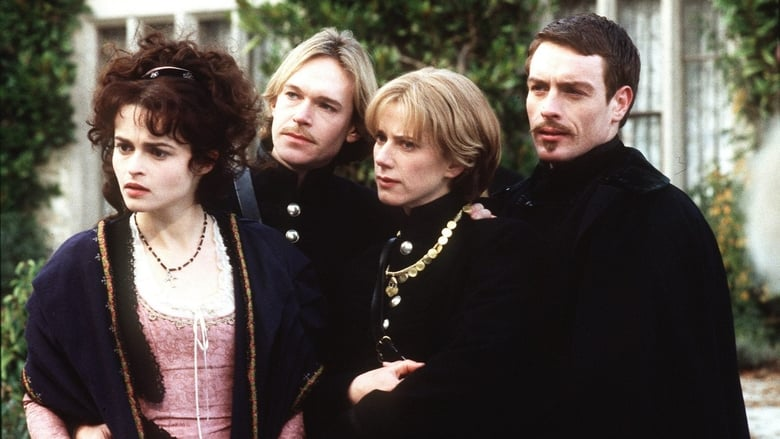
I have just watched Trevor Nunn’s 1996 film adaptation of Twelfth Night. I don’t like it.
As I was watching, I thought something was missing, something wasn’t working—but what was it? I suppose there are three main reasons.
My fear about Twelfth Night productions or adaptations is that they may perform the play as broad comedy and ignore the melancholic and dark elements in it, which is the problem with Tim Carroll’s production (the popularity of which shows that lots of people don’t really understand Shakespeare). The problem with Trevor Nunn’s film, as it turns out, is the opposite: he emphasises too much on the dark elements and there isn’t much comedy. Twelfth Night is a play where Shakespeare balances very well comedy and melancholy (and cruelty). I don’t think the film gets it right.
Shakespeare’s Feste is melancholic but still funny and witty. He does join in the partying at the beginning. He does take part in the prank. He does go along with Sir Toby and Fabian, until he realises that they have gone too far, and refuses to give Fabian the letter. Ben Kingsley’s Feste is serious, almost miserable, and the way he and Nigel Hawthorne’s Malvolio stare with hatred at each other in the first scene they’re together makes it too serious too early.
In Kenneth Branagh’s production, Feste is played by Anton Lesser*, and he plays him as someone who is at home in both houses, someone who is both part of the group, and outside it. The production is the closest to my interpretation of the play, especially in its handling of Malvolio. The prank should be funny—at the beginning—it should look like something harmless, turning the pompous killjoy Malvolio into a laughingstock. Shakespeare does what Jane Austen later does with the character of Miss Bates in Emma: we join in the fun and laugh at the character, until we realise it’s not right and feel ashamed of ourselves. That is the way it should be, and Kenneth Branagh achieves that effect in his production. The prank in Trevor Nunn’s film doesn’t seem particularly funny. Perhaps it’s just me, humour is subjective, but the looks that Sir Toby and Feste both give Malvolio before the prank look more like hatred than mere dislike and annoyance, and the prank therefore appears much more serious from the start.
I don’t have anything to say about Nigel Hawthorne as Malvolio. Regarding the cast, Kenneth Branagh’s production gets everything right, everyone is perfect in the role, especially Richard Briers as Malvolio. Malvolio is at the beginning austere and pompous, but by the end, Richard Briers gives him tragic stature—he shows us what could be done with the role of Malvolio.
The cast is another problem with the 1996 film, though I can’t pinpoint exactly where the problem is. The only person I like is Helena Bonham Carter as Olivia—she is my favourite part of the film—but everyone else doesn’t seem quite right.
For example, Imogen Stubbs** is generally quite good as Viola/ Cesario, especially in the scene with Olivia, but there are two things she gets wrong. The first time is about these lines:
“VIOLA Make me a willow cabin at your gate
And call upon my soul within the house;
Write loyal cantons of contemnèd love
And sing them loud even in the dead of night;
Hallo your name to the reverberate hills
And make the babbling gossip of the air
Cry out “Olivia!” O, you should not rest
Between the elements of air and earth
But you should pity me.”
(Act 1 scene 5)
Perhaps there are different ways of interpreting the speech, I personally prefer Frances Barber, who treats these lines as lyrical and moving, so you can see Olivia (Caroline Langrishe) fall in love with Cesario. Imogen Stubbs instead raises her voice and even cries out “OLIVIAAAA”, turning it into a performance like she’s mocking the lines she’s saying (and mocking Orsino’s love), but Olivia then falls for her and it doesn’t seem convincing (or is it the point?).
The other thing is about the duel, but I think it’s Trevor Nunn’s fault rather than Imogen Stubbs’s. We see Viola/ Cesario doing fencing earlier in the film, and in this scene, she seems to be doing all right fighting Sir Andrew Aguecheek. Viola in Shakespeare’s play is no fighter.
“VIOLA [Aside] Pray God defend me! A little thing would make me tell them how much I lack of a man.”
(Act 3 scene 4)
Because Viola in Shakespeare’s play and in Kenneth Branagh’s production seems hesitant and even scared, Sir Andrew Aguecheek and Sir Toby can confidently see Cesario as no threat and attack only to be surprised and beaten up by Sebastian. Imogen Stubbs’s Viola may not a very skilled fencer, but she does attack and seem “enthusiastic”.
The rest of the cast, except for the brilliant Helena Bonham Carter, is not awful but forgettable, and sometimes something doesn’t feel quite right.
The biggest problem with the film, however, is what Trevor Nunn does with the text. As the play is about 3 hours or so, and the film is a bit more than 2 hours, you can tell that lots of lines are removed and lots of speeches are shortened. That is understandable—I personally prefer to have all of Shakespeare’s text and therefore watch filmed plays—but this is a film adaptation. The more egregious thing he does is that he moves lines and sometimes scenes around, and some are questionable choices, especially the ending.
Trevor Nunn also adds a scene at the beginning, on the ship, and adds some narration. It’s understandable that he wants to add some context and depict the shipwreck, but I can’t see why he also adds the bit of Viola and Sebastian performing something in front of an audience, with both of them wearing women’s clothes and veils, and underneath the veils, both having moustaches.
Look at the reunion scene.
“SEBASTIAN Do I stand there? I never had a brother…”
(Act 5 scene 1)
Judging by the amazement and confusion in the entire exchange, I don’t think Sebastian would have already seen Viola with a moustache.
There are many other things that seem wrong, especially the ending, but I’ve said enough. It is such a disappointment, because I’m obsessed with his Macbeth (Ian McKellen and Judi Dench). Kenneth Branagh’s production, on the other hand, is not only my favourite version of Twelfth Night but one of my favourite Shakespeare productions. It is wonderful, everyone is perfect for the role, and Richard Briers in particular is exceptional. I watched it for the first time at University of Oslo, and watched it again a few months ago. Love it even more.
*: I love Anton Lesser as Hamlet in the audio recording of the play, to which I listened recently. Fantastic performance. His Hamlet sometimes turns demonic.
**: She is my favourite Desdemona and I have seen 3 versions of Othello so far.