Pages

Friday, 23 June 2023

Shakespeare’s Venus and Adonis

1/ Venus and Adonis, Shakespeare’s first narrative poem and first publication in general, is about the goddess seducing the beautiful man: 

““Fondling,” she said, “since I have hemmed thee here

Within the circuit of this ivory pale, 

I’ll be a park, and thou shalt be my deer; 

Feed where thou wilt, on mountain or in dale; 

Graze on my lips; and if those hills be dry, 

Stray lower, where the pleasant fountains lie. 


“Within this limit is relief enough, 

Sweet bottom-grass, and high delightful plain, 

Round rising hillocks, brakes obscure and rough,

To shelter thee from tempest and from rain.

Then be my deer since I am such a park;

No dog shall rouse thee though a thousand bark.”” 

Oo-er! 

If that doesn’t want to make you pick up the book, I don’t know what can. 


2/ So how does Venus try to persuade Adonis? 

““Torches are made to light, jewels to wear, 

Dainties to taste, fresh beauty for the use, 

Herbs for their smell, and sappy plants to bear. 

Things growing to themselves are growth’s abuse. 

Seeds spring from seeds, and beauty breedeth beauty. 

Thou wast begot; to get it is thy duty. 


“Upon the earth’s increase why shouldst thou feed 

Unless the earth with thy increase be fed? 

By law of nature thou art bound to breed, 

That shine may live when thou thyself art dead; 

And so in spite of death thou doth survive, 

In that thy likeness still is left alive.”

This makes me think of the sonnets, mostly the procreation sonnets (1-17). Sadly the comparison doesn’t do Venus and Adonis a favour: the sonnets are much more sophisticated.

Just look at two examples: 

Sonnet 3

Look in thy glass and tell the face thou viewest,

Now is the time that face should form another,

Whose fresh repair if now thou not renewest,

Thou dost beguile the world, unbless some mother.

For where is she so fair whose uneared womb

Disdains the tillage of thy husbandry?

Or who is he so fond will be the tomb

Of his self-love, to stop posterity?

Thou art thy mother’s glass, and she in thee

Calls back the lovely April of her prime;

So thou through windows of thine age shalt see,

Despite of wrinkles, this thy golden time.

    But if thou live rememb’red not to be,

    Die single, and thine image dies with thee.


Sonnet 12

When I do count the clock that tells the time, 

And see the brave day sunk in hideous night; 

When I behold the violet past prime, 

And sable curls all silver’d o’er with white;

When lofty trees I see barren of leaves 

Which erst from heat did canopy the herd,

And summer’s green all girded up in sheaves 

Borne on the bier with white and bristly beard, 

Then of thy beauty do I question make, 

That thou among the wastes of time must go,

Since sweets and beauties do themselves forsake

And die as fast as they see others grow; 

   And nothing ‘gainst Time’s scythe can make defence

   Save breed, to brave him when he takes thee hence. 


The language, the style in the sonnets is much better. 


3/ When Venus faints and “lies as she were slain”, Adonis, er, gives her CPR. Or kisses her, thinking she’s dead (are you a necrophile, mate?). 

She wakes up. You know, like Sleeping Beauty. 

“The night of sorrow now is turned to day: 

Her two blue windows faintly she upheaveth, 

Like the fair sun when in his fresh array 

He cheers the morn and all the earth relieveth; 

And as the bright sun glories the sky, 

So is her face illumined with her eye.” 

This goes on for a few more stanzas, but you get the idea: the story of Venus and Adonis may be unusual (a woman wooing and rejected by man), but the style is more conventional than in the sonnets. I should say that this narrative poem was published just a couple of years before Shakespeare was testing, bending, playing with the English language in Love’s Labour’s Lost, and his poetry was soaring in A Midsummer Night’s Dream and Romeo and Juliet

It is interesting, however, when Adonis tells Venus that her feeling for him is lust, not love: 

““… Call it not love, for Love to heaven is fled

Since sweating Lust on earth usurped his name; 

Under whose simple semblance he hath fed

Upon fresh beauty, blotting it with blame; 

Which the hot tyrant stains and soon bereaves,

As caterpillars do the tender leaves. 


[…] Love surfeits not, Lust like a glutton dies; 

Love is all truth, Lust full of forged lies…”” 

Shakespeare’s essentially a dramatic poet, so the poem is more interesting when we get Adonis’s voice—though only for a bit—the poem largely focuses on Venus’s perspective.

I can’t help wondering if Shakespeare was taking a deliberate dig at those who waxed poetic about love when they’re just horny. 


4/ I like the passages of grief, when Venus thinks he’s dead, and when she finds him dead. I don’t like the narrator’s descriptions, like “crystal tide”, “silver rain”, “like a stormy day, now wind, now rain”, “pearls in glass”, and so on and so forth, but I like the expressions of grief from her mouth. Then we get the dramatic Shakespeare. 

““Dost thou drink tears, that thou provok’st such weeping? 

What may a heavy groan advantage thee? 

Why hast thou cast into eternal sleeping

Those eyes that taught all other eyes to see?...”” 

Or: 

“For he being dead, with him is beauty slain, 

And, beauty dead, black chaos comes again.” 

Or: 

““Alas, poor world, what treasure hast thou lost! 

What face remains alive that’s worth the viewing? 

Whose tongue is music now? What canst thou boast 

Of things long since, or any thing ensuing? 

The flowers are sweet, their colors fresh and trim, 

But true sweet beauty lived and died with him…”” 

I also like it when Venus looks at Adonis’s body torn apart by a boar, and thinks “Had I been toothed like him, I must confess/ With kissing him I should have killed him first”. A bit corny, but still. 


5/ If I have to pick a single line that is the most interesting in Venus and Adonis, I’d say “Before I know myself, seek not to know me” (from Adonis). 

Tuesday, 20 June 2023

Shakespeare’s sonnets and “A Lover’s Complaint”: first impressions

1/ Having read all the plays, I decided to go for Shakespeare’s non-dramatic poetry. There are a handful of sonnets I know quite well (18, 116, 130, 138), but this time I was reading through them all with the intention of studying them closely over time, so there isn’t much to say. I love Shakespeare’s sonnets—not all, some are harder to read and some feel quite early—but I love most. 


2/ Sonnet 116 feels very different this time: 

Let me not to the marriage of true minds

Admit impediments. Love is not love

Which alters when it alteration finds,

Or bends with the remover to remove.

O no! it is an ever-fixed mark

That looks on tempests and is never shaken;

It is the star to every wand'ring bark,

Whose worth's unknown, although his height be taken.

Love's not Time's fool, though rosy lips and cheeks

Within his bending sickle's compass come;

Love alters not with his brief hours and weeks,

But bears it out even to the edge of doom.

If this be error and upon me prov'd,

I never writ, nor no man ever lov'd.


3/ I don’t think the publication was unauthorised: the sonnets were arranged in such a meaningful way that they had to be planned for publication by Shakespeare himself.  


4/ The sonnets, to me, feel more like literary exercises than expressions of personal thought and feeling. I think he was aiming to kill the sonnet and give it a rebirth—English theatre was no longer the same with Shakespeare and neither was the sonnet—he went against all norms and conventions, creating a sonnet sequence unlike anything that came before.


5/ I think Shakespeare wrote about real feelings of joy and lust and desire and longing and anger and jealousy and disappointment and confusion and hatred and so on, but there’s not necessarily one Fair Youth or one Rival Poet or one Dark Lady. 


6/ That doesn’t necessarily mean that I think Shakespeare’s not bisexual. I would say he’s almost certainly not gay; he could be bisexual or straight, probably bisexual. 


7/ It’s very likely that he had some venereal disease at some point, as hinted in some of the last sonnets. Scholars have long debated this subject, I myself think it’s likely around the time he was writing Timon of Athens and King Lear, because of the hateful and vicious and often out-of-place rants against female sexuality in these plays. 


8/ I didn’t like “A Lover’s Complaint”. Apparently there’s some debate surrounding the authorship—I’m not sure—some of it sounds Shakespearean and some of it doesn’t. If it was entirely Shakespeare’s, it must have been an early work. 


So here’s a record of my impressions. Slowly I’m going to read and absorb the sonnets properly over time.

Sunday, 18 June 2023

Hamlet (2018), ft. Andrew Scott

This is quite a creative production, and in quite a few ways, interesting.

It is set today: the Ghost for example is first seen on CCTV, and the actors all act modern (see the scene of Ophelia saying goodbye to Laertes and you’ll know what I mean). It feels fresh and works rather well for the large part, though one wonders why at a time when cameras, TV, computers, video calls… exist, Hamlet bothers to write to Ophelia on paper, like a hipster (this is also why I cannot sit and watch a contemporary Romeo and Juliet—a phone call would have resolved everything and prevented the tragedy). 

Joking aside, I do think the 2018 production is interesting, though a few choices don’t quite work for me. 

First of all, Robert Icke plays up the sexual attraction, the passion between Claudius (Angus Wright) and Gertrude (Juliet Stevenson), which works very well.

Secondly, he emphasises the surveillance theme, and our modern Polonius (Peter Wight) uses spy devices. Denmark feels like a prison indeed. But he also adds two overhearing moments and I don’t particularly like them: the first time, Hamlet (Andrew Scott) is, without intending to spy, hiding behind a couch as Ophelia (Jessica Brown Findlay) talks to her father and brother about her relationship with Hamlet, and her lines become less independent, less interesting when we see them spoken within Hamlet’s hearing; the second time, Hamlet overhears Claudius speak to Guildenstern and Rosencrantz of the England plan; the two moments make Hamlet appear less smart, as he discovers by chance how others are plotting against him, instead of having his own instinct and seeing through everyone as in Shakespeare’s play (and in the Kevin Kline production).

Thirdly, the production presents a very different Gertrude. There was one scene I didn’t recognise—there are three different texts of Hamlet, and my version was largely based on the second Quarto—so I looked it up and found the scene (slightly longer than in the production) in the first Quarto, often known as the bad Quarto: 

Hor. Madame, your sonne is safe arriv'de in Denmarke,

This letter I euen now receiv'd of him,

Whereas he writes how he escap't the danger,

And subtle treason that the king had plotted,

Being crossed by the contention of the windes,

He found the Packet sent to the king of England,

Wherein he saw himselfe betray'd to death,

As at his next conuersion with your grace,

He will relate the circumstance at full.

Queene Then I perceiue there's treason in his lookes

That seem'd to sugar o're his villanie:

But I will soothe and please him for a time,

For murderous mindes are alwayes jealous,

But know not you Horatio where he is?

Hor. Yes Madame, and he hath appoynted me

To meete him on the east side of the Cittie

To morrow morning.

Queene O faile not, good Horatio, and withall, commend me

A mothers care to him, bid him a while

Be wary of his presence, lest that he

Faile in that he goes about.

Hor. Madam, neuer make doubt of that:

I thinke by this the news be come to court:

He is arriv'de, obserue the king, and you shall

Quickely finde, Hamlet being here,

Things fell not to his minde.

Queene But what became of Gilderstone and Rossencraft?

Hor. He being set ashore, they went for England,

And in the Packet there writ down that doome

To be perform'd on them poynted for him:

And by great chance he had his fathers Seale, 

So all was done without discouerie.

Queene Thankes be to heauen for blessing of the prince,

Horatio once againe I take my leaue,

With thowsand mothers blessings to my sonne.

Horat. Madam adue.” 

(source

One may ask why Gertrude knows about Claudius’s murderous intent but still lets Hamlet and Laertes (Luke Thompson) play at duel, but in the final scene, she becomes very different from the Gertrude I have always known from the text I’ve read and from the Kevin Kline production (Dana Ivey), as she deliberately drinks from the cup she knows to have been poisoned. 

It is an interesting change.

Fourthly, Robert Icke decides to use quite a bit of Bob Dylan’s music in the production. Does it fit? Generally, I don’t mind it too much, except in the duelling scene when the music takes over and we don’t have Shakespeare’s words. 

The last creative choice I’d like to mention is the final scene: old Hamlet’s ghost returns, then we see other ghosts, then the people who have just died turn into ghosts and follow the others. Does it work? I guess to many people it does, as this production is quite popular, but I don’t like it—I can’t quite explain why—too gimmicky? It also appears quite silly that Hamlet, having been poisoned, continues talking on and on when everyone else has turned into a ghost and walked off.  

But the important question you’d probably want to ask is: what do I think about Andrew Scott as Hamlet? I shall say that I much prefer Kevin Kline, partly because Kevin Kline’s Hamlet is much closer to the Hamlet in my head (funnier, more likable, more noble), and partly because he depicts better Hamlet in different moods. Andrew Scott’s Hamlet lacks humour—he’s darker, more bitter, more violent and dangerous, especially with the way he waves the gun at everyone—one watches this production and thinks Claudius is perfectly right for packing him off to England. He and Kevin Kline also approach very differently the scene at Ophelia’s grave: Kevin Kline’s Hamlet mocks Laertes’s “performance” (Michael Cumpsty) but afterwards turns towards Ophelia’s coffin and shows that he loves her, whereas Andrew Scott’s Hamlet goes to extremes mocking Laertes and doesn’t seem to care at all about Ophelia. 

Andrew Scott’s Hamlet is more like a psychopath. Perhaps G. Wilson Knight would have liked it, but I don’t—not really.  

I also think he overacts. One may argue that he feels every line, every word he utters with his hands, his arms, the whole of his being, and sometimes it does work well, but often I just think he overacts. 

This turns out to be a lot longer than my “review” of the 1990 Hamlet with Kevin Kline, but what can I say, the Kevin Kline version was so perfect that there was nothing to say.

Saturday, 10 June 2023

Hamlet, A. C. Bradley, and Kevin Kline

1/ In Shakespearean Tragedy, A. C. Bradley makes an interesting point that Julius Caesar and Hamlet (two early plays in Shakespeare’s Tragic period) may be called tragedies of thought, whereas Othello, King Lear, Anthony and Cleopatra, and Coriolanus may be called tragedies of passion—the main characters have passionate natures and “we may attribute the tragic failure in each of these cases to passion” (Lecture III, 1).

Perhaps that’s why I’ve always been more obsessed with King Lear, Macbeth, and Othello than with Hamlet

But Hamlet is undoubtedly a great play and, on this revisit, I found myself relating a lot more to Hamlet.

“O that this too too solid flesh would melt,

Thaw, and resolve itself into a dew!

Or that the Everlasting had not fix'd

His canon 'gainst self-slaughter! O God! God!

How weary, stale, flat, and unprofitable

Seem to me all the uses of this world!

Fie on't! ah, fie! 'Tis an unweeded garden

That grows to seed; things rank and gross in nature 

Possess it merely…” 

(Act 1 scene 2) 

People often say Hamlet is a play in which you find something new, something different each time you reread it—and it certainly feels very different when you yourself are weary of everything. I have lost all my mirth. Man delights not me.

After reading the play the third time, I also read A. C. Bradley’s Shakespearean Tragedy: Lectures on Hamlet, Othello, King Lear and Macbeth, a classic of Shakespearean criticism. If only I had the time and energy to write at length about his analysis of each play! One thing I’d say is that I find myself more in agreement with A. C. Bradley than with G. Wilson Knight regarding the characters: Knight is right for pointing out, in The Wheel of Fire, the coldness and cruelty of Hamlet, which Bradley to some extent downplays, but I think Bradley gets it right for understanding the shock and disillusionment, the pain and weariness in Hamlet. 

“… his habitual feeling is one of disgust at life and everything in it, himself included,—a disgust which varies in intensity, rising at times into a longing for death, sinking often into weary apathy, but is never dispelled for more than brief intervals. Such a state of feeling is inevitably adverse to any kind of decided action; the body is inert, the mind indifferent or worse; its response is, 'it does not matter,' 'it is not worth while,' 'it is no good.' And the action required of Hamlet is very exceptional. It is violent, dangerous, difficult to accomplish perfectly, on one side repulsive to a man of honour and sensitive feeling, on another side involved in a certain mystery (here come in thus, in their subordinate place, various causes of inaction assigned by various theories). These obstacles would not suffice to prevent Hamlet from acting, if his state were normal; and against them there operate, even in his morbid state, healthy and positive feelings, love of his father, loathing of his uncle, desire of revenge, desire to do duty. But the retarding motives acquire an unnatural strength because they have an ally in something far stronger than themselves, the melancholic disgust and apathy; while the healthy motives, emerging with difficulty from the central mass of diseased feeling, rapidly sink back into it and 'lose the name of action.'” (Lecture III, 4) 

I think Bradley has more sympathy for, and therefore more understanding of, Hamlet.

I also think Knight exaggerates the good qualities of Claudius and the warmth of Elsinore. He’s right that Claudius appears to be a good king, and he and Gertrude love each other, but it’s a cold, vile world—a world without warmth, without loyalty, without honour, without trust—a world in which a widow remarries at most wicked speed and others don’t wonder at it, a world in which a father spies on and smears his own son and uses his own daughter as bait, a world in which a courtier spies on his Queen and Prince… Elsinore just appears sunny and happy because others don’t have the sensitivity of Hamlet. 

“The Queen was not a bad-hearted woman, not at all the woman to think little of murder. But she had a soft animal nature, and was very dull and very shallow. She loved to be happy, like a sheep in the sun; and, to do her justice, it pleased her to see others happy, like more sheep in the sun. She never saw that drunkenness is disgusting till Hamlet told her so; and, though she knew that he considered her marriage 'o'er-hasty' (ii. ii. 57), she was untroubled by any shame at the feelings which had led to it. It was pleasant to sit upon her throne and see smiling faces round her, and foolish and unkind in Hamlet to persist in grieving for his father instead of marrying Ophelia and making everything comfortable. She was fond of Ophelia and genuinely attached to her son (though willing to see her lover exclude him from the throne); and, no doubt, she considered equality of rank a mere trifle compared with the claims of love. The belief at the bottom of her heart was that the world is a place constructed simply that people may be happy in it in a good-humoured sensual fashion.” (Lecture IV, 5) 

This passage made me laugh. 


2/ A. C. Bradley makes an interesting point here, about Cordelia and Hamlet:  

“An expressiveness almost inexhaustible gained through paucity of expression; the suggestion of infinite wealth and beauty conveyed by the very refusal to reveal this beauty in expansive speech—this is at once the nature of Cordelia herself and the chief characteristic of Shakespeare's art in representing it. Perhaps it is not fanciful to find a parallel in his drawing of a person very different, Hamlet. It was natural to Hamlet to examine himself minutely, to discuss himself at large, and yet to remain a mystery to himself; and Shakespeare's method of drawing the character answers to it; it is extremely detailed and searching, and yet its effect is to enhance the sense of mystery. The results in the two cases differ correspondingly. No one hesitates to enlarge upon Hamlet, who speaks of himself so much; but to use many words about Cordelia seems to be a kind of impiety.” (Lecture VIII, 5) 

I’ve never thought of it that way. He has a point. 


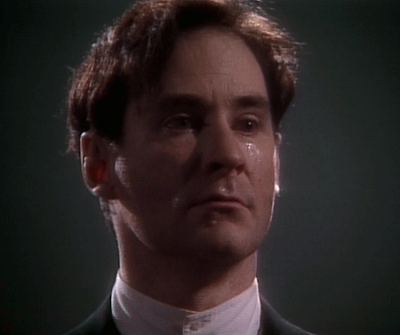
3/ Last night I watched the 1990 New York Festival production, with Kevin Kline playing Hamlet and directing the play. 

For years, I thought it’s better not to watch Hamlet, not because it wouldn’t work onstage but because the character’s so complex and the play’s so rich in meaning that it would be so hard to get it right—but my friends Himadri and Michael both recommended the Kevin Kline version—and he’s got it right. It’s an excellent production, everyone in it is good, especially Kevin Kline. 

I will be brief. There are two main things I have to say about his performance.

First of all, I think he captures extremely well Hamlet in different moods: weariness, disgust, excitement, rage, hatred, fatalistic acceptance, and so on. His joy, his energy when he meets the players gives us a glimpse of what Hamlet once was, before the death of his father and the disillusionment about his mother.

Secondly, his performance makes me think that perhaps the key thing is the comic touch. Hamlet is volatile, often sardonic and cruel, but he is witty and funny. An unfunny Hamlet wouldn’t work—I had a look at the “Words, words, words” scene in the Laurence Olivier film and it’s so serious, so devoid of humour—Kevin Kline, in contrast, is very funny. Even when he’s being cruel to Ophelia, or mocking and provocative towards Claudius after the death of Polonius, there’s a comic touch in his performance—that’s the way Hamlet is. But his Hamlet can also be terrifying: in the “Get thee to a nunnery” scene, or the “Do you think I am easier to be played on than a pipe?” scene, he is terrifying.

I will have to watch other versions, but Kevin Kline comes very close to the Hamlet in my head. 


See: my blog post about G. Wilson Knight on Hamlet

Sunday, 14 May 2023

Three Sisters by Anton Chekhov

1/ This is the first Chekhov play I’ve read, and it’s harder to read than Shakespeare or Ibsen—there are too many characters to keep track of, and too many things going on at the same time.

Here are my first impressions of Chekhov’s drama: 

- Chekhov’s characters frequently talk past each other, so there are always multiple threads in the same conversation. 

- As in his short stories, Chekhov writes about people suffering and feeling that they have wasted their lives, wasted their potential. However, in his short stories and novellas, he focuses on one thing (very often it’s a man and a woman and a reason for them to be unhappy) whereas in the play, there are many stories going on at the same time. 

- As in his short stories, he avoids overt drama. He and Ibsen are perhaps opposite—Ibsen is intense and depicts everything in a cold, brutal, uncompromising way, Chekhov leaves conflict and incident off-stage and depicts what appears to be ordinary life, suggesting a lot more underneath. 

In a way, Chekhov seems to write about “the moments between life”, or perhaps it’s better to say that life happens between the scenes that he depicts—for example, between Act 1 and Act 2, Andrey and Natasha have got married and had a baby, Andrey has got more debts and now works for the Council, Natasha has changed and slowly taken over the house, something has developed between Masha and Vershinin, Tuzenbakh has fallen for Irina—Chekhov throws us into a middle of a scene, then withholds all the changes and developments, and throws us into the middle of another scene some time later, forcing us to piece together the story. 

Later on, he doesn’t depict the two affairs, doesn’t depict the fire, doesn’t depict the quarrel, and doesn’t depict the duel. He leaves all the dramatic incidents off-stage. 


2/ I’ve noticed that many people, when praising Chekhov, talk about the range of his characters. It is true that he writes about different groups, different classes of people, but there are certain types that keep popping up in his works—such as the weak, ineffectual, spineless type, unable to stand up for himself or for anything, and Andrey in Three Sisters is that type. 

The scene of Andrey talking to Ferapont is so moving: 

“ANDREY: […] To be a member of the local District Council, when every night I dream that I am a professor of Moscow University, a famous scholar who is Russia’s pride! 

FERAPONT: I don’t really know… I don’t hear very well. 

ANDREY: If your hearing was all right, then perhaps I wouldn’t be talking to you. I need to talk to someone but my wife doesn’t understand me, and for some reason I’m afraid of my sisters, I’m afraid they’ll laugh at me or make me feel ashamed…” 

(Act 2) 

(translated by Peter Carson) 

Andrey and his sisters are all unhappy, all having wasted their potential, and they suffer in different ways. 


3/ I have said that people in Chekhov’s play talk past each other and don’t really listen, but it’s curious that in Act 2, Vershinin says several times that he hasn’t eaten since morning, but nobody cares. Even Masha doesn’t seem to notice. 

I read Three Sisters, then after a quick break with Chekhov’s letters, read the play again. Between the two readings, I talked to Himadri and he said this about Vershinin:  

“It would appear his wife (whom we never see) has some kind of mental condition. But the question remains unanswered: is his neglect of his family due to his wife making the home life so difficult? Or has she come to this state *because* he has neglected her?

He says he feels sorry for his daughters. So why isn’t he with them?” 

Masha gets bored with her simple, ridiculous husband and falls for a more intelligent man, but the one she’s in love with is probably a selfish, terrible man who neglects his own family. 

As I reread the play, I noticed Kulygin walking around looking for Masha and realising what’s going on, and it’s heartbreaking. Kulygin makes me think of Charles Bovary: both are boring, mediocre men, not particularly clever; both are betrayed, and suffer; and both don’t deserve to suffer that way.  

“KULYGIN […] Today the Army is leaving and everything will go back to what it was. Whatever they say there, Masha is a fine, honest woman, I love her very much, and I thank my destiny…” 

(Act 4) 

That is terribly sad. Kulygin is dim-witted, but he’s depicted with compassion and one can’t help feeling sorry for him. I especially love the scene where Masha breaks down, when saying farewell to Vershinin, and Kulygin, the kind Kulygin tries to distract the moment by putting on the moustache and beard he has confiscated from a boy at the school. 


4/ Instead of writing about Natasha, the villain of the play who slowly takes revenge on the family and ousts the sisters from their own house, I want to draw attention to a little moment when she shouts at Anfisa, the nyanya, and Olga does nothing. This kind of thing is depicted a few times in Chekhov—in “At Home”, for example—a good-natured but unhappy person is so wrapped up in her own problems that she does nothing when an injustice, a cruel act takes place before her eyes. 

In Three Sisters, a more cruel passivity is in the final Act, when Irina knows that there’s going to be a duel, that Tuzenbakh wants her to say something to him in the last moment, but she doesn’t—it’s heartbreaking. 

But it’s not just her or Masha: in the final Act, we see that Chebutykin, the army doctor, has also become cynical and indifferent. 

“MASHA: Everything has become muddled in my head… Anyway, I say they shouldn’t allow them. He could wound the Baron or even kill him. 

CHEBUTYKIN: The Baron is a good man, but one baron more or one baron less—what can it matter? Let it be! What can it matter!” 

(ibid.) 

Chekhov shows what suffering and failure do to a person. 

This is a great play, but a depressing play.  

Sunday, 7 May 2023

On the 1983 King Lear, starring Laurence Olivier

Yesterday I was feeling down all day, so I thought I might as well tear my heart to pieces watching King Lear, having for some time felt an overwhelming urge to revisit the play. I went for the 1983 version, directed by Michael Elliott and starring Laurence Olivier. 

It didn’t tear my heart to pieces. 

But let’s talk about the good things first. In many ways, it is good, and it’s got a brilliant cast, especially Robert Lindsay as Edmund and Diana Rigg as Regan. Not counting Ran and the Kozintsev film, I have hitherto seen three versions of King Lear onscreen, and Robert Lindsay is my favourite Edmund. In the 2016 version directed by Michael Buffong, which otherwise would be perfect, Fraser Ayres lacks the attractiveness of Edmund and terribly overacts. In the 1982 BBC version directed by Jonathan Miller, Michael Kitchen delivers a bland performance, overshadowed by Anton Lesser’s Edgar (which also says something about Anton Lesser’s brilliance, considering that there isn’t a lot to the role of Edgar). Robert Lindsay is just right—Machiavellian; attractive and magnetic despite his spiteful and treacherous nature; but also pathetic in the final scene. The final moment makes one realise that Edmund sets a trap against his brother and turns against his father not only because he, as a bastard, is legally entitled to nothing, but also because he’s never been loved. 

Diana Rigg is also great as Regan. Debbie Korley and Penelope Wilton are also excellent in the role, especially the latter’s girlish smile as she says “One side will mock the other; th’ other too”, which is unnerving, but in the 1983 version, Diana Rigg steals the scene whenever she appears. She is cold and cruel and mesmerising as Regan.

The rest of the cast are John Hurt as the Fool, Dorothy Tutin as Goneril, Anna Calder-Marshall as Cordelia…

There are many brilliant scenes, and with such a cast, this should be a great production of King Lear, but something is missing—and that I think is in the performance of Laurence Olivier. I’m not quite sure how to explain, as I’m not sure myself what is lacking. 

In the first half of the play, he’s quite good, and the scene in the storm is also good. But from the scene in the hovel with Edgar, till the end of the play, I think his performance lacks power. The scene of Lear putting his daughters on trial, in this production, leaves no impression—perhaps Laurence Olivier isn’t very good at playing madness. The scene of mad Lear meeting blind Gloucester also doesn’t work quite well—King Lear is a bleak, devastating play but there is comedy in it, and there are comic elements, albeit dark and twisted, in that scene—Don Warrington in the 2016 version and Michael Horden in the 1982 BBC version both capture well the funny aspect of the scene, I don’t think Laurence Olivier does. 

More importantly, there are two key moments in King Lear that always make me cry—Lear’s reunion with Cordelia and the final scene—but I didn’t cry watching the 1983 production, I wasn’t strongly moved. In the reunion scene, I think the problem is in the way Laurence Olivier says the line “If you have poison for me, I will drink it”—the scene is devastating because of that line, but his delivery for some reason doesn’t quite work. In the final scene, it should break your heart, it should rip you apart, it should leave you shattered—“Why should a dog, a horse, a rat have life/ And thou no breath at all?”—but the 1983 production doesn’t quite do so, and I think it’s partly because of Laurence Olivier’s acting and partly because of the music playing over the scene. 

With such a brilliant cast, it’s disappointing. 

Do I think you should watch it? Yes, for Diana Rigg and Robert Lindsay. It is currently available and free on youtube. But I would recommend Don Warrington and Michael Hordern for Lear. 

Thursday, 27 April 2023

On feeling close to Chekhov; 30 favourite stories

When I first read Chekhov, I was too young—I hadn’t lived. My rediscovery of Chekhov was two years ago, and now that I have loved and lost, now that I’m going through something never expected to happen, now that I must begin all over again and feel something akin to shame for doing so, I feel closer and closer to Chekhov. He is so good at discerning the subtlest emotional shades, at conveying the uncertainty and absurdity of life, at depicting the way people change and love doesn’t last. He writes about wasted lives, missed opportunities, and regrets, without descending into lachrymose wallowing or cynicism. 

I perhaps even feel closer to Chekhov now than to Jane Austen, because he writes about love and disappointment, sex, sexual desire, death, and the futility of life—which she doesn’t. On this blog, I have avoided identifying with characters and tried to write about literature with detachment, but reading is still a subjective thing, especially during a difficult time. 

It’s also interesting that at this time I’m turning to Chekhov rather than Tolstoy, my favourite writer of all time—why? 


___________________________________________


I have just finished Volume 4 of Constance Garnett’s Chekhov but find it hard to write about him, so here’s a list of my 30 favourite Chekhov stories so far: 

  • “Three Years”
  • “The Party” or “The Name-Day Party” 
  • “The Lady with the Dog” 
  • “About Love” 
  • “An Anonymous Story” 
  • “Terror” 
  • “My Life” 
  • “In the Ravine” 
  • “Peasants” 
  • “Ionitch” or “Ionych” 
  • “A Woman’s Kingdom” 
  • “A Dreary Story” 
  • “The Bishop” 
  • “The Betrothed” or “The Bride” 
  • “Neighbours” 
  • “The Murder” 
  • “Ward No. 6” 
  • “The Steppe” 
  • “The Kiss” 
  • “Verochka” 
  • “Man in a Case” 
  • “The Teacher of Literature” 
  • “An Artist’s Story” or “The House with the Mezzanine” 
  • “Volodya” 
  • “Ariadne”
  • “Mire” 
  • “The Chemist’s Wife” 
  • “The Duel” 
  • “The New Villa” 
  • “The Darling” 

The list is not in order of merit or importance; some of the stories are grouped thematically.  

Monday, 17 April 2023

War and Peace (1966-1967), dir. Sergei Bondarchuk

What possessed me to watch the Russian War and Peace less than 4 months after the BBC adaptation from 1972?

Before commenting on Bondarchuk’s film, I should talk a bit about Tolstoy’s book. I have stolen and often used an image from Himadri (Argumentative Old Git) because it’s true—some writers, such as Jane Austen or Henry James, use small brushstrokes and delineate the subtlest things with great delicacy, whereas others, such as Melville or Dostoyevsky, paint with broad brushstrokes and vigour—Tolstoy encompasses the entire spectrum, capable of depicting both epic battle scenes, and the tiniest changes of facial expressions in a living room. Tolstoy’s works have both breadth and depth, scope and subtlety. 

The 2 adaptations have different approaches. If the 1972 TV series focuses on drama, on characters and the conflicts between them, the 1966-1967 Russian film (consisting of 4 parts and lasting more than 7 hours) focuses on the epic-ness of War and Peace

And as an epic, Bondarchuk’s film is spectacular. All the big scenes, ball scenes, battle scenes, scenes of Moscow burning… are breathtaking, especially when we remember that they couldn’t have used CGI the way Hollywood can today. War and Peace is the most expensive film made in the Soviet Union, and it must be one of the most visually impressive war films ever made. 

The trouble is that Bondarchuk and his co-screenwriter Vasily Solovyov only focus on War and Peace as an epic. Tolstoy’s book may be admired for its scope, for its picture of the entire Russian society, but I think it is loved for the individual characters. The characters in the Russian film are but shallow representations of Tolstoy’s creations: Bondarchuk and Solovyov simplify Pierre, cut down on his search for meaning, remove the Freemasons storyline and reduce the significance of Platon; fail to convey the depravity of Hélène and the frivolity of Lise; simplify Andrei and mostly concentrate on his love story with Natasha; reduce to background characters not only Sonya but also Marya and Nikolai, and get rid of that storyline; place Natasha in the centre, together with Pierre and Andrei, without the contrast with Marya; fail to convey the warmth of the Rostovs and the cold, hard love of the Bolkonskys, etc. 

The film, especially Part 1, is not engaging, but I don’t think there’s anything wrong with the actors—the blame lies with the screenwriters and director. Solovyov and Bondarchuk don’t seem to care about conflict, and sometimes they remove the sense of conflict from a scene. For example, in one scene, Captain Tushin is questioned by his superiors about why he left the guns behind, and he remains silent, not wanting to blame his soldiers to justify himself—in Tolstoy’s novel, there’s a real sense of conflict as Captain Tushin says nothing and may be punished, but fortunately after some time, Andrei, an outsider, decides to speak up and defend him—in the Russian film, the superiors ask one question, then we see Captain Tushin saying nothing, then Andrei defends him right away, there’s no sense of conflict.

That is just one example.

Quite often, Bondarchuk depicts a scene as in the book, but rips it out of context and makes it devoid of meaning. For example, there’s nothing wrong as such with the scene of Nikolai running away in a battle and confusedly thinking why others would be shooting at him, but the scene loses its significance because up to that point, Nikolai has been in the background, barely remembered as a character.   

The film mostly focuses on spectacle, with the exception of Part 2. Part 2, named “Natasha Rostova”, demonstrates what Solovyov and Bondarchuk could achieve if only they paid more attention to individual characters. I love Ludmila Savelyeva as Natasha—not just in comparison with the dreadful Morag Hood in the 1972 adaptation (its only flaw)—but I do think Ludmila Savelyeva has the charm, the innocence and gracefulness of Natasha. In the ball scene, I like the shot where Bondarchuk places Natasha next to a large mirror, so we can see at the same time what she is looking at and what is happening on her face. The entire scene is good, but that is a particularly excellent shot. 


I also love the folk dance scene, and the sequence with Anatole. Ludmila Savelyeva has the qualities of the character, and portrays well Natasha at different ages: a lively child at the beginning of the story; a young, charming, impressionable woman; and a more quiet, mature Natasha who has gone through great suffering. Perhaps next time I return to the book, it will be Ludmila Savelyeva that I see in my head as Natasha.

Unfortunately, all the characters are pale representations of Tolstoy’s creations, especially the “thinking characters” like Pierre and Andrei. The 1972 adaptation from the BBC demonstrates that it is possible to represent Tolstoy’s characters well on screen. 

Solovyov and Bondarchuk also remove Tolstoy’s theory of history and religious ideas, and get rid of the epilogue. But perhaps these changes were due to censors. 

As a national epic and war film, the 1966-1967 War and Peace is magnificent. But it doesn’t have the qualities that make Tolstoy’s book a monumental work of art. It is hollow. 


The film is available on youtube: Part 1, Part 2, Part 3, Part 4

Monday, 10 April 2023

Heartbreak and Chekhov

I’m going through one of the worst times—perhaps the hardest—of my life. Heartbreak.

So I turned to Chekhov.

At a time of heartache and dejection, Chekhov seems like a perfect companion, making one feel less lonely—there are others who also feel unhappy, who also struggle, who also find life hard and unfair—but his stories aren’t just bleak or cynical. I love the warmth, the compassion in Chekhov. And even though he doesn’t aim for moral instruction—as Tolstoy does—he still gets me to think about my life as he depicts, over and over again though in different ways, people wasting their lives and/or being unkind to others. 

I’ve just finished Volumes 1 and 2 of Constance Garnett’s 13 volumes. Volume 1 is good, especially “Three Years”, which I have read in the NYRB Peasants and Other Stories, but most of the stories feel relatively early, more like sketches. In Volume 2, most of the stories feel more substantial, and they are wonderful.

In “Mire”, a lieutenant comes to a Jewish woman named Susanna telling her to repay a debt to his cousin, as he (the lieutenant) needs the money in order to get married. The cousin and his wife wait all day only for him to return the next day, not only without money but also without the IOU, having been seduced by Susanna. Angry, the cousin himself goes to Susanna to get back his money, and also returns the following day. 

“Kryukov flopped on the sofa, thrust his head in the pillow, and shook with suppressed laughter. A minute later he got up, and looking at the surprised lieutenant, with his eyes full of tears from laughing, said:

“Close the door. Well . . . she is a fe-e-male, I beg to inform you!”

“Did you get the IOUs?”

Kryukov waved his hand and went off into a peal of laughter again.

“Well! she is a female!” he went on. “Merci for the acquaintance, my boy! She’s a devil in petticoats…”” 

It’s an excellent scene. 

“Of Susanna Moiseyevna and the IOUs they said nothing. Both of them felt, somehow, ashamed to speak of the incident aloud. Yet they remembered it and thought of it with pleasure, as of a curious farce, which life had unexpectedly and casually played upon them, and which it would be pleasant to recall in old age.” 

But it doesn’t end there. The lieutenant decides to leave, and the married cousin one day cannot resist the temptation to go to Susanna again. The final scene—the shock, the shame, the anger—is magnificent. 

In both “Excellent People” and “Neighbours”, Chekhov writes about strained brother-sister relationships. 

In “Excellent People”: 

“His sister had become a stranger to him. And he was a stranger to her.”

In “Neighbours”, the relationship between the brother and sister changes because she comes to live with a married man, despite the family’s disapproval. 

“It seemed to Pyotr Mihalitch that she had not changed in the least during the last week, except that she was a little paler. She looked calm and just as usual, as though she had come with her brother to visit Vlassitch. But Pyotr Mihalitch felt that some change had taken place in himself. Before, when she was living at home, he could have spoken to her about anything, and now he did not feel equal to asking her the simple question, “How do you like being here?” The question seemed awkward and unnecessary. Probably the same change had taken place in her. She was in no haste to turn the conversation to her mother, to her home, to her relations with Vlassitch; she did not defend herself, she did not say that free unions are better than marriages in the church; she was not agitated, and calmly brooded over the story of Olivier. . . . And why had they suddenly begun talking of Olivier?”

I love the subtlety in Chekhov. Pyotr Mihalitch sets off in anger to have a talk with his sister Zina and Vlassitch, but the meeting doesn’t happen as he has imagined in his head: 

“And Pyotr Mihalitch felt all the bitterness and horror of his position. He thought of his deserted home, the closed piano, and Zina’s bright little room into which no one went now; he thought there were no prints of little feet on the garden-paths, and that before tea no one went off, laughing gaily, to bathe. What he had clung to more and more from his childhood upwards, what he had loved thinking about when he used to sit in the stuffy class-room or the lecture theatre—brightness, purity, and joy, everything that filled the house with life and light, had gone never to return, had vanished, and was mixed up with a coarse, clumsy story of some battalion officer, a chivalrous lieutenant, a depraved woman and a grandfather who had shot himself. . . . And to begin to talk about his mother or to think that the past could ever return would mean not understanding what was clear.”

Chekhov’s writing about a brother and sister, but that could be true for everything: life changes, people change, and the past could never return.

Another story I love in Volume 2 is “At Home”, in which a young woman named Vera returns to an estate she has inherited: 

“The space, the lovely peace of the steppe, told her that happiness was near at hand, and perhaps was here already; thousands of people, in fact, would have said: “What happiness to be young, healthy, well-educated, to be living on one’s own estate!” And at the same time the endless plain, all alike, without one living soul, frightened her, and at moments it was clear to her that its peaceful green vastness would swallow up her life and reduce it to nothingness. She was very young, elegant, fond of life; she had finished her studies at an aristocratic boarding-school, had learnt three languages, had read a great deal, had travelled with her father—and could all this have been meant to lead to nothing but settling down in a remote country-house in the steppe, and wandering day after day from the garden into the fields and from the fields into the garden to while away the time, and then sitting at home listening to her grandfather’s breathing? But what could she do? Where could she go? She could find no answer, and as she was returning home she doubted whether she would be happy here, and thought that driving from the station was far more interesting than living here.” 

Chekhov writes with compassion, and gets one to sympathise with Vera’s loneliness and restlessness. But somehow, in a subtle way, he changes one’s perspective of Vera towards the end of the story, as she becomes so wrapped up in her own problems and in her passivity that she does nothing when her servants are treated badly. 

“At Home” pairs well with “The Princess”, the story about a princess who feels unhappy about her life but finds consolation in philanthropy, only to be told the painful truth that her charities help nobody but her own self-satisfaction: “There was nothing but the desire to amuse yourself with living puppets, nothing else. . . . A person who does not feel the difference between a human being and a lap-dog ought not to go in for philanthropy.” But Chekhov has no illusion about human nature—the honesty shocks her, but doesn’t transform her. 

In Volume 2, I also love “Expensive Lessons”, about a man who hires a Frenchwoman to teach him French and gets nothing out of his lessons, but who continues taking lessons and falls in love with her; and “The Chemist’s Wife”, a little sketch about an unhappy wife. 

Chekhov is such a wonderful writer. 

Saturday, 25 March 2023

The Brothers Karamazov: characters and characterisation

Spoiler alert: Again, if you haven’t read the book, you probably shouldn’t read this blog post, in which I will discuss significant plot points. Whilst The Brothers Karamazov is not only a murder mystery and not only read for the plot, I do think the mystery is part of the enjoyment of the first reading. 


1/ I think Ivan is the most interesting of the Karamazov brothers. Both Dmitry and Ivan are more interesting than Alyosha because they are souls in torment. But between the two elder brothers, Ivan fascinates me more because Dmitry is hot-headed and often driven by animal passion whereas Ivan is the thinking man—“in the Hamlet mould”, as Ignat Avsey puts it—he thinks, he tortures himself, and he sees the devil.

The two most thought-provoking sections in the novel both involve Ivan: his discussion with Alyosha about God (“Rebellion” and “The Grand Inquisitor”), and his talk with the devil. I am not religious, but the characters of Dostoyevsky and Tolstoy ask serious questions and think deeply, and they get me to care about the things that torment them. 

I also find Ivan’s torment after old Fyodor’s murder more interesting than Dmitry’s, probably because he asks himself and raises questions for us about the nature of guilt and complicity. 

Why does Smerdyakov say that among the brothers, Ivan is most like his father? 


2/ Smerdyakov is another striking, vivid character. He’s full of contradictions—arrogant but servile, weak and seemingly cowardly but extremely sly, cunning, and manipulative—but he feels utterly real, at least within the world of the book.

Almost everyone in the novel, including old Fyodor and Dmitry, is deceived about his character, but the defence lawyer Fetyukovich seems to get right his arrogance, spite, and envy. The only thing he gets wrong is about the money—there is no indication that Smerdyakov has any interest in the money. 

The confrontations between Ivan and Smerdyakov are so good because Smerdyakov is Ivan’s alter-ego, his Hyde, and at the same time, Smerdyakov is like the devil himself—I don’t think it’s random that Dostoyevsky describes the room as unbearably hot—it’s hell. 

My friend Michael thinks:

“Smerdyakov’s obsession with Ivan is not overtly homosexual (there’s a similar relationship in the Devils that is far more overt), but I always felt that there was something in his obsession, his fawning desire for Ivan’s approval — and ultimately his killing for him, and his suicide at Ivan’s rejection — that seemed explicable as a kind of hidden or sublimated homosexual infatuation.”

As for the suicide, he thinks:

“There are multiple reasons, practical and existential. He committed the crime as a gift to Ivan, but Ivan rejects the gift and is going to turn him in. He also commits suicide because his nihilism is the ultimate dead end.

But there’s a heartbreak there too.

That’s what I think.”

Do I think it’s a kind of homosexual infatuation? I’m not sure. But I do think Smerdyakov has an obsession with Ivan, and there’s something in their final exchange—Smerdyakov provokes Ivan to kill him but he doesn’t, then: 

“‘Till tomorrow!’ shouted Ivan, and moved to go. 

 ‘Wait… show it to me once more.’ 

Ivan pulled out the banknotes and showed them to him. Smerdyakov looked at them for about ten seconds.

‘Well, off you go,’ he said waving him away. ‘Ivan Fyodorovich!’ he shouted after him suddenly. 

‘What do you want?’ Ivan, already on his way out, turned around.

‘Goodbye, sir!’ 

‘See you tomorrow!’ Ivan shouted again, and walked out of the house.” (P.4, B.11, ch.8) 

(translated by Ignat Avsey)

Smerdyakov clearly has made this decision then. 


3/ Himadri (Argumentative Old Git) thinks Alyosha is bland. In a way, he is, compared to the rest of the Karamazovs (including the one not officially named Karamazov). But I think Alyosha lightens up the book—which is filled with filth, sickness, and depravity—and the final chapter, the final speech from Alyosha makes me emotional. 


4/ Fyodor Pavlovich Karamazov is also a striking character—I’ve written about him before. This speech from Starets Zosima is especially interesting: 

“‘… A man may be perfectly well aware that no one has offended him, that he has imagined it all and put about a lie just for the sake of it, blown it out of proportion so as to attract attention, deliberately picked on a word and made a mountain out of a molehill—he may very well realize all this, and yet be the very first to take offence, to the point of deriving enjoyment and pleasure from it, and so fall into a state of real animosity…’” (P.1, B.2, ch.2)

I’ve seen a lot of this online.  


5/ What about the female characters in The Brothers Karamazov? They’re all bonkers, as the male characters are.

I find it hard to write about Dostoyevsky’s characters as they are all insane, bizarre, unpredictable, and full of contradictions and tortured logic, and yet they’re so vivid, so utterly real within the distorted world of the book.

Among the female characters, I think I understand Katerina Ivanovna and Grushenka—up to a point—but generally I understand them, understand their spite and jealousy, understand why Katerina Ivanovna clings to Dmitry despite her love for Ivan and hatred for Dmitry, understand why Grushenka mocks and refuses to kiss Katerina’s hand, understand why Katerina testifies the way she does at the trial then completely changes her mind a moment later, understand why Grushenka wants to seduce Alyosha for the fun of it but stops at once and changes her behaviour the moment she hears of Zosima’s death, and so on.  

The one I completely fail to understand is Lise, Mrs Khokhlakova’s fourteen-year-old daughter. 

“‘… And then suddenly Lise woke up this morning, flew into a rage at Yulia and, can you imagine, slapped her face. […] Then, barely an hour later, she was hugging Yulia and kissing her feet. And she sent me a message saying that she wasn’t going to come to my room and that she never wanted to see me again, and then, when I dragged myself over to her room, she threw her arms round me, kissing me and crying, and then just pushed me away without a word, so I was none the wiser…’” (P.4, B.11, ch.2) 

The final scene between Alyosha and Lise is even more bizarre and dramatic. Dostoyevsky’s characterisation is always exaggerated and dramatic—his characters are all insane and always on edge—there’s always lots of shouting, shrieking, laughing, crying, wailing, teeth clenching, fist thumping, eye flashing, face contorting—but there’s a lot of it in that scene between Lise and Alyosha. Too much. 

This is a character I don’t understand. Why does she tell Alyosha she loves him, then later calls him an errand boy not suited to be a husband? Why does she offer herself to Ivan? Why does she deliberately hurt her finger? 

I don’t get any of it.

But more importantly, why does Alyosha love her? What does he see in her? 


6/ I do think Dostoyevsky is a great writer—Tolstoy and Dostoyevsky focus on different aspects and reveal different truths about human nature. 

And yet I don’t think of Dostoyevsky when I think of male writers great at writing women. Is it because his female characters are all deranged? But his characters, male and female, all are. Do I think Katerina Ivanovna, Grushenka, and other female characters are less successful than Dmitry, Ivan, Smerdyakov…? Not necessarily. Is it that they’re all driven by spite and there’s nothing particularly feminine about them? 

Is it because I have different criteria when I think of female characters, favouring the ones who are realistic, complex, and life-like? Or is it because, when I talk about male writers great at writing women, I’m not just talking about good female characters, but also talking about a deep understanding of women and feminine sensibilities? 

I don’t think of Dickens as one of the male writers great at writing women either, even though I do like some of his female characters. 

Or perhaps I’m just overthinking, and there’s a difference between being able to write women (Dostoyevsky and Dickens are) and being exceptional at it (like Shakespeare, Tolstoy, Chekhov).