Pages

Thursday, 8 August 2019

Review of Enemy (2013)

I’ve just watched Enemy, which is meant to be a smart film.  
Guess what, I think it’s rubbish. 
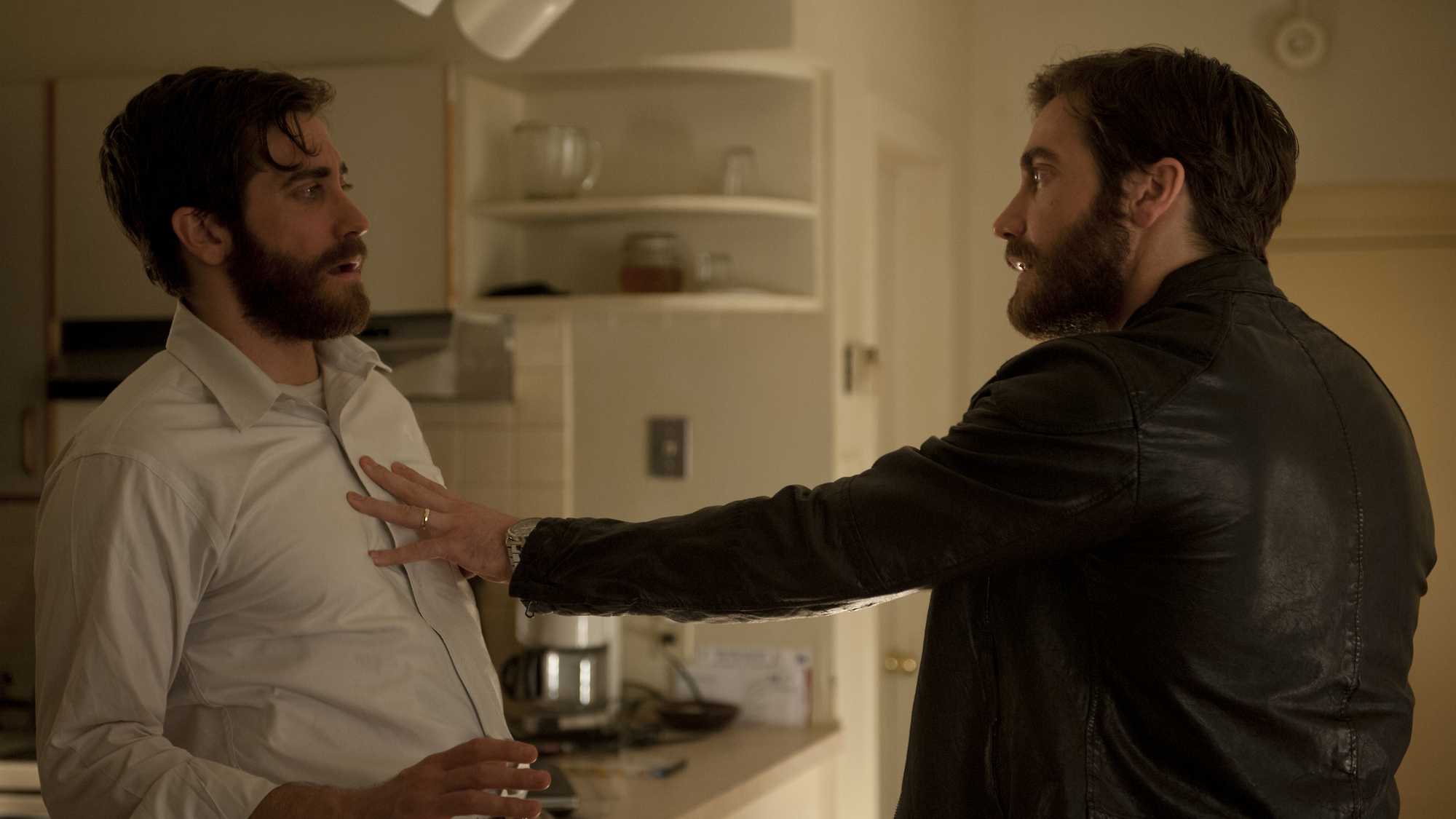
This is the full plot: Adam Bell (Jake Gyllenhaal) is a history teacher. He lives a monotonous life and has a girlfriend, Mary (Mélanie Laurent). One day he watches a film and finds a background actor who looks exactly like himself. He does some digging and finds the actor, Anthony Claire, who goes by the stage name Daniel Saint Claire. He contacts him. 
Anthony (Jake Gyllenhaal) has a wife, Helen (Sarah Gadon), who is 6-month pregnant. It’s said that he had an affair. Helen comes to find Adam at work and sees that he looks just like her husband. 
Anthony and Adam meet in a hotel—it turns out that they look exactly the same, sound the same, and even have the same scar. 
Adam feels uncomfortable and leaves, but Anthony follows him, then follows Mary, whom he finds attractive. 
Anthony then comes up with the idea of accusing Adam of having sex with his wife and thereby convincing him to give him his clothes and let him have sex with Mary in return, then Anthony would return everything and disappear forever. 
For no particular reason, Adam agrees. 
In the final act of the film, Anthony and Mary go on a romantic weekend getaway, and have sex in a motel, whilst Adam goes to Anthony’s house. 
Helen knows that he’s not Anthony, but pretends not to know, and Adam pretends not to know that she knows, and they have sex. 
Meanwhile at the motel, Mary notices the ring mark on Anthony’s finger and asks who he is, she leaves, and later in the car they fight again and have a collision. It’s implied that they’re both dead. 
Next morning Adam goes out of the room, talking to Helen, who suddenly falls silent, so he goes to look for her and, instead, finds a giant tarantula. Then the film ends. 


_____________________________________________________

The film is rubbish. 
First of all, the dialogue is atrocious. People can talk about the subconscious and the psyche, and some deep meaning behind the film, which I apparently don’t get, but I doubt anyone can (convincingly) defend the dialogue in Enemy. It is badly written, unnatural, and awkward. For almost the entire time watching the film, I kept thinking: Who talks like this? Who reacts like this? The bad dialogue that stood out the most was the conversation between Adam and the colleague who recommended the film, Adam’s talk with his mother, the first conversation in the film between Anthony and his wife Helen (after the phone call—in which she asks if it’s a woman), and the first meeting between Adam and Helen (when Adam doesn’t know that she’s Anthony’s wife). 
It baffles me that the film got nominated for Best Adapted Screenplay at Canadian Screen Awards. Can people not tell the difference between good and bad dialogue, or do they not care about dialogue anymore?  
Imagine watching Chinatown, or anything by Billy Wilder, and then Enemy
But it’s not only the dialogue. 
I had lots of questions whilst watching the film. Why does Adam Bell do everything so slowly? Why would a teacher—a lecturer—be so inarticulate?  
Why does he always appear confused, hesitant, neurotic, awkward, and just weird? 
Why does his mother tell her not to mention the Anthony thing again? 
Why does she say things that are true about Anthony rather than Adam? (nice apartment, being unable to stick to 1 woman) 
Why does Adam not pick up when his mother calls, and not call her back? 
Why does Helen cry and seem upset after meeting Adam? Why does she react that way?
Why does Adam agree to let Anthony pretend to be him and have sex with his girlfriend, when he himself hasn’t had sex with Anthony’s wife? Why would anyone do so?  
When Mary notices the ring mark that she has never seen on Adam, why does she ask Anthony who he is, when she apparently has never been told of the doppelganger’s existence? 
What’s the point of the sex club, and the key? 
When Helen say “your mother” in the final scene, is she talking about Adam’s mother or Anthony’s? 
What’s the meaning of the tarantula?
Now an Enemy fan would condescendingly tell me not to take the film so literally, and explain what the film is all about. Friends, I know what others have said is the meaning of the film—Adam and Anthony are the same person, Anthony is the subconscious, the cheater in Adam, he lives with his pregnant wife Helen but cheats on her with Mary, and he has to kill that part in him.   
Now let me add, I love Persona and 3 Women
I love Stevenson’s Strange Case of Dr Jekyll and Mr Hyde.  
I have seen many films about doubles and false doubles, such as Vertigo, Mulholland Drive, The Double Life of Veronique, Dead Ringers, The Prestige, and most recently, L'Amant double.   
Frankly, Enemy isn’t as smart as it seems to be. Part of my reaction is my dislike of films in which the reveal is that everything that we see happen in the film never happens—it is all in the main character’s head. A Tale of Two Sisters is an example. L'Amant double is another. That to me is a cheat.   
Let’s go back to the premise of the film: a history teacher comes across his lookalike, so he tracks him down, and is forced to switch places. They have different jobs (teacher and actor) and live in different houses (Adam lives in a shithole, Anthony lives in a nicer apartment) and have different personalities (Anthony is the evil one). The film is driven by the mystery of why they look the same, and what they can or may do when they are indistinguishable—this is a mystery to the audience as well as to the characters involved. 
There is a hint in the film about Adam and Anthony being the same person—at the beginning, Adam searches for Anthony, then finds a photo of himself in the house and places next to an image of Anthony in the internet. The photo is torn—he seems to be next to somebody but we can’t see who it is. At the end of the film, we see that photo again in Anthony’s house, now intact, and next to him is Helen. Otherwise, the interactions and reactions in the film rely on them being different people. In the 1st meeting between Adam and Helen, she is shocked by the resemblance whereas he doesn’t recognise her, so she calls her husband Anthony and hear him answer the phone, as she watches Adam going back to the classroom. 
As I said, the film is driven by the mystery of why they look the same and what 2 indistinguishable people can and may do, so when it turns out in the end that they are parts of the same person, with Anthony being the subconscious, it goes in a different direction and feels more like a cheap reveal. 
If the film is the mind of a character having a nervous breakdown, this isn’t an interesting character. Jake Gyllenhaal does a good job at portraying the 2 men with different personalities, so even though they have the same haircut and beard, and are dressed similarly, the audience never have to wonder who is who in the scene. But the characters are flat. All of the characters in Enemy are flat, especially the women, who seem to be there only to have sex and be treated like properties to be owned and traded. 
I haven’t even written about all the images of spiders all over the film—the spider about to get crushed by a woman in the sex club, the huge spider towering over the cityscape of Toronto, and the giant spider in the end. What’s that all about? It looks more like the filmmaker puts in random symbolism to be deliberately cryptic and ambiguous. 
Overall, I think Enemy is all artifice. It seems disturbing at the beginning, then falls flat. And it’s not as smart and profound as some people seem to think it is.

Monday, 5 August 2019

Little Dorrit: some random observations

Spoiler alerts. 

1/ I’ve concluded that the Flintwinch marriage presents a case of gaslighting (before the term was “coined”, from Patrick Hamilton’s 1938 play and the 1944 film adaptation starring Ingrid Bergman). 
According to Wikipedia
“Gaslighting is a form of psychological manipulation in which a person seeks to sow seeds of doubt in a targeted individual or in members of a targeted group, making them question their own memory, perception, and sanity. Using persistent denial, misdirection, contradiction, and lying, gaslighting involves attempts to destabilize the victim and delegitimize the victim's belief.” 
Is this not precisely what Jeremiah Flintwinch does to his wife Affery? 
He lies to her, ignores her feelings, pretends that the noises don’t exist, speaks down to her, says that she is “failing and breaking up” in her presence and in front of someone else (B.1, ch.30), manipulates her, convinces her that she daydreams and imagines things, makes her question reality and her own perceptions, etc. 

2/ I’ve written about Amy Dorrit, but Little Dorrit also has 3 proud women that I find particularly interesting: Fanny Dorrit, Miss Wade, and Harriet Beadle (called Tattycoram). 
Harriet doesn’t appear much, but we can see that she is proud and doesn’t like to submit. Chapter 20 in book 2 is very interesting—Harriet and Miss Wade argue, in Arthur Clennam’s presence, and Harriet refuses to be meek and submissive even though she lives with Miss Wade and has been “rescued” by her from the Meagles. 
Miss Wade is governed by anger and bitterness. At first I thought she was jilted by a man, like Miss Havisham in Great Expectations, but it turns out that she has always been resentful. “An unhappy temper” is what she says. She overthinks and overanalyses everything, interprets all words and actions through the lens of resentment, and thinks that she is so intelligent and sharp that she sees through everyone. A bitter person thinks everyone despises them and pretends to be nice. I have met quite a few people like her. 
Fanny Dorrit is another colourful, fascinating character. When the Dorrits were poor, I thought Fanny was selfish, self-entitled, ungrateful, unkind, and insufferable. As time went on, especially after the change of fortunes, I started to understand her better. As I side with Fanny against Mrs Merdle, I understand her sense of insult, and wish to triumph. I think she is foolish for being willing to sacrifice her own happiness in order to get back at a woman she hates and making it her life mission, but in a sense I get it. It makes sense that someone like her would do something like this. 
It is different, but I’m thinking of Henry James’s Washington Square, in which triumph does not equal happiness—Catherine Sloper sacrifices her own happiness for dignity and a sense of triumph. 

3/ It’s good that before Mr Dorrit dies, his mind wanders and he again thinks he’s the Father of the Marshalsea. He might leave the prison, but the prison never leaves him.

Saturday, 27 July 2019

On Amy Dorrit, or how Dickens improves himself

Amy Dorrit can be infuriating. She allows other family members to make unfair accusations about her, almost without protesting. She doesn’t argue, doesn’t explain herself, and doesn’t voice her thoughts. 
For the 1st half of the book, there is barely an outburst from Amy, or expression of annoyance. 
But as I read on, Amy becomes better, and more real. 
This is the 1st moment: 
“Little Dorrit had been thinking too. After softly putting his grey hair aside, and touching his forehead with her lips, she looked towards Arthur, who came nearer to her, and pursued in a low whisper the subject of her thoughts.
‘Mr Clennam, will he pay all his debts before he leaves here?’
‘No doubt. All.’
‘All the debts for which he had been imprisoned here, all my life and longer?’
‘No doubt.’
There was something of uncertainty and remonstrance in her look; something that was not all satisfaction. He wondered to detect it, and said:
‘You are glad that he should do so?’
‘Are you?’ asked Little Dorrit, wistfully.
‘Am I? Most heartily glad!’
‘Then I know I ought to be.’
‘And are you not?’
‘It seems to me hard,’ said Little Dorrit, ‘that he should have lost so many years and suffered so much, and at last pay all the debts as well. It seems to me hard that he should pay in life and money both.’” (B.1, ch.35) 
Amy is no longer a saint. 
In the 2nd half of Little Dorrit, Dickens lets the reader enter her mind, and she therefore becomes more like a person. She has an inner world. 
 “Sitting opposite her father in the travelling-carriage, and recalling the old Marshalsea room, her present existence was a dream. All that she saw was new and wonderful, but it was not real; it seemed to her as if those visions of mountains and picturesque countries might melt away at any moment, and the carriage, turning some abrupt corner, bring up with a jolt at the old Marshalsea gate.
To have no work to do was strange, but not half so strange as having glided into a corner where she had no one to think for, nothing to plan and contrive, no cares of others to load herself with. Strange as that was, it was far stranger yet to find a space between herself and her father, where others occupied themselves in taking care of him, and where she was never expected to be. […]
It was from this position that all she saw appeared unreal; the more surprising the scenes, the more they resembled the unreality of her own inner life as she went through its vacant places all day long. The gorges of the Simplon, its enormous depths and thundering waterfalls, the wonderful road, the points of danger where a loose wheel or a faltering horse would have been destruction, the descent into Italy, the opening of that beautiful land as the rugged mountain-chasm widened and let them out from a gloomy and dark imprisonment—all a dream—only the old mean Marshalsea a reality. Nay, even the old mean Marshalsea was shaken to its foundations when she pictured it without her father. She could scarcely believe that the prisoners were still lingering in the close yard, that the mean rooms were still every one tenanted, and that the turnkey still stood in the Lodge letting people in and out, all just as she well knew it to be.
With a remembrance of her father’s old life in prison hanging about her like the burden of a sorrowful tune, Little Dorrit would wake from a dream of her birth-place into a whole day’s dream...” (B.2, ch.3) 
These passages are the counterargument if anybody says Dickens is not a serious artist and cannot write well-rounded characters. 
If in Book 1, Dickens writes about Amy mostly from the outside or from the perspective of Arthur Clennam, in Book 2, he writes a lot more about her thoughts, perceptions, and feelings. The change in the Dorrit family’s fortune and their new life are chiefly seen through her eyes. 
“She would watch the sunset, in its long low lines of purple and red, and its burning flush high up into the sky: so glowing on the buildings, and so lightening their structure, that it made them look as if their strong walls were transparent, and they shone from within. She would watch those glories expire; and then, after looking at the black gondolas underneath, taking guests to music and dancing, would raise her eyes to the shining stars. Was there no party of her own, in other times, on which the stars had shone? To think of that old gate now!
She would think of that old gate, and of herself sitting at it in the dead of the night, pillowing Maggy’s head; and of other places and of other scenes associated with those different times. And then she would lean upon her balcony, and look over at the water, as though they all lay underneath it. When she got to that, she would musingly watch its running, as if, in the general vision, it might run dry, and show her the prison again, and herself, and the old room, and the old inmates, and the old visitors: all lasting realities that had never changed.” (ibid.) 
Not only so, Dickens lets Amy speak: chapter 4 is her letter to Arthur. The letter contains some self-depreciation, and kind words about other people, as one would expect from Amy. But look at this: 
 “It will not make you uneasy on Mrs Gowan’s account, I hope—for I remember that you said you had the interest of a true friend in her—if I tell you that I wish she could have married some one better suited to her. Mr Gowan seems fond of her, and of course she is very fond of him, but I thought he was not earnest enough—I don’t mean in that respect—I mean in anything. I could not keep it out of my mind that if I was Mrs Gowan (what a change that would be, and how I must alter to become like her!) I should feel that I was rather lonely and lost, for the want of some one who was steadfast and firm in purpose. I even thought she felt this want a little, almost without knowing it. But mind you are not made uneasy by this, for she was ‘very well and very happy.’ And she looked most beautiful.” (B.2, ch.4) 
She sees through Henry Gowan. If the reader has been under the impression that, in her passivity and self-sacrifices, Amy is naïve and believes everyone to be better than they are, they are mistaken. She sees through Henry, and in expressing it to someone else (Arthur), she becomes more human.  
Amy also sees through her own father: 
“Little Dorrit, whether speaking or silent, had preserved her quiet earnestness and her loving look. It had not been clouded, except for a passing moment, until now. But now that she was left alone with him the fingers of her lightly folded hands were agitated, and there was repressed emotion in her face.
Not for herself. She might feel a little wounded, but her care was not for herself. Her thoughts still turned, as they always had turned, to him. A faint misgiving, which had hung about her since their accession to fortune, that even now she could never see him as he used to be before the prison days, had gradually begun to assume form in her mind. She felt that, in what he had just now said to her and in his whole bearing towards her, there was the well-known shadow of the Marshalsea wall. It took a new shape, but it was the old sad shadow. She began with sorrowful unwillingness to acknowledge to herself that she was not strong enough to keep off the fear that no space in the life of man could overcome that quarter of a century behind the prison bars. She had no blame to bestow upon him, therefore: nothing to reproach him with, no emotions in her faithful heart but great compassion and unbounded tenderness.” (B.2, ch.5) 
That is such a wonderful passage. 
Now look at this: 
“In such further communication as passed among them before the sisters took their departure, Little Dorrit fancied it was revealed to her that Mr Gowan treated his wife, even in his very fondness, too much like a beautiful child. He seemed so unsuspicious of the depths of feeling which she knew must lie below that surface, that she doubted if there could be any such depths in himself. She wondered whether his want of earnestness might be the natural result of his want of such qualities, and whether it was with people as with ships, that, in too shallow and rocky waters, their anchors had no hold, and they drifted anywhere.” (B.2, ch.6) 
Another wonderful passage. It’s almost like something out of a Jane Austen novel. 
It shows Amy’s sensitivity and perceptiveness, and at the same time, also suggests that in this regard, Arthur isn’t much better than Henry either.

Thursday, 25 July 2019

The themes in Little Dorrit

Other readers have pointed out the 2 main themes of Little Dorrit, so I don’t need to write much about them. The main one is the prison theme: we have the Marshalsea prison and the Marseilles prison, London society is more or less a large prison, everyone in the book is imprisoned in one way of another—disability, constraints of social factors, or prison of the mind. 
The 2nd one is the theme of sun and shadow. The sun is already in the 1st line of the book: 
“Thirty years ago, Marseilles lay burning in the sun, one day.” (B.1, ch.1) 
Look at this line, when Arthur Clennam is about to tell William Dorrit he’s going to be released: 
“He looked steadfastly at Clennam, and, so looking at him, seemed to change into a very old haggard man. The sun was bright upon the wall beyond the window, and on the spikes at top. He slowly stretched out the hand that had been upon his heart, and pointed at the wall.” (B.1, ch.35) 
This is the day the Dorrits leave the prison: 
“There, were some who, in pure meanness of spirit, cringed and bowed before the enriched Collegian and his family; there, were others who did so really because their eyes, accustomed to the gloom of their imprisonment and poverty, could not support the light of such bright sunshine.” (B.1, ch.36) 
A quick search on Gutenberg and some calculations tell me that there are (at least) 75 words in Little Dorrit that are “sun”, “sunlight”, “sunshine”, “sunbeams”, “sunny”, “sunrise”, or “sunset”. I didn’t count “sunburnt”. 
Tom at Wuthering Expectations wrote about these themes: 
http://wutheringexpectations.blogspot.com/2012/01/dorrit-miscellaney-with-rambling.html 
Tom also wrote about the idea of the gentleman:  
http://wutheringexpectations.blogspot.com/2012/01/its-my-intent-to-be-gentleman-its-my.html 
Go read that blog post 1st and come back. 


I agree with Tom, but see it slightly differently: I see it as the theme of money and class—categorise the characters as having money, or class, or both, or neither.  
The Barnacles have both money and class, and they embody everything that Dickens hates. The book contains lots of satire of the aristocrats and the bureaucrats. 
In the Merdle family, Mr Merdle has money and Mrs Merdle has class, expressed as “manner”—she complains about his manner and he says “You supply manner, and I supply money.” (B.1, ch.33) He also says:
“If you were not an ornament to Society, and if I was not a benefactor to Society, you and I would never have come together.” (ibid.) 
In Mrs Merdle’s eyes, Fanny Dorrit has nothing—they go about in different societies. 
The marriage of Minnie Meagles and Henry Gowan is the reverse of the Merdle marriage. The Gowans have class and Mrs Gowan sees Minnie as beneath her son, but accepts the marriage because the Meagles have money and pay off Henry’s debts.  
The Dorrits, except for Amy (Little Dorrit), are the most interesting case, because for the 1st half of the book they have neither but act like they do, and put on a show of gentility. The father is delusional and in denial. The son and older sister also have pretensions and get touchy, without knowing that whilst they demand to be treated in a certain way, they themselves don’t have the manners of high class that they think they do. 
Fanny Dorrit, for example, feels humiliated about Mrs Merdle, but it is her who allows Mrs Merdle to insult her by accepting the money. 
Tip, in his self-entitlement, asks Arthur Clennam for accommodation and gets rejected and thus accuses Arthur of not treating him like a gentleman, without knowing that he’s not behaving like a gentleman. 
At the end of Book 1, however, the Dorrits come into money. I can tell that Tip, now Edward Dorrit, and Fanny, will act like they have always had money, and will be very obnoxious and intolerable, whereas Amy probably won’t change much. 
Another character in the book who also calls himself a gentleman though he isn’t, is Monsieur Rigaud, aka Lagnier, aka Blandois. 
From the 1st chapter, he insists on being seen as a gentleman, even though he’s in prison, convicted of murdering his wife. There is no evidence that he belongs to the upper class or upper middle class. 
“Mr Blandois, during this exposition, had been strictly attentive, keeping his eyes fastened on the lady, and thoughtfully stroking his moustache with his two hands. Mr Flintwinch had been a little fidgety, and now struck in.
‘There, there, there!’ said he. ‘That is quite understood, Mrs Clennam, and you have spoken piously and well. Mr Blandois, I suspect, is not of a pious cast.’
‘On the contrary, sir!’ that gentleman protested, snapping his fingers. ‘Your pardon! It’s a part of my character. I am sensitive, ardent, conscientious, and imaginative. A sensitive, ardent, conscientious, and imaginative man, Mr Flintwinch, must be that, or nothing!’
There was an inkling of suspicion in Mr Flintwinch’s face that he might be nothing, as he swaggered out of his chair (it was characteristic of this man, as it is of all men similarly marked, that whatever he did, he overdid, though it were sometimes by only a hairsbreadth), and approached to take his leave of Mrs Clennam.” (B.1, ch.30) 
What about the Clennams? They have money. I’m starting Book 2, so I don’t know what’s going to happen, but a few spoilers here and there have told me that they are going to lose money. The Dorrits get rich, the Clennams become poor. 
Let’s see.

Wednesday, 24 July 2019

2 videos of SeaLife aquarium, Blackpool

Recently I went to Blackpool and visited the SeaLife aquarium. Here are 2 videos I've just made: 


This one also contains footage from the trip to Tropical World in Leeds:


Hope you like them.

Sunday, 21 July 2019

Little Dorrit: The rivals [updated]

In chapter 26, Henry Gowan, Minnie Meagles’s suitor, brings Arthur Clennam to his family for a meal. This is a good scene, and we get wonderful passages like this: 
“Mrs Gowan, however, received him with condescension. He found her a courtly old lady, formerly a Beauty, and still sufficiently well-favoured to have dispensed with the powder on her nose and a certain impossible bloom under each eye. She was a little lofty with him; so was another old lady, dark-browed and high-nosed, and who must have had something real about her or she could not have existed, but it was certainly not her hair or her teeth or her figure or her complexion…”  
Or this: 
“Mr Henry Gowan seemed to have a malicious pleasure in playing off the three talkers against each other, and in seeing Clennam startled by what they said. Having as supreme a contempt for the class that had thrown him off as for the class that had not taken him on, he had no personal disquiet in anything that passed. His healthy state of mind appeared even to derive a gratification from Clennam’s position of embarrassment and isolation among the good company; and if Clennam had been in that condition with which Nobody was incessantly contending, he would have suspected it, and would have struggled with the suspicion as a meanness, even while he sat at the table.” 
And this: 
“In the course of a couple of hours the noble Refrigerator, at no time less than a hundred years behind the period, got about five centuries in arrears, and delivered solemn political oracles appropriate to that epoch. He finished by freezing a cup of tea for his own drinking, and retiring at his lowest temperature.” 
Delicious. Dickens is such a delight. 
But to go back to my point, Henry Gowan brings Arthur to see Mrs Gowan, who then asks Arthur about Minnie Meagles. 
Afterwards: 
“In that state of mind which rendered nobody uneasy, his thoughtfulness would have turned principally on the man at his side. He would have thought of the morning when he first saw him rooting out the stones with his heel, and would have asked himself, ‘Does he jerk me out of the path in the same careless, cruel way?’ He would have thought, had this introduction to his mother been brought about by him because he knew what she would say, and that he could thus place his position before a rival and loftily warn him off, without himself reposing a word of confidence in him? He would have thought, even if there were no such design as that, had he brought him there to play with his repressed emotions, and torment him? The current of these meditations would have been stayed sometimes by a rush of shame, bearing a remonstrance to himself from his own open nature, representing that to shelter such suspicions, even for the passing moment, was not to hold the high, unenvious course he had resolved to keep. At those times, the striving within him would have been hardest; and looking up and catching Gowan’s eyes, he would have started as if he had done him an injury.” 
Reading this passage, I can’t help thinking about chapter 24, when Amy Dorrit comes to work for Flora and Flora tells her she was once engaged to Arthur. Why does she do so? Does she take Amy on as a seamstress only to do something good for her former lover’s friend, or does she mean something else? What does she think? How does Amy feel? It’s not quite clear. 
The blurb on my copy says Amy cherishes an unrequited love for Arthur, so far in the book I don’t see much of that—it is clear that Arthur has an interest in Amy, and cares about her, and there’s lots of gratitude on her side, but love? It isn’t obvious*. I’m going to bet though, that Andrew Davies’s adaptation of Little Dorrit will make it very obvious from the start that there’s some romantic feeling—Andrew Davies sexes up everything
I’m digressing. Little Dorrit has a few pairs of love rivals, which is interesting. John Chivery’s mother reveals to Arthur that he loves and has been rejected by Amy. Amy comes to work for Flora and is told that Flora and Arthur were once engaged. Now Arthur considers marrying Minnie Meagles and his rival Henry Gowan brings him to see his mother, who asks about Minnie. 
As I read on, Little Dorrit becomes harder to analyse in terms of strands of story, because they intersect and there are so many characters. The strand I called the Bureaucrats leads to the love subplot of Arthur- Minnie- Henry Gowan, and also leads to Arthur becoming a business partner for Daniel Doyce, whom he meets through Mr Meagles. 
The strand of the Marshalsea prison becomes more complicated as we get the story of Fanny and the idiot Merdle, son of a merchant. 
I haven’t mentioned the story of Arthur’s past—Flora Finching, née Casby. 
Cavalletto of the Marseilles prisoners strand now lives in Bleeding Heart Yard, in the same house as the Plornish family, Amy’s friends. 
And then we have the strand of Mr Pancks, accountant/ grubber for Mr Casby (father of Flora and landlord of Bleeding Heart Yard), who follows and tries to find out something about Amy, and I don’t know for what or for whom. 
I’m about to start chapter 27. I predict that soon we have to come back to Mrs Clennam and the Flintwinches, Miss Wade from the beginning of the book will return and have a significant role which involves Tattycoram (Harriet Beadle), and Rigaud (alias Lagnier) will also be seen again. And of course we will find out why Mr Pancks wants to investigate Amy.


* Update on 23/7: the narrator finally tells us in chapter 32. 

Saturday, 20 July 2019

On the character of Little Dorrit

Tom at Wuthering Expectations wrote 2 blog posts about Amy:  
http://wutheringexpectations.blogspot.com/2012/01/nobody-cares-about-little-dorrit.html
http://wutheringexpectations.blogspot.com/2012/01/why-i-care-about-little-dorrit-many.htm
I care about her, to some extent, but Amy Dorrit is still an insipid character.
Before any wandering Dickens hater jumps in to say Dickens can’t write believable characters and most of all can’t write women, I have to say that that’s not what I’m saying, and I don’t agree. Little Dorrit is populated with lots of fascinating, colourful characters—Mrs Clennam, Mr Meagles (“practical people”), Flora Finching (Arthur’s old flame, now a large chatty, insufferable woman), Mr F’s aunt (“a face like a staring wooden doll too cheap for expression”), Mr Merdle the merchant (“extensive bosom which required so much room to be unfeeling enough in”), his son (“his brain had been frozen up in a mighty frost which prevailed at St John’s, New Brunswick, at the period of his birth there, and had never thawed from that hour”), Mrs Merdle’s parrot (“broken into a violent fit of laughter, after twisting divers bars of his cage with his crooked bill, and licking them with his black tongue”), etc. These are the caricatures, vivid and believable in the Dickens world. 
At the same time, Dickens also creates the more realistic characters—characters with complexity and contradictions. William Dorrit, the debtor and the Father of the Marshalsea, is a good example. I went back to the beginning of the book and tried to find out what he was before going to prison, and couldn’t find the answer. What was he that allowed him and his children, except Amy, to think so highly of themselves and their family? So far I think he’s the most interesting character in the book, because he lives in such a bubble and refuses to see the truth and recognise his dependence on Amy. In him, there’s a mixture of pride (and false pride) with a deep sense of humiliation—he is aware of his position whilst trying not to acknowledge it. 
I sympathise with him—after all, degradation and humiliation is something I know too well. But I do dislike his self-entitlement, insensitivity, and selfishness. He thinks more about himself than Amy.
But to go back to Amy Dorrit, she is insipid. Too good, too forgiving and self-sacrificing, as people say, and self-effacing without a sense of self-righteousness. Does that not make her a 2-dimensional, saintly good character without flaws? 
Except that Amy has a main weakness—she does not protest, and allows the whole family to use and exploit her, to take her for granted. 
She also has pride. Chapter 20 is particularly interesting, because Dickens writes about the difference between Amy and her sister Fanny, and shows the 2 kinds of pride. In the chapter, Fanny brings Amy to meet Mrs Merdle because her son wants to marry Fanny, and she disapproves. Amy would be too proud to take money or anything from Mrs Merdle, whereas Fanny, because of pride, says her family is unfortunate but not common, sees herself as a different from Amy (for not being born in prison), and says she must make Mrs Merdle pay for being insolent to her family. That’s the difference between the sisters. But this would be the reason that Fanny would nurse that sense of being insulted—she would always be bitter because, in accepting the money, she allows Mrs Merdle to humiliate her and her family. 
I’m reading chapter 24, when Amy, or Little Dorrit, comes to meet Flora.
Will Amy become more interesting?

Wednesday, 17 July 2019

The story strands in Little Dorrit

As Barbara Hardy wrote in her The Appropriate Form: An Essay on the Novel, “Henry James is almost always telling a single story, while Dickens and George Eliot and Tolstoy are telling several.” 
Middlemarch for example has 3 main plots (Dorothea- Casaubon- Will, Lydgate- Rosamond, and Fred- Mary). Anna Karenina has 2 main strands of story (the Anna one and the Levin one), each of which is expansive, complex, and populated with lots of different characters. War and Peace doesn’t have clearly separate strands, but tells the story of 5 families—the Bezukhovs, the Bolkonskys, the Rostovs, the Kuragins, the Drubetskoys, and a bunch of other characters. 
So how many story strands are there in Little Dorrit
I think there are 4: 
1/ The Marshalsea prison: Little Dorrit (Amy), her father William Dorrit, her sister Fanny, her brother Tip, her uncle Frederick, the turnkey… 
Dickens writes about the pride of the poor, which reminds me of Great Expectations. Amy is the main character, but the one who interests me more in terms of psychology is William Dorrit—as the Father of the Marshalsea, he lives in his own bubble, he lives in delusion and denial. Amy knows well that after many long years, her father cannot survive outside the prison—there is nothing he can do, and outside he doesn’t get the respect and reverence he has within Marshalsea. 
2/ The Clennams: Arthur Clennam, his mother Mrs Clennam, her servants Mr and Mrs Flintwinch… Amy Dorrit is also in this plot because she works there as a seamstress. 
3/ The bureaucrats—the term I use collectively for the Barnacles and the Meagles. Tite Barnacle is William Dorrit’s main creditor. The Meagles family meet Arthur during their Marseilles trip—they are Mr and Mrs Meagles, their daughter Pet (Minnie), and Pet has a maid called Tattycoram (real name Harriet Beadle). Tite Barnacle and Mr Meagles both work at the Circumlocution Office. 
4/ The Marseilles prisoners: Monsieur Rigaud (alias Lagnier) and John Baptist Cavalletto. In chapter 13, Cavalletto has an accident and Arthur Clennam sees him, but for the time being, I don’t know how they relate to other characters and the rest of the story.
In short, Little Dorrit has an intricate plot, packed with numerous characters. I would say the main character is Arthur Clennam because Dickens follows him more than other characters and he’s present in all 4 strands. Amy Dorrit is the 2nd main character. 
I am now on chapter 18, and Dickens makes everything more complicated by writing that Arthur Clennam considers marrying Minnie Meagles (Pet), and introducing Amy Dorrit’s lover John Chivery, son of a turnkey.  
This is such a good line: 
“In this affair, as in every other, Little Dorrit herself was the last person considered.” (B.1, ch.18)

On graduation

Yesterday I graduated with a Bachelor’s Degree with Honours in Filmmaking. 
This is my 2nd degree, after another BA, in European and American Studies: Language, Literature, Area (English). But that’s it, I’m out of studies, this time it’s serious. 
Here comes a time of struggle, uncertainty, self-doubt, and feelings of helplessness. But of course, it’s a feeling after graduation—excitement and a sense of triumph mixed with lots of fear and uncertainty for the future, because I have to leave the security of university and enter the world of competing for jobs and trying to survive. The film industry, everyone knows, is a difficult, highly competitive industry. But I’m not being negative, I’m preparing myself for the hardships ahead of me.
So this post will be a note to self: 
1/ You made Footfalls and won an RTS award (which was mentioned at graduation ceremony). You survived No More Than This and completed it, in spite of everything. You can do it. 
2/ In moments of self-doubt, remember that your greatest strength is that you get things done. 
3/ It is the nature of filmmaking that shit happens and people let you down. 
4/ Try again. Try harder. Try different ways. 
5/ If you can choose, work with the right people. If you happen to work with the wrong person, remember it won’t be forever. This too shall pass. 
6/ Whenever you’re angry at somebody, ask yourself if they will still be in your life in 5 years. If not, they don’t matter. 
7/ Don’t compare yourself to anyone else, especially at the beginning. People have different journeys, and there are different paths to success. It’s the long run that matters. 
8/ There will be injustices, as there have always been—that’s life. Accept it. When you feel like everything’s unfair and pointless, remember why you’re in film—you love cinema.
9/ Take care of yourself. Work hard but don’t overwork. Rest. Relax. Give yourself a break sometimes. 
10/ It’s OK to change your mind. It’s OK to take a different path.

Monday, 15 July 2019

Repetition in Little Dorrit

I’m on chapter 15, about Mrs Flintwinch’s dream. Check this out: 
“Strange, if the little sick-room fire were in effect a beacon fire, summoning some one, and that the most unlikely some one in the world, to the spot that must be come to. Strange, if the little sick-room light were in effect a watch-light, burning in that place every night until an appointed event should be watched out! Which of the vast multitude of travellers, under the sun and the stars, climbing the dusty hills and toiling along the weary plains, journeying by land and journeying by sea, coming and going so strangely, to meet and to act and react on one another; which of the host may, with no suspicion of the journey’s end, be travelling surely hither?” 
(emphasis mine) 
That sounds similar to a line in chapter 2: 
“The day passed on; and again the wide stare stared itself out; and the hot night was on Marseilles; and through it the caravan of the morning, all dispersed, went their appointed ways. And thus ever by day and night, under the sun and under the stars, climbing the dusty hills and toiling along the weary plains, journeying by land and journeying by sea, coming and going so strangely, to meet and to act and react on one another, move all we restless travellers through the pilgrimage of life.” 
(emphasis mine) 
I always get some amusement, and a slight sense of triumph, when noticing something like this. 


The key element to Dickens’s style is repetition. He creates rhythm in his sentences by using lots of repetition, especially anaphora and epistrophe, as written in my previous blog post. 
According to Wikipedia, “In rhetoric, an anaphora (Greek: ἀναφορά, "carrying back") is a rhetorical device that consists of repeating a sequence of words at the beginnings of neighboring clauses, thereby lending them emphasis.” 
Example: 
There was the dreary Sunday of his childhood, when he sat with his hands before him, scared out of his senses by a horrible tract which commenced business with the poor child by asking him in its title, why he was going to Perdition?—a piece of curiosity that he really, in a frock and drawers, was not in a condition to satisfy—and which, for the further attraction of his infant mind, had a parenthesis in every other line with some such hiccupping reference as 2 Ep. Thess. c. iii, v. 6 & 7. There was the sleepy Sunday of his boyhood, when, like a military deserter, he was marched to chapel by a picquet of teachers three times a day, morally handcuffed to another boy; and when he would willingly have bartered two meals of indigestible sermon for another ounce or two of inferior mutton at his scanty dinner in the flesh. There was the interminable Sunday of his nonage; when his mother, stern of face and unrelenting of heart, would sit all day behind a Bible—bound, like her own construction of it, in the hardest, barest, and straitest boards, with one dinted ornament on the cover like the drag of a chain, and a wrathful sprinkling of red upon the edges of the leaves—as if it, of all books! were a fortification against sweetness of temper, natural affection, and gentle intercourse. There was the resentful Sunday of a little later, when he sat down glowering and glooming through the tardy length of the day, with a sullen sense of injury in his heart, and no more real knowledge of the beneficent history of the New Testament than if he had been bred among idolaters. There was a legion of Sundays, all days of unserviceable bitterness and mortification, slowly passing before him.” (B.1, ch.3) 
The opposite is epistrophe, also known as epiphora, which is “the repetition of the same word or words at the end of successive phrases, clauses or sentences.” 
A combination of anaphora and epiphora is symploce, “a figure of speech in which a word or phrase is used successively at the beginning of two or more clauses or sentences and another word or phrase with a similar wording is used successively at the end of them”. 
Dickens also uses them: 
Nothing to see but streets, streets, streets. Nothing to breathe but streets, streets, streets. Nothing to change the brooding mind, or raise it up. Nothing for the spent toiler to do, but to compare the monotony of his seventh day with the monotony of his six days, think what a weary life he led, and make the best of it—or the worst, according to the probabilities.” (B.1, ch.3) 
There was a fire in the grate, as there had been night and day for fifteen years. There was a kettle on the hob, as there had been night and day for fifteen years. There was a little mound of damped ashes on the top of the fire, and another little mound swept together under the grate, as there had been night and day for fifteen years. There was a smell of black dye in the airless room, which the fire had been drawing out of the crape and stuff of the widow’s dress for fifteen months, and out of the bier-like sofa for fifteen years.” (ibid.)
(emphasis mine) 
If this sounds too theoretical, I find this particularly interesting because I myself use anaphora (and epiphora) a lot in my Vietnamese writings. Not sure why I don’t do that much in English.