Pages

Wednesday, 7 August 2013

In praise of the oft-ignored Acton Bell

In "The poems of Anne Bronte: A new text and commentary", Edward Chitham wrote:
"Of the 3 Bronte sisters who lived to maturity and published their poetry and novels, Anne is the least known or understood. There are various reasons for this neglect, including her own modesty and Charlotte's ambivalent attitude: she both shielded and depreciated her younger sister. Perhaps the paramount difficulty is the way in which Anne so often fails to come up to the popular expectation of a Bronte. "Agnes Grey" may appear a pale version of "Jane Eyre" until one recalls that it was written before "Jane Eyre", and "Wildfell hall" a tamer "Wuthering heights" until one catches the overtones of deliberate parody. Anne is writing a different kind of novel from her sisters, which cannot be judged by the same criteria."

___________________________________________________________


In my opinion, "The tenant of Wildfell hall" is not without flaws. I can't say whether Anne Bronte, instead of letting things follow their course, bends them slightly to fit her moral lessons, or my feeling of uneasiness with certain passages results from nothing other than my religious view (which has previously made me feel uncomfortable to read the last part of "Anna Karenina" or the 1st 50 pages of "Les misérables" or some passages in "Crime and punishment" or the whole of "I know why the caged bird sings"). Whatever the case, the chief thing that makes Anne differ from her sisters is that her books are very religious, and didactic, especially the 2nd one.

In 1 sense, "Agnes Grey" pales in comparison to "Jane Eyre" and "The tenant of Wildfell hall" doesn't have the originality and intensity of "Wuthering heights" and thus Anne becomes the 'other' Bronte, the forgotten one, the oft-ignored one. In another sense, because Anne differs from her sisters in that her books are didactic, she may not be valued as highly as her 2 sisters with regard to literary merit yet she goes further than her sisters in some aspects- if in her 1st book Anne digs deeper in the life of a governess with hardship and humiliation than Charlotte does in "Jane Eyre", in her 2nd book she describes in much more detail the effects of alcoholism than Emily does in "Wuthering heights", and in both she puts more focus on the nurture of children and, most important of all, on the inequalities between men and women in Victorian society. In fact, "The tenant of Wildfell hall" is the most shocking of the Brontes' novels (at least to contemporary readers) and Anne is the most radical of the 3 sisters. Anne also differs from her sisters in that she presents things as they are, bare and coarse, and her 2nd book is a realist's response to the romanticisation of violence and conflict that occurs in Charlotte's and Emily's writings. It's best expressed by her own statement: 
"I find myself censured for depicting con amore, with 'a morbid love of the coarse, if not of the brutal', those scenes which, I will venture to say, have not been more painful for the most fastidious of my critics to read than they were for me to describe. I may have gone too far; in which case I shall be careful not to trouble myself or my readers in the same way again; but when we have to do with vice and vicious characters, I maintain it is better to depict them as they really are than as they would wish to appear. To represent a bad thing in its least offensive light is, doubtless, the most agreeable course for a writer of fiction to pursue; but is it the most honest, or the safest? Is it better to reveal the snares and pitfalls of life to the young and thoughtless traveller, or to cover them with branches and flowers? Oh, reader! if there were less of this delicate concealment of facts—this whispering, ‘Peace, peace,’ when there is no peace, there would be less of sin and misery to the young of both sexes who are left to wring their bitter knowledge from experience."
Am I giving you the impression that Anne is to be praised more for her intentions, her views, her feminism, than her writing abilities? My apologies, it's not my intention. "The tenant of Wildfell hall" should not be read simply as a Bronte novel and a feminist novel, but for itself. Anne's writing style is beautiful, better or at least smoother than Emily's, many passages are pure gold. She vividly describes Huntingdon as a charming, frivolous, light-hearted, mischievous at times, irresponsible, glib, unreliable, thoughtless, insensitive, selfish, self-indulgent, imprudent, treacherous, incorrigible person and does even a more excellent job in her creation of Helen as a quiet, tolerant, calm, highly religious but independent, proud, strong-minded, frank, critical, strict person, especially when Anne convincingly lets us see Huntingdon's attraction to her (good girls are often drawn to bad guys, teased by them, provoked by them, infuriated with them and drawn even more to them), Helen's delusion and illusion, Helen's stubbornness and determination to follow her own decision and ignore all advice as, most important of all, her naive belief that Huntingdon may change (which is very common in real life- some women are not blind to their husbands' faults but believe they can change after the wedding). Her insight is remarkable (particularly considering the Brontes' seclusion). 
On further note I would say, Charlotte's and Emily's books are great and are to be appreciated as a whole (story, characters, themes, symbolism, mood, intensity, vision, etc), or at least in the case of Emily, I sometimes had to endure certain parts in "Wuthering heights" for the sake of the whole, whereas Anne's greatest strength is in the passages (writing style, insight and ability to put it into words). Unable to explain precisely this point, I can only say that it's best demonstrated by their quotes (quoting Anne is much easier). Another example of writers of group 1 can be Dostoyevsky, and group 2, Fitzgerald. 
I find it unfair and very sad that Anne Bronte, aka Acton Bell, is largely forgotten (even by some who say they love the Brontes). And, amazed by how she went from "Agnes Grey" to "The tenant of Wildfell hall", I can't help wondering- what would have happened if she had lived longer? 

___________________________________________________________


Bonus: a few essays/ articles/ blog entries about Anne: 

http://www.mick-armitage.staff.shef.ac.uk/anne/stanford.html
http://digital.library.upenn.edu/women/bronte/bronte-anne.html
http://delaisse.blogspot.no/2011/10/why-you-should-love-anne-bronte.html
http://www.academia.edu/1224712/Anne_Brontes_The_Tenant_of_Wildfell_Hall_An_Opposition_To_The_Patriarchal_Society_of_The_19th_Century_Britain_-_by_Cagla_Narter
http://www.openlettersmonthly.com/the-quiet-one/
https://gypsyscarlett.wordpress.com/2009/01/26/anne-bronte-the-strong-sister/
http://www.goodreads.com/author/quotes/1036615.Charlotte_Bront_
http://www.goodreads.com/author/quotes/4191.Emily_Bront_
http://www.goodreads.com/author/quotes/8249.Anne_Bront_

Saturday, 3 August 2013

A discussion on education (or what Anne Bronte can tell us about upbringing)

From "The tenant of Wildfell hall" by Anne Bronte, chapter 3 (the narrator here is Gilbert): 
"...Rose, now, at a hint from my mother, produced a decanter of wine, with accompaniments of glasses and cake, from the cupboard and the oak sideboard, and the refreshment was duly presented to the guests.  They both partook of the cake, but obstinately refused the wine, in spite of their hostess’s hospitable attempts to force it upon them.  Arthur, especially shrank from the ruby nectar as if in terror and disgust, and was ready to cry when urged to take it.
‘Never mind, Arthur,’ said his mamma; ‘Mrs. Markham thinks it will do you good, as you were tired with your walk; but she will not oblige you to take it!—I daresay you will do very well without.  He detests the very sight of wine,’ she added, ‘and the smell of it almost makes him sick.  I have been accustomed to make him swallow a little wine or weak spirits-and-water, by way of medicine, when he was sick, and, in fact, I have done what I could to make him hate them.’
Everybody laughed, except the young widow and her son.
‘Well, Mrs. Graham,’ said my mother, wiping the tears of merriment from her bright blue eyes—‘well, you surprise me!  I really gave you credit for having more sense.—The poor child will be the veriest milksop that ever was sopped!  Only think what a man you will make of him, if you persist in—’
‘I think it a very excellent plan,’ interrupted Mrs. Graham, with imperturbable gravity.  ‘By that means I hope to save him from one degrading vice at least.  I wish I could render the incentives to every other equally innoxious in his case.’
‘But by such means,’ said I, ‘you will never render him virtuous.—What is it that constitutes virtue, Mrs. Graham?  Is it the circumstance of being able and willing to resist temptation; or that of having no temptations to resist?—Is he a strong man that overcomes great obstacles and performs surprising achievements, though by dint of great muscular exertion, and at the risk of some subsequent fatigue, or he that sits in his chair all day, with nothing to do more laborious than stirring the fire, and carrying his food to his mouth?  If you would have your son to walk honourably through the world, you must not attempt to clear the stones from his path, but teach him to walk firmly over them—not insist upon leading him by the hand, but let him learn to go alone.’
‘I will lead him by the hand, Mr. Markham, till he has strength to go alone; and I will clear as many stones from his path as I can, and teach him to avoid the rest—or walk firmly over them, as you say;—for when I have done my utmost, in the way of clearance, there will still be plenty left to exercise all the agility, steadiness, and circumspection he will ever have.—It is all very well to talk about noble resistance, and trials of virtue; but for fifty—or five hundred men that have yielded to temptation, show me one that has had virtue to resist.  And why should I take it for granted that my son will be one in a thousand?—and not rather prepare for the worst, and suppose he will be like his—like the rest of mankind, unless I take care to prevent it?’
‘You are very complimentary to us all,’ I observed.
‘I know nothing about you—I speak of those I do know—and when I see the whole race of mankind (with a few rare exceptions) stumbling and blundering along the path of life, sinking into every pitfall, and breaking their shins over every impediment that lies in their way, shall I not use all the means in my power to insure for him a smoother and a safer passage?’
‘Yes, but the surest means will be to endeavour to fortify him against temptation, not to remove it out of his way.’
‘I will do both, Mr. Markham.  God knows he will have temptations enough to assail him, both from within and without, when I have done all I can to render vice as uninviting to him, as it is abominable in its own nature—I myself have had, indeed, but few incentives to what the world calls vice, but yet I have experienced temptations and trials of another kind, that have required, on many occasions, more watchfulness and firmness to resist than I have hitherto been able to muster against them.  And this, I believe, is what most others would acknowledge who are accustomed to reflection, and wishful to strive against their natural corruptions.’
‘Yes,’ said my mother, but half apprehending her drift; ‘but you would not judge of a boy by yourself—and, my dear Mrs. Graham, let me warn you in good time against the error—the fatal error, I may call it—of taking that boy’s education upon yourself.  Because you are clever in some things and well informed, you may fancy yourself equal to the task; but indeed you are not; and if you persist in the attempt, believe me you will bitterly repent it when the mischief is done.’
‘I am to send him to school, I suppose, to learn to despise his mother’s authority and affection!’ said the lady, with rather a bitter smile.
‘Oh, no!—But if you would have a boy to despise his mother, let her keep him at home, and spend her life in petting him up, and slaving to indulge his follies and caprices.’
‘I perfectly agree with you, Mrs. Markham; but nothing can be further from my principles and practice than such criminal weakness as that.’
‘Well, but you will treat him like a girl—you’ll spoil his spirit, and make a mere Miss Nancy of him—you will, indeed, Mrs. Graham, whatever you may think.  But I’ll get Mr. Millward to talk to you about it:—he’ll tell you the consequences;—he’ll set it before you as plain as the day;—and tell you what you ought to do, and all about it;—and, I don’t doubt, he’ll be able to convince you in a minute.’
‘No occasion to trouble the vicar,’ said Mrs. Graham, glancing at me—I suppose I was smiling at my mother’s unbounded confidence in that worthy gentleman—‘Mr. Markham here thinks his powers of conviction at least equal to Mr. Millward’s.  If I hear not him, neither should I be convinced though one rose from the dead, he would tell you.  Well, Mr. Markham, you that maintain that a boy should not be shielded from evil, but sent out to battle against it, alone and unassisted—not taught to avoid the snares of life, but boldly to rush into them, or over them, as he may—to seek danger, rather than shun it, and feed his virtue by temptation,—would you—?’
‘I beg your pardon, Mrs. Graham—but you get on too fast.  I have not yet said that a boy should be taught to rush into the snares of life,—or even wilfully to seek temptation for the sake of exercising his virtue by overcoming it;—I only say that it is better to arm and strengthen your hero, than to disarm and enfeeble the foe;—and if you were to rear an oak sapling in a hothouse, tending it carefully night and day, and shielding it from every breath of wind, you could not expect it to become a hardy tree, like that which has grown up on the mountain-side, exposed to all the action of the elements, and not even sheltered from the shock of the tempest.’
‘Granted;—but would you use the same argument with regard to a girl?’
‘Certainly not.’
‘No; you would have her to be tenderly and delicately nurtured, like a hot-house plant—taught to cling to others for direction and support, and guarded, as much as possible, from the very knowledge of evil.  But will you be so good as to inform me why you make this distinction?  Is it that you think she has no virtue?’
‘Assuredly not.’
‘Well, but you affirm that virtue is only elicited by temptation;—and you think that a woman cannot be too little exposed to temptation, or too little acquainted with vice, or anything connected therewith.  It must be either that you think she is essentially so vicious, or so feeble-minded, that she cannot withstand temptation,—and though she may be pure and innocent as long as she is kept in ignorance and restraint, yet, being destitute of real virtue, to teach her how to sin is at once to make her a sinner, and the greater her knowledge, the wider her liberty, the deeper will be her depravity,—whereas, in the nobler sex, there is a natural tendency to goodness, guarded by a superior fortitude, which, the more it is exercised by trials and dangers, is only the further developed—’
‘Heaven forbid that I should think so!’ I interrupted her at last.
‘Well, then, it must be that you think they are both weak and prone to err, and the slightest error, the merest shadow of pollution, will ruin the one, while the character of the other will be strengthened and embellished—his education properly finished by a little practical acquaintance with forbidden things.  Such experience, to him (to use a trite simile), will be like the storm to the oak, which, though it may scatter the leaves, and snap the smaller branches, serves but to rivet the roots, and to harden and condense the fibres of the tree.  You would have us encourage our sons to prove all things by their own experience, while our daughters must not even profit by the experience of others.  Now I would have both so to benefit by the experience of others, and the precepts of a higher authority, that they should know beforehand to refuse the evil and choose the good, and require no experimental proofs to teach them the evil of transgression.  I would not send a poor girl into the world, unarmed against her foes, and ignorant of the snares that beset her path; nor would I watch and guard her, till, deprived of self-respect and self-reliance, she lost the power or the will to watch and guard herself;—and as for my son—if I thought he would grow up to be what you call a man of the world—one that has “seen life,” and glories in his experience, even though he should so far profit by it as to sober down, at length, into a useful and respected member of society—I would rather that he died to-morrow!—rather a thousand times!’ she earnestly repeated, pressing her darling to her side and kissing his forehead with intense affection.  He had already left his new companion, and been standing for some time beside his mother’s knee, looking up into her face, and listening in silent wonder to her incomprehensible discourse.
‘Well! you ladies must always have the last word, I suppose,’ said I, observing her rise, and begin to take leave of my mother.
‘You may have as many words as you please,—only I can’t stay to hear them.’
‘No; that is the way: you hear just as much of an argument as you please; and the rest may be spoken to the wind.’
‘If you are anxious to say anything more on the subject,’ replied she, as she shook hands with Rose, ‘you must bring your sister to see me some fine day, and I’ll listen, as patiently as you could wish, to whatever you please to say.  I would rather be lectured by you than the vicar, because I should have less remorse in telling you, at the end of the discourse, that I preserve my own opinion precisely the same as at the beginning—as would be the case, I am persuaded, with regard to either logician.’
‘Yes, of course,’ replied I, determined to be as provoking as herself; ‘for when a lady does consent to listen to an argument against her own opinions, she is always predetermined to withstand it—to listen only with her bodily ears, keeping the mental organs resolutely closed against the strongest reasoning.’
‘Good-morning, Mr. Markham,’ said my fair antagonist, with a pitying smile; and deigning no further rejoinder, she slightly bowed, and was about to withdraw; but her son, with childish impertinence, arrested her by exclaiming,—‘Mamma, you have not shaken hands with Mr. Markham!’
She laughingly turned round and held out her hand.  I gave it a spiteful squeeze, for I was annoyed at the continual injustice she had done me from the very dawn of our acquaintance.  Without knowing anything about my real disposition and principles, she was evidently prejudiced against me, and seemed bent upon showing me that her opinions respecting me, on every particular, fell far below those I entertained of myself.  I was naturally touchy, or it would not have vexed me so much. Perhaps, too, I was a little bit spoiled by my mother and sister, and some other ladies of my acquaintance;—and yet I was by no means a fop—of that I am fully convinced, whether you are or not..." 
Anne Bronte 


_______________________________________________

PS: Currently on chapter 27, about half the book. I will discuss the novel as well as its author when I have finished the whole thing. 

The Narrow Way (Anne Bronte)

Believe not those who say 
The upward path is smooth, 
Lest thou shouldst stumble in the way, 
And faint before the truth. 

It is the only road 
Unto the realms of joy; 
But he who seeks that blest abode 
Must all his powers employ. 

Bright hopes and pure delight 
Upon his course may beam, 
And there, amid the sternest heights, 
The sweetest flowerets gleam. 

On all her breezes borne, 
Earth yields no scents like those; 
But he that dares not gasp the thorn 
Should never crave the rose. 

Arm--arm thee for the fight! 
Cast useless loads away; 
Watch through the darkest hours of night; 
Toil through the hottest day. 

Crush pride into the dust, 
Or thou must needs be slack; 
And trample down rebellious lust, 
Or it will hold thee back. 

Seek not thy honour here; 
Waive pleasure and renown; 
The world's dread scoff undaunted bear, 
And face its deadliest frown. 

To labour and to love, 
To pardon and endure, 
To lift thy heart to God above, 
And keep thy conscience pure; 

Be this thy constant aim, 
Thy hope, thy chief delight; 
What matter who should whisper blame 
Or who should scorn or slight? 

What matter, if thy God approve, 
And if, within thy breast, 
Thou feel the comfort of His love, 
The earnest of His rest? 

Anne Bronte 

Friday, 2 August 2013

Feminism in "Agnes Grey"

is not only in the choice of Agnes Grey, a young woman and governess, to be the protagonist and narrator, thus giving a voice to other women in general and governesses in particular, and the characterisation of her as a strong, independent person. 

But it's also in the characterisation of Rosalie Murray, later Mrs Ashby. It is undeniable that Rosalie is not a nice person- she is superficial, frivolous, shallow, selfish, pragmatic, calculating, dishonest, and above all, she toys with men's feelings. But she is not submissive and maintains her own independence in relations with men. Most notably, in chapter 22, she says to Agnes: 

"And so you think I would lay myself out for his amusement! No, that's not my idea of a wife. It's the husband's part to please the wife, not hers to please him; and if he isn't satisfied with her as she is- and thankful to possess her too, he isn't worthy of her- that's all..." 

The same idea appears in chapter 6 of "The tenant of Wildfell hall", in a discussion among Gilbert the narrator, his sister Rose and his mother: 

"I was too late for tea; but my mother had kindly kept the teapot and muffin warm upon the hobs, and, though she scolded me a little, readily admitted my excuses; and when I complained of the flavour of the overdrawn tea, she poured the remainder into the slop-basin, and bade Rose put some fresh into the pot, and reboil the kettle, which offices were performed with great commotion, and certain remarkable comments.

‘Well!—if it had been me now, I should have had no tea at all—if it had been Fergus, even, he would have to put up with such as there was, and been told to be thankful, for it was far too good for him; but you—we can’t do too much for you.  It’s always so—if there’s anything particularly nice at table, mamma winks and nods at me to abstain from it, and if I don’t attend to that, she whispers, “Don’t eat so much of that, Rose; Gilbert will like it for his supper.”—I’m nothing at all.  In the parlour, it’s “Come, Rose, put away your things, and let’s have the room nice and tidy against they come in; and keep up a good fire; Gilbert likes a cheerful fire.”  In the kitchen—“Make that pie a large one, Rose; I daresay the boys’ll be hungry; and don’t put so much pepper in, they’ll not like it, I’m sure”—or, “Rose, don’t put so many spices in the pudding, Gilbert likes it plain,”—or, “Mind you put plenty of currants in the cake, Fergus liked plenty.”  If I say, “Well, mamma, I don’t,” I’m told I ought not to think of myself.  “You know, Rose, in all household matters, we have only two things to consider, first, what’s proper to be done; and, secondly, what’s most agreeable to the gentlemen of the house—anything will do for the ladies.”’

‘And very good doctrine too,’ said my mother.  ‘Gilbert thinks so, I’m sure.’

‘Very convenient doctrine, for us, at all events,’ said I; ‘but if you would really study my pleasure, mother, you must consider your own comfort and convenience a little more than you do—as for Rose, I have no doubt she’ll take care of herself; and whenever she does make a sacrifice or perform a remarkable act of devotedness, she’ll take good care to let me know the extent of it.  But for you I might sink into the grossest condition of self-indulgence and carelessness about the wants of others, from the mere habit of being constantly cared for myself, and having all my wants anticipated or immediately supplied, while left in total ignorance of what is done for me,—if Rose did not enlighten me now and then; and I should receive all your kindness as a matter of course, and never know how much I owe you.’

‘Ah! and you never will know, Gilbert, till you’re married.  Then, when you’ve got some trifling, self-conceited girl like Eliza Millward, careless of everything but her own immediate pleasure and advantage, or some misguided, obstinate woman, like Mrs. Graham, ignorant of her principal duties, and clever only in what concerns her least to know—then you’ll find the difference.’

‘It will do me good, mother; I was not sent into the world merely to exercise the good capacities and good feelings of others—was I?—but to exert my own towards them; and when I marry, I shall expect to find more pleasure in making my wife happy and comfortable, than in being made so by her: I would rather give than receive.’

‘Oh! that’s all nonsense, my dear.  It’s mere boy’s talk that!  You’ll soon tire of petting and humouring your wife, be she ever so charming, and then comes the trial.’

‘Well, then, we must bear one another’s burdens.’

‘Then you must fall each into your proper place.  You’ll do your business, and she, if she’s worthy of you, will do hers; but it’s your business to please yourself, and hers to please you.  I’m sure your poor, dear father was as good a husband as ever lived, and after the first six months or so were over, I should as soon have expected him to fly, as to put himself out of his way to pleasure me.  He always said I was a good wife, and did my duty; and he always did his—bless him!—he was steady and punctual, seldom found fault without a reason, always did justice to my good dinners, and hardly ever spoiled my cookery by delay—and that’s as much as any woman can expect of any man.’

Is it so, Halford?  Is that the extent of your domestic virtues; and does your happy wife exact no more?" 

Thursday, 1 August 2013

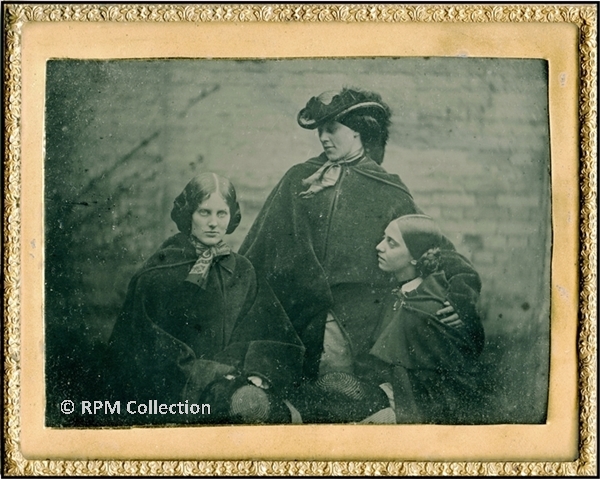
Are these the Brontes?


Left to right: Charlotte=> Emily=> Anne. 
(Bigger photo)
If you are fascinated by the Bronte sisters, like I am, read more here about the photo, the research and people's arguments. 

"Agnes Grey"

Having finished reading "Agnes Grey", I can safely say now that I love the Brontes. This is a quiet book, if one may say so, I find it understandable that it was outshone by "Wuthering heights" by Emily Bronte, the striking, haunting book about a turbulent love that was 1st published in the same volume with "Agnes Grey", and also outshone by "Jane Eyre" by Charlotte Bronte, whose narrator and protagonist Jane Eyre is similar- both are proud, independent, self-respecting, quiet, introverted, pious, tolerant and more importantly, plain and unattractive. But it should be read 1st as a book by a Bronte- Anne Bronte possesses the powerful voice, passion and strength of her sisters and also has the similar style, themes and concerns that make her a Bronte and mark the contrast to the works by Jane Austen. I was introduced 1st of all to Charlotte with "Jane Eyre", which has been 1 of my favourite books of all time and which has stayed with me since I read it in junior high school. Next came Emily with "Wuthering heights", in January this year. Anybody who admires Charlotte and Emily should not ignore Anne. For the time being, I do not wish to make any comment on Anne in comparison to her elder sisters, until I have finished her other, more famous, book. 
"Agnes Grey" should also be read in comparison to "Jane Eyre", or as a complement to "Jane Eyre". As a whole, "Jane Eyre" is a more remarkable novel, more 'inclusive', more complex, which follows the life of Jane Eyre for many years since she's a child. "Agnes Grey" focuses on the protagonist's life as a governess. Yet in this aspect, it digs deeper, because while Jane Eyre is a lucky governess, Agnes doesn't have such nice pupils. The novel explores the hardship, humiliation and loneliness that she must face, and thus, depicts the harsh conditions and injustices and class snobbery she's forced to endure, through which the reader can visualise a picture of England's society in the 19th century with classes, cruel treatment of governesses in particular and of women in general, mistreatment of animals, and the selfishness, meanness of the moneyed class, and through which one can see Anne's personal experience and understand her views. Therefore "Agnes Grey" should be read for its own values and should be appreciated in its own right. 
More will be said about Anne Bronte when sufficient.